

Manua

Encyclopedia
Samoan Islands
The Samoan Islands or Samoa Islands is an archipelago covering in the central South Pacific, forming part of Polynesia and the wider region of Oceania...
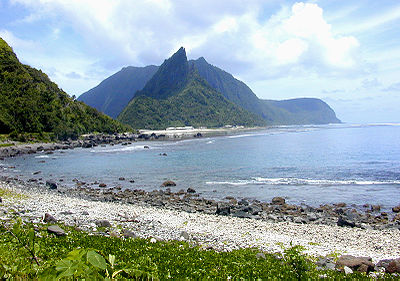
, consists of three main islands: Tau, Ofu
Ofu-Olosega
Ofu and Olosega are parts of a volcanic doublet in the Manu‘a Group of the Samoan Islands—part of American Samoa. The twin islands, formed from shield volcanoes, have a combined length of 6km. They are geographic volcanic remnants separated by the narrow 137m wide Asaga strait, a natural...
and Olosega
Ofu-Olosega
Ofu and Olosega are parts of a volcanic doublet in the Manu‘a Group of the Samoan Islands—part of American Samoa. The twin islands, formed from shield volcanoes, have a combined length of 6km. They are geographic volcanic remnants separated by the narrow 137m wide Asaga strait, a natural...
. The islands are located some 110 km (70 mi) east of Tutuila
Tutuila
Tutuila is the largest and the main island of American Samoa in the archipelago of Samoan Islands. It is the third largest island in the Samoan Islands chain of the Central Pacific located roughly northeast of Brisbane, Australia and over northeast of Fiji. It contains a large, natural harbor,...
and are a part of American Samoa
American Samoa
American Samoa is an unincorporated territory of the United States located in the South Pacific Ocean, southeast of the sovereign state of Samoa...
.
Politically, the islands form the Manu'a District
Manu'a District, American Samoa
The Manu'a District is one of the three, primary administrative divisions of American Samoa. The district comprises the Manu'a Islands, which are located approximately 61 miles east of the main island, Tutuila.-District Divisions:...
, one of the three administrative divisions of American Samoa
Administrative divisions of American Samoa
American Samoa is administratively divided into three districts and two "unorganized" atolls.The districts and unorganized atolls are subdivided into 16 counties and 74 villages.- Districts and counties :* Eastern District**Ituau County**Ma'Oputasi County...
.
Geography
All three islands are high islandHigh island
In geology , a high island is an island of volcanic origin. The term can be used to distinguish such islands from low islands, whose origin is due to sedimentation or uplifting of coral reefs.-Definition and origin:...
s: volcanic remnants rising out of the sea 14° south of the equator. In contrast to most places in the world, the population of these islands has been decreasing steadily for decades. In the 1930s some 20% of the population of American Samoa lived in the Manua Islands. By the 1980s, only 6% were located there. Emigration is the consequence of a lack of economic opportunities and a desire of young people to participate in the more modern lifestyle offered on Tutuila (Office of Tourism, 2005). However, all the land of Manua is owned communally by Samoan families of Manua, even the National Parks lands are communally owned by Samoan families, and only leased to the US National Parks system.
History
The traditional capital of Manua is the village of Taū, on the island of Taū. The Manua Group is now a part of the US Territory of American SamoaAmerican Samoa
American Samoa is an unincorporated territory of the United States located in the South Pacific Ocean, southeast of the sovereign state of Samoa...
. It was ceded to the U.S.
United States
The United States of America is a federal constitutional republic comprising fifty states and a federal district...
in a Deed of Cession, signed by the Tui Manua (supreme chief of Manua) on July 16, 1904 at the Crown residence of the Tuimanua called the Faleula in the place called Lalopua (from Official documents of the Tuimanua government, 1893; Office of the Governor, 2004).
Cession followed the Tripartite Convention of 1899 that partitioned the eastern islands of Samoa
Samoa
Samoa , officially the Independent State of Samoa, formerly known as Western Samoa is a country encompassing the western part of the Samoan Islands in the South Pacific Ocean. It became independent from New Zealand in 1962. The two main islands of Samoa are Upolu and one of the biggest islands in...
(including Tutuila and the Manua Group) from the western islands of Samoa (including Upolu and Savaii).
Society and culture
Samoa
Samoa , officially the Independent State of Samoa, formerly known as Western Samoa is a country encompassing the western part of the Samoan Islands in the South Pacific Ocean. It became independent from New Zealand in 1962. The two main islands of Samoa are Upolu and one of the biggest islands in...
n oratory to contain the origins of Samoan and Polynesia
Polynesia
Polynesia is a subregion of Oceania, made up of over 1,000 islands scattered over the central and southern Pacific Ocean. The indigenous people who inhabit the islands of Polynesia are termed Polynesians and they share many similar traits including language, culture and beliefs...
n culture, and the genealogy
Genealogy
Genealogy is the study of families and the tracing of their lineages and history. Genealogists use oral traditions, historical records, genetic analysis, and other records to obtain information about a family and to demonstrate kinship and pedigrees of its members...
of Polynesians east of Samoa is said to have originated in Manua. In traditional belief the sun rises over Samoa at Saua on the island of Taū, where the coral reef is supposed to be always yellow from the sun, and it sets at Falealupo
Falealupo
Falealupo is a village in Samoa situated at the west end of Savai'i island from the dateline. The village has two main settlements, Falealupo-Uta, situated inland by the main island highway and Falealupo-Tai, situated by the sea...
the western-most village on the island of Savaii in Samoa. This journey of the sun is strongly related to traditional beliefs and defines Samoa Sasae and Samoa Sisifo. The term Fa'asamoa
Fa'asamoa
Fa'asamoa literally means the ways of Samoa. Fa'a is a Samoan prefix that can be translated to English as 'the ways of'. Fa'a could also mean 'to do' or 'to implement' as in the word Fa'atonu .-Concept:...
describes "The Samoan Way", or traditional Samoan way of life
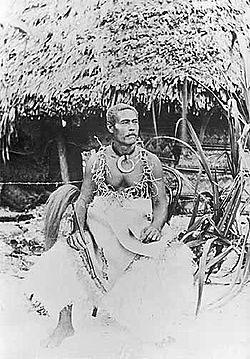
The sovereign of Manua was called the Tui Manua. The last Tui Manua was Tuimanua Elisara (or Tui Manua Elisala) of the early 20th century. Tuimanua Elisara died on July 2, 1909. The title Tui Manua technically still exists although there is no titleholder; Tuimanua Elisara desired before his death that the title die with him. It was the U.S. government position at the time that his title changed to District Governor upon the hoisting of the U.S. flag at Taū on June 5, 1900 (Office of the Governor. 2004). However, titles and holdings were not obliterated when the islands became a U.S. territory, and the title and estates of Tuimanua remain under the custody of the Anoalo clan (male side of the Tuimanua line).
Today, many families of Manua rely on income from family members working in Tutuila
Tutuila
Tutuila is the largest and the main island of American Samoa in the archipelago of Samoan Islands. It is the third largest island in the Samoan Islands chain of the Central Pacific located roughly northeast of Brisbane, Australia and over northeast of Fiji. It contains a large, natural harbor,...
and in the United States
United States
The United States of America is a federal constitutional republic comprising fifty states and a federal district...
. The local diet is generally healthier than in Tutuila, with less reliance on imported American and New Zealand
New Zealand
New Zealand is an island country in the south-western Pacific Ocean comprising two main landmasses and numerous smaller islands. The country is situated some east of Australia across the Tasman Sea, and roughly south of the Pacific island nations of New Caledonia, Fiji, and Tonga...
tinned foods, and a greater reliance on local fishing and farming.
Language
The people of Manua speak the Samoan languageSamoan language
Samoan Samoan Samoan (Gagana Sāmoa, is the language of the Samoan Islands, comprising the independent country of Samoa and the United States territory of American Samoa. It is an official language—alongside English—in both jurisdictions. Samoan, a Polynesian language, is the first language for most...
and utilize the "t", pronouncing it in the traditional manner almost like a "d", sometimes spelling it with a "d".
Education
The high school on Taū serves all of Manua. Most students seeking higher education go to American Samoa Community CollegeAmerican Samoa Community College
American Samoa Community College is a two-year WASC college located in the village of Mapusaga, on the island of Tutuila in American Samoa, an unorganized, unincorporated territory of the United States of America...
in Tutuila or National University of Samoa
National University of Samoa
The National University of Samoa is the only national university in Samoa. Established in 1984 by an act of parliament, the university is coeducational and provides certificate, diploma, and undergraduate degree programs, as well as technical and vocational training. About 2,000 students are...
on Upolu, or as far away as the University of Hawaii
University of Hawaii
The University of Hawaii System, formally the University of Hawaii and popularly known as UH, is a public, co-educational college and university system that confers associate, bachelor, master, and doctoral degrees through three university campuses, seven community college campuses, an employment...
and elsewhere.