
|
|
|
|
Old Bailey
|
| |
|
| |
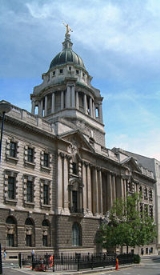
The Central Criminal Court in England, commonly known as the Old Bailey, is a court building in central London, one of a number housing the Crown Court. The Crown Court sitting at the Central Criminal Court deals with major criminal cases from Greater London and, exceptionally, from other parts of England. It stands on the site of the medieval Newgate Gaol, on Old Bailey, a road which follows the line of the City's fortified wall (or bailey), and gives the court its popular name.

Discussion
Ask a question about 'Old Bailey'
Start a new discussion about 'Old Bailey'
Answer questions from other users
|
Recent Posts

Encyclopedia
The Central Criminal Court in England, commonly known as the Old Bailey, is a court building in central London, one of a number housing the Crown Court. The Crown Court sitting at the Central Criminal Court deals with major criminal cases from Greater London and, exceptionally, from other parts of England. It stands on the site of the medieval Newgate Gaol, on Old Bailey, a road which follows the line of the City's fortified wall (or bailey), and gives the court its popular name. It lies between Holborn Circus and St Paul's Cathedral.
The building and its history The court originated as the sessions house of the Lord Mayor and Sheriffs of the City of London and of Middlesex. The original medieval court was first mentioned in 1585, it seems to have grown out of the endowment for an improved Newgate prison and rooms for the Sheriffs made possible by a gift of Sir Richard Whittington. It was destroyed in the 1666 Fire of London. It was rebuilt in 1674, with the court open to the weather to prevent the spread of disease. In 1734 it was refronted, enclosing the court and reducing the influence of spectators: this led to outbreaks of typhus, notably in 1750 when sixty people died, including the Lord Mayor and two judges. It was rebuilt again in 1774 and a second courtroom was added in 1824. In 1834 it was renamed as the Central Criminal Court and its jurisdiction extended beyond that of London and Middlesex to the whole of the English jurisdiction for trial of major cases. However, the building actually belongs to the City of London Corporation.
The Court was originally for trial only of crimes committed in the City and Middlesex but in 1856, public revulsion at the accusations made against doctor William Palmer, that he was a poisoner and murderer, led to fears that he could not enjoy a fair trial in his native Staffordshire. The Central Criminal Court Act 1856 was passed to enable his trial to be held at the Old Bailey.
The present building dates from 1902 (officially opened on 27 February 1907), was designed by E.W. Mountford and built on the site of the infamous Newgate Prison, which was demolished to allow the Courts to be built. Above the main entrance is inscribed "Defend the Children of the Poor & Punish the Wrongdoer". King Edward VII personally opened the courthouse.
On the dome above the court stands a statue of Lady Justice by British sculptor F. W. Pomeroy. She holds a sword in her right hand and a pair of weighing scales in her left. The statue is popularly supposed to show Blind Justice, however the figure is not blindfolded. A Remnant of the City wall is preserved in the basement area beneath the cells.
During the Blitz, the Old Bailey was bombed and severely damaged, but subsequent reconstruction work restored most of it in the early 1950s. In 1952 the restored interior of the Grand Hall of the Central Criminal Courts was once again open. The interior of the Great Hall (underneath the dome) is decorated with paintings commemorating the Blitz, and also quasi-historical scenes of St Paul's with nobles outside. Running around the entire Hall are a series of axioms, some of Biblical reference. They read:
"The law of the wise is a fountain of life/
The welfare of the people is supreme/
Right lives by law and law subsists by power/
Poise the cause in justice equal scales/
Moses gave unto the people the laws of God/
London shall have all its ancient rights"
The Great Hall (and the floor beneath it) are also decorated with many busts and statues, chiefly British monarchs, but also of legal figures and those who achieved notability by campaigning for improvement in prison conditions in the 18th and 19th centuries. This floor also houses the Shorthand Writers' offices.
The lower level also hosts a minor exhibition on the history of the Old Bailey/Newgate featuring historical prison artefacts.
From 1968 to 1972 a new South Block, designed by the architects Donald McMorran and George Whitby, was built containing more modern courts.
The original ceremonial gates to the 1907 part of the building are only used by the Lord Mayor and visiting Royalty. The general entrance to the building is a few yards down the road in the South Block and often features as a backdrop in television news reports. This is also a separate rear entrance not open to the public which permits more discreet access. In Warwick Square, on the western side of the complex, is the 'Lord Mayor's Entrance'.
Judges
All judges sitting in the Old Bailey are addressed as "My Lord" or "My Lady" whether they are High Court, Circuit Judges or Recorders. The Lord Mayor of the City of London and Aldermen of the City of London are entitled to sit on the judges' bench during a hearing but do not participate in trials.
The most senior permanent judge of the Central Criminal Court has the title of Recorder of London, and his deputy has the title of Common Serjeant of London. The present Recorder of London is His Honour Judge Peter Beaumont QC, who was appointed in December 2004 following the death earlier that year of his predecessor, His Honour Judge Michael Hyam. The present Common Serjeant is His Honour Judge Brian Barker QC. The position of Recorder of London should not be confused with that of Recorder, which is a part-time judicial office, holders of which sit part-time as judges of the Crown Court or the County Court. Some of the most senior criminal lawyers in the country sit at as Recorders in the Central Criminal Court.
Civic Role
The court house originated as part of the City of London's borough judicial system of which it so remains. The Recorder and the Common Serjeant are both City officers and the Recorder is a member of Common Council as a member of the Court of Aldermen. The City's Sheriffs and the Lord Mayor are justices there but their jurisdiction is now nominal. The Sheriffs are resident with the senior judges in the complex and entertain all of the judges at lunch along with senior visitors to the City. In Court No1 there are several benches set aside for the Bridge House Estates Committee (City Bridge Trust) which is the actual owner of the building.
In popular culture
- In the movie Sweeny Todd (2008 film), Judge Turpin and Beadle Bamford sentence a boy to hang by the neck, showing how cruel the Judge can be.
- In the book A Tale of Two Cities by Charles Dickens, the Old Bailey is the courthouse named in the book where Charles Darnay is put on trial for treason.
- In the movie Witness for the Prosecution, the court scenes are set in the Old Bailey.
- In the novel Patriot Games and the eponymous film, terrorist Sean Miller is tried in the Old Bailey.
- The Old Bailey is destroyed with explosives by the terrorist V in the graphic novel V for Vendetta and its film adaptation. In the graphic novel, V entertains a long, one-sided conversation with the statue of Justice on the roof, in which he professes his love for her but accuses her of being a whore for the fictional fascist government, and tells her of his new mistress named Anarchy.
- The television series Rumpole of the Bailey concerns a defence lawyer who works at the Bailey. Sir John Mortimer, a criminal barrister and author, often appeared at the Old Bailey. His courtroom experiences led him to create the fictional character Horace Rumpole.
- In the popular Australian folk song "Botany Bay", the first verse references the "well known Old Bailey". The song tells the tale of a group of prisoners being taken from Britain to the penal colonies of Australia.
- In the television series Bad Girls, the character Nikki Wade's successful appeal took place at the Old Bailey.
- The book Neverwhere by Neil Gaiman has a character named Old Bailey.
- In the television series Law & Order: UK several interior scenes set in the Old Bailey are shot in the Grand Hall of the Central Criminal Courts with the murals and axioms clearly visible.
See also
External links
|
| |
|
|