


Lycaon (mythology)

Encyclopedia
For the Trojan Lycaon, see Lycaon (son of Priamos)
.
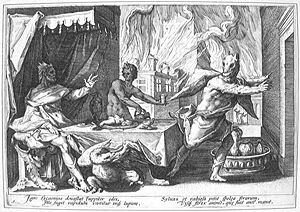 Lycaon was a king of Arcadia
, son of Pelasgus
and Meliboea
, who in the most popular version of the myth tested Zeus
and as a punishment was transformed into the form of a wolf
.
(Fragmenta astronomica, by Eratosthenes
, Catasterismi), told by several authors. The most popular version is the one reported by Ovid
in the first book of his Metamorphoses.
The different versions of the myth are as follows:
, the 50 sons of Lydscaon were:
Maenalus was in early modern times being represented by the now obsolete constellations Mons Maenalus
in the southern part of Boötes
.
An alternate list of Lycaon's sons is given by Pausanias. According to his account, almost each of them founded a city in Arcadia and became its eponym
.
Plutarch gives the names of two sons that stayed aside from the abomination: Eleuther and Lebadus.
Lycaon (son of Priam)
Lycaon , in Greek mythology, was a son of Priam and Laothoe. During the Trojan War, Lycaon was captured by Achilles while cutting branches in Priam's orchard. Achilles sold him as a slave to Euneus of Lemnos, but Eetion of Imbros bought him and took him back to Troy...
.
Arcadia
Arcadia is one of the regional units of Greece. It is part of the administrative region of Peloponnese. It is situated in the central and eastern part of the Peloponnese peninsula. It takes its name from the mythological character Arcas. In Greek mythology, it was the home of the god Pan...
, son of Pelasgus
Pelasgus
In Greek mythology, Pelasgus was the eponymous ancestor of the Pelasgians, the mythical inhabitants of Greece who established the worship of the Dodonaean Zeus, Hephaestus, the Cabeiri, and other divinities. In the different parts of the country once occupied by Pelasgians, there existed...
and Meliboea
Meliboea
In Greek mythology, Meliboea was a name attributed to the following individuals:*The wife of Magnes, who named the town of Meliboea in Thessaly after her. The town of Meliboea became a kingdom in eastern Thessalia . Nowadays, Meliboea is a municipality of Larissa prefecture...
, who in the most popular version of the myth tested Zeus
Zeus
In the ancient Greek religion, Zeus was the "Father of Gods and men" who ruled the Olympians of Mount Olympus as a father ruled the family. He was the god of sky and thunder in Greek mythology. His Roman counterpart is Jupiter and his Etruscan counterpart is Tinia.Zeus was the child of Cronus...
and as a punishment was transformed into the form of a wolf
Gray Wolf
The gray wolf , also known as the wolf, is the largest extant wild member of the Canidae family...
.
Versions of the myth
There are several version of the Lycaon myth, already reported by HesiodHesiod
Hesiod was a Greek oral poet generally thought by scholars to have been active between 750 and 650 BC, around the same time as Homer. His is the first European poetry in which the poet regards himself as a topic, an individual with a distinctive role to play. Ancient authors credited him and...
(Fragmenta astronomica, by Eratosthenes
Eratosthenes
Eratosthenes of Cyrene was a Greek mathematician, poet, athlete, geographer, astronomer, and music theorist.He was the first person to use the word "geography" and invented the discipline of geography as we understand it...
, Catasterismi), told by several authors. The most popular version is the one reported by Ovid
Ovid
Publius Ovidius Naso , known as Ovid in the English-speaking world, was a Roman poet who is best known as the author of the three major collections of erotic poetry: Heroides, Amores, and Ars Amatoria...
in the first book of his Metamorphoses.
The different versions of the myth are as follows:
- According to Pausanias VIII Lycaon was instantly transformed into a wolf after sacrificing a child on the altar of Zeus and sprinkling the blood on the altar.
- According to Apollodor, Lycaon had sired 50 sons with many wives. These sons were the most nefarious and carefree of all people. To test them Zeus visited them in the shape of a poor peon. They mixed the entrails of a child under the god's meal, whereupon the enraged Zeus threw over the table with the meal, which explains the name of the city Trapezus, and killed Lycaon and his sons with lightning. Only the youngest son was saved due to the intervention of the earth-goddess Gaia.
- According to Lykophron, all were transformed into wolves.
- According to HyginusGaius Julius HyginusGaius Julius Hyginus was a Latin author, a pupil of the famous Cornelius Alexander Polyhistor, and a freedman of Caesar Augustus. He was by Augustus elected superintendent of the Palatine library according to Suetonius' De Grammaticis, 20...
, Jupiter came to Lycaon . In this version only Lycaon was transformed into a wolf man and his 50 sons were killed by lightning. - Nicolas Damascenus tells that Lycaon's sons were nefarious. To test Zeus they mixed the flesh of a boy under the sacrifices, whereupon all who were present during the murder of the child were killed by lightning.
- According to Ovid, it was only Lycaon who served Zeus the flesh of a prisoner, partly cooked and partly roasted. Thereupon Zeus brought the roof down and transformed the fleeing Lycaon into a wolf.
- According to Eratosthenes, Lycaon butchered his grandson, who was put together again by Zeus and placed upon the constellations.
Sons of Lycaon
According to the Bibliotheca (Pseudo-Apollodorus)Bibliotheca (Pseudo-Apollodorus)
The Bibliotheca , in three books, provides a comprehensive summary of traditional Greek mythology and heroic legends, "the most valuable mythographical work that has come down from ancient times," Aubrey Diller observed, whose "stultifying purpose" was neatly expressed in the epigram noted by...
, the 50 sons of Lydscaon were:
|
|
|
|
|
Maenalus was in early modern times being represented by the now obsolete constellations Mons Maenalus
Mons Maenalus
Mons Maenalus was a constellation created by Johannes Hevelius. It was located between the constellations of Boötes and Virgo, and depicts a mountain in Greece that the herdsman is stepping upon. It was never popular and is no longer in use...
in the southern part of Boötes
Boötes
Boötes is a constellation in the northern sky, located between 0° and +60° declination, and 13 and 16 hours of right ascension on the celestial sphere. The name comes from the Greek Βοώτης, Boōtēs, meaning herdsman or plowman...
.
An alternate list of Lycaon's sons is given by Pausanias. According to his account, almost each of them founded a city in Arcadia and became its eponym
Eponym
An eponym is the name of a person or thing, whether real or fictitious, after which a particular place, tribe, era, discovery, or other item is named or thought to be named...
.
- Nyctimus succeeded to Lycaon's power
- Pallas founded Pallantium
- Orestheus, Oresthasium
- Phigalus, Phigalia
- Trapezeus, Trapezous
- Daseatas, Dasea
- Macareus, Macaria
- Helisson, town of Helisson (also gave his name to a nearby river)
- AcacusAcacus (Greek mythology)Acacus , in Greek mythology, was a king of Acacesium in Arcadia, the son of Lycaon, and the foster-father of the infant Hermes. Maia gave birth to Hermes at dawn in a sacred cave on Mount Cyllene in Arcadia, and he was raised by Acacus. He was believed to be the founder of the Arcadian town of...
, Acacesium - Thocnus, Thocnia
- Orchomenus, Orchomenus and Methydrium
- Hypsus, Hypsus
- (name missing), Melaneae
- Thyreus, Thyraeum
- Maenalus, Maenalus
- TegeatesTegeatesIn Greek mythology, Tegeates was a son of Lycaon, and the reputed founder and eponym of Tegea in Arcadia.Tegeates was married to Maera, daughter of Atlas, by whom he had five sons: Archedius, Gortys, Cydon, Leimon and Scephrus; Tegeates' and Maera's tombs were shown at Tegea...
, TegeaTegeaTegea was a settlement in ancient Greece, and it is also a former municipality in Arcadia, Peloponnese, Greece. Since the 2011 local government reform it is part of the municipality Tripoli, of which it is a municipal unit. Its seat was the village Stadio.... - Mantineus, Mantinea
- Cromus, Cromi
- Charisius, Charisia
- Tricolonus, Tricoloni
- Peraethus, Peraetheis
- Aseatas, Asea
- (name missing, Lyceus?), Lycoa
- Alipherus, a city of his name
- Heraeus, a city of his name
- Oenotrus (the youngest), Oenotria in Italy
Plutarch gives the names of two sons that stayed aside from the abomination: Eleuther and Lebadus.