


Lugger

Encyclopedia
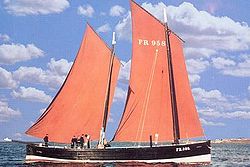
Sailing vessel
Sailing vessel can refer to:*Sailing ship*Sailboat*Ice boat*Land yacht...
with lugsails set on two or more masts
Mast (sailing)
The mast of a sailing vessel is a tall, vertical, or near vertical, spar, or arrangement of spars, which supports the sails. Large ships have several masts, with the size and configuration depending on the style of ship...
and perhaps lug topsail
Topsail
A topsail is a sail set above another sail; on square-rigged vessels further sails may be set above topsails.- Square rig :On a square rigged vessel, a topsail is a square sail rigged above the course sail and below the topgallant sail where carried...
s.
Defining the rig
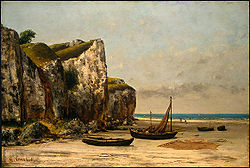
Rigging
Rigging is the apparatus through which the force of the wind is used to propel sailboats and sailing ships forward. This includes masts, yards, sails, and cordage.-Terms and classifications:...
, the upper side of the sail is attached to a spar
Spar
In sailing, a spar is a pole of wood, metal or lightweight materials such as carbon fiber used on a sailing vessel. Spars of all types In sailing, a spar is a pole of wood, metal or lightweight materials such as carbon fiber used on a sailing vessel. Spars of all types In sailing, a spar is a...
, the yard, which is hoisted up the mast by a rope known as the halyard
Halyard
In sailing, a halyard or halliard is a line that is used to hoist a sail, a flag or a yard. The term halyard comes from the phrase, 'to haul yards'...
. The lower side of the sail is held in place by a separate set of ropes, the sheet
Sheet (sailing)
In sailing, a sheet is a line used to control the movable corner of a sail.- Fore-and-aft rigs:Fore-and-aft rigs comprise the vast majority of sailing vessels in use today, including effectively all dinghies and yachts. The sheet on a fore-and-aft sail controls the angle of the sail to the wind,...
and tack
Tack (sailing)
Tack is a term used in sailing that has different meanings in different contexts, variously a part of a sail, and an alignment with the wind. When using the latter sense, the maneuver of turning between starboard and port tack is either tacking or jibing....
downhaul.
The main difference between the lugsail and square is the location of the yard in relation to the mast. A square sail is lifted with the halyard in the middle of the yard, lifting the sail so it lies evenly on either side of the mast. In the lugger, the halyard is attached much closer to one end or the other of the yard, and when lifted the majority of the sail will lie fore or aft of the mast. Since the luff
Luff
Luff or luffing may refer to:* Luffing, when a sailing sheet is eased so far past trim that airflow over the surface is disrupted* The leading edge of a sail...
of the sail is shorter than the leech, the after end of the yard is peaked up by the combination of the upward force of the halyard and the downward force of the tack downhaul. This allows the mast to be shorter than the sail, the peaked yard making up the difference in height.
The lugsail is somewhat similar to the gaff rig
Gaff rig
Gaff rig is a sailing rig in which the sail is four-cornered, fore-and-aft rigged, controlled at its peak and, usually, its entire head by a spar called the gaff...
as well, which also uses a spar, the gaff, which is hung at an angle to the mast. The difference is that the gaff is mounted such that it lies entirely behind the mast, as opposed to both in front and behind as in the lugger. While the gaff rig is "cleaner" in that the mast does not interfere with the sail, it requires more complex rigging and handling than the lugger.
Types of lugsail

The advantages of the dipping sail arise from the fact that the set of the sail is not deformed by pressing against the mast. This allows a more efficient air flow and reduces wear of the canvas.
Another source of variation is in the extent to which the yard was designed to be peaked up. That is to say, how nearly vertical the yard was intended to be.
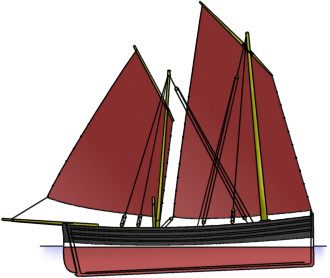
Fifie
The Fifie is a design of sailing boat developed on the east coast of Scotland. It was a traditional fishing boat used by Scottish fishermen from the 1850s until well into the 20th century...
s on the left, a fairly late design in the evolution of the rig, shows one extreme, where the white-sailed boat looks at first glance almost to have a Bermudian rig (although on closer examination, it is clearly a Fifie on the opposite tack). The boat off-shore is a little more obviously a lugger and the others have not got their sails fully set.
The fore lug (main sail) on a Fifie is a dipping lugsail. The extreme size of the dipping lugsail showing in the picture was only possible with the introduction of steam powered capstans to facilitate with dipping.
This short extract explains the procedure:
"Imagine tacking in a fresh breeze with those tremendous forelugs flogging about. First they were lowered down to deck, then unhooked from the traveller, hooked on the burton, swung aft and then for'ard on the other side of the mast, unhooked and rehooked on the traveller, and hoisted again. During this time the mast stood foursquare on its reputation. being completely unstayed until the halyards were unhooked to the weather side and the burton set up. Smart handling was essential, and even with the fall of the haylard taken to the capstan, it was heavy work, but hoisting by hand was back-breaking, five to ten minutes' sweating to get the sail set and drawing properly for most of the old skippers were very particular about the cut and set of their sails." Page 266, Chapter 12 (Fifies and Zulus), Sailing Drifter by Edgar J. March.
March also sets out the Cornish method of tacking a lug (pp133 and 146). The Cornish did not drop the sail onto the deck but took the sail forward of the mast. The halyard was started, and as soon as the luff was slack the tack was unhooked. The yard was lowered until it stood vertical with its peak on the deck forward of the mast. The clew was unhooked from the sheet and the sail was handed around the front of the mast to be hooked into the sheet again. Meanwhile the halyard was swapped over and made ready to raise the sail. As the yard rose, the tack came back down with the yard swinging through the horizontal, until the tack could be hooked back on and the halyard set up tight.
Handling characteristics
.jpg)
Brittany
Brittany is a cultural and administrative region in the north-west of France. Previously a kingdom and then a duchy, Brittany was united to the Kingdom of France in 1532 as a province. Brittany has also been referred to as Less, Lesser or Little Britain...
chasse-marée
Chasse-marée
In English, a chasse-marée is a specific, archaic type of decked commercial sailing vessel.In French, un chasse-marée was 'a wholesale fishmonger', originally on the Channel coast of France and later, on the Atlantic coast as well. He bought in the coastal ports and sold in inland markets. However,...
s carried topgallants. The standing sail is usually set to the starboard side of the mast. It is said that the comparative disadvantage of having the sail deformed on the starboard tack was why the rule of the road gave the right of way to a sailing vessel in that condition.
Once hoisted, the set of the sail is controlled by adjustment of the tack tackle and the sheet. It is therefore much simpler to use than a square sail so that the crew can be smaller or doing work other than that of sailing the vessel, such as that to do with fishing.
The tack tackle is critical to the performance of all lug rigs as it both brings the sail into the correct shape and, in the case of balance and standing lugs is responsible for holding the yard at the correct angle and controlling sail twist.
The name
The lugsail was the earliest of the fore and aft rigs. The origin of its name is not wholly clear. The name 'lugger' may derive from the Middle Dutch for 'to trawl' or it may take its name from the lugsail. That in turn, may have its origin in the similarity of the appearance of a human ear to a fore and aft sail. The French for a fore and aft rig is un gréement aurique or for the sail, it is une voile aurique - an ear type sail. Since 'lug' is an English word for ear, this origin is a possibility.Local types
- HastingsHastingsHastings is a town and borough in the county of East Sussex on the south coast of England. The town is located east of the county town of Lewes and south east of London, and has an estimated population of 86,900....
lugger - FifieFifieThe Fifie is a design of sailing boat developed on the east coast of Scotland. It was a traditional fishing boat used by Scottish fishermen from the 1850s until well into the 20th century...
Scottish East Coast, herring drifter - French (NormandyNormandyNormandy is a geographical region corresponding to the former Duchy of Normandy. It is in France.The continental territory covers 30,627 km² and forms the preponderant part of Normandy and roughly 5% of the territory of France. It is divided for administrative purposes into two régions:...
) lugger (lougre) - Breton chasse-maréeChasse-maréeIn English, a chasse-marée is a specific, archaic type of decked commercial sailing vessel.In French, un chasse-marée was 'a wholesale fishmonger', originally on the Channel coast of France and later, on the Atlantic coast as well. He bought in the coastal ports and sold in inland markets. However,...
- Barca-longaBarca-longaThe barca longa was a two or three-masted lugger found on the coasts of Spain and Portugal as well as more widely in the Mediterranean Sea. They were used in Spain and Portugal for fishing but were employed by the Royal Navy in Mediterranean waters, for shore raids or as dispatch boats. In general,...
of IberianIberian PeninsulaThe Iberian Peninsula , sometimes called Iberia, is located in the extreme southwest of Europe and includes the modern-day sovereign states of Spain, Portugal and Andorra, as well as the British Overseas Territory of Gibraltar...
and MediterraneanMediterranean SeaThe Mediterranean Sea is a sea connected to the Atlantic Ocean surrounded by the Mediterranean region and almost completely enclosed by land: on the north by Anatolia and Europe, on the south by North Africa, and on the east by the Levant...
coasts - CobleCobleThe coble is a type of open traditional fishing boat which developed on the North East coast of England. The southern-most examples occur around Hull The coble is a type of open traditional fishing boat which developed on the North East coast of England. The southern-most examples occur around Hull...
(not strictly a lugger as they had only one mast) On the English east coast from YorkshireYorkshireYorkshire is a historic county of northern England and the largest in the United Kingdom. Because of its great size in comparison to other English counties, functions have been increasingly undertaken over time by its subdivisions, which have also been subject to periodic reform...
northwards. - Manx Nickey
- Manx nobby
- Cornish Lugger
- Sgoth NiseachSgoth NiseachA Sgoth or Sgoth Niseach is a traditional type of clinker built skiff with a dipping lug rig and a Lateen style sail built mainly in Ness. The boats were used as traditional fishing boats, particularly for line fishing, during the 19th century and up until the early half of the twentieth century...
, ( dipping lug )
See also
- Mystery (lugger)Mystery (lugger)Mystery was a Mount's Bay lugger which made a voyage to Australia in 1854/55. Her passage to Cape Town was so fast that she was commissioned to take mail from there to Australia.-History:...
- Sophie Theresia (herring lugger)Tradewind (schooner)The Tradewind is a Dutch topsail schooner. She was built in the Netherlands in 1911 as a herring lugger named Sophie Theresia.In 1952, she was refitted for use as a coastal merchantman and an engine was added. She was renamed Aaltje en Willem...