

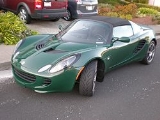
Lotus Elise

Encyclopedia
The 1996 Lotus Elise weighed 725 kg (1,598.4 lb). Because of its relatively low weight, it was able to accelerate 0-60 mph (96.6 km/h) in 5.8 seconds despite its relatively low power output of 118 bhp. Braking, cornering, and fuel consumption are also improved by the car's reduced weight.
Series 1 was designed by Julian Thomson, then head of design at Lotus, and Richard Rackham, Lotus's chief engineer.
Besides the standard higher-performance variants listed below, Lotus also released some limited edition models such as Sport 135 (1998/9) with approx 145 bhp, Sport 160 (2000) with 150 bhp, and Sport 190 (190 bhp). These were more competent on track with sports suspension, wheels and tires, seats according to model. There were other special editions such as the 50th Anniversary Edition (green/gold) celebrating 50 years of Lotus cars, the Type 49 ("Gold Leaf" red and white two-tone), and Type 79 ("JPS" black/gold) which refers to its successful Grand Prix car type numbers.
Rover K-Series engine with a modified head and VVT
technology, producing a declared 143 bhp rather than the standard Rover
1.8 L K-series 118 bhp I4
unit, along with a closer ratio manual gearbox and lower ratio final drive. It also had more padding in the seats. The 111S had headlamp covers, rear spoiler, cross drilled brake discs, alloy window winders and a 6 spoke road wheel design.
limited edition model, based on a Series 1 Elise was introduced. This roofless car was a special edition, limited to only 340 cars being built. The name 340 originally referred to the 340 bhp/tonne (254 kW/tonne) power-to-weight ratio of the original prototype which had 177 bhp while weighing just 500 kg (1,102.3 lb). However in production models the 340 refers to the number of cars built. The final production versions weighed 701 kg (1,545.4 lb) and had a power-to-weight ratio of (269 bhp/tonne). A "Track Pack" was created that upped power to 192 bhp and weighed only 571 kg (1,258.8 lb).
— a hardtop version of the Elise with the 177 bhp engine from the 340R
; as well as different front and rear clams, larger wheels, and a rear wing. Many models received an upgrade to 190 bhp with better driveability due to changes to ECU and cam timing.
offered to partner/fund the project, in return for a badged and GM-engined version of the car for their European brands, Opel
and Vauxhall
.
Announced on October 9, 2000, the Series 2 Elise was a redesigned Series 1 using a slightly modified version of the Series 1 chassis to meet the new regulations, and the same K-series engine with a brand new Lotus-developed ECU
. The design of the body paid homage to the still-born M250 project, and was the first Lotus to be designed on computer.
Both the Series 2 Elise and the Opel Speedster/Vauxhall VX220 were built on the same production line, in a newer facility at Hethel. Both cars shared many parts, including the chassis, although they have different drive-trains and power-plants. The VX220 carried the Lotus internal model identification Lotus 116, with the code name Skipton for the launch 2.2N/A version and Tornado for the 2004 introduced 2.0 L Turbo. Fitted with 17 inch over the Elise's 16 inch front wheels, the Vauxhall/Opel version ceased production in 2004.
engine technology producing 160 hp . The 111S models were discontinued in 2005 in favour of the Lotus powerplant (see below), mainly due to Lotus plans to introduce the Elise to the US market, which needed the engine to comply with the emission regulations in USA, which was not the case for the K-series Engine as MG Rover did not sell cars in the US.
Two more track-focused models, the 135R and Sport 190 were available with 135 bhp and 192 bhp respectively. These also came with associated handling upgrades such as Lotus Sport Suspension and wider wheels with Yokohama Advan A048 tyres. In certain markets, the 135R was replaced by the "Sport 111", which was similar, apart from sporting the 156 bhp VVC engine in place of the 135 bhp tuned K-series.
with a Yamaha
designed twin-cam head offering variable valve timing on both intake and exhaust valvetrain, and a 6 speed manual Lotus gearbox. The Series 2 model is acclaimed as the best version of the Elise to date, with tremendous performance numbers. Many tests show 0–60 miles per hour (96.6 km/h) in approximately 4.9 seconds, or 4.7 seconds with the Sport Package. The engine management computer is a Lotus programmed unit.
The 2005 Lotus Elise was the first to be sold commercially in the United States, in the summer of 2004. Approval for the Elise, however, required intervention by the National Highway Traffic Safety Administration
(NHTSA) who provided a three-year exemption for the car, as it had failed to meet US bumper and headlight regulations. All Lotus Elise cars manufactured after January 1, 2007 include the new headlights and 2.5 mi/h bumpers, although they are hidden in the front.
This model has been followed up by the 2006 Model Year Elise 111R and SportRacer models. Lotus made a limited edition (50 in the US) version of the Lotus Elise as well, called the Lotus Sport Elise.
2006 models also differ from the 2005 models in a few aspects. 2006 models sport LED
tail lights, drive by wire
(an updated ECU), improved fuel consumption, and more comfortable ProBax seats.
For the 2007 model year Lotus there were several further minor changes made. The LOTUS decals on the rear of the vehicle, which was previously flat stickers, was changed to raised lettering. The headlamp units were sealed. Also, in order to comply with US Federally mandated bumper restrictions, the frontal crash structure was slightly changed and rear bumperettes were added next to the licence plate mount. Approximately 100 2007 model year "launch" cars were shipped to the US without these bumper changes. Also in 2007, the Elise S was released and the 111R renamed Elise R.
The Elise S is the new base model with a Toyota sourced 1.8L engine replacing the previous models K series Rover
engine. The 1ZZ-FE engine produces 134 bhp at 6200 rpm (an increase over 120 bhp Rover engine). The inclusion of airbags, ABS brakes, electric windows, and carpet in addition to the new heavier engine has increased the base weight to 860 kg (1,896 lb) (approximately 85 kg (187.4 lb) higher than the previous S model).
Its successor, the third generation of Elise, first appeared at the 2010 Paris Motor Show
in the autumn of that year, and is set to be launched within the next couple of years.
' s were produced in a light two-tone leather (Biscuit) and the exterior modifications included a silver front grille (a nod to vintage-Ferrari), body-colored shutter grills on the side inlets and engine cover, enhanced 16-spoke wheels, and a large spoiler that covers the upper-rear deck (72-D style). The Cali' s were intended to appeal to "the lifestyle market."
In Europe, there are three models available; the Elise S with a 134 bhp, 1.8L Toyota 1ZZ-FE engine and 5 speed manual gearbox (0-60 mph in 5.8s, top speed 127 mph (204.4 km/h)); the Elise R with a 189 bhp, 1.8L Toyota 2ZZ-GE engine and 6 speed manual gearbox (0-60 mph in 4.9s, top speed 148 mph (238.2 km/h)); and the Elise SC with a 218 bhp, supercharged, 1.8L Toyota 2ZZ-GE, 6 speed manual gearbox and a spoiler (0-60 mph in 4.3s, top speed 150 mph (241.4 km/h)).
Several new colour options for 2008 were brought to the marketplace. These include new metallic colours (additional $590) Persian Blue and Liquid Blue; new Lifestyle colour (additional $1200) Isotope Green; new Limited Colour Level (additional $3,300) Candy Red, Ice White, and Burnt Orange; and the new Exclusive Colour Level (additional $5,100) Prism Green and Moonstone Silver. The following colours were discontinued for 2008: Nightfall Blue, Aubergine Purple, Magnetic Blue, Polar Blue, Autumn Gold, Chili Red, and Krypton Green.
engine and six speed gearbox as the Elise 111R, replacing the Rover
K-series engine of the previous Exige.
The Series 2 Exige has been followed up by the limited-edition Lotus Sport Exige 240R, incorporating a Lotus-developed supercharger atop the Lotus engine. The US Federalized version with the supercharger fitted is known as the Exige S 240.
sports car
jointly produced by Lotus and Zytek
, from 1998 and discontinued in 2003.
Its 70 kilograms (154.3 lb) extruded aluminium
space frame and lightweight composite body shell are factors in its low curb weight of 875 kilograms (1,929 lb). 250 nickel-cadmium batteries
provide 300 volt
s (at full charge) to two Zytek oil-cooled brushless DC motor
s, which deliver a total power of 150 kW (200 hp) and torque of 100 newton metre. These motors are each mated to a single-speed, fixed ratio transmission
with an aluminium
gear
. Its acceleration time from 30 to 70 mph (48.3 to 112.7 km/h) is 5 seconds, and from 0 to 90 miles per hour (144.8 km/h), 11.2 seconds. The car is governor-limited to 90 miles per hour (144.8 km/h) to conserve charge. The range per charge is typically 100 to 120 mi (160.9 to 193.1 km) and the car can be re-charged within an hour.
There is an example of the Zytek Elise on display at the Heritage Motor Centre
.
Series 1 was designed by Julian Thomson, then head of design at Lotus, and Richard Rackham, Lotus's chief engineer.
Besides the standard higher-performance variants listed below, Lotus also released some limited edition models such as Sport 135 (1998/9) with approx 145 bhp, Sport 160 (2000) with 150 bhp, and Sport 190 (190 bhp). These were more competent on track with sports suspension, wheels and tires, seats according to model. There were other special editions such as the 50th Anniversary Edition (green/gold) celebrating 50 years of Lotus cars, the Type 49 ("Gold Leaf" red and white two-tone), and Type 79 ("JPS" black/gold) which refers to its successful Grand Prix car type numbers.
111S
A faster edition called the 111S, named after the Lotus type-number of the Elise M111, was introduced in early 1999 and had a VVCVariable Valve Control
VVC is an automobile variable valve timing technology developed by Rover and applied to some high performance variants of the company's K Series 1800cc engine....
Rover K-Series engine with a modified head and VVT
Variable valve timing
In internal combustion engines, variable valve timing , also known as Variable valve actuation , is a generalized term used to describe any mechanism or method that can alter the shape or timing of a valve lift event within an internal combustion engine...
technology, producing a declared 143 bhp rather than the standard Rover
Rover (car)
The Rover Company is a former British car manufacturing company founded as Starley & Sutton Co. of Coventry in 1878. After developing the template for the modern bicycle with its Rover Safety Bicycle of 1885, the company moved into the automotive industry...
1.8 L K-series 118 bhp I4
Straight-4
The inline-four engine or straight-four engine is an internal combustion engine with all four cylinders mounted in a straight line, or plane along the crankcase. The single bank of cylinders may be oriented in either a vertical or an inclined plane with all the pistons driving a common crankshaft....
unit, along with a closer ratio manual gearbox and lower ratio final drive. It also had more padding in the seats. The 111S had headlamp covers, rear spoiler, cross drilled brake discs, alloy window winders and a 6 spoke road wheel design.
340R
In 2000, the 340RLotus 340R
The Lotus 340R is a limited edition sports car manufactured by Lotus Cars in 2000 at their Hethel factory.-Overview:The 340R is a special edition of the Lotus Elise. Just 340 were built, and all were sold before they were manufactured. It uses a custom built bodyshell with no roof or doors. All...
limited edition model, based on a Series 1 Elise was introduced. This roofless car was a special edition, limited to only 340 cars being built. The name 340 originally referred to the 340 bhp/tonne (254 kW/tonne) power-to-weight ratio of the original prototype which had 177 bhp while weighing just 500 kg (1,102.3 lb). However in production models the 340 refers to the number of cars built. The final production versions weighed 701 kg (1,545.4 lb) and had a power-to-weight ratio of (269 bhp/tonne). A "Track Pack" was created that upped power to 192 bhp and weighed only 571 kg (1,258.8 lb).
Exige
In 2000, Lotus introduced the ExigeLotus Exige
The Lotus Exige is a two-door, two-seat sports car made by Lotus Cars. It is essentially a coupé version of the Lotus Elise, a mid-engined roadster in production since 1996....
— a hardtop version of the Elise with the 177 bhp engine from the 340R
Lotus 340R
The Lotus 340R is a limited edition sports car manufactured by Lotus Cars in 2000 at their Hethel factory.-Overview:The 340R is a special edition of the Lotus Elise. Just 340 were built, and all were sold before they were manufactured. It uses a custom built bodyshell with no roof or doors. All...
; as well as different front and rear clams, larger wheels, and a rear wing. Many models received an upgrade to 190 bhp with better driveability due to changes to ECU and cam timing.
Series 2
The Series 1 was unable to be produced beyond the 2000 model production year due to new European regulations around crash sustainability, and so Lotus needed a development partner to meet the investment requirement. General MotorsGeneral Motors
General Motors Company , commonly known as GM, formerly incorporated as General Motors Corporation, is an American multinational automotive corporation headquartered in Detroit, Michigan and the world's second-largest automaker in 2010...
offered to partner/fund the project, in return for a badged and GM-engined version of the car for their European brands, Opel
Opel
Adam Opel AG, generally shortened to Opel, is a German automobile company founded by Adam Opel in 1862. Opel has been building automobiles since 1899, and became an Aktiengesellschaft in 1929...
and Vauxhall
Vauxhall
-Demography:Many Vauxhall residents live in social housing. There are several gentrified areas, and areas of terraced townhouses on streets such as Fentiman Road and Heyford Avenue have higher property values in the private market, however by far the most common type of housing stock within...
.
Announced on October 9, 2000, the Series 2 Elise was a redesigned Series 1 using a slightly modified version of the Series 1 chassis to meet the new regulations, and the same K-series engine with a brand new Lotus-developed ECU
Engine Control Unit
An engine control unit is a type of electronic control unit that determines the amount of fuel, ignition timing and other parameters an internal combustion engine needs to keep running...
. The design of the body paid homage to the still-born M250 project, and was the first Lotus to be designed on computer.
Both the Series 2 Elise and the Opel Speedster/Vauxhall VX220 were built on the same production line, in a newer facility at Hethel. Both cars shared many parts, including the chassis, although they have different drive-trains and power-plants. The VX220 carried the Lotus internal model identification Lotus 116, with the code name Skipton for the launch 2.2N/A version and Tornado for the 2004 introduced 2.0 L Turbo. Fitted with 17 inch over the Elise's 16 inch front wheels, the Vauxhall/Opel version ceased production in 2004.
111s
The Series 2 was also available as a 111S model, with the VVCVariable Valve Control
VVC is an automobile variable valve timing technology developed by Rover and applied to some high performance variants of the company's K Series 1800cc engine....
engine technology producing 160 hp . The 111S models were discontinued in 2005 in favour of the Lotus powerplant (see below), mainly due to Lotus plans to introduce the Elise to the US market, which needed the engine to comply with the emission regulations in USA, which was not the case for the K-series Engine as MG Rover did not sell cars in the US.
Two more track-focused models, the 135R and Sport 190 were available with 135 bhp and 192 bhp respectively. These also came with associated handling upgrades such as Lotus Sport Suspension and wider wheels with Yokohama Advan A048 tyres. In certain markets, the 135R was replaced by the "Sport 111", which was similar, apart from sporting the 156 bhp VVC engine in place of the 135 bhp tuned K-series.
111R / Federal Elise
This Series 2 Elise model comes in European 111R version or a version sold in North America, called the Federal Elise. It is powered by the all-aluminium 189 hp 1.8L DOHC Toyota ZZ engineToyota ZZ engine
The Toyota ZZ engine family is a straight-4 piston engine series. The ZZ series uses an aluminum engine block and aluminum DOHC 4-valve cylinder heads, a first for Toyota. The camshafts are chain-driven. The two 1.8 L members of the family, the 1ZZ and 2ZZ, use different bore and stroke...
with a Yamaha
Yamaha
Yamaha may refer to:* Yamaha Corporation, a Japanese company with a wide range of products and services** Yamaha Motor Company, a Japanese motorized vehicle-producing company...
designed twin-cam head offering variable valve timing on both intake and exhaust valvetrain, and a 6 speed manual Lotus gearbox. The Series 2 model is acclaimed as the best version of the Elise to date, with tremendous performance numbers. Many tests show 0–60 miles per hour (96.6 km/h) in approximately 4.9 seconds, or 4.7 seconds with the Sport Package. The engine management computer is a Lotus programmed unit.
The 2005 Lotus Elise was the first to be sold commercially in the United States, in the summer of 2004. Approval for the Elise, however, required intervention by the National Highway Traffic Safety Administration
National Highway Traffic Safety Administration
The National Highway Traffic Safety Administration is an agency of the Executive Branch of the U.S. government, part of the Department of Transportation...
(NHTSA) who provided a three-year exemption for the car, as it had failed to meet US bumper and headlight regulations. All Lotus Elise cars manufactured after January 1, 2007 include the new headlights and 2.5 mi/h bumpers, although they are hidden in the front.
This model has been followed up by the 2006 Model Year Elise 111R and SportRacer models. Lotus made a limited edition (50 in the US) version of the Lotus Elise as well, called the Lotus Sport Elise.
2006 models also differ from the 2005 models in a few aspects. 2006 models sport LED
Light-emitting diode
A light-emitting diode is a semiconductor light source. LEDs are used as indicator lamps in many devices and are increasingly used for other lighting...
tail lights, drive by wire
Drive by wire
Drive-by-wire, DbW, by-wire, or x-by-wire technology in the automotive industry replaces the traditional mechanical control systems with electronic control systems using electromechanical actuators and human-machine interfaces such as pedal and steering feel emulators...
(an updated ECU), improved fuel consumption, and more comfortable ProBax seats.
For the 2007 model year Lotus there were several further minor changes made. The LOTUS decals on the rear of the vehicle, which was previously flat stickers, was changed to raised lettering. The headlamp units were sealed. Also, in order to comply with US Federally mandated bumper restrictions, the frontal crash structure was slightly changed and rear bumperettes were added next to the licence plate mount. Approximately 100 2007 model year "launch" cars were shipped to the US without these bumper changes. Also in 2007, the Elise S was released and the 111R renamed Elise R.
The Elise S is the new base model with a Toyota sourced 1.8L engine replacing the previous models K series Rover
Land Rover
Land Rover is a British car manufacturer with its headquarters in Gaydon, Warwickshire, United Kingdom which specialises in four-wheel-drive vehicles. It is owned by the Indian company Tata Motors, forming part of their Jaguar Land Rover group...
engine. The 1ZZ-FE engine produces 134 bhp at 6200 rpm (an increase over 120 bhp Rover engine). The inclusion of airbags, ABS brakes, electric windows, and carpet in addition to the new heavier engine has increased the base weight to 860 kg (1,896 lb) (approximately 85 kg (187.4 lb) higher than the previous S model).
Its successor, the third generation of Elise, first appeared at the 2010 Paris Motor Show
2010 Paris Motor Show
The 2010 Paris Motor Show took place from 2 October to 17 October 2010, in Paris Expo, Porte de Versailles.For 2010, the theme of the special exhibition was "The Incredible Collection 2: automobile manufacturers collections and museums."- Production cars :...
in the autumn of that year, and is set to be launched within the next couple of years.
2008 models
For 2008, there were several additions to the Lotus line-up. There are three versions of the Elise. Lotus continued to provide a naturally aspirated Elise producing 189 hp. The second version is the Elise SC sporting a non-intercooled supercharger producing 218 hp. 0-60 mph is reduced from 4.9 for the base Elise or 4.7 seconds for the Elise with Sport package to 4.3 seconds for the Elise SC. The NA Elise styling is similar to the prior model years. The Elise SC, however, is distinguishable from the NA version by a rear spoiler identical to the Type 72-D edition spoiler and new wheels. Weight remained a Lotus-claimed 1987 lb (901.3 kg); just 3 pounds (1.4 kg) more than the previous year. Prior to the release of the 2008 Elise SC, the limited production California Edition arrived at dealerships. A total of fifty California Edition Elises were produced; 25 in Saffron Yellow and 25 in Ardent Red. The interiors of the CaliIn Europe, there are three models available; the Elise S with a 134 bhp, 1.8L Toyota 1ZZ-FE engine and 5 speed manual gearbox (0-60 mph in 5.8s, top speed 127 mph (204.4 km/h)); the Elise R with a 189 bhp, 1.8L Toyota 2ZZ-GE engine and 6 speed manual gearbox (0-60 mph in 4.9s, top speed 148 mph (238.2 km/h)); and the Elise SC with a 218 bhp, supercharged, 1.8L Toyota 2ZZ-GE, 6 speed manual gearbox and a spoiler (0-60 mph in 4.3s, top speed 150 mph (241.4 km/h)).
Several new colour options for 2008 were brought to the marketplace. These include new metallic colours (additional $590) Persian Blue and Liquid Blue; new Lifestyle colour (additional $1200) Isotope Green; new Limited Colour Level (additional $3,300) Candy Red, Ice White, and Burnt Orange; and the new Exclusive Colour Level (additional $5,100) Prism Green and Moonstone Silver. The following colours were discontinued for 2008: Nightfall Blue, Aubergine Purple, Magnetic Blue, Polar Blue, Autumn Gold, Chili Red, and Krypton Green.
Special editions
- Sport 190
- Sport 135R
- Type 23
- 50th Anniversary Edition
- Jim Clark Type 25
- Type 25
- Type 49
- Type 72
- Type 99T
- Sports Racer
- Club Racer http://www.lotuscars.com/club_racer.html
- California Edition
- Purist Edition
- Final Edition
Exige
The Series 2 Exige, comes with the same high revving LotusLotus
- Botany :*Lotus , various botanical taxa*Lotus *Lotus Flower, Nelumbo nucifera- Motor cars :*Lotus Cars, a British motor vehicle manufacturer**Team Lotus, a British Formula One racing team that competed between 1954 and 1994...
engine and six speed gearbox as the Elise 111R, replacing the Rover
Rover (car)
The Rover Company is a former British car manufacturing company founded as Starley & Sutton Co. of Coventry in 1878. After developing the template for the modern bicycle with its Rover Safety Bicycle of 1885, the company moved into the automotive industry...
K-series engine of the previous Exige.
The Series 2 Exige has been followed up by the limited-edition Lotus Sport Exige 240R, incorporating a Lotus-developed supercharger atop the Lotus engine. The US Federalized version with the supercharger fitted is known as the Exige S 240.
Zytek Lotus Elise
The Zytek Lotus Elise is an electricBattery electric vehicle
A battery electric vehicle, or BEV, is a type of electric vehicle that uses chemical energy stored in rechargeable battery packs. BEVs use electric motors and motor controllers instead of, or in addition to, internal combustion engines for propulsion.A battery-only electric vehicle or...
sports car
Sports car
A sports car is a small, usually two seat, two door automobile designed for high speed driving and maneuverability....
jointly produced by Lotus and Zytek
Zytek
Zytek Group Ltd is an automotive and motorsport company founded in 1981 and based in Fradley and Repton, United Kingdom. Zytek Group has two main division: Zytek Automotive, which is based at Fradley, Staffordshire; and Zytek Engineering, which is based at Repton, Derbyshire.-Zytek Automotive:Zytek...
, from 1998 and discontinued in 2003.
Its 70 kilograms (154.3 lb) extruded aluminium
Aluminium
Aluminium or aluminum is a silvery white member of the boron group of chemical elements. It has the symbol Al, and its atomic number is 13. It is not soluble in water under normal circumstances....
space frame and lightweight composite body shell are factors in its low curb weight of 875 kilograms (1,929 lb). 250 nickel-cadmium batteries
Nickel-cadmium battery
The nickel–cadmium battery ' is a type of rechargeable battery using nickel oxide hydroxide and metallic cadmium as electrodes....
provide 300 volt
Volt
The volt is the SI derived unit for electric potential, electric potential difference, and electromotive force. The volt is named in honor of the Italian physicist Alessandro Volta , who invented the voltaic pile, possibly the first chemical battery.- Definition :A single volt is defined as the...
s (at full charge) to two Zytek oil-cooled brushless DC motor
Electric motor
An electric motor converts electrical energy into mechanical energy.Most electric motors operate through the interaction of magnetic fields and current-carrying conductors to generate force...
s, which deliver a total power of 150 kW (200 hp) and torque of 100 newton metre. These motors are each mated to a single-speed, fixed ratio transmission
Transmission (mechanics)
A machine consists of a power source and a power transmission system, which provides controlled application of the power. Merriam-Webster defines transmission as: an assembly of parts including the speed-changing gears and the propeller shaft by which the power is transmitted from an engine to a...
with an aluminium
Aluminium
Aluminium or aluminum is a silvery white member of the boron group of chemical elements. It has the symbol Al, and its atomic number is 13. It is not soluble in water under normal circumstances....
gear
Gear
A gear is a rotating machine part having cut teeth, or cogs, which mesh with another toothed part in order to transmit torque. Two or more gears working in tandem are called a transmission and can produce a mechanical advantage through a gear ratio and thus may be considered a simple machine....
. Its acceleration time from 30 to 70 mph (48.3 to 112.7 km/h) is 5 seconds, and from 0 to 90 miles per hour (144.8 km/h), 11.2 seconds. The car is governor-limited to 90 miles per hour (144.8 km/h) to conserve charge. The range per charge is typically 100 to 120 mi (160.9 to 193.1 km) and the car can be re-charged within an hour.
There is an example of the Zytek Elise on display at the Heritage Motor Centre
Heritage Motor Centre
The Heritage Motor Centre is a British motor museum and research centre, located adjacent to the Jaguar Land Rover Gaydon Centre near Gaydon in Warwickshire, England. The centre is open to the public, and houses a collection of important vehicles, celebrating Britain's motoring heritage...
.
Other cars sharing the Elise platform
- Dodge Circuit EV
- Hennessey Venom GTHennessey Venom GTThe Hennessey Venom GT is a sports car manufactured by Hennessey Performance Engineering. It was revealed on March 29, 2010.-Engineering:The Venom GT is based on a highly modified Lotus Exige chassis. The Venom GT is powered by General Motors' LS9 supercharged V8 that can be found in the Chevrolet...
- Lotus 2-ElevenLotus 2-ElevenThe Lotus 2-Eleven is a car produced by British car manufacturer Lotus. It is based on the Lotus Exige S, and thus has the same supercharged 2ZZ-GE engine. Weighing and with , the 2-Eleven can sprint from 0-60 in 3.8 seconds and has a top speed of...
- Lotus 340RLotus 340RThe Lotus 340R is a limited edition sports car manufactured by Lotus Cars in 2000 at their Hethel factory.-Overview:The 340R is a special edition of the Lotus Elise. Just 340 were built, and all were sold before they were manufactured. It uses a custom built bodyshell with no roof or doors. All...
- Lotus Circuit Car
- Lotus Elise GT1Lotus Elise GT1The Lotus Elise GT1 was a race car developed for grand tourer-style sports car racing starting in 1997.-Development:...
- Lotus Europa SLotus Europa SLotus Europa S is a GT-type two-seat sports car, designed to complement the successful Lotus Elise and its derivative, the Exige. The Europa S is the continuation of the Europa line of the 1960s and 1970s....
- Lotus Motorsport Elise
- Lotus Sport Exige 300RR
- Melkus RS 2000
- Pininfarina Enjoy
- Rinspeed sQuba
- Tesla RoadsterTesla RoadsterThe Tesla Roadster is a battery electric vehicle sports car produced by the electric car firm Tesla Motors in California. The Roadster was the first highway-capable all-electric vehicle in serial production available in the United States. Since 2008 Tesla has sold 2,024 Roadsters in 30 countries...
- Vauxhall VX220Vauxhall VX220The Opel Speedster/Vauxhall VX220 is a British-built mid engined, targa-topped, 2-seater sports car introduced in the summer of 2000.It was built in both right-hand drive and left-hand drive versions at the Lotus Cars plant in Hethel, Norfolk, England. It was sold as the Vauxhall VX220 in the UK,...
/ Opel Speedster / Opel Eco-Speedster Concept
Awards and recognition
The Elise has received critical acclaim for its performance and driving experience, including Best Driver's Car 2001 by Autocar, Car of the Year 2003 by UK Horizons TV, and Best Sportscar 2004 by BBC Top Gear Magazine.External links
- Group Lotus PLC Manufacturer website
- Lotus USA US distributor
- SELOC Techwiki Lotus Technical Wiki