

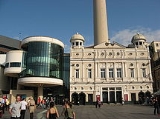
Liverpool Playhouse

Encyclopedia
The Liverpool Playhouse is a theatre in Williamson Square
in the city of Liverpool
, Merseyside
, England. It originated in 1866 as a music hall
, and in 1911 developed into a repertory
theatre. As such it nurtured the early careers of many actors and actresses, some of which went on to achieve national and international reputations. Architectural changes have been made to the building over the years, the latest being in 1968 when a modern-style extension was added to the north of the theatre. In 1999 a trust was formed, joining the management of the Playhouse with that of the Everyman Theatre
.
as its "controller and producer". The company could not afford to build a new theatre, and bought the Star Theatre for £28,000 (£ as of ). This made it the first repertory
in Britain to own the freehold of a theatre. The company spent a further £4,000 (£ as of ) on redesigning and modernising the theatre. The auditorium and the basement foyer were redesigned by Stanley Adshead, the Professor of Civic Design at the Liverpool School of Architecture. The theatre was renamed the Liverpool Repertory Theatre, and in 1916 renamed again, as the Liverpool Playhouse. Minor structural alterations were made to the theatre in 1961 and in 1966. In 1968 a modern-style extension was added to the north of the theatre to accommodate new foyers, bars, dressing rooms and a workshop. In the 1990s the theatre company went into liquidation. In 1999 the Liverpool and Merseyside Theatres Trust Limited was established as a charity, and the theatre re-opened. It is managed jointly with the Everyman Theatre
by Liverpool City Council
.
and Gertrude Lawrence
worked with the company as child actors. Other artistes who gained experience at the theatre include Robert Donat
, Lilian Braithwaite
, Cecil Parker
, John Gregson
, Clive Brook, C. Aubrey Smith, Richard Burton
, Michael Redgrave
, Diana Wynyard
, Rex Harrison
, Patricia Routledge
, Anthony Hopkins
, and Richard Briers
.
ed, and it has a slate
roof. Its entrance front faces Williamson Square. It has seven bays
and is in three storeys. The central three bays project forward and are surmounted by a broken pediment
. On the ground floor the central bays contain three entrances, separated by pillars, which lead to a recessed porch. Over each entrance is an architrave
containing a fanlight
. The lateral bays contain two round-headed and one flat-headed entrance on each side, over which are three blind round windows. In the middle storey, the bays are separated by pilaster
s. The three central bays each have a balustrade
and a window with a tympanum
containing a roundel. Each of the three lateral bays contains a window with a cornice
, and a round window above it. Along the top storey are oculi
between panelled pilasters. On the summit of each of the two lateral bays is a cupola
on a short Tuscan
colonnade
. Inside the older part of the theatre are two balconies supported by cast iron
columns. The interior is decorated in Greek Revival
style.
ed from a central column. To the left is a smaller cylinder, cantilevered from a separate column, interlocking with the larger cylinder. Inside the whole is a hollow column containing the stairs.
as a Grade II* listed building. In its description, the National Heritage List for England quotes the Architects' Journal of 1968 which says of the older section that it is "significant as an early and rare work by one of the pioneers of the Liverpool School of Architecture, in the Grecian style favoured by the school at that date", and of the newer section that it is "a brilliant concept, joyously realised, which exploits asymmetrical volumes and ever varying spaces yet achieves unity and also balance with the adjoining Victorian
façade". In the Buildings of England
series the architectural historians Richard Pollard and Nikolaus Pevsner
say of the newer section that it is "a spectacular composition" which creates an atmosphere of excitement and anticipation, exactly right for a theatre foyer".
Williamson Square
Williamson Square is in the city centre of Liverpool, England. It was initially laid out as a residential square in the middle of the 18th century....
in the city of Liverpool
Liverpool
Liverpool is a city and metropolitan borough of Merseyside, England, along the eastern side of the Mersey Estuary. It was founded as a borough in 1207 and was granted city status in 1880...
, Merseyside
Merseyside
Merseyside is a metropolitan county in North West England, with a population of 1,365,900. It encompasses the metropolitan area centred on both banks of the lower reaches of the Mersey Estuary, and comprises five metropolitan boroughs: Knowsley, St Helens, Sefton, Wirral, and the city of Liverpool...
, England. It originated in 1866 as a music hall
Music hall
Music Hall is a type of British theatrical entertainment which was popular between 1850 and 1960. The term can refer to:# A particular form of variety entertainment involving a mixture of popular song, comedy and speciality acts...
, and in 1911 developed into a repertory
Repertory
Repertory or rep, also called stock in the United States, is a term used in Western theatre and opera.A repertory theatre can be a theatre in which a resident company presents works from a specified repertoire, usually in alternation or rotation...
theatre. As such it nurtured the early careers of many actors and actresses, some of which went on to achieve national and international reputations. Architectural changes have been made to the building over the years, the latest being in 1968 when a modern-style extension was added to the north of the theatre. In 1999 a trust was formed, joining the management of the Playhouse with that of the Everyman Theatre
Everyman Theatre
The Everyman Theatre stands at the north end of Hope Street, Liverpool, Merseyside, England. Established in 1964 in a former cinema, it encouraged local talent and played a part in the development of new artistes and writers. The theatre was rebuilt between 1975 and 1977, and was closed again for...
.
History
The present theatre on the site was designed by Edward Davies, and opened in 1866. It replaced an earlier theatre called the Star Concert Hall. The present theatre was originally named the Star Music Hall. In 1895 its name was changed to the Star Theatre of Varieties. The theatre was improved in 1898 by Harry Percival with a new auditorium and foyer, and electricity was installed. In 1911 the Liverpool Repertory Theatre Limited was established, with Basil DeanBasil Dean
Basil Herbert Dean CBE was an English actor, writer, film producer/director and theatrical producer/director....
as its "controller and producer". The company could not afford to build a new theatre, and bought the Star Theatre for £28,000 (£ as of ). This made it the first repertory
Repertory
Repertory or rep, also called stock in the United States, is a term used in Western theatre and opera.A repertory theatre can be a theatre in which a resident company presents works from a specified repertoire, usually in alternation or rotation...
in Britain to own the freehold of a theatre. The company spent a further £4,000 (£ as of ) on redesigning and modernising the theatre. The auditorium and the basement foyer were redesigned by Stanley Adshead, the Professor of Civic Design at the Liverpool School of Architecture. The theatre was renamed the Liverpool Repertory Theatre, and in 1916 renamed again, as the Liverpool Playhouse. Minor structural alterations were made to the theatre in 1961 and in 1966. In 1968 a modern-style extension was added to the north of the theatre to accommodate new foyers, bars, dressing rooms and a workshop. In the 1990s the theatre company went into liquidation. In 1999 the Liverpool and Merseyside Theatres Trust Limited was established as a charity, and the theatre re-opened. It is managed jointly with the Everyman Theatre
Everyman Theatre
The Everyman Theatre stands at the north end of Hope Street, Liverpool, Merseyside, England. Established in 1964 in a former cinema, it encouraged local talent and played a part in the development of new artistes and writers. The theatre was rebuilt between 1975 and 1977, and was closed again for...
by Liverpool City Council
Liverpool City Council
Liverpool City Council is the governing body for the city of Liverpool in Merseyside, England. It consists of 90 councillors, three for each of the city's 30 wards. The council is currently controlled by the Labour Party and is led by Joe Anderson.-Domain:...
.
Artistes
As a repertory company, the theatre has been involved in the careers of actors and actresses who have later achieved wide fame. Noel CowardNoël Coward
Sir Noël Peirce Coward was an English playwright, composer, director, actor and singer, known for his wit, flamboyance, and what Time magazine called "a sense of personal style, a combination of cheek and chic, pose and poise".Born in Teddington, a suburb of London, Coward attended a dance academy...
and Gertrude Lawrence
Gertrude Lawrence
Gertrude Lawrence was an English actress, singer and musical comedy performer known for her stage appearances in the West End theatre district of London and on Broadway.-Early life:...
worked with the company as child actors. Other artistes who gained experience at the theatre include Robert Donat
Robert Donat
Robert Donat was an English film and stage actor. He is best-known for his roles in Alfred Hitchcock's The 39 Steps and Goodbye, Mr...
, Lilian Braithwaite
Lilian Braithwaite
Dame Lilian Braithwaite DBE , born Florence Lilian Braithwaite, was an English actress.She was the daughter of a clergyman, and born in Ramsgate, Kent. She was educated at Croydon High School, and married actor-manager Gerald Lawrence, first acting with amateur companies...
, Cecil Parker
Cecil Parker
Cecil Parker was an English character and comedy actor with a distinctive husky voice, who usually played supporting roles in his 91 films made between 1928 and 1969....
, John Gregson
John Gregson
John Gregson was an English actor.He was born Harold Thomas Gregson, of Irish descent, and grew up in Wavertree, Liverpool, where he was educated at Greenbank Road primary school, later St Francis Xavier School...
, Clive Brook, C. Aubrey Smith, Richard Burton
Richard Burton
Richard Burton, CBE was a Welsh actor. He was nominated seven times for an Academy Award, six of which were for Best Actor in a Leading Role , and was a recipient of BAFTA, Golden Globe and Tony Awards for Best Actor. Although never trained as an actor, Burton was, at one time, the highest-paid...
, Michael Redgrave
Michael Redgrave
Sir Michael Scudamore Redgrave, CBE was an English stage and film actor, director, manager and author.-Youth and education:...
, Diana Wynyard
Diana Wynyard
Diana Wynyard, CBE , whose birth name was Dorothy Isobel Cox, was an English stage and film actress.-Life and career:...
, Rex Harrison
Rex Harrison
Sir Reginald Carey “Rex” Harrison was an English actor of stage and screen. Harrison won an Academy Award and two Tony Awards.-Youth and stage career:...
, Patricia Routledge
Patricia Routledge
Katherine Patricia Routledge, CBE is an English character comedy actress and singer. She is best known for her role as character Hyacinth Bucket in the British television series Keeping Up Appearances and Hetty Wainthropp in the British television series Hetty Wainthropp Investigates...
, Anthony Hopkins
Anthony Hopkins
Sir Philip Anthony Hopkins, KBE , best known as Anthony Hopkins, is a Welsh actor of film, stage and television...
, and Richard Briers
Richard Briers
Richard David Briers, CBE is an English actor whose career has encompassed theatre, television, film and radio.He first came to prominence as George Starling in Marriage Lines in the 1960s, but it was in the following decade when he played Tom Good in the BBC sitcom The Good Life that he became a...
.
Older section
The exterior of the older part of the theatre is stuccoStucco
Stucco or render is a material made of an aggregate, a binder, and water. Stucco is applied wet and hardens to a very dense solid. It is used as decorative coating for walls and ceilings and as a sculptural and artistic material in architecture...
ed, and it has a slate
Slate
Slate is a fine-grained, foliated, homogeneous metamorphic rock derived from an original shale-type sedimentary rock composed of clay or volcanic ash through low-grade regional metamorphism. The result is a foliated rock in which the foliation may not correspond to the original sedimentary layering...
roof. Its entrance front faces Williamson Square. It has seven bays
Bay (architecture)
A bay is a unit of form in architecture. This unit is defined as the zone between the outer edges of an engaged column, pilaster, or post; or within a window frame, doorframe, or vertical 'bas relief' wall form.-Defining elements:...
and is in three storeys. The central three bays project forward and are surmounted by a broken pediment
Pediment
A pediment is a classical architectural element consisting of the triangular section found above the horizontal structure , typically supported by columns. The gable end of the pediment is surrounded by the cornice moulding...
. On the ground floor the central bays contain three entrances, separated by pillars, which lead to a recessed porch. Over each entrance is an architrave
Architrave
An architrave is the lintel or beam that rests on the capitals of the columns. It is an architectural element in Classical architecture.-Classical architecture:...
containing a fanlight
Fanlight
A fanlight is a window, semicircular or semi-elliptical in shape, with glazing bars or tracery sets radiating out like an open fan, It is placed over another window or a doorway. and is sometimes hinged to a transom. The bars in the fixed glazed window spread out in the manner a sunburst...
. The lateral bays contain two round-headed and one flat-headed entrance on each side, over which are three blind round windows. In the middle storey, the bays are separated by pilaster
Pilaster
A pilaster is a slightly-projecting column built into or applied to the face of a wall. Most commonly flattened or rectangular in form, pilasters can also take a half-round form or the shape of any type of column, including tortile....
s. The three central bays each have a balustrade
Baluster
A baluster is a moulded shaft, square or of lathe-turned form, one of various forms of spindle in woodwork, made of stone or wood and sometimes of metal, standing on a unifying footing, and supporting the coping of a parapet or the handrail of a staircase. Multiplied in this way, they form a...
and a window with a tympanum
Tympanum (architecture)
In architecture, a tympanum is the semi-circular or triangular decorative wall surface over an entrance, bounded by a lintel and arch. It often contains sculpture or other imagery or ornaments. Most architectural styles include this element....
containing a roundel. Each of the three lateral bays contains a window with a cornice
Cornice
Cornice molding is generally any horizontal decorative molding that crowns any building or furniture element: the cornice over a door or window, for instance, or the cornice around the edge of a pedestal. A simple cornice may be formed just with a crown molding.The function of the projecting...
, and a round window above it. Along the top storey are oculi
Oculus
An Oculus, circular window, or rain-hole is a feature of Classical architecture since the 16th century. They are often denoted by their French name, oeil de boeuf, or "bull's-eye". Such circular or oval windows express the presence of a mezzanine on a building's façade without competing for...
between panelled pilasters. On the summit of each of the two lateral bays is a cupola
Cupola
In architecture, a cupola is a small, most-often dome-like, structure on top of a building. Often used to provide a lookout or to admit light and air, it usually crowns a larger roof or dome....
on a short Tuscan
Tuscan order
Among canon of classical orders of classical architecture, the Tuscan order's place is due to the influence of the Italian Sebastiano Serlio, who meticulously described the five orders including a "Tuscan order", "the solidest and least ornate", in his fourth book of Regole generalii di...
colonnade
Colonnade
In classical architecture, a colonnade denotes a long sequence of columns joined by their entablature, often free-standing, or part of a building....
. Inside the older part of the theatre are two balconies supported by cast iron
Cast iron
Cast iron is derived from pig iron, and while it usually refers to gray iron, it also identifies a large group of ferrous alloys which solidify with a eutectic. The color of a fractured surface can be used to identify an alloy. White cast iron is named after its white surface when fractured, due...
columns. The interior is decorated in Greek Revival
Greek Revival architecture
The Greek Revival was an architectural movement of the late 18th and early 19th centuries, predominantly in Northern Europe and the United States. A product of Hellenism, it may be looked upon as the last phase in the development of Neoclassical architecture...
style.
Newer section
The newer section is constructed in concrete, and largely faced by glass. On the ground floor are entrance doors. Above this, the building is based around three cylinders. The largest of these starts at the first floor and rises through two storeys. It is cantileverCantilever
A cantilever is a beam anchored at only one end. The beam carries the load to the support where it is resisted by moment and shear stress. Cantilever construction allows for overhanging structures without external bracing. Cantilevers can also be constructed with trusses or slabs.This is in...
ed from a central column. To the left is a smaller cylinder, cantilevered from a separate column, interlocking with the larger cylinder. Inside the whole is a hollow column containing the stairs.
Assessment and critique
On 14 March 1975 the theatre was designated by English HeritageEnglish Heritage
English Heritage . is an executive non-departmental public body of the British Government sponsored by the Department for Culture, Media and Sport...
as a Grade II* listed building. In its description, the National Heritage List for England quotes the Architects' Journal of 1968 which says of the older section that it is "significant as an early and rare work by one of the pioneers of the Liverpool School of Architecture, in the Grecian style favoured by the school at that date", and of the newer section that it is "a brilliant concept, joyously realised, which exploits asymmetrical volumes and ever varying spaces yet achieves unity and also balance with the adjoining Victorian
Victorian architecture
The term Victorian architecture refers collectively to several architectural styles employed predominantly during the middle and late 19th century. The period that it indicates may slightly overlap the actual reign, 20 June 1837 – 22 January 1901, of Queen Victoria. This represents the British and...
façade". In the Buildings of England
Pevsner Architectural Guides
The Pevsner Architectural Guides are a series of guide books to the architecture of the British Isles. Begun in the 1940s by art historian Sir Nikolaus Pevsner, the 46 volumes of the Buildings of England series were published between 1951 and 1975. The series was then extended to Scotland and...
series the architectural historians Richard Pollard and Nikolaus Pevsner
Nikolaus Pevsner
Sir Nikolaus Bernhard Leon Pevsner, CBE, FBA was a German-born British scholar of history of art and, especially, of history of architecture...
say of the newer section that it is "a spectacular composition" which creates an atmosphere of excitement and anticipation, exactly right for a theatre foyer".