
All Topics  
Lise Meitner

 
Lise Meitner

   Email Print
   Bookmark   Link


Lise Meitner


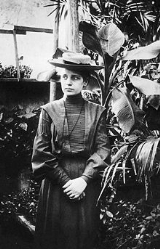
Lise Meitner (7 or 17 November 1878 – 27 October 1968) was an Austria
Austria

Austria , officially the Republic of Austria , is a landlocked country in Central Europe. It borders both Germany and the Czech Republic to the north, Slovakia and Hungary to the east, Slovenia and Italy to the south, and Switzerland and Liechtenstein to the west....
n-born, later Swedish
Sweden

Sweden , officially the Kingdom of Sweden , is a Nordic countries on the Scandinavian Peninsula in Northern Europe. Sweden has land borders with Norway to the west and Finland to the northeast, and it is connected to Denmark by the ?resund Bridge in the south....
 physicist
Physics

Physics is the natural science which examines basic concepts such as energy, force, and spacetime and all that derives from these, such as mass, charge, matter and its Motion ....
 who studied radioactivity and nuclear physics
Nuclear physics

Nuclear physics is the field of physics that studies the building blocks and interactions of atomic nuclei.The most commonly known applications of nuclear physics are nuclear power and nuclear weapons, but the research field is also the basis for a far wider range of applications, including in the medical sector , in materials engineering...
.

Biography
Lise Meitner was part of the team that discovered nuclear fission
Nuclear fission

In nuclear physics and nuclear chemistry, nuclear fission is a nuclear reaction in which the atomic nucleus of an atom splits into smaller parts, often producing free neutrons and lighter atomic nucleus, which may eventually produce photons ....
, an achievement for which her colleague Otto Hahn
Otto Hahn

Otto Hahn was a German chemist and Nobel laureate who pioneered the fields of radioactivity and radiochemistry. He is regarded as "the father of nuclear chemistry" and the "founder of the atomic age"....
 was awarded the Nobel Prize
Nobel Prize

The Nobel Prize , established in the 1895 will of Swedish chemist Alfred Nobel; it was first awarded in Nobel Prize in Physics, Nobel Prize in Chemistry, Nobel Prize in Physiology or Medicine, Nobel Prize in Literature, and Nobel Peace Prize in 1901....
. Meitner is often mentioned as one of the most glaring examples of scientific achievement overlooked by the Nobel committee.


Discussion
Ask a question about 'Lise Meitner'
Start a new discussion about 'Lise Meitner'
Answer questions from other users
Full Discussion Forum


Encyclopedia


Lise Meitner (7 or 17 November 1878 – 27 October 1968) was an Austria
Austria

Austria , officially the Republic of Austria , is a landlocked country in Central Europe. It borders both Germany and the Czech Republic to the north, Slovakia and Hungary to the east, Slovenia and Italy to the south, and Switzerland and Liechtenstein to the west....
n-born, later Swedish
Sweden

Sweden , officially the Kingdom of Sweden , is a Nordic countries on the Scandinavian Peninsula in Northern Europe. Sweden has land borders with Norway to the west and Finland to the northeast, and it is connected to Denmark by the ?resund Bridge in the south....
 physicist
Physics

Physics is the natural science which examines basic concepts such as energy, force, and spacetime and all that derives from these, such as mass, charge, matter and its Motion ....
 who studied radioactivity and nuclear physics
Nuclear physics

Nuclear physics is the field of physics that studies the building blocks and interactions of atomic nuclei.The most commonly known applications of nuclear physics are nuclear power and nuclear weapons, but the research field is also the basis for a far wider range of applications, including in the medical sector , in materials engineering...
.

Biography


Lise Meitner was part of the team that discovered nuclear fission
Nuclear fission

In nuclear physics and nuclear chemistry, nuclear fission is a nuclear reaction in which the atomic nucleus of an atom splits into smaller parts, often producing free neutrons and lighter atomic nucleus, which may eventually produce photons ....
, an achievement for which her colleague Otto Hahn
Otto Hahn

Otto Hahn was a German chemist and Nobel laureate who pioneered the fields of radioactivity and radiochemistry. He is regarded as "the father of nuclear chemistry" and the "founder of the atomic age"....
 was awarded the Nobel Prize
Nobel Prize

The Nobel Prize , established in the 1895 will of Swedish chemist Alfred Nobel; it was first awarded in Nobel Prize in Physics, Nobel Prize in Chemistry, Nobel Prize in Physiology or Medicine, Nobel Prize in Literature, and Nobel Peace Prize in 1901....
. Meitner is often mentioned as one of the most glaring examples of scientific achievement overlooked by the Nobel committee. A 1997 Physics Today study concluded that Meitner's omission was "a rare instance in which personal negative opinions apparently led to the exclusion of a deserving scientist" from the Nobel.

Early years

Lise Meitner was born into a Jew
Jew

A Jew is a member of the Jewish people, an ethnoreligious group that traces its ancestry to the Israelites or Hebrews of the Ancient Near East....
ish family as the third of eight children in Vienna
Vienna

Vienna is the Capital of Republic of Austria and also one of the nine states of Austria. Vienna is Austria's primary city, with a population of about 1.7 million...
, 2nd district (Leopoldstadt). Her father, Philipp Meitner
Philipp Meitner

Philipp Meitner was a lawyer and Austrian chess master.His the most famous game was the "Immortal Draw" . He won at Vienna 1875, and won a match against Adolf Schwarz at Vienna 1878....
, was one of the first Jewish lawyers in Austria. She was born on 7 November 1878. She shortened her name from Elise to Lise. The birth register of Vienna's Jewish community lists Meitner as being born on 17 November 1878, but all other documents list it as 7 November, which is what she used.

Meitner was the second woman to earn a doctoral degree
Doctor of Philosophy

Doctor of Philosophy, abbreviated Ph.D. or PhD for the Latin , meaning "teacher of philosophy", is an postgraduate academic degree awarded by University....
 in physics at the University of Vienna
University of Vienna

The University of Vienna is a public university located in Vienna, Austria. Having opened in 1365, it is one of the oldest universities in Europe....
. Women were not allowed to attend institutions of higher education in those days, but thanks to support from her parents, she was able to obtain private higher education, which she completed in 1901 ("externe Matura").

Scientific career

Inspired by her teacher, the physicist Ludwig Boltzmann
Ludwig Boltzmann

Ludwig Eduard Boltzmann was an Austrian physicist famous for his founding contributions in the fields of statistical mechanics and statistical thermodynamics....
, she studied physics and became the second woman to obtain a doctoral degree at the University of Vienna in 1905 ("Wärmeleitung im inhomogenen Körper"). Following the doctoral degree, she rejected an offer to work in a gas lamp factory. Encouraged by her father and backed by his financial support, she went to Berlin. Max Planck
Max Planck

Karl Ernst Ludwig Marx Planck, better known as Max Planck was a Germany physicist. He is considered to be the founder of the Quantum mechanics, and one of the most important physicists of the twentieth century....
 allowed her to attend his lectures, an unusual gesture by Planck, who until then had rejected any women wanting to attend his lectures. After one year, Meitner became Max Planck's assistant. During the first years she worked together with Otto Hahn and discovered with him several new isotopes. In 1909 she presented two papers on beta-radiation.

In 1912 the research group Hahn-Meitner moved to the newly founded Kaiser-Wilhelm-Institut(Emperor Wilhelm Institute - KWI)in Berlin-Dahlem, south west in Berlin. She worked without salary as a "guest" in Hahn's department of Radiochemistry. It was not until 1913, at 35 years old and following an offer to go to Prague as associate professor, that she got a permanent position at KWI.

In the first part of the First World War (WW I), she served as a nurse handling X-ray equipment. She returned to Berlin and her research in 1916, but not without inner struggle. She felt in a way ashamed of wanting to continue her research efforts when thinking about the pain and suffering of the victims of war and their medical and emotional needs.

In 1917, she and chemist Otto Hahn
Otto Hahn

Otto Hahn was a German chemist and Nobel laureate who pioneered the fields of radioactivity and radiochemistry. He is regarded as "the father of nuclear chemistry" and the "founder of the atomic age"....
 discovered the first long-lived isotope
Isotope

Isotopes are any of the different types of atoms of the same chemical element, each having a different atomic mass . Isotopes of an element have atomic nucleus with the same number of protons but different numbers of neutron....
 of the element protactinium
Protactinium

Protactinium is a chemical element with the symbol Pa and atomic number 91. Its longest-lived isotope has a half-life of 32,760 years....
. That year, Meitner was given her own physics section at the Kaiser Wilhelm Institute for Chemistry. In 1923, she discovered the cause, known as the Auger effect
Auger electron spectroscopy

Auger electron spectroscopy is a common analytical technique used specifically in the study of surface science and, more generally, in the area of materials science....
, of the emission from surfaces of electrons with 'signature' energies. The effect is named for Pierre Victor Auger
Pierre Victor Auger

Pierre Victor Auger was a French physicist, born in Paris. He worked in the fields of atomic physics, nuclear physics and cosmic ray physics....
, a French scientist who independently discovered the effect in 1925.

In 1930, Meitner taught a seminar on nuclear physics and chemistry with Leó Szilárd
Leó Szilárd

Le? Szil?rd was a Hungary-United States physicist who conceived the nuclear chain reaction and worked on the Manhattan Project. He was born in Budapest under the Austro-Hungarian Empire, and died in La Jolla, California, California....
. With the discovery of the neutron
Neutron

The neutron is a subatomic particle with no net electric charge and a mass slightly larger than that of a proton.Neutrons are usually found in atomic nucleus....
 in the early 1930s, speculation arose in the scientific community that it might be possible to create elements heavier than uranium
Uranium

Uranium is a silvery-gray metallic chemical element in the actinide series of the periodic table that has the chemical symbol U and atomic number 92....
 (atomic number 92) in the laboratory. A scientific race began between Ernest Rutherford
Ernest Rutherford

Ernest Rutherford, 1st Baron Rutherford of Nelson, Order of Merit , Royal Society was a New Zealand-born British chemist who became known as the father of nuclear physics....
 in Britain, Irene Joliot-Curie
Irène Joliot-Curie

Ir?ne Joliot-Curie was a French people scientist, the daughter of Marie Curie and Pierre Curie and the wife of Fr?d?ric Joliot-Curie. Jointly with her husband, Joliot-Curie was awarded the Nobel Prize for chemistry in 1935 for their discovery of artificial radioactivity....
 in France, Enrico Fermi
Enrico Fermi

Enrico Fermi was an Italian physicist most noted for his work on the development of the first nuclear reactor, and for his contributions to the development of Quantum mechanics, nuclear physics and particle physics, and statistical mechanics....
 in Italy, and the Meitner-Hahn team in Berlin. At the time, all concerned believed that this was abstract research for the probable honor of a Nobel prize. None suspected that this research would culminate in nuclear weapons.

When Adolf Hitler
Adolf Hitler

Adolf Hitler was an Austrian-born Germany politician and the leader of the National Socialist German Workers Party , popularly known as the Nazi Party....
 came to power in 1933, Meitner was acting director of the Institute for Chemistry. Although she was protected by her Austrian citizenship, all other Jewish scientists, including her nephew Otto Frisch, Fritz Haber
Fritz Haber

Fritz Haber was a German chemistry, who received the Nobel Prize in Chemistry in 1918 for his development for Haber process, important for fertilizers and explosives....
, Leó Szilárd
Leó Szilárd

Le? Szil?rd was a Hungary-United States physicist who conceived the nuclear chain reaction and worked on the Manhattan Project. He was born in Budapest under the Austro-Hungarian Empire, and died in La Jolla, California, California....
 and many other eminent figures, were dismissed or forced to resign from their posts. Most of them emigrated from Germany. Her response was to say nothing and bury herself in her work. In 1946 she acknowledged that "It was not only stupid but also very wrong that I did not leave at once." After the Anschluss
Anschluss

The ' , also known as the ', was the 1938 unification of Austria into Gro?deutschland by Nazi Germany.Austria was merged into Nazi Germany on 12 March 1938....
, her situation became desperate. In July 1938, Meitner, with help from the Dutch
Netherlands

The Netherlands is a country that is part of the Kingdom of the Netherlands. It is a parliamentary democratic constitutional monarchy. The Netherlands is located in North-West Europe, and bordered by the North Sea to the north and west, Belgium to the south, and Germany to the east....
 physicists Coster
Dirk Coster

Dirk Coster , was a Netherlands physicist. He was a Professor of Physics and Meteorology at the University of Groningen.Coster was born in Amsterdam....
 and Fokker, escaped to Holland. She was forced to travel under cover to the Dutch border, where Coster persuaded German immigration officers that she had permission to travel to the Netherlands. She reached safety, though without her possessions. Meitner later said that she left Germany forever with 10 marks in her purse. Before she left, Otto Hahn had given her a diamond
Diamond

In mineralogy, diamond is the Allotropes of carbon where the carbon atoms are arranged in an isometric-hexoctahedral crystal lattice. After graphite, diamond is the second most stable form of carbon....
 ring he had inherited from his mother: this was to be used to bribe the frontier guards if required. It was not required, and Meitner's nephew's wife later wore it. Meitner was lucky to escape, as Kurt Hess, a chemist who was an avid Nazi, had informed the authorities that she was about to flee. However, unknown friends only checked after they knew she was safe. An appointment at Groningen University did not come through, and she went instead to Stockholm
Stockholm

is the capital and largest city of Sweden. It is the site of the national Swedish Government of Sweden, the Parliament of Sweden, and the official residence of the Swedish Monarchy of Sweden....
, where she took up a post at Manne Siegbahn
Manne Siegbahn

Karl Manne Georg Siegbahn was a Sweden physicist, and Nobel Prize in Physics in physics for his discoveries and research in the field of X-ray spectroscopy....
's laboratory, despite the difficulty caused by Siegbahn's prejudice against women in science. Here she established a working relationship with Niels Bohr
Niels Bohr

Niels Henrik David Bohr was a Denmark physicist who made fundamental contributions to understanding atomic structure and quantum mechanics, for which he received the Nobel Prize in Physics in 1922....
, who travelled regularly between Copenhagen
Copenhagen

Copenhagen is the capital and largest city of Denmark, with an urban area with a population of 1,153,615 . Copenhagen is situated on the Islands of Zealand and Amager....
 and Stockholm. She continued to correspond with Hahn and other German scientists.

Hahn and Meitner met clandestinely in Copenhagen
Copenhagen

Copenhagen is the capital and largest city of Denmark, with an urban area with a population of 1,153,615 . Copenhagen is situated on the Islands of Zealand and Amager....
 in November to plan a new round of experiments; in this regard they subsequently exchanged a series of letters. Hahn then performed the difficult experiments which isolated the evidence for nuclear fission at his laboratory in Berlin. The surviving correspondence shows that Hahn recognized that fission was the only explanation for the barium, but, baffled by this remarkable conclusion, he wrote to Meitner. The possibility that uranium nuclei might break up under neutron bombardment had been suggested years before, notably by Ida Noddack
Ida Noddack

Ida Noddack , n?e Ida Tacke, was a German chemist and physicist. She was among the first physicists to propose nuclear fission. With her husband Walter Noddack she discovered element 75 rhenium....
 in 1934. However, by employing the existing "liquid-drop" model of the nucleus, Meitner and Frisch were the first to articulate a theory of how the nucleus of an atom could be split into smaller parts: uranium nuclei had split to form barium
Barium

Barium is a chemical element. It has the symbol Ba, and atomic number 56. Barium is a soft silvery metallic alkaline earth metal. It is never found in nature in its pure form due to its reactivity with Earth's atmosphere....
 and krypton
KRYPTON

KRYPTON is a frame language computer programming language."An Essential Hybrid Reasoning System: Knowledge and Symbol Level Accounts of KRYPTON", R.J. Brachman et al, Proc IJCAI-85, 1985....
, accompanied by the ejection of several neutrons and a large amount of energy (the latter two products accounting for the loss in mass). She and Frisch had discovered the reason that no stable elements beyond uranium (in atomic number) existed naturally; the electrical repulsion of so many protons overcame the "strong" nuclear force. Meitner also first realized that Einstein's famous equation, E = mc2, explained the source of the tremendous releases of energy seen in atomic decay, by the conversion of the mass-defect into energy.

A letter from Bohr, commenting on the fact that the amount of energy released when he bombarded uranium atoms was far larger than had been predicted by calculations based on a non-fissile core, had sparked the above inspiration in December 1938. Hahn claimed that his chemistry had been solely responsible for the discovery, although he had been unable to explain the results.

It was politically impossible for the exiled Meitner to publish jointly with Hahn in 1939. Otto Hahn
Otto Hahn

Otto Hahn was a German chemist and Nobel laureate who pioneered the fields of radioactivity and radiochemistry. He is regarded as "the father of nuclear chemistry" and the "founder of the atomic age"....
 and Fritz Strassmann
Fritz Strassmann

Friedrich Wilhelm "Fritz" Strassmann was a Germany chemistry who, with Otto Hahn in 1938, identified barium in the residue after bombarding uranium with neutrons, which led to the interpretation of their results as being from nuclear fission....
 had sent the manuscript of their paper to Naturwissenschaften
Die Naturwissenschaften

Die Naturwissenschaften is a weekly publication of the Max-Planck-Gesellschaft. The publication has the subtitle Wochenschrift f?r die Fortschritte der Naturwissenschaften, der Medizin und der Technik ....
 in December 1938, reporting they had detected the element barium
Barium

Barium is a chemical element. It has the symbol Ba, and atomic number 56. Barium is a soft silvery metallic alkaline earth metal. It is never found in nature in its pure form due to its reactivity with Earth's atmosphere....
 after bombarding uranium
Uranium

Uranium is a silvery-gray metallic chemical element in the actinide series of the periodic table that has the chemical symbol U and atomic number 92....
 with neutrons; simultaneously, they had communicated their results to Meitner in a letter. Meitner, and her nephew Otto Robert Frisch
Otto Robert Frisch

Otto Robert Frisch , Austrian-United Kingdom physicist. With his collaborator Rudolf Peierls he designed the first theoretical mechanism for the detonation of an atomic bomb in 1940....
, correctly interpreted their results as being nuclear fission
Nuclear fission

In nuclear physics and nuclear chemistry, nuclear fission is a nuclear reaction in which the atomic nucleus of an atom splits into smaller parts, often producing free neutrons and lighter atomic nucleus, which may eventually produce photons ....
. Frisch confirmed this experimentally on 13 January 1939.

Meitner recognized the possibility for a chain reaction
Nuclear chain reaction

A nuclear chain reaction occurs when one nuclear reaction causes an average of one or more nuclear reactions, thus leading to a self-propagating number of these reactions....
 of enormous explosive potential. This report had an electrifying effect on the scientific community. Because this could be used as a weapon, and since the knowledge was in German hands, Leó Szilárd, Edward Teller
Edward Teller

Edward Teller was a Jewish-Hungarian-American theoretical physics physicist, known colloquially as "the father of the hydrogen bomb", even though he claimed that he did not care for the title....
, and Eugene Wigner together jumped into action, persuading Albert Einstein, who had the celebrity, to write President Franklin D. Roosevelt
Franklin D. Roosevelt

Franklin Delano Roosevelt , often referred to by his initials FDR, was the List of Presidents of the United States President of the United States....
 a warning letter; this led directly to the establishment of the Manhattan Project
Manhattan Project

The Manhattan Project was the project to develop the first atomic weapon during World War II; involving the United States, the United Kingdom, and Canada....
. Meitner refused an offer to work on the project at Los Alamos
Los Alamos, New Mexico

Los Alamos is a townsite and census-designated place in Los Alamos County, New Mexico, New Mexico, United States. The population of the CDP was 11,909 at the United States Census, 2000....
, declaring "I will have nothing to do with a bomb!"

Einstein himself respected Meitner and called her "our Marie Curie
Marie Curie

Marie Sklodowska Curie was a physicist and chemist of Poland upbringing and, subsequently, France citizenship. She was a pioneer in the field of radioactivity, the first person honored with two Nobel Prizes, and the first female professor at the University of Paris....
."

Awards and honours


In 1944, Hahn received the Nobel Prize for Chemistry for the discovery of nuclear fission. Some historians who have documented the history of the discovery of nuclear fission believe Meitner should have been awarded the Nobel Prize with Hahn. In 1966 Hahn, Fritz Strassmann
Fritz Strassmann

Friedrich Wilhelm "Fritz" Strassmann was a Germany chemistry who, with Otto Hahn in 1938, identified barium in the residue after bombarding uranium with neutrons, which led to the interpretation of their results as being from nuclear fission....
 and Meitner together were awarded the Enrico Fermi Award
Enrico Fermi Award

The Enrico Fermi Award is an award honoring scientists of international stature for their lifetime achievement in the development, use, or production of energy....
. On a visit to the USA in 1946 she received American press celebrity treatment as someone who had "left Germany with the bomb in my purse." She was honoured as "Woman of the Year" by the National Women's Press Club (USA) in 1946, and received the Max Planck Medal
Max Planck medal

The Max Planck medal is an award for extraordinary achievements in theoretical physics. It is awarded annually by the Deutsche Physikalische Gesellschaft ....
 of the German Physics Society in 1949. Meitner was suggested to receive the prize three times. An even rarer honour was given to her in 1997 when element 109 was named meitnerium
Meitnerium

Meitnerium is a chemical element in the periodic table that has the symbol Mt and atomic number 109.Mt is a synthetic element whose most stable isotope, Mt-278, has a predicted half-life of a half-hour....
 in her honour.

Later years

After the war, Meitner, while acknowledging her own moral failing in staying in Germany from 1933 to 1938, was bitterly critical of Hahn and other German scientists who had collaborated with the Nazis and done nothing to protest against the crimes of Hitler's regime. Referring to the leading German scientist Werner Heisenberg
Werner Heisenberg

Werner Heisenberg was a German Theoretical physics who made foundational contributions to quantum mechanics and is best known for asserting the uncertainty principle of quantum theory....
, she said: "Heisenberg and many millions with him should be forced to see these camps and the martyred people." She wrote to Hahn:
"You all worked for Nazi Germany. And you tried to offer only a passive resistance. Certainly, to buy off your conscience you helped here and there a persecuted person, but millions of innocent human beings were allowed to be murdered without any kind of protest being uttered ... [it is said that] first you betrayed your friends, then your children in that you let them stake their lives on a criminal war – and finally that you betrayed Germany itself, because when the war was already quite hopeless, you did not once arm yourselves against the senseless destruction of Germany."


Meitner and Hahn were lifelong friends, see: L. Meitner: Erinnerungen an Otto Hahn, hg. v. D. Hahn (2005)

Meitner became a Swedish citizen in 1949, but moved to Britain
United Kingdom

The United Kingdom of Great Britain and Northern Ireland, commonly known as the United Kingdom , the UK or Britain,is a sovereign state located off the northwestern coast of continental Europe....
 in 1960 and died in Cambridge
Cambridge

The city status in the United Kingdom of Cambridge is a College town and the administrative centre of the county of Cambridgeshire, England. It lies about 50 miles north of London....
 in 1968, shortly before her 90th birthday. As was her wish, she was buried in the village of Bramley
Bramley, Hampshire

Bramley is a village and Civil parish in Hampshire, United Kingdom. In the United Kingdom Census 2001 it had a population of 3,348. It has a village shop, bakers, estate agents, pub and a Bramley railway station....
 in Hampshire
Hampshire

Hampshire , sometimes historically Southamptonshire, Hamptonshire, , or the County of Southampton, is a Counties of England on the south coast of England....
, at St. James parish church, close to her younger brother Walter, who had died in 1964. Her nephew Otto Robert Frisch
Otto Robert Frisch

Otto Robert Frisch , Austrian-United Kingdom physicist. With his collaborator Rudolf Peierls he designed the first theoretical mechanism for the detonation of an atomic bomb in 1940....
 composed the inscription on her headstone. It reads "Lise Meitner: a physicist who never lost her humanity."


Popular culture

Besides the element named in her honor, there have been other mentions in popular culture:

  • In episode S01E09
    List of Eureka episodes

    The following is a list of episodes for the United States science fiction drama Eureka . In addition to the regularly televised episodes, there is a short webisode series called "Hide and Seek", which is available on the Sci Fi Channel 's Eureka homepage....
     of Eureka
    Eureka (TV series)

    Eureka is an United States science fiction television series set in a town inhabited almost entirely by geniuses. In the United Kingdom, it is known as A Town Called Eureka....
    , the high school holds an annual dance that honors Lise Meitner, and says that Eureka strives to follow her ideals.
  • According to the psychologist David Keirsey
    David Keirsey

    David West Keirsey , is an internationally renowned psychologist, a professor emeritus at California State University, Fullerton, and the author of several books....
    , she was an .


Further reading

  • Sime, Ruth Lewin (2006) "Lise Meitner" in , Nina Byers and Gary Williams, ed., Cambridge University Press.
  • Sime, Ruth Lewin From Exceptional Prominence to Prominent Exception: Lise Meitner at the Kaiser Wilhelm Institute for Chemistry Forschungsprogramm Geschichte der Kaiser-Wilhelm-Gesellschaft im Nationalsozialismus (2005).


See also


  • List of Austrian scientists
    List of Austrian scientists

    This is a list of Austrian scientists and scientists from the Austria of Austria-Hungary....
  • Meitnerium
    Meitnerium

    Meitnerium is a chemical element in the periodic table that has the symbol Mt and atomic number 109.Mt is a synthetic element whose most stable isotope, Mt-278, has a predicted half-life of a half-hour....
  • Hans-Hermann Hupfeld
    Hans-Hermann Hupfeld

    Gustav Theodor Hans Hermann Hupfeld was a Germany physicist known for his work on the scattering of gamma rays....


External links

  • "Lise Meitner" in