


Le Marais

Encyclopedia
-
-
- For other meanings, see Marais (disambiguation).
-

Paris
Paris is the capital and largest city in France, situated on the river Seine, in northern France, at the heart of the Île-de-France region...
, France
France
The French Republic , The French Republic , The French Republic , (commonly known as France , is a unitary semi-presidential republic in Western Europe with several overseas territories and islands located on other continents and in the Indian, Pacific, and Atlantic oceans. Metropolitan France...
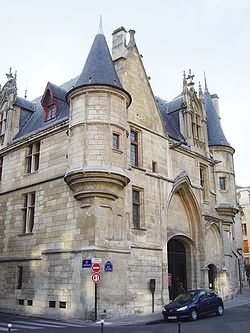
. Long the aristocratic district of Paris, it hosts many outstanding buildings of historic and architectural importance. It spreads across parts of the 3rd
IIIe arrondissement
The 3rd arrondissement of Paris, situated on the right bank of the River Seine, is the second smallest in area after the 2nd arrondissement. The arrondissement contains the northern, quieter part of the medieval district of Le Marais...
and 4th
IVe arrondissement
The 4th arrondissement of Paris is one of the 20 arrondissements of the capital city of France.Situated on the Right Bank of the River Seine, it is bordered to the west by the 1st arrondissement; to the north by the 3rd, to the east by the 11th and 12th, and to the south by the Seine and the...
arrondissement
Arrondissements of Paris
The city of Paris is divided into twenty arrondissements municipaux administrative districts, more simply referred to as arrondissements . These are not to be confused with departmental arrondissements, which subdivide the 101 French départements...
s in Paris (on the Rive Droite
Rive Droite
La Rive Droite is most associated with the river Seine in central Paris. Here the river flows roughly westwards, cutting the city into two: looking downstream, the northern bank is to the right, and the southern bank is to the left....
, or Right Bank, of the Seine
Seine
The Seine is a -long river and an important commercial waterway within the Paris Basin in the north of France. It rises at Saint-Seine near Dijon in northeastern France in the Langres plateau, flowing through Paris and into the English Channel at Le Havre . It is navigable by ocean-going vessels...
).
Paris aristocratic district
In 1240 the Order of the Temple built its fortified church just outside Paris' walls, in the northern part of the Marais. The Temple turned the district into an attractive area, and many religious institutions were built nearby: the des Blancs-Manteaux, de Sainte-Croix-de-la-Bretonnerie and des Carmes-Billettes conventConvent
A convent is either a community of priests, religious brothers, religious sisters, or nuns, or the building used by the community, particularly in the Roman Catholic Church and in the Anglican Communion...
s, as well as the church of Sainte-Catherine-du-Val-des-Écoliers.
During the mid-13th century, Charles I of Anjou, King of Naples
Naples
Naples is a city in Southern Italy, situated on the country's west coast by the Gulf of Naples. Lying between two notable volcanic regions, Mount Vesuvius and the Phlegraean Fields, it is the capital of the region of Campania and of the province of Naples...
and Sicily
Sicily
Sicily is a region of Italy, and is the largest island in the Mediterranean Sea. Along with the surrounding minor islands, it constitutes an autonomous region of Italy, the Regione Autonoma Siciliana Sicily has a rich and unique culture, especially with regard to the arts, music, literature,...
, and brother of King Louis IX of France
Louis IX of France
Louis IX , commonly Saint Louis, was King of France from 1226 until his death. He was also styled Louis II, Count of Artois from 1226 to 1237. Born at Poissy, near Paris, he was an eighth-generation descendant of Hugh Capet, and thus a member of the House of Capet, and the son of Louis VIII and...
built his residence near the current n°7 rue de Sévigné. In 1361 the King Charles V
Charles V of France
Charles V , called the Wise, was King of France from 1364 to his death in 1380 and a member of the House of Valois...
built a mansion known as the Hôtel Saint-Pol in which the Royal Court settled during his reign as well as his son's.
From that time to the 17th century and especially after the Royal Square (Place Royale, current place des Vosges
Place des Vosges
The Place des Vosges is the oldest planned square in Paris.It is located in the Marais district, and it straddles the dividing-line between the 3rd and 4th arrondissements of Paris.- History :...
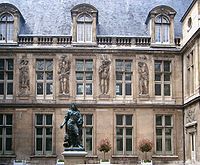
) was designed under King Henri IV in 1605, the Marais was the French nobility's favorite place of residence. French nobles built their urban mansions there such as the Hôtel de Sens
Hôtel de Sens
The Hôtel de Sens is a city palace in the Marais, in the IVe arrondissement of Paris, France.It was originally owned by the archbishops of Sens. The building is in between late Gothic and early Renaissance style, and now houses the Forney art library. This mansion is one of three medieval private...
, the Hôtel de Sully
Hôtel de Sully
The Hôtel de Sully is a hôtel particulier, or private mansion, in the Louis XIII style, located in the Le Marais, IV arondissement, Paris. It is located at 62 rue Saint-Antoine.-History:...
, the Hôtel de Beauvais
Hôtel de Beauvais
The Hôtel de Beauvais is a hôtel particulier located in Paris in the 4th arrondissement at 68 rue Francois-Miron . It was built by the royal architect Antoine Le Pautre for Catherine Beauvais in 1657...
, the Hôtel Carnavalet, the Hôtel de Guénégaud
Hôtel de Guénégaud
-3rd arrondissement:At 60, rue des Archives, this Hôtel de Guénégaud was built between 1651 and 1655 for Jean-François de Guénégaud des Brosses, secrétaire du Roi, maître des Comptes and conseiller d'État, by François Mansart . It now houses the Musée de la Chasse et de la Nature and the Club de la...
, and the Hôtel de Soubise
Hôtel de Soubise
The Hôtel de Soubise is a city mansion entre cour et jardin , located at 60 rue des Francs-Bourgeois, in the IIIe arrondissement of Paris....
.
Jewish community
Faubourg Saint-Germain
The Faubourg Saint Germain is an historic district of Paris. The Faubourg has long been known as the favorite home of the French high nobility and hosts many aristocratic Hôtels particuliers...
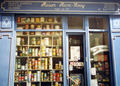
, the district became a popular and active commercial area, hosting one of Paris' main Jewish communities.
At the end of the 19th century and during the first half of the 20th, the district around the rue des Rosiers
Rue des Rosiers
The Rue des Rosiers, which means "street of the rosebushes", is a street in the 4th arrondissement of Paris, France. It begins at the Rue Mahler and proceeds west-northwestward across the Rue Pavée, the Rue Ferdinand Duval, the Rue des Écouffes, and the Rue des Hospitalières-Saint-Gervais, before...
, refers to as the"Pletzl
Pletzl
The Pletzl is the Jewish quarter in the fourth arrondissement of Paris, France. The Place Saint-Paul and the surrounding area were, unofficially, named the Pletzl when the neighborhood became predominantly Jewish because of an influx of immigrants at the end of the nineteenth century and the...
", welcomed many Eastern European Jews (Ashkenazi) who reinforced the district clothing specialization. But, during World War II the Jewish community was targeted by the Nazis who were occupying France.
The rue des Rosiers
Rue des Rosiers
The Rue des Rosiers, which means "street of the rosebushes", is a street in the 4th arrondissement of Paris, France. It begins at the Rue Mahler and proceeds west-northwestward across the Rue Pavée, the Rue Ferdinand Duval, the Rue des Écouffes, and the Rue des Hospitalières-Saint-Gervais, before...
is still a major centre of the Paris Jewish community, which has made a renewal since the 1990s. Public notices announce Jewish events, bookshops specialize in Jewish books, and numerous restaurants and other outlets sell kosher food.
The synagogue
Agoudas Hakehilos Synagogue
The Agoudas Hakehilos synagogue , at 10 rue Pavée, in the IVe arrondissement of Paris , commonly referred to at the Pavee synagogue, rue Pavee synagogue, or Guimard synagogue, was erected in 1913 by the architect Hector Guimard, and inaugurated on June 7, 1914.This synagogue was commissioned by the...
on 10 rue Pavée, not far from rue des Rosiers
Rue des Rosiers
The Rue des Rosiers, which means "street of the rosebushes", is a street in the 4th arrondissement of Paris, France. It begins at the Rue Mahler and proceeds west-northwestward across the Rue Pavée, the Rue Ferdinand Duval, the Rue des Écouffes, and the Rue des Hospitalières-Saint-Gervais, before...
, is a strong religious centre. It was designed in 1913 by Art Nouveau architect Hector Guimard
Hector Guimard
Hector Guimard was an architect, who is now the best-known representative of the French Art Nouveau style of the late nineteenth and early twentieth centuries....
, famous for having designed several Paris Metro
Paris Métro
The Paris Métro or Métropolitain is the rapid transit metro system in Paris, France. It has become a symbol of the city, noted for its density within the city limits and its uniform architecture influenced by Art Nouveau. The network's sixteen lines are mostly underground and run to 214 km ...
stations.
Post-War Rehabilitation
By the 1950s, the district had become a working-class area and most of its architectural masterpieces were in bad state of repair. In 1964, General de Gaulle's Culture Minister Andre MalrauxAndré Malraux
André Malraux DSO was a French adventurer, award-winning author, and statesman. Having traveled extensively in Indochina and China, Malraux was noted especially for his novel entitled La Condition Humaine , which won the Prix Goncourt...
made the Marais the first secteur sauvegardé (Literally secured area). These were meant to protect and conserve places of special cultural significance. The following decades, the government and the Parisian municipality have led an active restoration and Rehabilitation Policy
Rehabilitation Policy
Rehabilitation policies are those that intend to reform criminal offenders rather than punish them or segregate them from the greater community.-History:...
.
The main Hôtels particuliers have been restored and turned into museums: the Hôtel Salé hosts the Picasso Museum, the Hôtel Carnavalet hosts the Paris Historical Museum, the Hôtel Donon hosts the Cognac-Jay Museum etc. The site of Beaubourg, the western part of Marais, was chosen for the Centre Georges Pompidou
Centre Georges Pompidou
Centre Georges Pompidou is a complex in the Beaubourg area of the 4th arrondissement of Paris, near Les Halles, rue Montorgueil and the Marais...
, France's national Museum of Modern Art and one of the world's most important cultural institutions. The building was completed in 1977 with revolutionary architecture by Renzo Piano
Renzo Piano
Renzo Piano is an Italian architect. He is the recipient of the Pritzker Architecture Prize, AIA Gold Medal, Kyoto Prize and the Sonning Prize...
and Richard Rogers
Richard Rogers
Richard George Rogers, Baron Rogers of Riverside CH Kt FRIBA FCSD is a British architect noted for his modernist and functionalist designs....
.
Today's Marais
The neighbourhood has experienced a growing gay
Gay
Gay is a word that refers to a homosexual person, especially a homosexual male. For homosexual women the specific term is "lesbian"....
presence since the 1980s, as evidenced by the existence of many gay cafés, nightclubs, cabarets and shops. These establishments are mainly concentrated in the southwestern portion of the Marais, many on or near the streets Sainte-Croix de la Bretonnerie and Rue des Archives.
The Marais is also known for the strong Chinese community it hosts. The community began during World War I
World War I
World War I , which was predominantly called the World War or the Great War from its occurrence until 1939, and the First World War or World War I thereafter, was a major war centred in Europe that began on 28 July 1914 and lasted until 11 November 1918...
. At that time, France needed workers to replace its at-war soldiers and China decided to send a few thousands of its citizens on the condition that they would not take part of the war. After the 1918's victory, some of them decided to stay in Paris, specifically living around the current rue au Maire. Today, most work in jewelery and leather-related products. The Marais' Chinese community has settled in the north of the district, particularly in the surrounding of Place de la République
Place de la République
The Place de la République is a square in Paris, located on the border between the 3rd, 10th and 11th arrondissements. It is named after the French Republic. The Métro station of République lies beneath the square.-History:...
. Right next to it, on the rue du Temple, is the Chinese Church of Paris.
Other features of the neighbourhood include the Musée Picasso
Musée Picasso
The Musée Picasso is an art gallery located in the Hôtel Salé in rue de Thorigny, in the Marais district of Paris dedicated to the work of the artist Pablo Picasso .-Building:...
, the house of Nicolas Flamel, the Musée Cognacq-Jay
Musée Cognacq-Jay
The Musée Cognacq-Jay is a museum located in the Hôtel Donon in the 3rd arrondissement at 8 rue Elzévir, Paris, France. It is open daily except Monday; admission is free...
, the Musée Carnavalet and the new and very popular Café Charlot.
Notable residents
- Maximilien de Béthune, duc de SullyMaximilien de Béthune, duc de SullyMaximilien de Béthune, first Duke of Sully was the doughty soldier, French minister, staunch Huguenot and faithful right-hand man who assisted Henry IV of France in the rule of France.-Early years:...
- Urbain de Maillé-BrézéUrbain de Maillé-BrézéUrbain de Maillé-Brézé , was a Marshal of France during the Thirty Years' War and Franco-Spanish War .- Biography :...
- Armand de Vignerot du Plessis
- Princes of Rohan SoubiseRohan (family)The House of Rohan is a family of viscounts, later dukes and princes, coming from the locality of Rohan in Brittany. Their line descends from the viscounts of Porhoët and said to trace back to the legendary Conan Meriadoc. Through the Porhoët, the Rohan are related to the Dukes of Brittany, with...
- Catherine de Vivonne, marquise de RambouilletCatherine de Vivonne, marquise de RambouilletCatherine de Vivonne, marquise de Rambouillet , known as Madame de Rambouillet, was a society hostess and a major figure in the literary history of 17th-century France.-Biography:...
- Marie de Rabutin-Chantal, marquise de SévignéMarie de Rabutin-Chantal, marquise de SévignéMarie de Rabutin-Chantal, marquise de Sévigné was a French aristocrat, remembered for her letter-writing. Most of her letters, celebrated for their wit and vividness, were addressed to her daughter.-Life:...
- Maximilien RobespierreMaximilien RobespierreMaximilien François Marie Isidore de Robespierre is one of the best-known and most influential figures of the French Revolution. He largely dominated the Committee of Public Safety and was instrumental in the period of the Revolution commonly known as the Reign of Terror, which ended with his...
- Victor HugoVictor HugoVictor-Marie Hugo was a Frenchpoet, playwright, novelist, essayist, visual artist, statesman, human rights activist and exponent of the Romantic movement in France....
- Ellen Mary Howells and Chloe Anna Julius
- John GallianoJohn GallianoJohn Charles Galliano CBE, RDI is a Gibraltan-born British fashion designer who was best known as head designer of French haute couture houses Givenchy and Christian Dior , and his own self titled fashion house.-Family:He was born in Gibraltar to a Gibraltarian father, Juan Galliano, and a...
Places and monuments of note
- Church Saint-Merri
- Church Notre-Dame-des-Blancs-Manteaux
- Hôtel de SensHôtel de SensThe Hôtel de Sens is a city palace in the Marais, in the IVe arrondissement of Paris, France.It was originally owned by the archbishops of Sens. The building is in between late Gothic and early Renaissance style, and now houses the Forney art library. This mansion is one of three medieval private...
- Place des VosgesPlace des VosgesThe Place des Vosges is the oldest planned square in Paris.It is located in the Marais district, and it straddles the dividing-line between the 3rd and 4th arrondissements of Paris.- History :...
, including the home of Victor HugoVictor HugoVictor-Marie Hugo was a Frenchpoet, playwright, novelist, essayist, visual artist, statesman, human rights activist and exponent of the Romantic movement in France....
and café Ma BourgogneMa BourgogneMa Bourgogne is a café in Place des Vosges in the Le Marais district of Paris. It is on the North-West point and is a café in the traditional French style. It has been around for many years and it has been spoken of as one of the best Cafes in Paris.... - Musée Cognacq-JayMusée Cognacq-JayThe Musée Cognacq-Jay is a museum located in the Hôtel Donon in the 3rd arrondissement at 8 rue Elzévir, Paris, France. It is open daily except Monday; admission is free...
- Musée PicassoMusée PicassoThe Musée Picasso is an art gallery located in the Hôtel Salé in rue de Thorigny, in the Marais district of Paris dedicated to the work of the artist Pablo Picasso .-Building:...
- National ArchivesArchives nationales (France)The Archives nationales preserve the national archives of the French state, apart from the archives of the Ministry of Defence and the Ministry of Foreign Affairs, as these two ministries have their own archive services, the Service historique de la défense and the Archives diplomatiques...
, including the Hôtel de SoubiseHôtel de SoubiseThe Hôtel de Soubise is a city mansion entre cour et jardin , located at 60 rue des Francs-Bourgeois, in the IIIe arrondissement of Paris....
and the Hôtel de Rohan - Carnavalet MuseumCarnavalet MuseumThe Carnavalet Museum in Paris is dedicated to the history of the city. The museum occupies two neighboring mansions: the Hôtel Carnavalet and the former Hôtel Le Peletier de Saint Fargeau...
- Hôtel de SullyHôtel de SullyThe Hôtel de Sully is a hôtel particulier, or private mansion, in the Louis XIII style, located in the Le Marais, IV arondissement, Paris. It is located at 62 rue Saint-Antoine.-History:...
- PletzlPletzlThe Pletzl is the Jewish quarter in the fourth arrondissement of Paris, France. The Place Saint-Paul and the surrounding area were, unofficially, named the Pletzl when the neighborhood became predominantly Jewish because of an influx of immigrants at the end of the nineteenth century and the...
, the Jewish quarter
External links
- Magical Marais: Place des Vosges, rue du Bourg-Tibourg, etc. Tour the neighbourhood in photographies and descriptions
- Le Marais
- Le Marais: The Indifferent Ghetto Article about Le Marais as the gay neighbourhood of Paris.
- Gay Paris: English speaking gay walks in Paris
- ParisMarais.com: the official guide, partner of the Paris Tourist Office
- Le Marais photos
- Marais district Photographs