

Arrondissements of Paris

Encyclopedia
The city of Paris
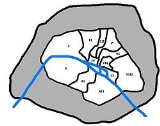
is divided into twenty arrondissements municipaux
administrative districts, more simply referred to as arrondissements ' onMouseout='HidePop("34233")' href="/topics/French_language">French
). These are not to be confused with departmental arrondissements
, which subdivide the 101 French départements. The word "arrondissement", when applied to Paris, refers almost always to the municipal arrondissements listed below.
The number of the arrondissement is indicated by the last two digits in most Parisian postal codes (75001 up to 75020).
spiral
, starting in the middle of the city, with the first on the Right Bank
(north bank) of the Seine
. The French cities of Lyon
and Marseille
are also subdivided in this way.
The list below indicates Right Bank
(R) or Left Bank
(L) (the islands Île de la Cité
and Île Saint-Louis
being in the 4e, and partly the 1er, arrondissements):
In French, notably on street signs - the number is often given in Roman numerals for example the Eiffel tower
is in the VIIe Arrondissment while Gare de l'est is in the Xe Arrondissment
Notes:
1. With the Bois de Vincennes
2. Without the Bois de Vincennes
3. With the Bois de Boulogne
4. Without the Bois de Boulogne
5. 2005 is the year of the most recent official estimate; population of these arrondissements may still be growing
Each arrondissement is subdivided administratively into four quartiers. Paris thus has eighty quartiers administratifs, each containing a police station. For a table giving the names of the eighty quartiers, see :fr:Quartiers administratifs de Paris.
 On 11 October 1795, Paris was divided into twelve arrondissements. They were numbered from west to east, with numbers 1-9 situated on the Right Bank of the Seine
, and 10-12 on the Left Bank.
Each arrondissement was subdivided into four quartiers, which corresponded to the 48 original districts created in 1790.
by Napoleon III
. The previous twelve arrondissements were rearranged with this new territory to become the present twenty.
In references to historical records (where it is important to distinguish between the old and new systems), the old arrondissements are indicated by following the number with the term ancienne ("old") (e.g. 2ème ancienne or 7ème anc.).
Paris
Paris is the capital and largest city in France, situated on the river Seine, in northern France, at the heart of the Île-de-France region...
is divided into twenty arrondissements municipaux
Municipal arrondissements of France
The municipal arrondissement is a subdivision of the commune, used in the three largest cities: Paris, Lyon and Marseille. It functions as an even lower administrative division, with its own mayor...
administrative districts, more simply referred to as arrondissements ' onMouseout='HidePop("34233")' href="/topics/French_language">French
French language
French is a Romance language spoken as a first language in France, the Romandy region in Switzerland, Wallonia and Brussels in Belgium, Monaco, the regions of Quebec and Acadia in Canada, and by various communities elsewhere. Second-language speakers of French are distributed throughout many parts...
). These are not to be confused with departmental arrondissements
Arrondissements of France
The 101 French departments are divided into 342 arrondissements, which may be translated into English as districts.The capital of an arrondissement/district is called a subprefecture...
, which subdivide the 101 French départements. The word "arrondissement", when applied to Paris, refers almost always to the municipal arrondissements listed below.
The number of the arrondissement is indicated by the last two digits in most Parisian postal codes (75001 up to 75020).
Description
The twenty arrondissements are arranged in the form of a clockwiseClockwise
Circular motion can occur in two possible directions. A clockwise motion is one that proceeds in the same direction as a clock's hands: from the top to the right, then down and then to the left, and back to the top...
spiral
Spiral
In mathematics, a spiral is a curve which emanates from a central point, getting progressively farther away as it revolves around the point.-Spiral or helix:...
, starting in the middle of the city, with the first on the Right Bank
Rive Droite
La Rive Droite is most associated with the river Seine in central Paris. Here the river flows roughly westwards, cutting the city into two: looking downstream, the northern bank is to the right, and the southern bank is to the left....
(north bank) of the Seine
Seine
The Seine is a -long river and an important commercial waterway within the Paris Basin in the north of France. It rises at Saint-Seine near Dijon in northeastern France in the Langres plateau, flowing through Paris and into the English Channel at Le Havre . It is navigable by ocean-going vessels...
. The French cities of Lyon
Lyon
Lyon , is a city in east-central France in the Rhône-Alpes region, situated between Paris and Marseille. Lyon is located at from Paris, from Marseille, from Geneva, from Turin, and from Barcelona. The residents of the city are called Lyonnais....
and Marseille
Marseille
Marseille , known in antiquity as Massalia , is the second largest city in France, after Paris, with a population of 852,395 within its administrative limits on a land area of . The urban area of Marseille extends beyond the city limits with a population of over 1,420,000 on an area of...
are also subdivided in this way.
The list below indicates Right Bank
Rive Droite
La Rive Droite is most associated with the river Seine in central Paris. Here the river flows roughly westwards, cutting the city into two: looking downstream, the northern bank is to the right, and the southern bank is to the left....
(R) or Left Bank
Rive Gauche
La Rive Gauche is the southern bank of the river Seine in Paris. Here the river flows roughly westward, cutting the city in two: looking downstream, the southern bank is to the left, and the northern bank is to the right....
(L) (the islands Île de la Cité
Île de la Cité
The Île de la Cité is one of two remaining natural islands in the Seine within the city of Paris . It is the centre of Paris and the location where the medieval city was refounded....
and Île Saint-Louis
Île Saint-Louis
The Île Saint-Louis is one of two natural islands in the Seine river, in Paris, France . The island is named after King Louis IX of France ....
being in the 4e, and partly the 1er, arrondissements):
In French, notably on street signs - the number is often given in Roman numerals for example the Eiffel tower
Eiffel Tower
The Eiffel Tower is a puddle iron lattice tower located on the Champ de Mars in Paris. Built in 1889, it has become both a global icon of France and one of the most recognizable structures in the world...
is in the VIIe Arrondissment while Gare de l'est is in the Xe Arrondissment
| Arrondissement | Name | Area (in km²) | Population (March 1999 census) |
Population (July 2005 estimate) |
Density (2005) (inh. per km²) |
Peak of population |
|---|---|---|---|---|---|---|
| 1st R | Louvre | 1.826 | 16,888 | 17,700 | 9,693 | before 1861 |
| 2nd R | Bourse | 0.992 | 19,585 | 20,700 | 20,867 | before 1861 |
| 3rd R | Temple | 1.171 | 34,248 | 35,100 | 29,974 | before 1861 |
| 4th R | Hôtel-de-Ville | 1.601 | 30,675 | 28,600 | 17,864 | before 1861 |
| 5th L | Panthéon | 2.541 | 58,849 | 60,600 | 23,849 | 1911 |
| 6th L | Luxembourg | 2.154 | 44,919 | 45,200 | 20,984 | 1911 |
| 7th L | Palais-Bourbon | 4.088 | 56,985 | 55,400 | 13,552 | 1926 |
| 8th R | Élysée | 3.881 | 39,314 | 38,700 | 9,972 | 1891 |
| 9th R | Opéra | 2.179 | 55,838 | 58,500 | 26,847 | 1901 |
| 10th R | Enclos-St-Laurent | 2.892 | 89,612 | 88,800 | 30,705 | 1881 |
| 11th R | Popincourt | 3.666 | 149,102 | 152,500 | 41,598 | 1911 |
| 12th R | Reuilly | 16.324¹ 6.377² |
136,591 | 138,300 | 21,687² | 1962 |
| 13th L | Gobelins | 7.146 | 171,533 | 181,300 | 25,371 | 20055 |
| 14th L | Observatoire | 5.621 | 132,844 | 134,700 | 23,964 | 1954 |
| 15th L | Vaugirard | 8.502 | 225,362 | 232,400 | 27,335 | 1962 |
| 16th R | Passy | 16.305³ 7.8464 |
161,773 | 149,500 | 19,0544 | 1962 |
| 17th R | Batignolles-Monceau | 5.669 | 160,860 | 160,300 | 28,277 | 1954 |
| 18th R | Butte-Montmartre | 6.005 | 184,586 | 188,700 | 31,424 | 1931 |
| 19th R | Buttes-Chaumont | 6.786 | 172,730 | 187,200 | 27,586 | 20055 |
| 20th R | Ménilmontant | 5.984 | 182,952 | 191,800 | 32,052 | 1936 |
Notes:
1. With the Bois de Vincennes
Bois de Vincennes
The Bois de Vincennes is a park in the English landscape manner to the east of Paris. The park is named after the nearby town of Vincennes....
2. Without the Bois de Vincennes
3. With the Bois de Boulogne
Bois de Boulogne
The Bois de Boulogne is a park located along the western edge of the 16th arrondissement of Paris, near the suburb of Boulogne-Billancourt and Neuilly-sur-Seine...
4. Without the Bois de Boulogne
5. 2005 is the year of the most recent official estimate; population of these arrondissements may still be growing
Each arrondissement is subdivided administratively into four quartiers. Paris thus has eighty quartiers administratifs, each containing a police station. For a table giving the names of the eighty quartiers, see :fr:Quartiers administratifs de Paris.
Before 1860
Seine
The Seine is a -long river and an important commercial waterway within the Paris Basin in the north of France. It rises at Saint-Seine near Dijon in northeastern France in the Langres plateau, flowing through Paris and into the English Channel at Le Havre . It is navigable by ocean-going vessels...
, and 10-12 on the Left Bank.
Each arrondissement was subdivided into four quartiers, which corresponded to the 48 original districts created in 1790.
After 1860
On 1 January 1860, new territory was defined to be within the cityCity
A city is a relatively large and permanent settlement. Although there is no agreement on how a city is distinguished from a town within general English language meanings, many cities have a particular administrative, legal, or historical status based on local law.For example, in the U.S...
by Napoleon III
Napoleon III of France
Louis-Napoléon Bonaparte was the President of the French Second Republic and as Napoleon III, the ruler of the Second French Empire. He was the nephew and heir of Napoleon I, christened as Charles Louis Napoléon Bonaparte...
. The previous twelve arrondissements were rearranged with this new territory to become the present twenty.
In references to historical records (where it is important to distinguish between the old and new systems), the old arrondissements are indicated by following the number with the term ancienne ("old") (e.g. 2ème ancienne or 7ème anc.).
See also
- ArrondissementArrondissementArrondissement is any of various administrative divisions of France, certain other Francophone countries, and the Netherlands.-France:The 101 French departments are divided into 342 arrondissements, which may be translated into English as districts. The capital of an arrondissement is called a...
, for other uses of the term. - Paris districtsParis districtsMost of the Paris we see today is a result of a nineteenth-century renovation, but its boulevards and arrondissements were but a new grid bisecting quarters built by centuries of Parisian habit; as a result of this, Paris has many quarters that are not necessarily mentioned on any administrative...
- Paris, je t'aimeParis, je t'aimeParis, Je t'aime is a 2006 anthology film starring an ensemble cast of actors of various nationalities. The two-hour film consists of eighteen short films set in different arrondissements...
, film composed of five-minute sequences on each arrondissement