


Le Bourgeois Gentilhomme

Encyclopedia
Comédie-ballet
Comédie-ballet is a genre of French drama which mixes a spoken play with interludes containing music and dance.-History:The first example of the genre is considered to be Les fâcheux, with words by Molière, performed in honour of Louis XIV at Vaux-le-Vicomte, the residence of Nicolas Fouquet, in...
—a play
Play (theatre)
A play is a form of literature written by a playwright, usually consisting of scripted dialogue between characters, intended for theatrical performance rather than just reading. There are rare dramatists, notably George Bernard Shaw, who have had little preference whether their plays were performed...
intermingled with music, dance and singing—by Molière
Molière
Jean-Baptiste Poquelin, known by his stage name Molière, was a French playwright and actor who is considered to be one of the greatest masters of comedy in Western literature...
, first presented on 14 October 1670 before the court of Louis XIV at the Château of Chambord by Molière's troupe of actors. The music was composed by Jean-Baptiste Lully
Jean-Baptiste Lully
Jean-Baptiste de Lully was an Italian-born French composer who spent most of his life working in the court of Louis XIV of France. He is considered the chief master of the French Baroque style. Lully disavowed any Italian influence in French music of the period. He became a French subject in...
, the choreography was by Pierre Beauchamp
Pierre Beauchamp
Pierre Beauchamp was a French choreographer, dancer and composer, and the probable inventor of Beauchamp-Feuillet notation.-Biography:...
, the sets were by Carlo Vigarani and the costumes were done by the chevalier d’Arvieux.
Le Bourgeois gentilhomme satirizes attempts at social climbing and the bourgeois personality, poking fun both at the vulgar, pretentious middle-class and the vain, snobbish aristocracy
Aristocracy
Aristocracy , is a form of government in which a few elite citizens rule. The term derives from the Greek aristokratia, meaning "rule of the best". In origin in Ancient Greece, it was conceived of as rule by the best qualified citizens, and contrasted with monarchy...
. The title is meant as an oxymoron
Oxymoron
An oxymoron is a figure of speech that combines contradictory terms...
: in Molière's France, a "gentleman" was by definition nobly born, and thus there could be no such thing as a bourgeois gentleman. The play is in prose
Prose
Prose is the most typical form of written language, applying ordinary grammatical structure and natural flow of speech rather than rhythmic structure...
(except for the ballet openings which are in verse
Verse (poetry)
A verse is formally a single line in a metrical composition, e.g. poetry. However, the word has come to represent any division or grouping of words in such a composition, which traditionally had been referred to as a stanza....
).
Performances
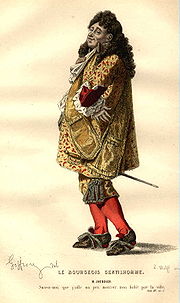
The original production brought together the finest actors and musicians of the time. Molière played the role of Monsieur Jourdain, clothed in bright colors trimmed with silver lace and muilticolored feathers; Hubert played Madame Jourdain ; Mlle de Brie played Dorimène; Armande BéjartArmande Béjart
Armande-Grésinde-Claire-Élisabeth Béjart , was a French actress, one of the most famous French stage actors of the 17th-century. She belonged to the Béjart family, a famous theatre family in 17th-century France, and daughter of Madeleine Béjart. She was married to Molière in 1662...
played Lucile; and the composer Lully danced the mufti
Mufti
A mufti is a Sunni Islamic scholar who is an interpreter or expounder of Islamic law . In religious administrative terms, a mufti is roughly equivalent to a deacon to a Sunni population...
in the last act cérémonie des Turcs.
Le Bourgeois gentilhomme reflected the then-current trend for les turqueries, all things related to the Ottoman Empire
Ottoman Empire
The Ottoman EmpireIt was usually referred to as the "Ottoman Empire", the "Turkish Empire", the "Ottoman Caliphate" or more commonly "Turkey" by its contemporaries...
. The work stemmed from the scandal caused by the Turkish ambassador Suleiman Aga
Suleiman Aga
Suleiman Aga, also Soleiman Agha or Müteferrika Süleyman Ağa, was an Ottoman Empire ambassador to the French king Louis XIV in 1669. Suleiman visited Versailles, but only wore a simple wool coat and refused to bow to Louis XIV. Louis XIV immediately banned him to Paris, away from Versailles...
who, upon visiting the court of Louis XIV in 1669, affirmed the superiority of the Ottoman court over that of the Sun King.
The first performance of Der Bürger als Edelmann, a German version of the play, took place on 25 October 1912, adapted by Hugo von Hofmannsthal
Hugo von Hofmannsthal
Hugo Laurenz August Hofmann von Hofmannsthal ; , was an Austrian novelist, librettist, poet, dramatist, narrator, and essayist.-Early life:...
with incidental music
Incidental music
Incidental music is music in a play, television program, radio program, video game, film or some other form not primarily musical. The term is less frequently applied to film music, with such music being referred to instead as the "film score" or "soundtrack"....
by Richard Strauss
Richard Strauss
Richard Georg Strauss was a leading German composer of the late Romantic and early modern eras. He is known for his operas, which include Der Rosenkavalier and Salome; his Lieder, especially his Four Last Songs; and his tone poems and orchestral works, such as Death and Transfiguration, Till...
. The turquerie was replaced by an appended operatic entertainment Ariadne auf Naxos
Ariadne auf Naxos
Ariadne auf Naxos is an opera by Richard Strauss with a German libretto by Hugo von Hofmannsthal. Bringing together slapstick comedy and consuming beautiful music, the opera's theme is the competition between high and low art for the public's attention.- First version :The opera was originally...
, composed by Strauss to a libretto by Hofmannsthal, in which Jourdain's eccentric requirements have led to Ariadne
Ariadne
Ariadne , in Greek mythology, was the daughter of King Minos of Crete, and his queen Pasiphaë, daughter of Helios, the Sun-titan. She aided Theseus in overcoming the Minotaur and was the bride of the god Dionysus.-Minos and Theseus:...
being marooned on a desert island where there just happens to be a commedia dell'arte
Commedia dell'arte
Commedia dell'arte is a form of theatre characterized by masked "types" which began in Italy in the 16th century, and was responsible for the advent of the actress and improvised performances based on sketches or scenarios. The closest translation of the name is "comedy of craft"; it is shortened...
troupe. The whole was directed by Max Reinhardt
Max Reinhardt
----Max Reinhardt was an Austrian theater and film director and actor.-Biography:...
. The combination of play and opera proved problematic. Hofmannsthal created a revised version of the play, reinstating the turquerie and removing the opera. Strauss provided further incidental music including some arrangements of Lully. Meanwhile the entertainment was provided with a separate operatic prologue and this is the form in which Ariadne is now usually given.
George Balanchine
George Balanchine
George Balanchine , born Giorgi Balanchivadze in Saint Petersburg, Russia, to a Georgian father and a Russian mother, was one of the 20th century's most famous choreographers, a developer of ballet in the United States, co-founder and balletmaster of New York City Ballet...
choreographed a modern version
Le Bourgeois Gentilhomme (ballet)
Le Bourgeois Gentilhomme is a ballet made by New York City Ballet co-founder and balletmaster George Balanchine to the Concert Suite of Richard Strauss with a libretto after Molière...
in 1979 for the New York City Opera
New York City Opera
The New York City Opera is an American opera company located in New York City.The company, called "the people's opera" by New York Mayor Fiorello La Guardia, was founded in 1943 with the aim of making opera financially accessible to a wide audience, producing an innovative choice of repertory, and...
, using Strauss's score. The production starred Jean-Pierre Bonnefoux, Patricia McBride
Patricia McBride
Patricia McBride is a ballerina who spent nearly 30 years dancing with the New York City Ballet....
, Rudolf Nureyev
Rudolf Nureyev
Rudolf Khametovich Nureyev was a Russian dancer, considered one of the most celebrated ballet dancers of the 20th century. Nureyev's artistic skills explored expressive areas of the dance, providing a new role to the male ballet dancer who once served only as support to the women.In 1961 he...
, Darla Hoover, Michael Puleo
Michael Puleo
Michael Puleo is an American dancer, currently ballet master at the Compagnia Virgilio Sieni Danza, Florence, and assistant choreographer at Compagnia del Teatro Nuovo, Turin, Italy...
and students of the School of American Ballet.
In 2005 Le Poeme Harmonique
Le Poème Harmonique
Le Poème Harmonique is a musical ensemble founded in 1998 by Vincent Dumestre to recreate and promote early music, in particular that of the 17th century. Using rare instruments such as the theorbo, the lirone, the tiorbino and the arpa tripla, Le Poème Harmonique aims to recapture the poetry of...
in collaboration with Benjamin Lazar (stage director) and Cecile Roussat (choreographer) presented Le Bourgeois Gentilhomme at the Utrecht Baroque Festival. Informed by the musical and theatrical traditions of 17th century France, the production revived the musical and dance interludes originally scored by Jean-Baptiste Lully
Jean-Baptiste Lully
Jean-Baptiste de Lully was an Italian-born French composer who spent most of his life working in the court of Louis XIV of France. He is considered the chief master of the French Baroque style. Lully disavowed any Italian influence in French music of the period. He became a French subject in...
and the work was presented in its entirety. The wardrobe was notably bourgeois and ridiculous, evidently the intent of the directors to present Monsieur Jordain as a naive, stunned and yet vulnerable man new to the world of money and privilege "victim and architect of the action". The use of candlelight as the only lighting source on stage and a frontal performance style even during conversations between characters gave the production a distinctly baroque air and was well received. The 2005 production was the first ever since the play's first performance to render it in its entirety, as faithful as possible to the original score and script by Molière and Lully.
Roles
Monsieur Jourdain:a bourgeoisMadame Jourdain:his wife
Lucile:the daughter of Monsieur Jourdain
Nicole:their maid
Cléonte:suitor of Lucile
Covielle:Cléonte's lackey and who takes an interest in Nicole
Dorante:Count, suitor of Dorimène
Dorimène:Marchioness, a widow
Music Master
Pupil of the Music Master
Dancing Master
Fencing Master
Master of Philosophy
Tailor
Tailor's apprentice
Two lackeys
Many male and female musicians, instrumentalists, dancers, cooks, tailor's apprentices, and others are needed for the interludes.
Synopsis
The play takes place at Mr. Jourdain's house in ParisParis
Paris is the capital and largest city in France, situated on the river Seine, in northern France, at the heart of the Île-de-France region...
. Jourdain is a middle-aged "bourgeois" whose father grew rich as a cloth merchant
Cloth merchant
Cloth merchant is, strictly speaking, like a draper, the term for any vendor of cloth. However, it is generally used for one who owned and/or ran a cloth manufacturing and/or wholesale import and/or export business in the Middle Ages or 16th and 17th centuries...
. The foolish Jourdain now has one aim in life, which is to rise above this middle-class background and be accepted as an aristocrat. To this end, he orders splendid new clothes and is very happy when the tailor's boy mockingly addresses him as "my Lord". He applies himself to learning the gentlemanly arts of fencing, dancing, music and philosophy, despite his age; in doing so he continually manages to make a fool of himself, to the disgust of his hired teachers. His philosophy lesson becomes a basic lesson on language in which he is surprised and delighted to learn that he has been speaking "prose" all his life without knowing it:
- « Par ma foi ! il y a plus de quarante ans que je dis de la prose sans que j'en susse rien, et je vous suis le plus obligé du monde de m'avoir appris cela. »
Madame Jourdain, his intelligent wife, sees that he is making a fool of himself and urges him to return to his previous middle-class life, and to forget all he has learned. A cash-strapped nobleman called Dorante has attached himself to M. Jourdain. He secretly despises Jourdain but flatters his aristocratic dreams. For example, by telling Jourdain that he mentioned his name to the King
Louis XIV of France
Louis XIV , known as Louis the Great or the Sun King , was a Bourbon monarch who ruled as King of France and Navarre. His reign, from 1643 to his death in 1715, began at the age of four and lasted seventy-two years, three months, and eighteen days...
at Versailles
Versailles
Versailles , a city renowned for its château, the Palace of Versailles, was the de facto capital of the kingdom of France for over a century, from 1682 to 1789. It is now a wealthy suburb of Paris and remains an important administrative and judicial centre...
he can get Jourdain to pay his debts. Jourdain's dreams of being highclass go higher and higher. He dreams of marrying a Marchioness
Marchioness
Marchioness could refer to:*A noblewoman with the rank of Marquess, or the wife of a Marquess.*The Marchioness, a pleasure boat that was sunk on the River Thames in 1989....
, Dorimene, and having his daughter Lucille marry a nobleman. But Lucille is in love with the middle-class Cléonte. Of course, M. Jourdain refuses his permission for Lucille to marry Cléonte.
Then Cléonte, with the assistance of his valet Covielle and Mme Jourdain, disguises himself and presents himself to Jourdain as the son of the Sultan of Turkey. Jourdain is taken in and is very pleased to have his daughter marry foreign royalty. He is even more delighted when the "Turkish prince" informs him that, as father of the bride, he too will be officially ennobled at a special ceremony. The play ends with this ridiculous ceremony, including Sabir
Mediterranean Lingua Franca
The Mediterranean Lingua Franca or Sabir was a pidgin language used as a lingua franca in the Mediterranean Basin from the 11th to the 19th century.-History:...
standing in for Turkish.