

La Trochita

Encyclopedia
La Trochita, in English
known as the Old Patagonian Express, is a narrow gauge railway in Patagonia
, Argentina
using steam locomotive
s. The nickname La Trochita means literally "The Little Narrow Gauge" in Spanish
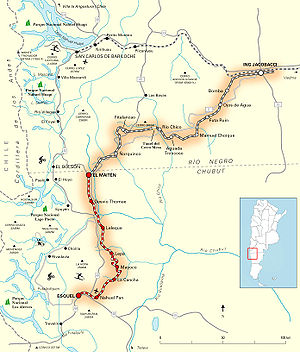
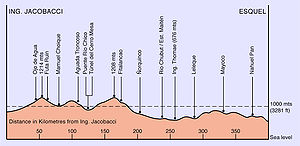
. It is 402 km in length and runs through the foothills of the Andes
between Esquel
and El Maitén
in Chubut Province
and Ingeniero Jacobacci
in Río Negro Province
, originally it was part of Ferrocarriles Patagónicos
, a network of railways in southern Argentina. Nowadays, with its original character largely unchanged, it operates as a heritage railway
and was made internationally famous by the 1978 Paul Theroux
book The Old Patagonian Express
, which described it as the railway almost at the end of the world.
planned a network of railways across Patagonia. Two main lines would join San Carlos de Bariloche
in the central Andes
with the sea ports of San Antonio Oeste
on the Atlantic
coast to the east, and Puerto Deseado
on the coast to the south east. Branches were to be built to connect the mainline with Buenos Aires Lake (connecting at Las Heras
) and Comodoro Rivadavia
(connecting at Sarmiento
). Colonia 16 de Octubre - the Esquel and Trevelin
area - would be connected via a branch line to Ingeniero Jacobacci. The whole network would connect to Buenos Aires via San Antonio Oeste.
 The project ran out of steam following ministerial changes and the start of World War I
which affected the economy of Argentina
and the input of technology and investment required from Europe
. The northern main line from the coast reached Ingeniero Jacobacci in 1916. 282 km of the southern main line from Deseado to Las Heras, and the 197 km branch line from Comodoro Rivadavia to Sarmiento were laid, but never connected with each other or the northern network. After 1916, the only further work was the completion of the link from Jacobacci to Bariloche, finished in 1934.
railroads were used extensively in Buenos Aires Province
in rural areas and to carry freight. For passenger services, locomotives for track were readily available and it was decided to pursue this cheaper option. In 1921 it was agreed to lay down the Jacobacci-Esquel line, and also to connect it with the existing private gauge railway in the Chubut Valley from Dolavon
to Puerto Madryn
. This would be the Patagonian Light Railways Network.
Belgian
coaches and freight wagons were ordered in 1922, plus fifty locomotives from Henschel & Sohn, a German
company in Cassel (today spelt Kassel). Later 25 more locomotives were bought from the Baldwin Locomotive Works
in Philadelphia, U.S.A.
The first part of the project was to lay a third rail inside the existing tracks at Jacobacci and the Chubut Valley so that they could be used by the narrow gauge vehicles. New tracks were laid to extend the Chubut Valley line from Trelew
to Rawson
at the coast and westwards to Las Plumas
. After floods destroyed much of the line in 1931-32, work began again in 1934 with new plans, with a 105 m-long bridge and a 110 m-long tunnel to be built. 1,000 labourers worked in the harsh Patagonian environment, many later settling.
Trains began to run on the completed parts of the line in 1935. In 1941 the line reached El Maitén
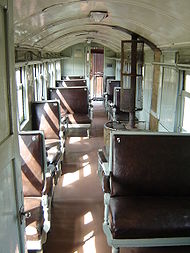
, where maintenance facilities were built. The first train to Esquel entered the city on May 25, 1945. However, until 1950 it was a freight-only service. The first passenger service launched in 1950 and connected Esquel with Buenos Aires (arriving at Constitución station), changing trains at Jacobacci. Passengers would occupy loose wooden benches around a stove which could be used for light cooking and above all to prepare mate
and keep warm. The bends of the line in the Andean foothills and the slow speed of the network allowed passengers to walk alongside the train on certain sections along the 14 hour journey.
 The service was much used for freight through the 1960s and 1970s, contributing to the development of the area, especially the construction of the dam on the Futaleufú River
and the growth of El Maitén thanks to the locomotive maintenance operation.
La Trochita also began to decline, due to the improvement of the road network and of trucks and buses, and the difficulties of maintaining a railway so far from the country's capital and the global rail industry. However over the same period, Patagonia had been 'discovered' by tourists and La Trochita was something of a backpacker
highlight. Theroux's book brought it to wider attention and gave the railway a name - The Old Patagonian Express - which highlighted its timeless appeal both to Argentine nostalgics and tourists. In 1991, the railway was filmed for an episode of Nick Lera's World Steam Classics.
Nevertheless, the line was not profitable. Given the communities it served, private investors were not interested in making necessary investment. In 1992, under the liberal economic practices of the central government, it was decided to close the line. However there was a national and even an international outcry at the decision to close a line which had become emblematic of a bygone age and of that region. The two provincial governments came together to keep the line open.
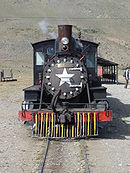
"Mikado" type locomotives, 7 of which are currently operable, 2 Baldwin and 3 Henschel in the Maitén - Esquel section, and 2 Baldwin locomotives in the Jacobacci section. The locomotives are oil fired and have been in continuous service since its introduction. There are no diesel engines in use anywhere on the line. The present rolling stock as the locomotives date from 1922, with the exception of the dining car and some first class carriages that were constructed in 1955.
The train no longer runs between Esquel and El Maitén; instead two special tourist services run (i) between Esquel and the settlement of Nahuel Pan and (ii) between El Maitén and Desvio Thomae.
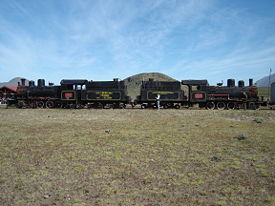 The journey from Esquel to El Maiten took almost seven hours, while the tourist services offering a trip just to the first station and back from each end take about an hour. As of 2010, tickets for the tourist services are $150 pesos
, round-trip, but $80 pesos for residents of Argentina.
Carlos Kmet is the Mechanical Area Coordinator, and Locomotive and Rolling Stock Maintenance and Repairs Manager of the line. His job to maintain the original 1922 locomotives is increasingly difficult, due to the lack of parts and expertise, and the remoteness of his base in El Maitén. This leads to frequent shut-downs of the service.
The Government of Argentina
declared La Trochita as a National Historic Monument in 1999.
In 2003, "Friends of La Trochita Association” is created with members mainly from Esquel, El Maitén and Bariloche.
English language
English is a West Germanic language that arose in the Anglo-Saxon kingdoms of England and spread into what was to become south-east Scotland under the influence of the Anglian medieval kingdom of Northumbria...
known as the Old Patagonian Express, is a narrow gauge railway in Patagonia
Patagonia
Patagonia is a region located in Argentina and Chile, integrating the southernmost section of the Andes mountains to the southwest towards the Pacific ocean and from the east of the cordillera to the valleys it follows south through Colorado River towards Carmen de Patagones in the Atlantic Ocean...
, Argentina
Argentina
Argentina , officially the Argentine Republic , is the second largest country in South America by land area, after Brazil. It is constituted as a federation of 23 provinces and an autonomous city, Buenos Aires...
using steam locomotive
Steam locomotive
A steam locomotive is a railway locomotive that produces its power through a steam engine. These locomotives are fueled by burning some combustible material, usually coal, wood or oil, to produce steam in a boiler, which drives the steam engine...
s. The nickname La Trochita means literally "The Little Narrow Gauge" in Spanish
Spanish language
Spanish , also known as Castilian , is a Romance language in the Ibero-Romance group that evolved from several languages and dialects in central-northern Iberia around the 9th century and gradually spread with the expansion of the Kingdom of Castile into central and southern Iberia during the...
. It is 402 km in length and runs through the foothills of the Andes
Andes
The Andes is the world's longest continental mountain range. It is a continual range of highlands along the western coast of South America. This range is about long, about to wide , and of an average height of about .Along its length, the Andes is split into several ranges, which are separated...
between Esquel
Esquel
According to the , the Esquel district had about 28,000 inhabitants, with one of the highest rates of growth in the province, mainly as result of the immigration of people from Buenos Aires, but also from other provinces. It has wide cement streets with sidewalks, and is clean and well maintained...
and El Maitén
El Maitén
El Maitén is a town in Argentina in Cushamen Department on the margins of the Chubut River, on the northwest of Chubut Province, in Patagonia. In older times it was the intermediate point in the railroad tracks of the Old Patagonian Express between the towns of Ingeniero Jacobacci and Esquel.-...
in Chubut Province
Chubut Province
Chubut a province in the southern part of Argentina situated between the 42nd parallel south and the 46th parallel south , the Andes range separating Argentina from Chile, and the Atlantic ocean...
and Ingeniero Jacobacci
Ingeniero Jacobacci
Ingeniero Jacobacci is a city in Río Negro Province, Argentina. It has a population of 5,719 inhabitants and was named in honor of Guido Jacobacci, the director of the railway opened in 1916 between San Antonio Oeste, on the Atlantic Ocean coast, and San Carlos de Bariloche, in the Andes...
in Río Negro Province
Río Negro Province
Río Negro is a province of Argentina, located at the northern edge of Patagonia. Neighboring provinces are from the south clockwise Chubut, Neuquén, Mendoza, La Pampa and Buenos Aires. To the east lies the Atlantic Ocean.Its capital is Viedma...
, originally it was part of Ferrocarriles Patagónicos
Ferrocarriles Patagónicos
In 1900 two British-owned companies were operating railways in Patagonia; the Central of Chubut metre gauge, , line between Puerto Madryn and Trelew and the Buenos Aires Great Southern broad gauge line between Bahía Blanca and Neuquén...
, a network of railways in southern Argentina. Nowadays, with its original character largely unchanged, it operates as a heritage railway
Heritage railway
thumb|right|the Historical [[Khyber train safari|Khyber Railway]] goes through the [[Khyber Pass]], [[Pakistan]]A heritage railway , preserved railway , tourist railway , or tourist railroad is a railway that is run as a tourist attraction, in some cases by volunteers, and...
and was made internationally famous by the 1978 Paul Theroux
Paul Theroux
Paul Edward Theroux is an American travel writer and novelist, whose best known work of travel writing is perhaps The Great Railway Bazaar . He has also published numerous works of fiction, some of which were made into feature films. He was awarded the 1981 James Tait Black Memorial Prize for his...
book The Old Patagonian Express
The Old Patagonian Express
The Old Patagonian Express is a written account of a journey taken by novelist Paul Theroux. Starting out from his home town in Massachusetts, via Boston and Chicago, Theroux travels by train across the North American plains to Laredo, Texas. He then crosses the border and takes a train south...
, which described it as the railway almost at the end of the world.
Plans
In 1908, the Government of ArgentinaGovernment of Argentina
The government of Argentina, functioning within the framework of a federal system, is a presidential representative democratic republic. The President of Argentina is both head of state and head of government. Executive power is exercised by the President. Legislative power is vested in both the...
planned a network of railways across Patagonia. Two main lines would join San Carlos de Bariloche
San Carlos de Bariloche
San Carlos de Bariloche, usually known as Bariloche, is a city in the , situated in the foothills of the Andes on the southern shores of Nahuel Huapi Lake and is located inside Nahuel Huapi National Park...
in the central Andes
Andes
The Andes is the world's longest continental mountain range. It is a continual range of highlands along the western coast of South America. This range is about long, about to wide , and of an average height of about .Along its length, the Andes is split into several ranges, which are separated...
with the sea ports of San Antonio Oeste
San Antonio Oeste
San Antonio Oeste is a port city in the Argentine province of Río Negro, and head of the department of San Antonio.The town is bordered by its sister communities of San Antonio Este, to the east, and Las Grutas, to the southwest. Discovered by an expedition of the Spanish Empire in 1779, San Matías...
on the Atlantic
Atlantic Ocean
The Atlantic Ocean is the second-largest of the world's oceanic divisions. With a total area of about , it covers approximately 20% of the Earth's surface and about 26% of its water surface area...
coast to the east, and Puerto Deseado
Puerto Deseado
Puerto Deseado, originally called Port Desire, is a city of about 15,000 inhabitants and a fishing port in Patagonia in Santa Cruz Province of Argentina, on the estuary of the Deseado River....
on the coast to the south east. Branches were to be built to connect the mainline with Buenos Aires Lake (connecting at Las Heras
Las Heras, Santa Cruz
Las Heras is a small city in the Patagonic province of Santa Cruz, Argentina. It is located 566 km north of the provincial capital Río Gallegos, and has a population of about 9,300 as per the ....
) and Comodoro Rivadavia
Comodoro Rivadavia
Comodoro Rivadavia is a city in the Patagonian province of Chubut in southern Argentina, located on the San Jorge Gulf, an inlet of the Atlantic Ocean, at the foot of the Chenque Hill. Comodoro Rivadavia is the most important city of the San Jorge Basin....
(connecting at Sarmiento
Sarmiento, Chubut
Sarmiento is a town in the province of Chubut, Argentina. It has about 8,000 inhabitants as per the , and is the head town of the department of the same name. It is located on the so-called Central Corridor of Patagonia, in a fertile valley amidst an otherwise arid region, 140 km west from...
). Colonia 16 de Octubre - the Esquel and Trevelin
Trevelín
Trevelin is a town in the Patagonian Argentine province of Chubut. It is located in the department of Futaleufú, south of Esquel, and had about 6,400 inhabitants at the time of the ....
area - would be connected via a branch line to Ingeniero Jacobacci. The whole network would connect to Buenos Aires via San Antonio Oeste.
World War I
World War I , which was predominantly called the World War or the Great War from its occurrence until 1939, and the First World War or World War I thereafter, was a major war centred in Europe that began on 28 July 1914 and lasted until 11 November 1918...
which affected the economy of Argentina
Economy of Argentina
This article provides an overview of the Economic history of Argentina.-Emergence into the world economy:Prior to the 1880s, Argentina was a relatively isolated backwater, dependent on the wool, leather and hide industry for both the greater part of its foreign exchange and the generation of...
and the input of technology and investment required from Europe
Europe
Europe is, by convention, one of the world's seven continents. Comprising the westernmost peninsula of Eurasia, Europe is generally 'divided' from Asia to its east by the watershed divides of the Ural and Caucasus Mountains, the Ural River, the Caspian and Black Seas, and the waterways connecting...
. The northern main line from the coast reached Ingeniero Jacobacci in 1916. 282 km of the southern main line from Deseado to Las Heras, and the 197 km branch line from Comodoro Rivadavia to Sarmiento were laid, but never connected with each other or the northern network. After 1916, the only further work was the completion of the link from Jacobacci to Bariloche, finished in 1934.
The Esquel line
The exception was the Esquel line. After the end of World War I, narrow gauge track and facilities were plentiful and cheaper, given their extensive use at the front for supplies and troop movement. DecauvilleDecauville
The Decauville manufacturing company was founded by Paul Decauville , a French pioneer in industrial railways. Decauville's major innovation was the use of ready-made sections of light, narrow gauge track fastened to steel sleepers; this track was portable and could be disassembled and transported...
railroads were used extensively in Buenos Aires Province
Buenos Aires Province
The Province of Buenos Aires is the largest and most populous province of Argentina. It takes the name from the city of Buenos Aires, which used to be the provincial capital until it was federalized in 1880...
in rural areas and to carry freight. For passenger services, locomotives for track were readily available and it was decided to pursue this cheaper option. In 1921 it was agreed to lay down the Jacobacci-Esquel line, and also to connect it with the existing private gauge railway in the Chubut Valley from Dolavon
Dolavon
Dolavon is a small town in the Patagonian province of Chubut, Argentina. It has a population of 2,929 according to the . It is located close to the Chubut River, about 19 km to the west of Gaiman. The name comes from Welsh dôl and afon . Welsh immigrants began to settle in the area after their...
to Puerto Madryn
Puerto Madryn
Puerto Madryn is a city in the province of Chubut in the Argentine Patagonia. It is the head town of the Viedma Department, and has about 57,571 inhabitants according to the last census in 2001....
. This would be the Patagonian Light Railways Network.
Belgian
Belgium
Belgium , officially the Kingdom of Belgium, is a federal state in Western Europe. It is a founding member of the European Union and hosts the EU's headquarters, and those of several other major international organisations such as NATO.Belgium is also a member of, or affiliated to, many...
coaches and freight wagons were ordered in 1922, plus fifty locomotives from Henschel & Sohn, a German
Germany
Germany , officially the Federal Republic of Germany , is a federal parliamentary republic in Europe. The country consists of 16 states while the capital and largest city is Berlin. Germany covers an area of 357,021 km2 and has a largely temperate seasonal climate...
company in Cassel (today spelt Kassel). Later 25 more locomotives were bought from the Baldwin Locomotive Works
Baldwin Locomotive Works
The Baldwin Locomotive Works was an American builder of railroad locomotives. It was located in Philadelphia, Pennsylvania, originally, and later in nearby Eddystone, Pennsylvania. Although the company was very successful as a producer of steam locomotives, its transition to the production of...
in Philadelphia, U.S.A.
The first part of the project was to lay a third rail inside the existing tracks at Jacobacci and the Chubut Valley so that they could be used by the narrow gauge vehicles. New tracks were laid to extend the Chubut Valley line from Trelew
Trelew
-References:La Pasión según Trelew, Espejo de la Argentina, 1997, Editorial Planeta Argentina S.A.I.C.; Third Edition: April 2000, Buenos Aires, ISBN 950-742-859-3-External links:* * * *...
to Rawson
Rawson, Chubut
Rawson is the capital of the Argentine province of Chubut, in Patagonia. It has about 26,000 inhabitants, and it is the head town of the Rawson Department, which has 122,000 inhabitants...
at the coast and westwards to Las Plumas
Las Plumas
Las Plumas is a village in Chubut Province, Argentina. It is the head town of the Mártires Department. It was established in 1921....
. After floods destroyed much of the line in 1931-32, work began again in 1934 with new plans, with a 105 m-long bridge and a 110 m-long tunnel to be built. 1,000 labourers worked in the harsh Patagonian environment, many later settling.
Trains began to run on the completed parts of the line in 1935. In 1941 the line reached El Maitén
El Maitén
El Maitén is a town in Argentina in Cushamen Department on the margins of the Chubut River, on the northwest of Chubut Province, in Patagonia. In older times it was the intermediate point in the railroad tracks of the Old Patagonian Express between the towns of Ingeniero Jacobacci and Esquel.-...
, where maintenance facilities were built. The first train to Esquel entered the city on May 25, 1945. However, until 1950 it was a freight-only service. The first passenger service launched in 1950 and connected Esquel with Buenos Aires (arriving at Constitución station), changing trains at Jacobacci. Passengers would occupy loose wooden benches around a stove which could be used for light cooking and above all to prepare mate
Mate (beverage)
Mate , also known as chimarrão or cimarrón, is a traditional South American infused drink, particularly in Argentina, Uruguay, Paraguay, southern states of Brazil, south of Chile, the Bolivian Chaco, and to some extent, Syria and Lebanon...
and keep warm. The bends of the line in the Andean foothills and the slow speed of the network allowed passengers to walk alongside the train on certain sections along the 14 hour journey.
Futaleufú River
The Futaleufú River is a river fed by the lakes in the Los Alerces National Park in Chubut Province, Argentina, crossing the Andes Mountains and the international border into Chile and opening into the Yelcho Lake....
and the growth of El Maitén thanks to the locomotive maintenance operation.
Decline
In 1961, the line at the lower Chubut valley between Puerto Madryn and Las Plumas was closed, never having been connected with the Esquel or Bariloche lines. In the 1970s the two isolated lines to the south also shut down.La Trochita also began to decline, due to the improvement of the road network and of trucks and buses, and the difficulties of maintaining a railway so far from the country's capital and the global rail industry. However over the same period, Patagonia had been 'discovered' by tourists and La Trochita was something of a backpacker
Backpacking (travel)
Backpacking is a term that has historically been used to denote a form of low-cost, independent international travel. Terms such as independent travel and/or budget travel are often used...
highlight. Theroux's book brought it to wider attention and gave the railway a name - The Old Patagonian Express - which highlighted its timeless appeal both to Argentine nostalgics and tourists. In 1991, the railway was filmed for an episode of Nick Lera's World Steam Classics.
Nevertheless, the line was not profitable. Given the communities it served, private investors were not interested in making necessary investment. In 1992, under the liberal economic practices of the central government, it was decided to close the line. However there was a national and even an international outcry at the decision to close a line which had become emblematic of a bygone age and of that region. The two provincial governments came together to keep the line open.
The Trochita today
The line is in possession of 22 steam locomotives, 11 Henschel and 11 Baldwins 2-8-22-8-2
Under the Whyte notation for the classification of steam locomotives, 2-8-2 represents the wheel arrangement of two leading wheels on one axle , eight powered and coupled driving wheels on four axles, and two trailing wheels on one axle...
"Mikado" type locomotives, 7 of which are currently operable, 2 Baldwin and 3 Henschel in the Maitén - Esquel section, and 2 Baldwin locomotives in the Jacobacci section. The locomotives are oil fired and have been in continuous service since its introduction. There are no diesel engines in use anywhere on the line. The present rolling stock as the locomotives date from 1922, with the exception of the dining car and some first class carriages that were constructed in 1955.
The train no longer runs between Esquel and El Maitén; instead two special tourist services run (i) between Esquel and the settlement of Nahuel Pan and (ii) between El Maitén and Desvio Thomae.
Argentine peso
The peso is the currency of Argentina, identified by the symbol $ preceding the amount in the same way as many countries using dollar currencies. It is subdivided into 100 centavos. Its ISO 4217 code is ARS...
, round-trip, but $80 pesos for residents of Argentina.
Carlos Kmet is the Mechanical Area Coordinator, and Locomotive and Rolling Stock Maintenance and Repairs Manager of the line. His job to maintain the original 1922 locomotives is increasingly difficult, due to the lack of parts and expertise, and the remoteness of his base in El Maitén. This leads to frequent shut-downs of the service.
The Government of Argentina
Government of Argentina
The government of Argentina, functioning within the framework of a federal system, is a presidential representative democratic republic. The President of Argentina is both head of state and head of government. Executive power is exercised by the President. Legislative power is vested in both the...
declared La Trochita as a National Historic Monument in 1999.
In 2003, "Friends of La Trochita Association” is created with members mainly from Esquel, El Maitén and Bariloche.