
All Topics  
Vihara


   Email Print
   Bookmark   Link


Vihara


Vihara is Sanskrit
Sanskrit

Sanskrit is a historical Indo-Aryan language, one of the liturgical languages of Hinduism and Buddhism, and one of the 22 official languages of India....
 or Pali
Páli

P?li is a village in Gyor-Moson-Sopron county, Hungary.External links...
 for (Buddhist) monastery
Monastery

Monastery , a term derived from the Greek language word ???ast?????, neut. of ???ast????? - monasterios denotes the building, or complex of buildings, that houses a room reserved for prayer as well as the domestic quarters and workplace of Monk, whether monks or nuns, and whether living in Cenobium or alone ....
. Vihara is a place of worship
Place of worship

A place of worship or house of worship is a building or other location where a group of people comes to perform acts of religious praise, honour, or devotion....
 for followers of Buddhism
Buddhism

Buddhism is a family of beliefs and practices considered by most to be a religionand is based on the teachings attributed to Siddhartha Gautama, commonly known as "The Buddha" , who was born in what is today Nepal....
.It originally meant "dwelling" or "refuge", such as those used by wandering monks during the rainy season.

In the early decades of Buddhism the wandering monks of the Sangha
Sangha

Sangha is a word in Pali or Sanskrit that can be translated roughly as "association" or "assembly," "company" or "community" with common goal, vision or purpose....
 had no fixed abode
No fixed abode

No fixed abode is a legal term generally applied to those who do not have a fixed geographical location as their residence. This is applicable to several groups:...
, but during the rainy season (cf. vassa
Vassa

Vassa , also called Rains Retreat, is the traditional Retreat during the rainy season lasting for three lunar months from July to October....
) they stayed in temporary shelters. These dwellings were simple wooden constructions or thatched bamboo huts.


Discussion
Ask a question about 'Vihara'
Start a new discussion about 'Vihara'
Answer questions from other users
Full Discussion Forum


Encyclopedia


Vihara is Sanskrit
Sanskrit

Sanskrit is a historical Indo-Aryan language, one of the liturgical languages of Hinduism and Buddhism, and one of the 22 official languages of India....
 or Pali
Páli

P?li is a village in Gyor-Moson-Sopron county, Hungary.External links...
 for (Buddhist) monastery
Monastery

Monastery , a term derived from the Greek language word ???ast?????, neut. of ???ast????? - monasterios denotes the building, or complex of buildings, that houses a room reserved for prayer as well as the domestic quarters and workplace of Monk, whether monks or nuns, and whether living in Cenobium or alone ....
. Vihara is a place of worship
Place of worship

A place of worship or house of worship is a building or other location where a group of people comes to perform acts of religious praise, honour, or devotion....
 for followers of Buddhism
Buddhism

Buddhism is a family of beliefs and practices considered by most to be a religionand is based on the teachings attributed to Siddhartha Gautama, commonly known as "The Buddha" , who was born in what is today Nepal....
.It originally meant "dwelling" or "refuge", such as those used by wandering monks during the rainy season.

In the early decades of Buddhism the wandering monks of the Sangha
Sangha

Sangha is a word in Pali or Sanskrit that can be translated roughly as "association" or "assembly," "company" or "community" with common goal, vision or purpose....
 had no fixed abode
No fixed abode

No fixed abode is a legal term generally applied to those who do not have a fixed geographical location as their residence. This is applicable to several groups:...
, but during the rainy season (cf. vassa
Vassa

Vassa , also called Rains Retreat, is the traditional Retreat during the rainy season lasting for three lunar months from July to October....
) they stayed in temporary shelters. These dwellings were simple wooden constructions or thatched bamboo huts. However, as it was considered an act of merit not only to feed a monk but also to shelter him, sumptuous monasteries were created by rich lay devotees (Mitra 1971). They were located near settlements, close enough for begging alms from the population but with enough seclusion to not disturb meditation.

Trade-routes were therefore ideal locations for a vihara and donations from wealthy traders increased their economic strength. From the first century CE onwards viharas also developed into educational institutions, due to the increasing demands for teaching in Mahayana
Mahayana

Mahayana is one of the two main existing schools of Buddhism and a term for classification of Buddhist philosophy and practice. It was History of Buddhism in India....
 Buddhism (Chakrabarti 1995).

In the second century BCE a standard plan for a vihara was established. It could be either structural, which was more common in the south of India
India

India, officially the Republic of India , is a country in South Asia. It is the List of countries and outlying territories by total area country by geographical area, the List of countries by population country, and the most populous liberal democracy in the world....
, or rock-cut like the chaitya
Chaitya

A chaitya is a Buddhist or Jain shrine including a stupa . In modern texts on Indian architecture, the term chaitya-griha is often used to denote assembly or prayer hall that houses a stupa....
-grihas of the Deccan. It consisted of a walled quadrangular court, flanked by small cells. The front wall was pierced by a door, the side facing it in later periods often incorporated a shrine for the image of the Buddha
Buddharupa

Buddharupa is the Sanskrit and Pali term used in Buddhism for statues or models of the Gautama Buddha....
. The cells were fitted with rock-cut platforms for beds and pillows (Mitra 1971). This basic layout was still similar to that of the communal space of an ashram
Ashram

An "ashram" in ancient India was a Hindu hermitage where sages lived in peace and tranquility amidst nature. Today, the term "ashram" is sometimes used to refer to an intentional community formed primarily for spiritual upliftment of its members, often headed by a religious leader or mysticism....
a ringed with huts in the early decades of Buddhism (Tadgell 1990).

As permanent monasteries became established, the name "Vihara" was kept. Some Viharas became extremely important institutions, some of them evolving into major Buddhist Universities with thousands of students, such as Nalanda
Nalanda

Nalanda is the name of an ancient university in Bihar, India.The site of Nalanda is located in the States and territories of India of Bihar, about 55 miles south east of Patna, and was a Buddhism center of learning from 427 to 1197 CE....
.

Life in "Viharas" was codified early on. It is the object of a part of the Pali canon
Pali Canon

The Pali Canon is the standard collection of scriptures in the Theravada Buddhism tradition, as preserved in the Pali. It is the only completely surviving Early Buddhist schools canon, and one of the first to be written down....
, the Vinaya Pitaka
Vinaya

The Vinaya is the regulatory framework for the Buddhist monastic community, or sangha, based in the canonical texts called Vinaya Pitaka. The teachings of the Gautama Buddha, or Buddhadharma can be divided into two broad categories: 'Dharma' or doctrine, and 'Vinaya', or discipline....
 or "basket of monastic discipline".

The northern India
India

India, officially the Republic of India , is a country in South Asia. It is the List of countries and outlying territories by total area country by geographical area, the List of countries by population country, and the most populous liberal democracy in the world....
n state of Bihar
Bihar

Bihar is a States and territories of India in East India. Bihar is the 12th largest state in terms of geographical size 38,202 square mile and 3rd largest by population....
 derives its name from the word "Vihara", probably due to the abundance of Buddhist monasteries in that area. The Uzbek city of Bukhara
Bukhara

Bukhara , also spelled as Bukhoro and Bokhara, from the Soghdian ?uxarak , is the Capital of the Bukhara Province of Uzbekistan. The nation's fifth-largest city, it has a population of 237,900 ....
 also probably takes it name from "Vihara".

In Thailand
Thailand

The Kingdom of Thailand is an independent country that lies in the heart of Southeast Asia. It is bordered to the north by Laos and Myanmar, to the east by Laos and Cambodia, to the south by the Gulf of Thailand and Malaysia, and to the west by the Andaman Sea and Myanmar....
 and China
China

China is a Culture of China, an ancient civilization, and, depending on perspective, a national or multinational entity extending over a large area in East Asia....
 (called in Chinese), "Vihara" has a narrower meaning, and designates a shrine
Shrine

A shrine, from the Latin scrinium is a holy or sacred place which is dedicated to a specific deity, ancestor veneration, hero, martyr, saint or similar figure of awe and respect, at which they are veneration or worshipped....
 hall. It is called a "Wihan" in Thai, and a "Vihear" in Khmer
Khmer

Khmer can refer to:*Srok Khmer the modern Kingdom of Cambodia*Khmer people, the ethnic group to which the great majority of Cambodians belong*Khmer language, the language of the Khmer and the official language of Cambodia...
.

Buddhist Vihara or monastery is an important form of institution associated with Buddhism. It may be defined as a residence for monks, a centre for religious work and meditation and a centre of Buddhist learning. Reference to five kinds of dwellings (Pancha Lenani) namely, Vihara, Addayoga, Pasada, Hammiya and Guha is found in the Buddhist canonical texts as fit for monks. Of these only the Vihara (monastery) and Guha (Cave) have survived.

Etymology


History

Epigraphic, literary and archaeological evidence testify to the existence of many Buddhist Viharas in Bengal (West Bengal
West Bengal

West Bengal is a States and territories of India in eastern India. With Bangladesh, which lies on its eastern border, the state forms the ethno-linguistic region of Bengal....
 and Bangladesh
Bangladesh

, officially the People's Republic of Bangladesh is a country in South Asia. It is bordered by India on all sides except for a small border with Burma to the far southeast and by the Bay of Bengal to the south....
) and Bihar from the 5th century AD to the end of the 12th century. These monasteries were generally designed in the old traditional Kushana pattern, a square block formed by four rows of cells along the four sides of an inner courtyard. They were usually built of stone or brick. As the monastic organization developed, they became elaborate brick structures with many adjuncts. Often they consisted of several stories and along the inner courtyard there usually ran a veranda supported on pillars. In some of them a stupa
Stupa

A stupa is a mound-like structure containing Buddhist relics, once thought to be places of Buddhist worship, typically the remains of a Buddha or saint....
 or shrine
Shrine

A shrine, from the Latin scrinium is a holy or sacred place which is dedicated to a specific deity, ancestor veneration, hero, martyr, saint or similar figure of awe and respect, at which they are veneration or worshipped....
 with a dais
Dais

Dais is any raised platform located either within or without a room or enclosure, often for dignified occupancy, as at the front of a lecture hall or sanctuary....
 appeared. Within the shrine stood the icon
Icon

An 'icon' is a religious work of art, most commonly a painting, from Eastern Christianity. More broadly the term is used in a wide number of contexts for an image, picture, or representation; it is a sign or likeness that stands for an object by signifying or representing it either concretely or by analogy, as in semiotics; by extension, ...
 of Buddha, Bodhisattva or Buddhist female deities. More or less the same plan was followed in building monastic establishments in Bengal and Bihar during the Gupta
Gupta Empire

The Gupta Empire was ruled by members of the Gupta dynasty from around 280 to 550 CE and covered most of Northern India, Southern and Eastern Pakistan, parts of Gujarat and Rajasthan and what is now western India and Bangladesh....
 and Pala
Pala

The word Pala can refer to many different things:...
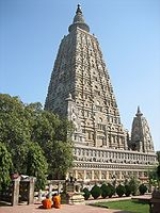
 period. In course of time monasteries became important centres of learning. At the age of Mauryan emperor Ashoka the great the Mahabodhi Temple
Mahabodhi Temple

The Mahabodhi Temple is a Buddhism temple in Bodh Gaya, the location where Gautama Buddha, the Gautama Buddha, attained Enlightenment . Bodh Gaya is located about 96 km from Patna, Bihar state, India....
 was build in the form of vihara.
Mahabodhitemple
. An idea of the plan and structure of some of the flourishing monasteries may be found from the account of Hsuan-Tsang, who referred to the grand monastery of po-si-po, situated about 6.5 km west of the capital city of Pundravardhana
Pundravardhana

This article is about the historical territory. For the Mahabharata kingdom see Pundra KingdomPundravardhana , was a territory located in Bengal in ancient times, of Pundra, a group of non-Aryan people....
 (Mahasthan
Mahasthangarh

File:BD Mahasthangarh1.JPGMahasthangarh is the earliest urban archaeological site so far discovered in Bangladesh. The village Mahasthan in Shibganj Upazila, Bogra thana of Bogra District contains the remains of an ancient city which was called Pundranagara or Paundravardhanapura in the territory of Pundravardhana.A limestone slab bearin...
). The monastery was famous for its spacious halls and tall chambers. General Cunningham identified this vihara with bhasu vihara. Huen-tsang also noticed the famous Lo-to-mo-chi vihara (Raktamrittika Mahavihara) near Karnasuvarna (Rangamati, Murshidabad, West Bengal). The site of the monastery has been identified at Rangamati (modern Chiruti, Murshidabad, West Bengal). A number of smaller monastic blocks arranged on a regular plan, with other adjuncts, like shrines, stupas, pavilions etc have been excavated from the site.

One of the earliest viharas in Bengal was located at Biharail (Rajshahi district, Bangladesh). The plan of the monastery was designed on an ancient pattern, i.e. rows of cells round a central courtyard. The date of the monastery may be ascribed to the Gupta period.

A number of monasteries grew up during the Pala period in ancient Bengal. One of them was Somapura Mahavihara
Somapura Mahavihara

Somapura Mahavihara in Paharpur, Naogaon District, Bangladesh is among the best known Buddhist Vihara s in South Asia and is one of the most important archeological sites in the country....
 at Paharpur, 46.5 km to the northwest of Mahasthana. The available data suggests that the Pala ruler Dharmapala founded the vihara. It followed the traditional cruciform
Cruciform

Cruciform means having the shape of a cross....
 plan for the central shrine. There were 177 individual cells around the central courtyard. There were central blocks in the middle of the eastern, southern and western sides. These might have been subsidiary chapels. It was the premier vihara of its kind and its fame lingered till the 11th century AD.

The famous Nalanda
Nalanda

Nalanda is the name of an ancient university in Bihar, India.The site of Nalanda is located in the States and territories of India of Bihar, about 55 miles south east of Patna, and was a Buddhism center of learning from 427 to 1197 CE....
 Mahavihara was founded a few centuries earlier; Huen-tsang speaks about its magnificence and grandeur. Reference to this monastery is found in Tibetan and Chinese sources. The fame of this monastery lingered even after the Pala period. Reference to a monastery known as Vikramashila is found in Tibetan records. The Pala ruler Dharmapala was its founder. The exact site of this vihara is at Antichak, a small village in Bhagalpur district (Bihar). The monastery had 107 temples and 50 other institutions providing room for 108 monks. It attracted scholars from neighboring countries.

The name of the Odantapuri monastery is traceable in Pagsam jon zang (a Tibetan text), but no full-length description is available in the Tibetan source. Gopala I built it near Nalanda. This was the monastery invaded by Bakhtiyar Khalji.

Very interesting and important structural complexes have been discovered at Mainamati
Mainamati

Mainamati is located almost 8 miles from the town of Comilla, Bangladesh. It is the home of one of the most important Buddhist archaeological sites in the region....
 (Comilla district, Bangladesh). Remains of quite a few viharas have been unearthed here and the most elaborate is the Shalvan Vihara. The complex consists of a fairly large vihara of the usual plan of four ranges of monastic cells round a central court, with a temple in cruciform plan situated in the centre. According to a legend on a seal (discovered at the site) the founder of the monastery was Bhavadeva, a ruler of the Deva dynasty.

Other notable monasteries of Pala period were Traikuta, Devikota (identified with ancient kotivarsa, 'modern Bangarh'), Pandita vihara and Jagaddala (situated near Ramavati). Excavations conducted in 1972 to 1974 yielded a Buddhist monastic complex at Bharatpur in the Burdwan district of West Bengal. The date of the monastery may be ascribed to the early medieval period. Recent excavations at Jagjivanpur (Malda district, West Bengal) revealed another Buddhist monastery of the ninth century AD. Unfortunately, nothing of the superstructure has survived. However, a number of monastic cells facing a rectangular courtyard have been found. An interesting feature is the presence of circular corner cells. It is believed that the general layout of the monastic complex at Jagjivanpur is by and large similar to that of Nalanda.

Beside these, scattered references to some monasteries are found in epigraphic and other sources. They were no less important. Among them Pullahari (in western Magadha), Halud vihara (45 km south of Paharpur), Parikramana vihara and Yashovarmapura vihara (in Bihar) deserve mention.

Religious functions


Architecture


Types of Viharas


Rules and etiquette


Importance in Buddhism


Gallery


See also

  • Brahma-vihara
  • Nava Vihara
    Nava Vihara

    Navbahar was a Buddhist stupa or monastery near the ancient city of Balkh, in the Greater Khorasan province of the Persian Empire .The temple may have been an old Zoroastrian fire-temple, or it may have been converted to a Zoroastrian temple ....
  • Wat
    Wat

    A wat is a monastery temple in Cambodia, Thailand, Lanna or Laos. The word "wat" means "school." Strictly speaking a wat is a Buddhist sacred precinct with monks' quarters, the temple proper, an edifice housing a large image of Buddha, and a structure for lessons....
     - a Buddhist temple in Cambodia, Laos or Thailand.
  • Mahabodhi Temple
    Mahabodhi Temple

    The Mahabodhi Temple is a Buddhism temple in Bodh Gaya, the location where Gautama Buddha, the Gautama Buddha, attained Enlightenment . Bodh Gaya is located about 96 km from Patna, Bihar state, India....


External links

  • - A short article on the meaning of Vassa, and its observation by lay Buddhists.