


Kumbum

Encyclopedia
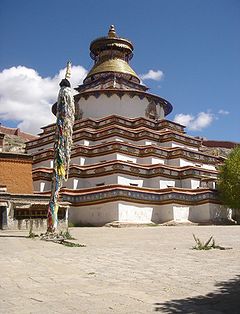
A Kumbum is a multi-storied aggregate of Buddhist chapels in Tibet
Tibet
Tibet is a plateau region in Asia, north-east of the Himalayas. It is the traditional homeland of the Tibetan people as well as some other ethnic groups such as Monpas, Qiang, and Lhobas, and is now also inhabited by considerable numbers of Han and Hui people...
. It forms part of Palcho Monastery
Palcho Monastery
The Palcho Monastery or Pelkor Chode Monastery or Shekar Gyantse is the main monastery in Gyantse, Gyangzê County, Shigatse Prefecture, Tibet, in the Nyangchu river valley...
.
The first Kumbum was founded in the fire-sheep year 1427 by a Gyantse prince. It has nine lhakangs or levels, is 35 metres (115 ft) high surmounted by a golden dome, and contains 77 chapels which line its walls. Many of the statues were damaged during the Cultural Revolution
Cultural Revolution
The Great Proletarian Cultural Revolution, commonly known as the Cultural Revolution , was a socio-political movement that took place in the People's Republic of China from 1966 through 1976...
but have since been replaced with clay images, though they lack the artistic merit of the originals. The 14th century mural
Mural
A mural is any piece of artwork painted or applied directly on a wall, ceiling or other large permanent surface. A particularly distinguishing characteristic of mural painting is that the architectural elements of the given space are harmoniously incorporated into the picture.-History:Murals of...
s showing Newari and Chinese influences, survived much better.
The Kumbum or great gomang (many-doored) chorten at Gyantse is a three dimensional mandala
Mandala
Maṇḍala is a Sanskrit word that means "circle". In the Buddhist and Hindu religious traditions their sacred art often takes a mandala form. The basic form of most Hindu and Buddhist mandalas is a square with four gates containing a circle with a center point...
, meant to portray the Buddhist cosmos. The Kumbum, like other mandalas, which are portrayed by a circle within a square, enables the devotee to take part in the Buddhist perception of the universe and can depict one's potential as they move through it. Mandalas are meant to aid an individual on the path to enlightenment. The Kumbum holds a vast number of images of deities throughout its structure with Vajradhara
Vajradhara
Vajradhara is the ultimate primordial Buddha, or Adi Buddha, according to the Gelug and Kagyu schools of Tibetan Buddhism.In the evolution of Indian Buddhism, Vajradhara gradually displaced Samantabhadra, who remains the...
(Sanskrit:Vajradhāra, Tibetan: rdo rje 'chang (Dorje Chang), English: Vajraholder), the cosmic Buddha, at the top.
- "The lhakangs of the nine levels of the Kumbum, decreasing in number at each level, are structured according to the compendium of Sakya tantras called Drubtab Kantu. Thus each lhakang and each level creates a mandalaMandalaMaṇḍala is a Sanskrit word that means "circle". In the Buddhist and Hindu religious traditions their sacred art often takes a mandala form. The basic form of most Hindu and Buddhist mandalas is a square with four gates containing a circle with a center point...
, and the entire Kumbum represents a three-dimensional path to the Buddha's enlightenment in terms of increasingly subtle tantricVajrayanaVajrayāna Buddhism is also known as Tantric Buddhism, Tantrayāna, Mantrayāna, Secret Mantra, Esoteric Buddhism and the Diamond Vehicle...
mandalas."
The best known Kumbum is the Gyantse
Gyantse
Gyantse is a town located in Gyangzê County, Shigatse Prefecture. It was historically considered the third largest and most prominent town in the Tibet region , but there are now at least ten larger Tibetan cities.-Location:The town is strategically located in the Nyang River Valley on the ancient...
Kumbum, built in 1497 by a prince of Gyantse, but there are other surviving examples at Jonang
Jonang
The Jonang is one of the schools of Tibetan Buddhism. Its origins in Tibet can be traced to early 12th century master Yumo Mikyo Dorje, but became much wider known with the help of Dolpopa Sherab Gyeltsen, a monk originally trained in the Sakya school...
, built by Dolpopa Sherab Gyaltsen
Dolpopa Sherab Gyaltsen
Dolpopa Sherab Gyaltsen , known simply as Dolpopa, the Tibetan Buddhist master known as "The Buddha from Dolpo," is often seen as the founder of the Jonangpa tradition of Tibetan Buddhism...
and consecrated in 1333, and the Chung Riwoche Kumbun at Päl Riwoche which was built by Thang Tong Gyalpo
Thang Tong Gyalpo
Thangtong Gyalpo also known as Drubthob Chakzampa and Tsundru Zangpo was a great Buddhist adept, a yogi, physician, blacksmith, architect, and a pioneering civil engineer....
who began work on it in 1449. A further Kumbum is at Kumbum Monastery
Kumbum Monastery
Kumbum Monastery is a Buddhist monastery in Qinghai province, China. Kumbum was founded in 1583 in a narrow valley close to the village of Lusar in the Tibetan cultural region of Amdo. Its superior monastery is Drepung, immediately to the west of Lhasa...
(Ta'er Si) near Xining
Xining
Xining is the capital of Qinghai province, People's Republic of China, and the largest city on the Tibetan Plateau. It has 2,208,708 inhabitants at the 2010 census whom 1,198,304 live in the built up area made of 4 urban districts.-History:...
in Qinghai
Qinghai
Qinghai ; Oirat Mongolian: ; ; Salar:) is a province of the People's Republic of China, named after Qinghai Lake...
province.