

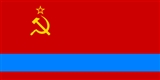
Kazakh SSR

Encyclopedia
The Kazakh Soviet Socialist Republic , also known as the Kazakh SSR for short, was one of republics
that made up the Soviet Union
.
At 2717300 square kilometres (1,049,155.4 sq mi) in area, it was the second largest constituent republic in the USSR, after the Russian SFSR
. Its capital was Alma-Ata (today known as Almaty). Today it is the independent state of Kazakhstan
in Central Asia
. During its existence it was led by the Communist Party of the Kazakh SSR.
The country is named after the Kazakh
people, Turkic
-speaking former nomad
s who sustained a powerful khanate
in the region before Russia
n and then Soviet domination. The Soviet Union's spaceport
, now known as the Baikonur Cosmodrome
, was located in this republic at Tyuratam
, and the secret town of Baikonur
was constructed to accommodate its personnel.
) and was a part of the Russian SFSR. On April 15–19, 1925, it was renamed Kazak ASSR (subsequently Kazakh ASSR) and on December 5, 1936 it was elevated to the status of a Union-level republic, Kazakh SSR. During the 1950s and 1960s Soviet citizens were urged to settle in the Virgin Lands
of the Kazakh Soviet Socialist Republic. The influx of immigrants, mostly Russians
, skewed the ethnic mixture and enabled non-Kazakhs to outnumber natives. As a result, the use of Kazakh language has declined but has started to pick up again after the independence, both as a result of its resurging popularity in law and business and growing proportion of Kazakhs since the Independence
. The other nationalities included Ukrainians
, Germans
, Jews
, Belarusians
, Koreans and others; Germans at the time of independence formed about 8% of the population, the largest concentration of Germans in the entire Soviet Union. Independence
has caused many of these newcomers to emigrate.
On December 10, 1991 Kazakh SSR was renamed into Republic of Kazakhstan
and fifteen days later became independent, with the final collapse of the Soviet Union.
Table: Ethnic Composition of Kazakhstan (census data)
Republics of the Soviet Union
The Republics of the Soviet Union or the Union Republics of the Soviet Union were ethnically-based administrative units that were subordinated directly to the Government of the Soviet Union...
that made up the Soviet Union
Soviet Union
The Soviet Union , officially the Union of Soviet Socialist Republics , was a constitutionally socialist state that existed in Eurasia between 1922 and 1991....
.
At 2717300 square kilometres (1,049,155.4 sq mi) in area, it was the second largest constituent republic in the USSR, after the Russian SFSR
Russian Soviet Federative Socialist Republic
The Russian Soviet Federative Socialist Republic , commonly referred to as Soviet Russia, Bolshevik Russia, or simply Russia, was the largest, most populous and economically developed republic in the former Soviet Union....
. Its capital was Alma-Ata (today known as Almaty). Today it is the independent state of Kazakhstan
Kazakhstan
Kazakhstan , officially the Republic of Kazakhstan, is a transcontinental country in Central Asia and Eastern Europe. Ranked as the ninth largest country in the world, it is also the world's largest landlocked country; its territory of is greater than Western Europe...
in Central Asia
Central Asia
Central Asia is a core region of the Asian continent from the Caspian Sea in the west, China in the east, Afghanistan in the south, and Russia in the north...
. During its existence it was led by the Communist Party of the Kazakh SSR.
The country is named after the Kazakh
Kazakhs
The Kazakhs are a Turkic people of the northern parts of Central Asia ....
people, Turkic
Turkic languages
The Turkic languages constitute a language family of at least thirty five languages, spoken by Turkic peoples across a vast area from Eastern Europe and the Mediterranean to Siberia and Western China, and are considered to be part of the proposed Altaic language family.Turkic languages are spoken...
-speaking former nomad
Nomad
Nomadic people , commonly known as itinerants in modern-day contexts, are communities of people who move from one place to another, rather than settling permanently in one location. There are an estimated 30-40 million nomads in the world. Many cultures have traditionally been nomadic, but...
s who sustained a powerful khanate
Khanate
Khanate, or Chanat, is a Turco-Mongol-originated word used to describe a political entity ruled by a Khan. In modern Turkish, the word used is kağanlık, and in modern Azeri of the republic of Azerbaijan, xanlıq. In Mongolian the word khanlig is used, as in "Khereidiin Khanlig" meaning the Khanate...
in the region before Russia
Russia
Russia or , officially known as both Russia and the Russian Federation , is a country in northern Eurasia. It is a federal semi-presidential republic, comprising 83 federal subjects...
n and then Soviet domination. The Soviet Union's spaceport
Spaceport
A spaceport or cosmodrome is a site for launching spacecraft, by analogy with seaport for ships or airport for aircraft. The word spaceport, and even more so cosmodrome, has traditionally been used for sites capable of launching spacecraft into orbit around Earth or on interplanetary trajectories...
, now known as the Baikonur Cosmodrome
Baikonur Cosmodrome
The Baikonur Cosmodrome , also called Tyuratam, is the world's first and largest operational space launch facility. It is located in the desert steppe of Kazakhstan, about east of the Aral Sea, north of the Syr Darya river, near Tyuratam railway station, at 90 meters above sea level...
, was located in this republic at Tyuratam
Tyuratam
Tyuratam is a station on the main Moscow to Tashkent railway, located in Kazakhstan. The name is a word in the Kazakh language and means "Töre's grave"; Töre, or more formally, Töre-Baba, was a noble, a descendant of Genghis Khan...
, and the secret town of Baikonur
Leninsk
Leninsk may refer to:*Leninsk, Volgograd Oblast, a town in Volgograd Oblast, Russia*Leninsk, a former urban-type settlement in Chelyabinsk Oblast, Russia; since 2005—part of the city of Miass *Leninsk-Kuznetsky, a city in Kemerovo Oblast, Russia...
was constructed to accommodate its personnel.
History
Established on August 26, 1920, it was initially called Kirghiz ASSR (Kirghiz Autonomous Soviet Socialist RepublicKirghiz Autonomous Soviet Socialist Republic
The Kirghiz Autonomous Soviet Socialist Republic was an autonomous republic of the Soviet Union within the Russian Soviet Federative Socialist Republic existing from 1920 until 1925, when it took the name of Kazakh Autonomous Soviet Socialist Republic....
) and was a part of the Russian SFSR. On April 15–19, 1925, it was renamed Kazak ASSR (subsequently Kazakh ASSR) and on December 5, 1936 it was elevated to the status of a Union-level republic, Kazakh SSR. During the 1950s and 1960s Soviet citizens were urged to settle in the Virgin Lands
Virgin Lands Campaign
The Virgin Lands Campaign was an initiative by Nikita Khrushchev to open up vast tracts of unseeded steppe in the northern Kazakh Soviet Socialist Republic and the Altay region of the Russian Soviet Federative Socialist Republic, started in 1954....
of the Kazakh Soviet Socialist Republic. The influx of immigrants, mostly Russians
Russians
The Russian people are an East Slavic ethnic group native to Russia, speaking the Russian language and primarily living in Russia and neighboring countries....
, skewed the ethnic mixture and enabled non-Kazakhs to outnumber natives. As a result, the use of Kazakh language has declined but has started to pick up again after the independence, both as a result of its resurging popularity in law and business and growing proportion of Kazakhs since the Independence
Independence
Independence is a condition of a nation, country, or state in which its residents and population, or some portion thereof, exercise self-government, and usually sovereignty, over its territory....
. The other nationalities included Ukrainians
Ukrainians
Ukrainians are an East Slavic ethnic group native to Ukraine, which is the sixth-largest nation in Europe. The Constitution of Ukraine applies the term 'Ukrainians' to all its citizens...
, Germans
Germans
The Germans are a Germanic ethnic group native to Central Europe. The English term Germans has referred to the German-speaking population of the Holy Roman Empire since the Late Middle Ages....
, Jews
Jews
The Jews , also known as the Jewish people, are a nation and ethnoreligious group originating in the Israelites or Hebrews of the Ancient Near East. The Jewish ethnicity, nationality, and religion are strongly interrelated, as Judaism is the traditional faith of the Jewish nation...
, Belarusians
Belarusians
Belarusians ; are an East Slavic ethnic group who populate the majority of the Republic of Belarus. Introduced to the world as a new state in the early 1990s, the Republic of Belarus brought with it the notion of a re-emerging Belarusian ethnicity, drawn upon the lines of the Old Belarusian...
, Koreans and others; Germans at the time of independence formed about 8% of the population, the largest concentration of Germans in the entire Soviet Union. Independence
Independence
Independence is a condition of a nation, country, or state in which its residents and population, or some portion thereof, exercise self-government, and usually sovereignty, over its territory....
has caused many of these newcomers to emigrate.
On December 10, 1991 Kazakh SSR was renamed into Republic of Kazakhstan
Kazakhstan
Kazakhstan , officially the Republic of Kazakhstan, is a transcontinental country in Central Asia and Eastern Europe. Ranked as the ninth largest country in the world, it is also the world's largest landlocked country; its territory of is greater than Western Europe...
and fifteen days later became independent, with the final collapse of the Soviet Union.
Population
According to the 1897 census, the earliest census taken in the region, Kazakhs constituted 81.7% of the total population (3,392,751 people) within the territory of contemporary Kazakhstan. The Russian population in Kazakhstan was 454,402, or 10.95% of total population; there were 79,573 Ukrainians (1.91%); 55,984 Tatars (1.34%); 55,815 Uyghurs (1.34%); 29,564 Uzbeks (0.7%); 11,911 Mordovans (0.28%); 4,888 Dungan (0.11%); 2,883 Turkmen; 2,613 Germans; 2,528 Bashkir; 1,651 Jews; and 1,254 Poles.Table: Ethnic Composition of Kazakhstan (census data)
| Nationality | 1959 % | 1970 % | 1979 % | 1989 % | 1999 % |
|---|---|---|---|---|---|
| Kazakh | 30.0 | 32.6 | 36.0 | 40.1 | 53.4 |
| Russian | 42.7 | 42.4 | 40.8 | 37.4 | 29.9 |
| Ukrainian | 8.2 | 7.2 | 6.1 | 5.4 | 3.7 |
| Belarusian | 1.2 | 1.5 | 1.2 | 1.1 | 0.8 |
| German | 7.1 | 6.6 | 6.1 | 5.8 | 2.4 |
| Tatar | 2.1 | 2.2 | 2.1 | 2.0 | 1.7 |
| Uzbek | 1.5 | 1.7 | 1.8 | 2.0 | 2.5 |
| Uyghur | 0.6 | 0.9 | 1.0 | 1.1 | 1.4 |
| Korean | 0.8 | 0.6 | 0.6 | 0.6 | 0.7 |
External links
- Kazakhstan: Seven Year Plan for Prosperity by Dinmukhamed Konayev, a 1958 Soviet propaganda booklet