
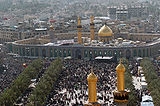
The
Shrine of Husayn ibn ‘Alī is one of the oldest mosques on Earth and a holy site of Shīah Islām in the city of
KarbalāKarbala is a city in Iraq, located about southwest of Baghdad. Karbala is the capital of Karbala Governorate, and has an estimated population of 572,300 people ....
,
IraqIraq ; officially the Republic of Iraq is a country in Western Asia spanning most of the northwestern end of the Zagros mountain range, the eastern part of the Syrian Desert and the northern part of the Arabian Desert....
. It stands on the site of the grave of
Husayn ibn ‘AlīHussein ibn ‘Alī ibn Abī Ṭālib was the son of ‘Alī ibn Abī Ṭālib and Fātimah Zahrā...
, the second grandson of
MuhammadMuhammad |ligature]] at U+FDF4 ;Arabic pronunciation varies regionally; the first vowel ranges from ~~; the second and the last vowel: ~~~. There are dialects which have no stress. In Egypt, it is pronounced not in religious contexts...
, near the place where he was killed during the
Battle of KarbalāThe Battle of Karbala took place on Muharram 10, in the year 61 of the Islamic calendar in Karbala, in present day Iraq. On one side of the highly uneven battle were a small group of supporters and relatives of Muhammad's grandson Husain ibn Ali, and on the other was a large military detachment...
in 680
C.E.Common Era ,abbreviated as CE, is an alternative designation for the calendar era originally introduced by Dionysius Exiguus in the 6th century, traditionally identified with Anno Domini .Dates before the year 1 CE are indicated by the usage of BCE, short for Before the Common Era Common Era...
. The tomb of
Husayn ibn ‘AlīHussein ibn ‘Alī ibn Abī Ṭālib was the son of ‘Alī ibn Abī Ṭālib and Fātimah Zahrā...
is one of the holiest places for Shī‘as outside of
MeccaMecca is a city in the Hijaz and the capital of Makkah province in Saudi Arabia. The city is located inland from Jeddah in a narrow valley at a height of above sea level...
and
MedinaMedina , or ; also transliterated as Madinah, or madinat al-nabi "the city of the prophet") is a city in the Hejaz region of western Saudi Arabia, and serves as the capital of the Al Madinah Province. It is the second holiest city in Islam, and the burial place of the Islamic Prophet Muhammad, and...
, and many make
pilgrimageA pilgrimage is a journey or search of great moral or spiritual significance. Typically, it is a journey to a shrine or other location of importance to a person's beliefs and faith...
s to the site. Every year, millions of pilgrims visit the city to observe
‘ĀshūrāThe Day of Ashura is on the 10th day of Muharram in the Islamic calendar and marks the climax of the Remembrance of Muharram.It is commemorated by Shia Muslims as a day of mourning for the martyrdom of Husayn ibn Ali, the grandson of the Islamic Prophet Muhammad at the Battle of Karbala on 10...
, which marks the anniversary of
Husayn ibn ‘AlīHussein ibn ‘Alī ibn Abī Ṭālib was the son of ‘Alī ibn Abī Ṭālib and Fātimah Zahrā...
's death.
The
UmayyadThe Umayyad Caliphate was the second of the four major Arab caliphates established after the death of Muhammad. It was ruled by the Umayyad dynasty, whose name derives from Umayya ibn Abd Shams, the great-grandfather of the first Umayyad caliph. Although the Umayyad family originally came from the...
and
AbbasidThe Abbasid Caliphate or, more simply, the Abbasids , was the third of the Islamic caliphates. It was ruled by the Abbasid dynasty of caliphs, who built their capital in Baghdad after overthrowing the Umayyad caliphate from all but the al-Andalus region....
caliphThe Caliph is the head of state in a Caliphate, and the title for the ruler of the Islamic Ummah, an Islamic community ruled by the Shari'ah. It is a transcribed version of the Arabic word which means "successor" or "representative"...
s prevented construction of the shrines and discouraged pilgrimage to the sites. The tomb and its annexes were destroyed by Abbasid caliph
Al-MutawakkilAl-Mutawakkil ʻAlā Allāh Jaʻfar ibn al-Muʻtasim was an Abbasid caliph who reigned in Samarra from 847 until 861...
in 850-851 and Shi'a pilgrimage was prohibited, but shrines in Karbala and Najaf were built by the
BuwayhidThe Buyid dynasty, also known as the Buyid Empire or the Buyids , also known as Buwaihids, Buyahids, or Buyyids, were a Shī‘ah Persian dynasty that originated from Daylaman in Gilan...
emir
'Adud al-DaulaAḍud al-Dawla or Azod od-Dowleh Panah Khusraw was an emir of the Buyid dynasty in Iran and Iraq...
in 979-80.
Two main roads lead the visitor to Karbala. One is from the Iraqi capital Baghdad, through Al-Musails, and the other is from
NajafNajaf is a city in Iraq about 160 km south of Baghdad. Its estimated population in 2008 is 560,000 people. It is the capital of Najaf Governorate...
. At the city's entrance there is a row of houses decorated with wooden columns.
The boundary wall of the shrine surrounds wooden gates covered with glass decorations. The gates open into a courtyard separated into smaller rooms or precincts with many
"IwanAn iwan is a rectangular hall or space, usually vaulted, walled on three sides, with one end entirely open. The formal gateway to the iwan is called pishtaq, a Persian term for a portal projecting from the facade of a building, usually decorated with calligraphy bands, glazed tilework, and...
s" along the walls. The grave of
HusaynHussein ibn ‘Alī ibn Abī Ṭālib was the son of ‘Alī ibn Abī Ṭālib and Fātimah Zahrā...
is enclosed within a cage-like structure, found directly beneath the golden dome.
Al Abbas MosqueThe Al-‘Abbās Mosque or Masjid al-‘Abbās is the mausoleum of ‘Abbās ibn ‘Alī, located across from the Imām Husayn Mosque in Karbalā, Iraq. ‘Abbās was the brother Hasan and Husayn, and was the flag-bearer for Husayn in the Battle of Karbalā...
is located nearby.
History of Karbala
Karbala, a city in
IraqIraq ; officially the Republic of Iraq is a country in Western Asia spanning most of the northwestern end of the Zagros mountain range, the eastern part of the Syrian Desert and the northern part of the Arabian Desert....
is located about 100 km southwest of
BaghdadBaghdad is the capital of Iraq, as well as the coterminous Baghdad Governorate. The population of Baghdad in 2011 is approximately 7,216,040...
at 32.61°N, 44.08°E. It was at first a desolate place and did not witness any noteworthy activity, although it was rich in water and its soil was fertile. When Imam
HusainHusain is a common Arabic name especially among Muslims, because of the popularity of Hussein bin AliGrand son of Muhammadhe said .....al husain o mini wa ana minal hussain* Adrian A...
arrived at Karbala and was surrounded by the forces of Ubaidullah bin Ziyad, he inquired about the name of the place. Someone replied it is Aqr - meaning ‘harsh’. Imam Husain then said: we seek refuge with Allah from Al Aqr. He once again asked the name of the village. Then one of the attendants replied, its name is Karbala. Imam Husain spontaneously declared: land of Karb and Bal’a meaning (land of) “torture and trial”. In the time of Imam Husain, the place was also known as al Ghadiriyah, Nainawa, and Shat ul Furat. Imam Husain bought a piece of land, after his arrival at Karbala from Bani Asad. He and his Ahl al Bait are buried in that portion, known by as Hair, where the Shrines are presently located. The history of destruction and reconstruction of the Shrines of Karbala is long. Both the Shrines were greatly extended by successive Muslim rulers, but suffered repeated destruction from attacking armies. Karbala's development was strongly influenced by the Persians.
History has recorded the names of several rulers who shared the honor of extending, decorating and keeping the Shrines and its precincts in good condition. Among them is Fateh Ali Qajar, who in 1250 (A.H) ordered the construction of two Shrines, one over Imam Husain’s grave and the other over the grave of his brother, Abul Fazlil Abbas ibn Ali. The first dome is 27 meters high and completely covered with gold. At the bottom, it is surrounded with 12 windows, each of which is about 1.25 m away from the other, from the inside, and 1.30 m from the outside. The Shrine has an area of 59 m / 75 m with ten gates, and about 65 rooms, well decorated from the inside and outside, and used as class rooms for studying. As for the grave itself, which is in the middle of the precinct, it is called the Rawzah or garden and it has several doors. The most famous one is called al Qiblah or Bab al Zah’ab.
Karbala consists of some places like Ganj E Shaheedah where all the Followers of Imam Hussain were buried and Qatl Gaah where Imam Hussain and his followers fought with the Syrian Army
Quran
Some Shias consider this verse to refer to Shia sacred sites of
NajafNajaf is a city in Iraq about 160 km south of Baghdad. Its estimated population in 2008 is 560,000 people. It is the capital of Najaf Governorate...
and
KarbalaKarbala is a city in Iraq, located about southwest of Baghdad. Karbala is the capital of Karbala Governorate, and has an estimated population of 572,300 people ....
since the Islamic view of Lot claims Lot lived in
UrUr was an important city-state in ancient Sumer located at the site of modern Tell el-Muqayyar in Iraq's Dhi Qar Governorate...
which lies in present day Iraq.
Hadith
The mosque stands on the site of the grave of
Husayn ibn ‘AlīHussein ibn ‘Alī ibn Abī Ṭālib was the son of ‘Alī ibn Abī Ṭālib and Fātimah Zahrā...
, where he was martyred during the
Battle of KarbalāThe Battle of Karbala took place on Muharram 10, in the year 61 of the Islamic calendar in Karbala, in present day Iraq. On one side of the highly uneven battle were a small group of supporters and relatives of Muhammad's grandson Husain ibn Ali, and on the other was a large military detachment...
in 680. Up to a million pilgrims visit the city to observe
‘ĀshūrāThe Day of Ashura is on the 10th day of Muharram in the Islamic calendar and marks the climax of the Remembrance of Muharram.It is commemorated by Shia Muslims as a day of mourning for the martyrdom of Husayn ibn Ali, the grandson of the Islamic Prophet Muhammad at the Battle of Karbala on 10...
, which marks the anniversary of Husayn ibn ‘Alī's death. There are many Shī‘ah traditions which narrate the status of Karbalā:
Karbala: origin and meaning
There are many opinions among different investigators, as to the origin of the word "Karbala". Some have pointed out that "Karbala" has a connection to the "Karbalato" language, while others attempt to derive the meaning of word "Karbala" by analysing its spelling and language. They conclude that it originates from the Arabic word "Kar Babel" which was a group of ancient Babylonian villages that included Nainawa, Al-Ghadiriyya, Karbella (Karb Illu. as in Arba Illu [Arbil]), Al-Nawaweess, and Al-Heer. This last name is today known as Al-Hair and is where Hussain ibn Ali’s grave is located.
The investigator Yaqut al-Hamawy had pointed out that the meaning of "Karbala" could have several explanations, one of which is that the place where Hussain ibn Ali was martyred is made of soft earth - "Al-Karbalat".
According to Shī‘ah belief, the true meaning of the name Karbalā was narrated to
MuhammadMuhammad |ligature]] at U+FDF4 ;Arabic pronunciation varies regionally; the first vowel ranges from ~~; the second and the last vowel: ~~~. There are dialects which have no stress. In Egypt, it is pronounced not in religious contexts...
by the archangel
GabrielIn Abrahamic religions, Gabriel is an Archangel who typically serves as a messenger to humans from God.He first appears in the Book of Daniel, delivering explanations of Daniel's visions. In the Gospel of Luke Gabriel foretells the births of both John the Baptist and of Jesus...
as being, "the land which will cause many agonies (
karb) and afflictions (
balā)."
Buried within the Mosque
The grave of
Imam HusaynHussein ibn ‘Alī ibn Abī Ṭālib was the son of ‘Alī ibn Abī Ṭālib and Fātimah Zahrā...
is found in the middle of the precinct, and is called the
"Rawda" or
"Garden" and it has several entry gates. The most famous one is called "Al-Qibla" or "Bāb al-Dhahab". When it is entered, one can see the tomb of
Habīb ibn Madhāhir al-AsadīHabīb ibn Muzāhir al-Asadi was of the Banu Asad clan, one of the companions of Muhammad who was martyred in Karbala.-Battle of Karbala:Habib heavily contributed in the Battle of Karbala. He fought with the third Shia Imam, Husayn ibn Ali against the forces of Yazid, led by Umar ibn Sa'ad...
, to the right hand side. Habīb was a friend and companion of
Imam HusaynHussein ibn ‘Alī ibn Abī Ṭālib was the son of ‘Alī ibn Abī Ṭālib and Fātimah Zahrā...
since their childhood and was honored with martyrdom at the
Battle of KarbalāThe Battle of Karbala took place on Muharram 10, in the year 61 of the Islamic calendar in Karbala, in present day Iraq. On one side of the highly uneven battle were a small group of supporters and relatives of Muhammad's grandson Husain ibn Ali, and on the other was a large military detachment...
.
Within the shrine of
Imam HusaynHussein ibn ‘Alī ibn Abī Ṭālib was the son of ‘Alī ibn Abī Ṭālib and Fātimah Zahrā...
can also be found a grave of all the 72 martyrs of Karbalā. They were buried in a mass grave which was then covered with soil to the ground level. This mass grave is at the foot of
Imam HusaynHussein ibn ‘Alī ibn Abī Ṭālib was the son of ‘Alī ibn Abī Ṭālib and Fātimah Zahrā...
's grave. As well, beside
Imam HusaynHussein ibn ‘Alī ibn Abī Ṭālib was the son of ‘Alī ibn Abī Ṭālib and Fātimah Zahrā...
's grave are the graves of his two sons: ‘Alī al-Akbar and the 6-month old, ‘Alī al-Asghar. Also buried within the mosque is Ibrāhīm (son of the seventh Twelver Shī‘ah
ImāmImāmah is the Shia doctrine of religious, spiritual and political leadership of the Ummah. The Shīa believe that the A'immah are the true Caliphs or rightful successors of Muḥammad, and further that Imams are possessed of divine knowledge and authority as well as being part of the Ahl al-Bayt,...
,
Mūsā al-Kādhim' was the seventh of the Twelve Imams of Twelver Shi'a Islam. He was the son of Imam and his mother was Hamidah Khātūn, a student and former Zanjiyyah slave...
), who spent his life preaching about Karbalā.
Martyrdom and popularity
Karbalā was at first an uninhabited place and did not witness any constructional activity, although it was rich in water and its soil fertile.
From the time of
Husayn ibn ‘AlīHussein ibn ‘Alī ibn Abī Ṭālib was the son of ‘Alī ibn Abī Ṭālib and Fātimah Zahrā...
's death in 680, pilgrimages to commemorate the massacre have often been repressed.
Despite many attempts by successive rulers, such as
Al-RashīdHārūn al-Rashīd was the fifth Arab Abbasid Caliph in Iraq. He was born in Rey, Iran, close to modern Tehran. His birth date remains a point of discussion, though, as various sources give the dates from 763 to 766)....
and
Al-MutawakkilAl-Mutawakkil ʻAlā Allāh Jaʻfar ibn al-Muʻtasim was an Abbasid caliph who reigned in Samarra from 847 until 861...
, to put a restriction on the development of this area, it has nonetheless spread with time to become a city.
Early development and specifications
The historian Ibn Kuluwayh mentioned that those who buried
Husayn ibn ‘AlīHussein ibn ‘Alī ibn Abī Ṭālib was the son of ‘Alī ibn Abī Ṭālib and Fātimah Zahrā...
, made a special and rigid construction with signs above the grave.
Higher and bigger constructions above the grave started during the ruling of
al-SaffahAbu al-`Abbās `Abdu'llāh ibn Muhammad as-Saffāh, or Abul `Abbas al-Saffah , was the first Abbasid caliph .As-Saffah was the head of one branch of the Banu Hashim, who traced their lineage to Hashim, a great-grandfather of...
, but heavy restrictions were put in place to prevent people from visiting the grave during the rule of
Hārūn al-RashīdHārūn al-Rashīd was the fifth Arab Abbasid Caliph in Iraq. He was born in Rey, Iran, close to modern Tehran. His birth date remains a point of discussion, though, as various sources give the dates from 763 to 766)....
.
At the time of
al-Mā'mūnAbū Jaʿfar Abdullāh al-Māʾmūn ibn Harūn was an Abbasid caliph who reigned from 813 until his death in 833...
, construction around the grave resumed until the year 850, when
al-MutawakkilAl-Mutawakkil ʻAlā Allāh Jaʻfar ibn al-Muʻtasim was an Abbasid caliph who reigned in Samarra from 847 until 861...
ordered the destruction and digging of the grave, and then filling the pit with water. His son who succeeded him
al-MuntasirAl-Muntasir was the Abbasid caliph in Baghdad from 861 to 862. His pious title means He that Triumphs in the Lord.Muhammad ibn Jarir al-Tabari records that in A.H. 236 al-Muntasir led the pilgrimage. The previous year al-Mutawakkil had named his three son's heirs and seeming to favour al-Muntasir...
, allowed people to visit the grave site, and since then building the precinct to the grave increased and developed step by step.
On the other hand, the historian
Ibn al-AthirAbu al-Hassan Ali ibn Muhammad ibn Muhammad, better known as Ali 'Izz al-Din Ibn al-Athir al-Jazari was a Kurdish Muslim historian from the Ibn Athir family...
, stated that in the year 371 AH,
‘Adhud ad-DawlahAḍud al-Dawla or Azod od-Dowleh Panah Khusraw was an emir of the Buyid dynasty in Iran and Iraq...
became the first to largely lay the foundations for large scale construction, and generously decorated the place. He also built houses and markets around the precinct, and surrounded Karbalā with a high boundary wall turning it into a strong castle.
In the year 407 AH, the precinct caught fire due to the dropping of two large candles on the wooden decorations. The state minister at the time, Hasan ibn Fadl, rebuilt the damaged sections.
History has recorded the names of several rulers who shared the honor of widening, decorating or keeping the precinct in good condition. Amongst them is Fat'h ‘Alī Shāh Qājār, who in 1250 AH ordered the construction of two domes, one over
Husayn ibn ‘AlīHussein ibn ‘Alī ibn Abī Ṭālib was the son of ‘Alī ibn Abī Ṭālib and Fātimah Zahrā...
's grave and the other over his brother
‘Abbās ibn ‘AlīAl-‘Abbās ibn ‘Ali was the son of ‘Alī ibn Abī Tālib and fourth Rashidun Caliph) and Fātimah bint Hizam al-Kilabiyyah .Al-‘Abbās is revered by Muslims for his loyalty to his half-brother Husayn ibn ‘Alī, his respect for the...
.
The first dome is 27 meters high and completely covered with gold. At the bottom, it is surrounded with 12 windows, each of which is about 1.25 m away from the ookoutside.
The mausoleum has an area of 59 m / 75 m with ten gates, and about 65 rooms, well decorated from the inside and outside, used as classrooms for studying.
Timeline
| Year |
Event |
AHThe Hijri calendar , also known as the Muslim calendar or Islamic calendar , is a lunar calendar consisting of 12 lunar months in a year of 354 or 355 days. It is used to date events in many Muslim countries , and used by Muslims everywhere to determine the proper day on which to celebrate Islamic... | | CE Common Era ,abbreviated as CE, is an alternative designation for the calendar era originally introduced by Dionysius Exiguus in the 6th century, traditionally identified with Anno Domini .Dates before the year 1 CE are indicated by the usage of BCE, short for Before the Common Era Common Era...
|
| 61 |
680 |
October 10: HusaynHussein ibn ‘Alī ibn Abī Ṭālib was the son of ‘Alī ibn Abī Ṭālib and Fātimah Zahrā... is said to have been buried on this day. It was Bani Asad who, after the departure of Ahl al Bait, assembled at the grave of Imam Husayn. Historical accounts provide little light on the first builder of the Shrine. It is assumed that Bani Asad also the first, who erected a tent upon the grave of Imam Husayn. A Shaikh of Bani Asad lighted a candle at the grave of the Imam and planted a berry tree a few feet away from the side of the head of the grave, to indicate the grave of Husayn. |
| 65 |
684 |
A mosque was built by Mukhtar ibn Abu `Ubayd ath-Thaqafi on the spot and a dome was created over the grave. Over the dome he fixed a green flag. Two entrance gates were made for the mosque. He also settled several families around the enclosure. |
| 132 |
749 |
Another dome was erected over the mosque and additional two gates for entrance were made at the mausoleum during the reign of Abbasid CaliphThe Abbasid Caliphate or, more simply, the Abbasids , was the third of the Islamic caliphates. It was ruled by the Abbasid dynasty of caliphs, who built their capital in Baghdad after overthrowing the Umayyad caliphate from all but the al-Andalus region.... as-SaffahAbu al-`Abbās `Abdu'llāh ibn Muhammad as-Saffāh, or Abul `Abbas al-Saffah , was the first Abbasid caliph .As-Saffah was the head of one branch of the Banu Hashim, who traced their lineage to Hashim, a great-grandfather of... . |
| 140 |
763 |
During the reign of Caliph al-Mansur Al-Mansur, Almanzor or Abu Ja'far Abdallah ibn Muhammad al-Mansur was the second Abbasid Caliph from 136 AH to 158 AH .-Biography:... , the roof along with the domes were destroyed. |
| 158 |
774 |
The demolished roof was rebuilt during the reign of Caliph al-Mahdi Muhammad ibn Mansur al-Mahdi , was the third Abbasid Caliph who reigned from 158 AH to 169 AH . He succeeded his father, al-Mansur.... . |
| 171 |
787 |
During the reign of Caliph Harun ar-RashidHārūn al-Rashīd was the fifth Arab Abbasid Caliph in Iraq. He was born in Rey, Iran, close to modern Tehran. His birth date remains a point of discussion, though, as various sources give the dates from 763 to 766).... , the mausoleum was destroyed and the Berry tree that stood besides the grave of Husayn was cut down. Even then people kept visiting the grave of Imam Husayn, guided by the traces of the ‘Tree of the Berry’, which covered the grave. Harun al-Rashid could not tolerate this, and ordered the tree to be totally cut off from the roots, with the intention to wipe out the sign of the grave of Husayn and stop the practice of visiting the grave. |
| 193 |
808 |
The mausoleum was reconstructed during the reign of Caliph al-Amin Muhammad ibn Harun al-Amin , Abbasid Caliph. He succeeded his father, Harun al-Rashid in 809 and ruled until he was killed in 813.-Caliph:... . |
| 236 |
850 |
Caliph al-Mutawakkil Al-Mutawakkil ʻAlā Allāh Jaʻfar ibn al-Muʻtasim was an Abbasid caliph who reigned in Samarra from 847 until 861... destroyed the mausoleum and ordered the nearby land, including the grave, to be ploughed. |
| 247 |
861 |
Caliph al-Muntasir Al-Muntasir was the Abbasid caliph in Baghdad from 861 to 862. His pious title means He that Triumphs in the Lord.Muhammad ibn Jarir al-Tabari records that in A.H. 236 al-Muntasir led the pilgrimage. The previous year al-Mutawakkil had named his three son's heirs and seeming to favour al-Muntasir... reconstructed the shrine with an iron pillar build a roof over the grave. Under instruction of Al Muntasir, new houses were built around the Shrines. |
| 273 |
886 |
Once again the mausoleum was destroyed. |
| 280 |
893 |
The shrine was rebuilt by the Alid council and two minarets were constructed on either side of the grave. Two entrance gates for the shrine were also constructed. |
| 307 |
977 |
A sepulcher was constructed within the shrine using teak wood, by the BuwayhidThe Buyid dynasty, also known as the Buyid Empire or the Buyids , also known as Buwaihids, Buyahids, or Buyyids, were a Shī‘ah Persian dynasty that originated from Daylaman in Gilan... emir ‘Adhud ad-DawlahAḍud al-Dawla or Azod od-Dowleh Panah Khusraw was an emir of the Buyid dynasty in Iran and Iraq... . Surrounding galleries were also constructed. He also constructed the city of KarbalaKarbala is a city in Iraq, located about southwest of Baghdad. Karbala is the capital of Karbala Governorate, and has an estimated population of 572,300 people .... by making houses and the city boundary. ‘Imrān ibn ShahinImran ibn Shahin was a Nabataean and the founder of a state in the Batihah marshlands in the 10th century. His reign was marked by decades of struggle against the Buyids of Iraq.- Life :... at that time also constructed a mosque adjacent to the shrine. |
| 407 |
1016 |
Fire destroyed the shrine. The vizier A vizier or in Arabic script ; ; sometimes spelled vazir, vizir, vasir, wazir, vesir, or vezir) is a high-ranking political advisor or minister in a Muslim government.... Hasan ibn Fadl rebuilt the structure. |
| 620 |
1223 |
The sepulcher was renovated by an-Nasir li-Din AllahAn-Nasir li-Din Allah was the 34th Abbasid Caliph in Baghdad from 1180 until his death. His laqab literally means The Victor for the Religion of God. He attempted to restore the Caliphate to its ancient dominant role and achieved a surprising amount of success, despite the fact that the... . |
| 757 |
1365 |
The dome and walls of the shrine were reconstructed by Sultan `Uways ibn Hasan Jalayiri Shaikh Uvais, also known as Uways or Oways , was a Jalayirid ruler of Iraq and Azerbaijan . He was the son of Hasan Buzurg and the Chobanid Delsad Katun.-Life:... . He also raised the walls of the enclosure. |
| 780 |
1384 |
The two minarets were reconstructed of gold by Sultan Ahmad ibn `Uways. The courtyard was also extended. |
| 920 |
1514 |
The Safavid shahShāh is the title of the ruler of certain Southwest Asian and Central Asian countries, especially Persia , and derives from the Persian word shah, meaning "king".-History:... of IranIran , officially the Islamic Republic of Iran , is a country in Southern and Western Asia. The name "Iran" has been in use natively since the Sassanian era and came into use internationally in 1935, before which the country was known to the Western world as Persia... Ismail IIsmail I , known in Persian as Shāh Ismāʿil , was a Shah of Iran and the founder of the Safavid dynasty which survived until 1736. Isma'il started his campaign in Azerbaijan in 1500 as the leader of the Safaviyya, an extremist heterodox Twelver Shi'i militant religious order and unified all of Iran... , constructed a sarcophagus of inlaid glass work over the real grave. |
| 1032 |
1622 |
Abbas Shah Safavi renovated the sarcophagus with brass and bronze and also the dome with Kashi tiles. |
| 1048 |
1638 |
Sultan Murad IVMurad IV Ghazi was the Sultan of the Ottoman Empire from 1623 to 1640, known both for restoring the authority of the state and for the brutality of his methods... whitewashed the dome. |
| 1155 |
1742 |
Nadir Shah Afshar decorated the shrine and offered expensive gems to the treasury of the shrine. |
| 1211 |
1796 |
Aghā Muhammad Shāh Qājār plastered the dome with pure gold. He also decorated the Min’ar and gold plated it. |
| 1216 |
1801 |
Wahhabis attacked Karbala, damaged the shrine, and looted the sepulchre. |
| 1232 |
1817 |
Fat'h ‘Alī Shāh Qājār reconstructed the screens by plating with silver. He also replated the dome with gold and therefore repaired the damage caused by the Wahhabis. |
| 1283 |
1866 |
Nāsir ad-Dīn Shāh Qājār broadened the courtyard of the mausoleum. |
| 1358 |
1939 |
Dr. Syedna Taher Saifuddin, of the Dawoodi Bohra Dawoodi Bohra is a subsect of Ismāʿīlī Shīʿa Islām. While the Dawoodi Bohra is based in India, their belief system originates in Yemen, where it evolved from the Fatimid Caliphate and where they were persecuted due to their differences from mainstream Sunni Islam... community presented a set of solid silver screens with gold which were attached to the shrine. This set is made of 500 gold coins (each coin consisted 12 grams weight) and 200 thousand coins of silver, beautified with precious gems. |
| 1360 |
1941 |
The western minaret was rebuilt by Dr. Syedna Taher Saifuddin. He spent a huge amount generously for the purpose of gold plating all the Min’ar. From top to bottom, pure gold was installed. |
| 1367 |
1948 |
A road was built around the shrine by the then administrator of KarbalaKarbala is a city in Iraq, located about southwest of Baghdad. Karbala is the capital of Karbala Governorate, and has an estimated population of 572,300 people .... City, Sayyid Abd al-Rasul al-Khalsi. He also broadened the courtyard of the shrine. |
| 1411 |
1991 |
Major damage to the shrine occurs as the city experiences violent reprisals by the army of Saddam HusseinSaddam Hussein Abd al-Majid al-Tikriti was the fifth President of Iraq, serving in this capacity from 16 July 1979 until 9 April 2003... after an uprisingThe Shiite Uprising in Karbala was one of many major points of unrest in Iraq following the Gulf War. The uprising started after demoralized troops throughout Iraq began to rebel against Saddam Hussein. From March 5 to March 19, 1991, the city of Karbala became chaotic battlefield between the... against his regime following the Persian Gulf WarThe Persian Gulf War , commonly referred to as simply the Gulf War, was a war waged by a U.N.-authorized coalition force from 34 nations led by the United States, against Iraq in response to Iraq's invasion and annexation of Kuwait.The war is also known under other names, such as the First Gulf... . |
| 1415 |
1994 |
Repairs to the shrine from the damage done in 1991 are finally completed. |
| 1425 |
2004 |
March 2: At least 6 explosions occurred during the ‘Āshūrā'The Day of Ashura is on the 10th day of Muharram in the Islamic calendar and marks the climax of the Remembrance of Muharram.It is commemorated by Shia Muslims as a day of mourning for the martyrdom of Husayn ibn Ali, the grandson of the Islamic Prophet Muhammad at the Battle of Karbala on 10... commemorations, killing 85 people and wounding 230. |
| 1425 |
2004 |
December 15: A bomb detonated near the gate of the shrine, killing at least 7 people and injuring 31 others. |
| 1426 |
2006 |
January 5 The 5 January 2006 Iraq bombings were a series of suicide attacks that occurred on 5 January 2006, in the Shiite holy city of Karbala and in central city of Ramadi, each claiming about 60 or more lives.... : Suicide bombers among the crowd between the two shrines, killed at least 60 people and injured more than 100. |
| 1428 |
2007 |
April 14: A suicide attack 200m from the shrine killed at least 36 people and injured more than 160 others. |
| 1428 |
2007 |
December: Construction work began on building a roof over the courtyard of the mosque, with hopes of creating a second floor and expanding the mosque. |
| 1429 |
2008 |
March 17The 2008 Karbala bombing occurred on March 17, 2008 in Karbala, Iraq.- Background :Karbala is a city in central Iraq, south of Baghdad. It is home to the Imam Husayn Shrine, one of the holiest sites of Shiite Islam... : A female suicide bomber detonated herself in the market near the shrine, killing at least 42 people and injured 58 others. |
| 1429 |
2008 |
September 11: A bomb was detonated 800m from the shrine, killing one woman and injuring 12 others. |
| 1430 |
2009 |
February 12: A bomb blast killed 8 people and wounded more than 50 others during the commemoration of Arba‘eenArba'een or Chelom , is one of the largest pilgrimage gatherings on Earth, in which over 10 million people go to the city of Karbala in Iraq. As it is known by Persian-speaking and Urdu-speaking Muslims in Central and South Asia, Arba'een is a Shia Muslim religious observation that occurs 40 days... . |
| 1431 |
2010 |
Attacks aimed at pilgrims attending the commemoration of Arba‘eenArba'een or Chelom , is one of the largest pilgrimage gatherings on Earth, in which over 10 million people go to the city of Karbala in Iraq. As it is known by Persian-speaking and Urdu-speaking Muslims in Central and South Asia, Arba'een is a Shia Muslim religious observation that occurs 40 days... : February 1: A female suicide bomber detonated herself, killing 54 people and injuring more than 100 others. February 3: A bomb blast killed at least 23 people and injured more than 147. February 5: A double bomb-blast, or a combination of a bomb-blast and mortar attack killed at least 42 people and left 150 injured. |
See also
- Arba'een
Arba'een or Chelom , is one of the largest pilgrimage gatherings on Earth, in which over 10 million people go to the city of Karbala in Iraq. As it is known by Persian-speaking and Urdu-speaking Muslims in Central and South Asia, Arba'een is a Shia Muslim religious observation that occurs 40 days...
- Al-‘Abbās Mosque
The Al-‘Abbās Mosque or Masjid al-‘Abbās is the mausoleum of ‘Abbās ibn ‘Alī, located across from the Imām Husayn Mosque in Karbalā, Iraq. ‘Abbās was the brother Hasan and Husayn, and was the flag-bearer for Husayn in the Battle of Karbalā...
- Holiest sites in Islam (Shia)
In addition to the three Mosques accepted by all Muslims as holy sites, Shī'ah Muslims consider sites associated with Muhammad, his family members and descendants , their companions, and the Prophets as holy places...
- Jannatul Baqee'
- Jannatul Mualla
Jannatul Mualla also known as Al-Hajun, is a famous cemetery located in Makkah, Saudi Arabia.-History:...
- Baab Sagheer
Bāb Saghīr , also called "Goristan-e-Ghariban", is an ancient cemetery and street in Damascus, Syria, with tombs on either side of the road...
External links