


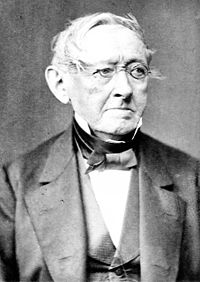
Johann Christian Poggendorff

Encyclopedia
Germany
Germany , officially the Federal Republic of Germany , is a federal parliamentary republic in Europe. The country consists of 16 states while the capital and largest city is Berlin. Germany covers an area of 357,021 km2 and has a largely temperate seasonal climate...
physicist
Physicist
A physicist is a scientist who studies or practices physics. Physicists study a wide range of physical phenomena in many branches of physics spanning all length scales: from sub-atomic particles of which all ordinary matter is made to the behavior of the material Universe as a whole...
born in Hamburg
Hamburg
-History:The first historic name for the city was, according to Claudius Ptolemy's reports, Treva.But the city takes its modern name, Hamburg, from the first permanent building on the site, a castle whose construction was ordered by the Emperor Charlemagne in AD 808...
.
By far the greater and more important part of his work related to electricity
Electricity
Electricity is a general term encompassing a variety of phenomena resulting from the presence and flow of electric charge. These include many easily recognizable phenomena, such as lightning, static electricity, and the flow of electrical current in an electrical wire...
and magnetism
Magnetism
Magnetism is a property of materials that respond at an atomic or subatomic level to an applied magnetic field. Ferromagnetism is the strongest and most familiar type of magnetism. It is responsible for the behavior of permanent magnets, which produce their own persistent magnetic fields, as well...
. Poggendorff is known for his electrostatic motor
Electrostatic motor
An electrostatic motor or capacitor motor is a type of electric motor based on the attraction and repulsion of electric charge.Often, electrostatic motors are the dual of conventional coil-based motors. They typically require a high voltage power supply, although very small motors employ lower...
which is analogous to Wilhelm Holtz
Wilhelm Holtz
Wilhelm Holtz was a German physicist who was a native of Saatel bei Barth, Mecklenburg. Between 1857 and 1862 he studied physics and natural sciences in Berlin, Dijon and Edinburgh...
's electrostatic machine
Electrostatic generator
An electrostatic generator, or electrostatic machine, is a mechanical device that produces static electricity, or electricity at high voltage and low continuous current...
. In 1841 he described the use of the potentiometer
Potentiometer (measuring instrument)
A potentiometer is an instrument for measuring the potential in a circuit. Before the introduction of the moving coil and digital volt meters, potentiometers were used in measuring voltage, hence the '-meter' part of their name...
for measurement of electrical potentials without current draw.
Biography
Poggendorf had apprenticed himself to an apothecaryApothecary
Apothecary is a historical name for a medical professional who formulates and dispenses materia medica to physicians, surgeons and patients — a role now served by a pharmacist and some caregivers....
in Hamburg, and when twenty-two began to earn his living as an apothecary's assistant at Itzehoe. Ambition and a strong inclination towards a scientific career led him to throw up his business and move to Berlin, where he entered Humboldt University in 1820. Here his abilities were speedily recognized, and in 1823 he was appointed meteorological
Meteorology
Meteorology is the interdisciplinary scientific study of the atmosphere. Studies in the field stretch back millennia, though significant progress in meteorology did not occur until the 18th century. The 19th century saw breakthroughs occur after observing networks developed across several countries...
observer to the Academy of Sciences.
Even at this early period he had conceived the idea of founding a physical and chemical scientific journal, and the realization of this plan was hastened by the sudden death of Ludwig Wilhelm Gilbert
Ludwig Wilhelm Gilbert
Ludwig Wilhelm Gilbert was a German physicist and chemist, and professor of physics at the University of Leipzig. From 1799-1824 he published the "Annalen der Physik", of which Poggendorffs "Annalen der Physik und Chemie" was a continuation.-Biography:Gilbert was born in Berlin...
, the editor of Gilbert's Annalen der Physik, in 1824 Poggendorff immediately put himself in communication with the publisher, Barth of Leipzig. He became editor of Annalen der Physik und Chemie, which was to be a continuation of Gilbert's Annalen on a somewhat extended plan. Poggendorff was admirably qualified for the post, and edited the journal for 52 years, until 1876. In 1826, Poggendorff developed the mirror galvanometer
Mirror galvanometer
thumb|right|200px|A mirror galvanometerA mirror galvanometer is a mechanical meter that senses electric current, except that instead of moving a needle, it moves a mirror. The mirror reflects a beam of light, which projects onto a meter, and acts as a long, weightless, massless pointer...
, a device for detecting electric currents.
He had an extraordinary memory, well stored with scientific knowledge, both modern and historical, a cool and impartial judgment, and a strong preference for facts as against theory of the speculative kind. He was thus able to throw himself into the spirit of modern experimental science. He possessed in abundant measure the German virtue of orderliness in the arrangement of knowledge and in the conduct of business. Further he had an engaging geniality of manner and much tact in dealing with men. These qualities soon made Poggendorff's Annalen (abbreviation: Pogg. Ann.) the foremost scientific journal in Europe.
In the course of his fifty-two years editorship of the Annalen Poggendorff could not fail to acquire an unusual acquaintance with the labors of modern men of science. This knowledge, joined to what he had gathered by historical reading of equally unusual extent, he carefully digested and gave to the world in his Biographisch-literarisches Handworterbuch zur Geschichte der exacten Wissenschaften, containing notices of the lives and labors of mathematicians, astronomers, physicists, and chemists, of all peoples and all ages. This work contains an astounding collection of facts invaluable to the scientific biographer and historian. The first two volumes were published in 1863; after his death a third volume appeared in 1898, covering the period 1858-1883, and a fourth in 1904, coming down to the beginning of the 20th century.
His literary and scientific reputation speedily brought him honorable recognition. In 1830 he was made royal professor, in 1838 Hon. Ph.D. and extraordinary professor in the University of Berlin, and in 1839 member of the Berlin Academy of Sciences. In 1845, he was elected a foreign member of the Royal Swedish Academy of Sciences
Royal Swedish Academy of Sciences
The Royal Swedish Academy of Sciences or Kungliga Vetenskapsakademien is one of the Royal Academies of Sweden. The Academy is an independent, non-governmental scientific organization which acts to promote the sciences, primarily the natural sciences and mathematics.The Academy was founded on 2...
. Many offers of ordinary professorships were made to him, but he declined them all, devoting himself to his duties as editor of the Annalen, and to the pursuit of his scientific researches. He died at Berlin on 24 January 1877.
His daughter Marie Poggendorff (born 12 August 1838) married Valentin Rose
Valentin Rose (classicist)
Valentin Rose was a German classicist and textual critic.-Personal life:Valentin Rose was the son of mineralogist Gustav Rose , and a nephew to famed mineralogist Heinrich Rose and to the pharmacist Wilhelm Rose , of whom he published a brief remembrance...
in 1872.
Illusion
The Poggendorff IllusionPoggendorff illusion
The Poggendorff Illusion is a geometrical-optical illusion that involves the misperception of the position of one segment of a transverse line that has been interrupted by the contour of an intervening structure...
is an optical illusion
Optical illusion
An optical illusion is characterized by visually perceived images that differ from objective reality. The information gathered by the eye is processed in the brain to give a perception that does not tally with a physical measurement of the stimulus source...
that involves the brain's perception of the interaction between diagonal lines and horizontal and vertical edges. It is named after Poggendorff, who discovered it in the drawing of Johann Karl Friedrich Zöllner
Johann Karl Friedrich Zöllner
Johann Karl Friedrich Zöllner was a German astrophysicist who studied optical illusions. He invented the Zöllner illusion where lines that are parallel appear diagonal. The lunar Zöllner crater is named in his honor...
, in which he showed the Zöllner illusion
Zollner illusion
The Zöllner illusion is a classic optical illusion named after its discoverer, German astrophysicist Johann Karl Friedrich Zöllner. In 1860, Zöllner sent his discovery in a letter to physicist and scholar Johann Christian Poggendorff, editor of Annalen der Physik und Chemie, who subsequently...
in 1860. In the picture to the right, a straight black line is obscured by a dark gray rectangle. The black line appears disjointed, although it is in fact straight; the second picture illustrates this fact.
Publications
- J. C. Poggendorff, Annalen Der Physik, Ser. 2, Vol. 139, pp 513–546 (1870)
- J. C. Poggendorff, "Biographisch-Literarisches Handwörterbuch der exakten Naturwissenschaften" "(Tr. "biographic-literary hand dictionary of the accurate natural sciences"). Johann Ambrosius Barth, Leipzig, 1863. Two volumes, (weitergeführt in den Bänden III bis VIII durch die Sächsische Akademie der Wissenschaften zu Leipzig)
- Emil FrommelEmil FrommelEmil Frommel was a German theologian and author, born at Karlsruhe. He studied at Halle upon Saale, Erlangen, and Heidelberg, held several pastorates, served as army chaplain in the Franco-German War of 1870–1871 and in 1872 was appointed court preacher at Berlin and pastor of the garrison in that...
, Johann Christian Poggendorff (Berlin, 1877) - Lebenslinien zur Geschichte der exacten Wissenschaften seit Wiederherstellung derselben. Alexander Duncker, Berlin 1853.
- Geschichte der Physik. Joh. Ambr. Barth, Leipzig 1879. , ,
External links
General- Poggendorff's disk, f3wm.free.fr, 2004-11-08.
Illusion