

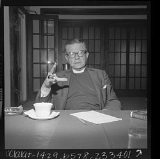
James Pike

Encyclopedia
James Albert Pike was an American
Episcopal bishop
, prolific writer, and one of the first mainline religious figures to appear regularly on television.
His outspoken views on many theological and social issues made him one of the most controversial public figures of his time. He was an early proponent of ordination of women
, racial desegregation
, and the acceptance of LBGT people within mainline churches. Pike was the fifth Bishop of California
.
and married Jane Alvies. He served as an attorney in Washington, D.C., for the Securities and Exchange Commission (SEC) during Franklin D. Roosevelt's New Deal
era and taught Law at George Washington University
. After his first marriage ended in divorce (later annulled), Pike married Esther Yanovsky. In World War II, he served with Naval Intelligence.
and, then, the Union Theological seminary
and began to prepare for the priesthood. He was ordained in 1946, first serving as an assistant at St. John's, Lafayette Square in Washington, D.C., and then as Rector of Christ Church in Poughkeepsie, New York. He next became head of the Department of Religion and chaplain at Columbia University
. He left Columbia in 1952 to become the Dean of the Cathedral of St. John the Divine, New York. Using his new position and media savvy, he picked a fight with local Catholic bishops over their attacks on Planned Parenthood
and their opposition to birth control. He accepted an invitation to receive an honorary doctorate from Sewanee: The University of the South in Tennessee but then publicly declined after finding that the university did not admit African Americans. An example of Pike's use of the media is that he released his letter to the New York Times before it was delivered to Sewanee's trustees: they heard the news when reporters called for reactions. It was also at this time that he publicly challenged Senator Joseph McCarthy
's allegation that 7,000 U.S. pastors were part of the Kremlin's conspiracy; and, when the newly elected President Dwight D. Eisenhower
backed up Pike, McCarthy and his movement began to lose their influence.
In New York, Pike reached a large audience with liberal sermons and weekly television programs. Common topics included birth control, abortion laws, racism, capital punishment, apartheid, antisemitism, and farm worker exploitation.
of California in 1958 and succeeded to the See a few months later, following the death of his predecessor, Karl Morgan Block. In this position, he served until 1966, when he abdicated/resigned. At that point, he began to work for the Center for the Study of Democratic Institutions
, a liberal, private-sector think tank
.
 His episcopate was marked by both professional and personal controversy. He was one of the leaders of the Protestants and Other Americans United for the Separation of Church and State movement, which advocated against John Kennedy's presidential campaign because of the pre-Vatican II Catholic teachings of the time. While at Grace Cathedral, he was involved with promoting a living wage
for workers in San Francisco, the acceptance of LBGT people in the church, and civil rights. He also recognized a Methodist minister as having dual ordination and freedom to serve in the diocese. Later, he ordained a woman as a first-order deacon, now known as a "transitional deacon", usually the first step in the process towards ordination in the priesthood in the Episcopal church. The ordination was not approved until after Pike's death.
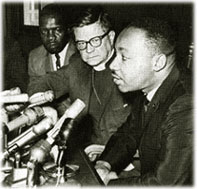
Among his notable accomplishments, Pike met with Dr. Martin Luther King, Jr. during his march to Selma, Alabama
.
Pike's theology was profoundly challenging to the Church, involving the rejection of central Christian beliefs. His writings questioned a number of widely regarded theological stances, including the virginity of Mary, the Mother of Jesus, and the doctrine of Hell
, and the Trinity
. He famously called for "fewer beliefs, more belief." Heresy procedures were begun in 1962, 1964, 1965, and 1966, each growing in intensity; but, in the end, the Church decided it was not in the denomination's best interest to pursue an actual heresy trial. However, he was censured in 1966 by his brother bishops and resigned his position shortly thereafter.
In his personal life, Pike was a chain-smoker and an alcoholic. He craved attention and was likely addicted in some way to romance and relationships. His charismatic personality drew many people to him, including his secretary Maren Hackett, with whom he developed a romantic relationship that cost him his second marriage in 1969.
. Shortly after his son's death, Pike reported experiencing poltergeist
phenomena—books vanishing and reappearing, safety pins open and indicating the approximate hour of his son's death, half the clothes in a closet disarranged and heaped up. Pike led a public (and, for the Church, embarrassing) pursuit of various spiritualist and clairvoyant methods of contacting his deceased son to reconcile. In September 1967, Pike participated in a televised séance with his dead son through the medium Arthur Ford
, who served at the time as a Disciples of Christ minister. Pike detailed these experiences in his book The Other Side
.
, searching for proof of the historical Jesus. With typical Pike bravado, they were unprepared for the journey; and, when their car broke down and became stuck, they separated to search for help. Accounts differ, but apparently Pike either fell into a wadi
/oasis
/creek bed to his death or climbed in and died of exposure and thirst some time between September 2 and 9. Mrs. Pike survived. Pike's body was recovered and, following his wishes and those of his family, buried in the Protestant cemetery in Jaffa, Israel.
United States
The United States of America is a federal constitutional republic comprising fifty states and a federal district...
Episcopal bishop
Bishop
A bishop is an ordained or consecrated member of the Christian clergy who is generally entrusted with a position of authority and oversight. Within the Catholic Church, Eastern Orthodox, Oriental Orthodox Churches, in the Assyrian Church of the East, in the Independent Catholic Churches, and in the...
, prolific writer, and one of the first mainline religious figures to appear regularly on television.
His outspoken views on many theological and social issues made him one of the most controversial public figures of his time. He was an early proponent of ordination of women
Ordination of women
Ordination in general religious usage is the process by which a person is consecrated . The ordination of women is a regular practice among some major religious groups, as it was of several religions of antiquity...
, racial desegregation
Desegregation
Desegregation is the process of ending the separation of two groups usually referring to races. This is most commonly used in reference to the United States. Desegregation was long a focus of the American Civil Rights Movement, both before and after the United States Supreme Court's decision in...
, and the acceptance of LBGT people within mainline churches. Pike was the fifth Bishop of California
Episcopal Diocese of California
The Episcopal Diocese of California is an ecclesiastical territory or diocese of the Episcopal Church in the United States of America in Northern California...
.
Early life
Pike was born in Oklahoma City on February 14, 1913. His father died when he was two, and his mother married California attorney Claude McFadden. The young Pike was a Roman Catholic and considered the priesthood; but, while attending the University of Santa Clara, he came to consider himself an agnostic. Pike earned a doctorate from Yale Law SchoolYale Law School
Yale Law School, or YLS, is the law school of Yale University in New Haven, Connecticut, United States. Established in 1824, it offers the J.D., LL.M., J.S.D. and M.S.L. degrees in law. It also hosts visiting scholars, visiting researchers and a number of legal research centers...
and married Jane Alvies. He served as an attorney in Washington, D.C., for the Securities and Exchange Commission (SEC) during Franklin D. Roosevelt's New Deal
New Deal
The New Deal was a series of economic programs implemented in the United States between 1933 and 1936. They were passed by the U.S. Congress during the first term of President Franklin D. Roosevelt. The programs were Roosevelt's responses to the Great Depression, and focused on what historians call...
era and taught Law at George Washington University
George Washington University
The George Washington University is a private, coeducational comprehensive university located in Washington, D.C. in the United States...
. After his first marriage ended in divorce (later annulled), Pike married Esther Yanovsky. In World War II, he served with Naval Intelligence.
Conversion and early church life
After WWII, Pike and his wife joined the Episcopal Church. He entered, first, the Virginia Theological SeminaryVirginia Theological Seminary
Virginia Theological Seminary , formally called the Protestant Episcopal Theological Seminary in Virginia, is the largest accredited Episcopal seminary in the United States. Founded in 1818, VTS is situated on an campus in Alexandria, Virginia, just a few miles from downtown Washington, DC. VTS...
and, then, the Union Theological seminary
Union Theological Seminary in the City of New York
Union Theological Seminary in the City of New York is a preeminent independent graduate school of theology, located in Manhattan between Claremont Avenue and Broadway, 120th to 122nd Streets. The seminary was founded in 1836 under the Presbyterian Church, and is affiliated with nearby Columbia...
and began to prepare for the priesthood. He was ordained in 1946, first serving as an assistant at St. John's, Lafayette Square in Washington, D.C., and then as Rector of Christ Church in Poughkeepsie, New York. He next became head of the Department of Religion and chaplain at Columbia University
Columbia University
Columbia University in the City of New York is a private, Ivy League university in Manhattan, New York City. Columbia is the oldest institution of higher learning in the state of New York, the fifth oldest in the United States, and one of the country's nine Colonial Colleges founded before the...
. He left Columbia in 1952 to become the Dean of the Cathedral of St. John the Divine, New York. Using his new position and media savvy, he picked a fight with local Catholic bishops over their attacks on Planned Parenthood
Planned Parenthood
Planned Parenthood Federation of America , commonly shortened to Planned Parenthood, is the U.S. affiliate of the International Planned Parenthood Federation and one of its larger members. PPFA is a non-profit organization providing reproductive health and maternal and child health services. The...
and their opposition to birth control. He accepted an invitation to receive an honorary doctorate from Sewanee: The University of the South in Tennessee but then publicly declined after finding that the university did not admit African Americans. An example of Pike's use of the media is that he released his letter to the New York Times before it was delivered to Sewanee's trustees: they heard the news when reporters called for reactions. It was also at this time that he publicly challenged Senator Joseph McCarthy
Joseph McCarthy
Joseph Raymond "Joe" McCarthy was an American politician who served as a Republican U.S. Senator from the state of Wisconsin from 1947 until his death in 1957...
's allegation that 7,000 U.S. pastors were part of the Kremlin's conspiracy; and, when the newly elected President Dwight D. Eisenhower
Dwight D. Eisenhower
Dwight David "Ike" Eisenhower was the 34th President of the United States, from 1953 until 1961. He was a five-star general in the United States Army...
backed up Pike, McCarthy and his movement began to lose their influence.
In New York, Pike reached a large audience with liberal sermons and weekly television programs. Common topics included birth control, abortion laws, racism, capital punishment, apartheid, antisemitism, and farm worker exploitation.
Election as bishop
He was elected as bishop coadjutorCoadjutor bishop
A coadjutor bishop is a bishop in the Roman Catholic or Anglican churches who is designated to assist the diocesan bishop in the administration of the diocese, almost as co-bishop of the diocese...
of California in 1958 and succeeded to the See a few months later, following the death of his predecessor, Karl Morgan Block. In this position, he served until 1966, when he abdicated/resigned. At that point, he began to work for the Center for the Study of Democratic Institutions
Center for the Study of Democratic Institutions
The Center for the Study of Democratic Institutions in Santa Barbara, California was an important think tank from 1959 to 1977, declining in influence thereafter. The Center held discussions in a variety of areas that it hoped would influence public deliberation...
, a liberal, private-sector think tank
Think tank
A think tank is an organization that conducts research and engages in advocacy in areas such as social policy, political strategy, economics, military, and technology issues. Most think tanks are non-profit organizations, which some countries such as the United States and Canada provide with tax...
.
Living wage
In public policy, a living wage is the minimum hourly income necessary for a worker to meet basic needs . These needs include shelter and other incidentals such as clothing and nutrition...
for workers in San Francisco, the acceptance of LBGT people in the church, and civil rights. He also recognized a Methodist minister as having dual ordination and freedom to serve in the diocese. Later, he ordained a woman as a first-order deacon, now known as a "transitional deacon", usually the first step in the process towards ordination in the priesthood in the Episcopal church. The ordination was not approved until after Pike's death.
Among his notable accomplishments, Pike met with Dr. Martin Luther King, Jr. during his march to Selma, Alabama
Selma, Alabama
Selma is a city in and the county seat of Dallas County, Alabama, United States, located on the banks of the Alabama River. The population was 20,512 at the 2000 census....
.
Pike's theology was profoundly challenging to the Church, involving the rejection of central Christian beliefs. His writings questioned a number of widely regarded theological stances, including the virginity of Mary, the Mother of Jesus, and the doctrine of Hell
Hell
In many religious traditions, a hell is a place of suffering and punishment in the afterlife. Religions with a linear divine history often depict hells as endless. Religions with a cyclic history often depict a hell as an intermediary period between incarnations...
, and the Trinity
Trinity
The Christian doctrine of the Trinity defines God as three divine persons : the Father, the Son , and the Holy Spirit. The three persons are distinct yet coexist in unity, and are co-equal, co-eternal and consubstantial . Put another way, the three persons of the Trinity are of one being...
. He famously called for "fewer beliefs, more belief." Heresy procedures were begun in 1962, 1964, 1965, and 1966, each growing in intensity; but, in the end, the Church decided it was not in the denomination's best interest to pursue an actual heresy trial. However, he was censured in 1966 by his brother bishops and resigned his position shortly thereafter.
In his personal life, Pike was a chain-smoker and an alcoholic. He craved attention and was likely addicted in some way to romance and relationships. His charismatic personality drew many people to him, including his secretary Maren Hackett, with whom he developed a romantic relationship that cost him his second marriage in 1969.
The Other Side
In 1966, Pike's son Jim took his own life in a New York city hotel room, following a period of recreational drug useRecreational drug use
Recreational drug use is the use of a drug, usually psychoactive, with the intention of creating or enhancing recreational experience. Such use is controversial, however, often being considered to be also drug abuse, and it is often illegal...
. Shortly after his son's death, Pike reported experiencing poltergeist
Poltergeist
A poltergeist is a paranormal phenomenon which consists of events alluding to the manifestation of an imperceptible entity. Such manifestation typically includes inanimate objects moving or being thrown about, sentient noises and, on some occasions, physical attacks on those witnessing the...
phenomena—books vanishing and reappearing, safety pins open and indicating the approximate hour of his son's death, half the clothes in a closet disarranged and heaped up. Pike led a public (and, for the Church, embarrassing) pursuit of various spiritualist and clairvoyant methods of contacting his deceased son to reconcile. In September 1967, Pike participated in a televised séance with his dead son through the medium Arthur Ford
Arthur Ford
Arthur Ford was an American psychic spiritual medium, clairaudient and in 1955 founded the Spiritual Frontiers Fellowship.- Biographical problems :...
, who served at the time as a Disciples of Christ minister. Pike detailed these experiences in his book The Other Side
The Other Side (book)
The Other Side is a book written by Bishop James Pike with Diane Kennedy about his experiences of paranormal phenomena following his son's death by drug overdose in New York in 1966. The book was published by Doubleday and Co. Inc., Garden City, NY, in 1968 and in paperback, Dell Publishing, NY,...
.
Death
In September 1969, Pike and his third wife Diane drove into the Judean DesertJudean desert
The Judaean Desert is a desert in Israel and the West Bank that lies east of Jerusalem and descends to the Dead Sea. It stretches from the northeastern Negev to the east of Beit El, and is marked by terraces with escarpments. It ends in a steep escarpment dropping to the Dead Sea and the Jordan...
, searching for proof of the historical Jesus. With typical Pike bravado, they were unprepared for the journey; and, when their car broke down and became stuck, they separated to search for help. Accounts differ, but apparently Pike either fell into a wadi
Wadi
Wadi is the Arabic term traditionally referring to a valley. In some cases, it may refer to a dry riverbed that contains water only during times of heavy rain or simply an intermittent stream.-Variant names:...
/oasis
Oasis
In geography, an oasis or cienega is an isolated area of vegetation in a desert, typically surrounding a spring or similar water source...
/creek bed to his death or climbed in and died of exposure and thirst some time between September 2 and 9. Mrs. Pike survived. Pike's body was recovered and, following his wishes and those of his family, buried in the Protestant cemetery in Jaffa, Israel.
In literature
- James Pike was an inspiration for the character of Timothy Archer in Philip K. DickPhilip K. DickPhilip Kindred Dick was an American novelist, short story writer and essayist whose published work is almost entirely in the science fiction genre. Dick explored sociological, political and metaphysical themes in novels dominated by monopolistic corporations, authoritarian governments and altered...
's book, The Transmigration of Timothy ArcherThe Transmigration of Timothy ArcherThe Transmigration of Timothy Archer is a 1982 novel by Philip K. Dick. As his final work, the book was published shortly after his death in March 1982 following a series of strokes, although it was written the previous year...
. They were friends, and Pike officiated at Dick's wedding to Nancy Hackett, step-daughter of Maren Hackett (1966). - Joan DidionJoan DidionJoan Didion is an American author best known for her novels and her literary journalism. Her novels and essays explore the disintegration of American morals and cultural chaos, where the overriding theme is individual and social fragmentation...
wrote about Pike and the building of the Grace Cathedral in her collection of essays, The White AlbumThe White Album (book)The White Album is a 1979 book of essays by Joan Didion. The entire contents of this book are reprinted in Didion's We Tell Ourselves Stories in Order to Live: Collected Nonfiction .-I...
(1979). - E. L. DoctorowE. L. DoctorowEdgar Lawrence Doctorow is an American author.- Biography :Edgar Lawrence Doctorow was born in the Bronx, New York City, the son of second-generation Americans of Russian Jewish descent...
includes Pike as a fictionalized character in his novel, City of God (2000). - Sam PeckinpahSam PeckinpahDavid Samuel "Sam" Peckinpah was an American filmmaker and screenwriter who achieved prominence following the release of the Western epic The Wild Bunch...
may have appropriated his name for the anti-hero Pike Bishop (played by William HoldenWilliam HoldenWilliam Holden was an American actor. Holden won the Academy Award for Best Actor in 1954 and the Emmy Award for Best Actor in 1974...
) of his Western The Wild BunchThe Wild BunchThe Wild Bunch is a 1969 American Western film directed by Sam Peckinpah about an aging outlaw gang on the Texas-Mexico border, trying to exist in the changing "modern" world of 1913...
(1969).
Major works
- Beyond Anxiety Charles Scribner’s Sons, NY, 1953
- Beyond the Law Doubleday and Co. Inc., Garden City, NY, 1963
- The Church, Politics and Society (with John W. Pyle) Morehouse-Gorham Co., NY, 1955
- The Holy Scriptures- The Churches Teaching (V. 1) (assistant author to Robert C, Dentan) National Council, Protestant Episcopal Church, NY, 1949
- Doing the Truth Doubleday and Co. Inc., Garden City, NY, 1955
- Facing the Next Day see The Next Day below
- The Faith of the Church (with Norman Pittenger) Seabury Press, Greenwich, CT, 1951 (second copy Crossroads/Seabury Press, 1961)
- If This Be Heresy Harper and Rowe Publishers, NY, 1967 (also paperback- Delta Book/Dell Publishing, NY, 1969)
- If You Marry Outside Your Faith Harper and Bros., NY, 1954
- Man in the Middle (with Howard A. Johnson) The Seabury Press, Greenwich, CT, 1956
- Modern Canterbury Pilgrims (editor and essay) Morehouse-Gorham Co., NY, 1956 (also second, abridged edition, 1959)
- A New Look at Preaching Charles Scribner’s Sons, NY, 1961
- The Next Day Dolphin Books/ Doubleday and Co. Inc., Garden City, NY, 1957 also MacMillan Co. NY paperback Facing the Next Day, 1968)
- The Other Side (with Diane Kennedy) Doubleday and Co. Inc., Garden City, NY, 1968 (also paperback, Dell Publishing, NY, 1969)
- Our Christmas Challenge Sterling Publishing Co., Inc., NY, 1961
- Roadblocks to Faith (with John McG. Krumm) Morehouse-Gorham Co., NY, 1954
- A Roman Catholic in the White House (with Richard Byfield) - Doubleday and Co. Inc., Garden City, NY, 1960
- Teen-Agers and Sex Prentice-Hall Inc., Englewood Cliffs, NJ, 1965
- A Time for Christian Candor Harper and Rowe Publishers, NY, 1964
- What is This Treasure Harper and Rowe Publishers, NY, 1966
- You and the New Morality Harper and Rowe Publishers, NY, 1967
External links
- James A. Pike Papers at Syracuse University
- In Search Of...segment on Bishop Pike hosted by Leonard Nimoy