

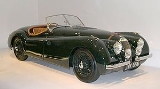
Jaguar XK120

Encyclopedia
The Jaguar XK120 is a sports car
which was manufactured by Jaguar between 1948 and 1954. It was Jaguar's first sports car since the SS 100
, which ceased production in 1940.
form at the 1948 London Motor Show as a testbed
and show car for the new Jaguar XK engine
. It caused a sensation, which persuaded Jaguar founder and design boss William Lyons
to put it into production.
The "120" in its name referred to its 120 mph (193 km/h) top speed (faster with the windscreen removed), which made the XK120 the world's fastest standard production car at the time of its launch.
It was available in two open versions, first as the roadster (designated OTS, for open two-seater, in America
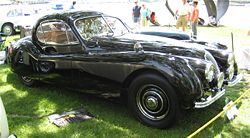
), then also as a drophead coupé (DHC) from 1953 – and also as a closed, or "fixed-head" coupé
(FHC) from 1951. The DHC was a more deluxe open model, with wind-up windows, and wood-veneer dashboard and interior door caps, as on the FHC.
The roadster was successful in racing.
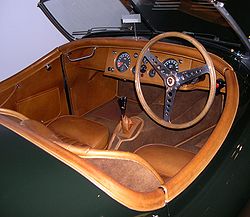 The first 242 cars, all roadsters hand-built between late 1948 and early 1950, had aluminium bodies on ash
frames. To meet demand it was necessary for the mass-production versions, beginning with the 1950 model year, to have pressed-steel bodies. They retained aluminium doors, bonnet
, and boot
lid.
With alloy cylinder head
and twin side-draft SU carburetors, the dual overhead-cam 3.4 L straight-6
XK engine
was comparatively advanced for a mass-produced unit of the time. With standard 8:1 compression ratio it developed 160 bhp. A 7:1 low compression version was also available to cope with low quality fuel. This same basic design of the XK engine, later modified into 3.8L and 4.2L versions, survived into the late 1980s.
All XK120s had independent torsion bar front suspension, semi-elliptic leaf springs
at the rear, recirculating ball
steering, telescopically adjustable steering column, and all-round 12 inch drum brakes
that were prone to fade. Some cars were fitted with Alfin (ALuminium FINned) brake drums to help overcome the fade.
The roadster's lightweight canvas top and detachable sidescreens stowed out of sight behind the seats, and its barchetta
-style doors had no external handles; instead there was an interior pull-cord which was accessible through a flap in the sidescreens when the weather equipment was in place. The windscreen could be removed for aeroscreens to be fitted.
The drophead coupé (DHC) had a padded, lined canvas top, which folded onto the rear deck behind the seats when retracted, and roll-up windows with opening quarter lights. The flat glass two-piece windscreen was set in a steel frame that was integrated with the body and painted the same colour. Dashboards and door-caps in both the DHC and the closed coupé (FHC) were wood-veneered, whereas the more spartan roadster's were leather-trimmed. All models had removable spats ("fender skirts" in America
) covering the rear wheel arches, which enhanced the streamlined look. On cars fitted with optional centre-lock wire wheels
(available from 1951), the spats were omitted as they gave insufficient clearance for the two-eared Rudge-Whitworth chromed knockoff hubs.
In addition to wire wheels, upgrades on the Special Equipment, or SE, version (called the M version in the United States) included increased power, stiffer suspension and dual exhaust system.
All XK models are collectible.
magazine road-tested an XK120 roadster in 1949. With hood and sidescreens in place, it achieved a top speed of 124.6 mph (200.5 km/h), accelerated from 0–60 mph (96.6 km/h) in 10.0 seconds and consumed fuel at the rate of 19.8 mpgimp. The car as tested cost £1263 including taxes.
In May 1949, Jaguar demonstrated an XK120 roadster to the press on the high-speed autoroute between Jabbeke
and Aeltre in Belgium
. The road was closed for the occasion. The white left-hand drive car, chassis number 670002, was the second XK120 built. Jaguar's development engineer Walter Hassan
was to have driven but fell ill, so Jaguar test-driver Ron "Soapy" Sutton substituted. With hood and sidescreens erected, and the airflow under the car improved by the addition of a full-length aluminium undertray, the Jaguar was timed through the flying mile by the Royal Automobile Club of Belgium at 126.448 mph (203.5 km/h). With hood, sidescreens and windscreen removed, a metal airflow deflector fitted in front of the driver, and a tonneau cover
fastened over the passenger side of the cockpit the speed improved to 136.596 mph (219.8 km/h). The XK120 showed itself to be the fastest production car in the world.
In 1950 Jaguar allocated six alloy-bodied XK120s to drivers Johnson, Walker, Nick Haines, Clemente Biondetti
, Ian Appleyard and Tommy Wisdom.
, near Paris
:
Sports car
A sports car is a small, usually two seat, two door automobile designed for high speed driving and maneuverability....
which was manufactured by Jaguar between 1948 and 1954. It was Jaguar's first sports car since the SS 100
Jaguar SS100
The SS100 is a British 2-seat sports car built between 1936 and 1940 by SS Cars Ltd of Coventry, England. The last one is thought to have been delivered in 1941. In 1936 the name Jaguar was given to a new saloon car and from then on to all the cars...
, which ceased production in 1940.
History
The XK120 was launched in roadsterRoadster
A roadster is a two-seat open car with emphasis on sporty handling and without a fixed roof or side weather protection. Strictly speaking a roadster with wind-up windows is a convertible but as true roadsters are no longer made the distinction is now irrelevant...
form at the 1948 London Motor Show as a testbed
Testbed
A testbed is a platform for experimentation of large development projects. Testbeds allow for rigorous, transparent, and replicable testing of scientific theories, computational tools, and new technologies.The term is used across many disciplines to describe a development environment that is...
and show car for the new Jaguar XK engine
Jaguar XK6 engine
The renowned Jaguar XK dual overhead camshaft inline 6-cylinder engine was introduced in 1949 and continued in manufacture until 1992. It was produced in five displacements for Jaguar passenger cars, with other sizes being made by Jaguar and privateers for racing...
. It caused a sensation, which persuaded Jaguar founder and design boss William Lyons
William Lyons
Sir William Lyons , known as "Mr. Jaguar", was with fellow motorcycle enthusiast William Walmsley, the co-founder in 1922 of the Swallow Sidecar Company, which became Jaguar Cars Limited after the Second World War....
to put it into production.
The "120" in its name referred to its 120 mph (193 km/h) top speed (faster with the windscreen removed), which made the XK120 the world's fastest standard production car at the time of its launch.
It was available in two open versions, first as the roadster (designated OTS, for open two-seater, in America
United States
The United States of America is a federal constitutional republic comprising fifty states and a federal district...
), then also as a drophead coupé (DHC) from 1953 – and also as a closed, or "fixed-head" coupé
Coupé
A coupé or coupe is a closed car body style , the precise definition of which varies from manufacturer to manufacturer, and over time...
(FHC) from 1951. The DHC was a more deluxe open model, with wind-up windows, and wood-veneer dashboard and interior door caps, as on the FHC.
The roadster was successful in racing.
Construction
Ash tree
Fraxinus is a genus flowering plants in the olive and lilac family, Oleaceae. It contains 45-65 species of usually medium to large trees, mostly deciduous though a few subtropical species are evergreen. The tree's common English name, ash, goes back to the Old English æsc, while the generic name...
frames. To meet demand it was necessary for the mass-production versions, beginning with the 1950 model year, to have pressed-steel bodies. They retained aluminium doors, bonnet
Hood (vehicle)
The hood or bonnet is the hinged cover over the engine of motor vehicles that allows access to the engine compartment for maintenance and repair. In British terminology, hood refers to a fabric cover over the passenger compartment of the car...
, and boot
Trunk (automobile)
The trunk or boot of an automobile or car is the vehicle's main storage, luggage, or cargo compartment. Trunk is used in North American English and Jamaican English; boot is used elsewhere in the English speaking world. Trunk is also primarily used in many non-English speaking regions, such as...
lid.
With alloy cylinder head
Cylinder head
In an internal combustion engine, the cylinder head sits above the cylinders on top of the cylinder block. It closes in the top of the cylinder, forming the combustion chamber. This joint is sealed by a head gasket...
and twin side-draft SU carburetors, the dual overhead-cam 3.4 L straight-6
Straight-6
The straight-six engine or inline-six engine is a six-cylinder internal combustion engine with all six cylinders mounted in a straight line along the crankcase...
XK engine
Jaguar XK6 engine
The renowned Jaguar XK dual overhead camshaft inline 6-cylinder engine was introduced in 1949 and continued in manufacture until 1992. It was produced in five displacements for Jaguar passenger cars, with other sizes being made by Jaguar and privateers for racing...
was comparatively advanced for a mass-produced unit of the time. With standard 8:1 compression ratio it developed 160 bhp. A 7:1 low compression version was also available to cope with low quality fuel. This same basic design of the XK engine, later modified into 3.8L and 4.2L versions, survived into the late 1980s.
All XK120s had independent torsion bar front suspension, semi-elliptic leaf springs
Leaf spring
Originally called laminated or carriage spring, a leaf spring is a simple form of spring, commonly used for the suspension in wheeled vehicles...
at the rear, recirculating ball
Recirculating ball
Recirculating ball, also known as recirculating ball and nut or worm and sector, is a steering mechanism commonly found in older automobiles, and some trucks...
steering, telescopically adjustable steering column, and all-round 12 inch drum brakes
Drum brake
A drum brake is a brake in which the friction is caused by a set of shoes or pads that press against a rotating drum-shaped part called a brake drum....
that were prone to fade. Some cars were fitted with Alfin (ALuminium FINned) brake drums to help overcome the fade.
The roadster's lightweight canvas top and detachable sidescreens stowed out of sight behind the seats, and its barchetta
Barchetta
A barchetta was originally an Italian style of open 2-seater sports car which was built for racing. Weight and wind resistance were kept to a minimum, and any unnecessary equipment or decoration were sacrificed in order to maximize performance....
-style doors had no external handles; instead there was an interior pull-cord which was accessible through a flap in the sidescreens when the weather equipment was in place. The windscreen could be removed for aeroscreens to be fitted.
The drophead coupé (DHC) had a padded, lined canvas top, which folded onto the rear deck behind the seats when retracted, and roll-up windows with opening quarter lights. The flat glass two-piece windscreen was set in a steel frame that was integrated with the body and painted the same colour. Dashboards and door-caps in both the DHC and the closed coupé (FHC) were wood-veneered, whereas the more spartan roadster's were leather-trimmed. All models had removable spats ("fender skirts" in America
Fender skirts
Fender skirts, known in Australia and the United Kingdom as spats, are pieces of bodywork on the fender that cover the upper portions of the rear tires of an automobile.-Functions:...
) covering the rear wheel arches, which enhanced the streamlined look. On cars fitted with optional centre-lock wire wheels
Wire wheels
The rims of wire wheels are connected to their hubs by wire spokes. Although these wires are generally stiffer than a typical wire rope, they function mechanically the same as tensioned flexible wires, keeping the rim true while supporting applied loads.Wire wheels are used on most bicycles and...
(available from 1951), the spats were omitted as they gave insufficient clearance for the two-eared Rudge-Whitworth chromed knockoff hubs.
In addition to wire wheels, upgrades on the Special Equipment, or SE, version (called the M version in the United States) included increased power, stiffer suspension and dual exhaust system.
All XK models are collectible.
Engine specifications
| Model | Years | Displacement | Configuration | Bore/Stroke | Carburettor | Power |
|---|---|---|---|---|---|---|
| XK 120 3.4 | 1948–1954 | |
DOHC Straight-6 | |
Double SU H6 | 160 bhp @ 5000 rpm |
| XK 120 3.4 SE ("M" in USA) | 1951–1954 | |
DOHC Straight-6 | |
Double SU H6 | 180 bhp @ 5300 rpm |
| XK 120 3.4 SE (C-Type Head) ("MC" in USA) | 1951–1954 | |
DOHC Straight-6 | |
Double SU H8 | 210 bhp @ 5750 rpm |
Performance
The MotorThe Motor (magazine)
The Motor was a British weekly car magazine founded on 28 January 1903....
magazine road-tested an XK120 roadster in 1949. With hood and sidescreens in place, it achieved a top speed of 124.6 mph (200.5 km/h), accelerated from 0–60 mph (96.6 km/h) in 10.0 seconds and consumed fuel at the rate of 19.8 mpgimp. The car as tested cost £1263 including taxes.
In May 1949, Jaguar demonstrated an XK120 roadster to the press on the high-speed autoroute between Jabbeke
Jabbeke
Jabbeke is a municipality located in the Belgian province of West Flanders. The municipality comprises the towns of Jabbeke proper, Snellegem, Stalhille, Varsenare and Zerkegem. On 1 January 2006 the municipality had 13,572 inhabitants...
and Aeltre in Belgium
Belgium
Belgium , officially the Kingdom of Belgium, is a federal state in Western Europe. It is a founding member of the European Union and hosts the EU's headquarters, and those of several other major international organisations such as NATO.Belgium is also a member of, or affiliated to, many...
. The road was closed for the occasion. The white left-hand drive car, chassis number 670002, was the second XK120 built. Jaguar's development engineer Walter Hassan
Walter Hassan
Walter Hassan OBE, C.Eng., M.I. Mech.E. was a distinguished UK automotive engineer who took part in the design and development of three very successful engines: Jaguar XK, Coventry Climax and Jaguar V12 as well as the ERA racing car....
was to have driven but fell ill, so Jaguar test-driver Ron "Soapy" Sutton substituted. With hood and sidescreens erected, and the airflow under the car improved by the addition of a full-length aluminium undertray, the Jaguar was timed through the flying mile by the Royal Automobile Club of Belgium at 126.448 mph (203.5 km/h). With hood, sidescreens and windscreen removed, a metal airflow deflector fitted in front of the driver, and a tonneau cover
Tonneau
right|thumb|260px|1903 [[Ford Model A |Ford Model A]] rear-door TonneauTonneau cover , describes a hard or soft cover used to protect unoccupied passenger seats in a convertible, roadster, or for a pickup truck bed. Hard tonneau covers open by a hinging or folding mechanism while soft covers open...
fastened over the passenger side of the cockpit the speed improved to 136.596 mph (219.8 km/h). The XK120 showed itself to be the fastest production car in the world.
1949
- First race victory: In the Daily ExpressDaily ExpressThe Daily Express switched from broadsheet to tabloid in 1977 and was bought by the construction company Trafalgar House in the same year. Its publishing company, Beaverbrook Newspapers, was renamed Express Newspapers...
-sponsored One-Hour Production Car Race held on 30 August 1949 at Silverstone CircuitSilverstone CircuitSilverstone Circuit is an English motor racing circuit next to the Northamptonshire villages of Silverstone and Whittlebury. The circuit straddles the Northamptonshire and Buckinghamshire border, with the current main circuit entry on the Buckinghamshire side...
, England, Leslie JohnsonLeslie JohnsonLeslie George Johnson was a British racing driver who competed in rallies, hill climbs, sports car races and Grand Prix races.-Overview:...
drove the Jabbeke car to the XK120's first-ever race victory (despite an early collision with a spinning Jowett JavelinJowett JavelinThe Jowett Javelin is an award-winning British car that was produced from 1947 to 1953 by Jowett Cars Ltd of Idle, near Bradford. The model went through five variants labelled PA to PE, each having a standard and "de luxe" option. The car was designed by Gerald Palmer during World War II and was...
which dropped the Jaguar to fifth). The car, road-registered HKV 500, was converted to right-hand drive for Silverstone. Two other XK120s took part. One, driven by Peter WalkerPeter Walker (driver)Peter Douglas Conyers Walker was a British racing driver. He was born in Leeds, Yorkshire and died in Newtown, Worcestershire....
, finished second and the other, driven by Prince BiraPrince Bira12th, 1956 Melbourne, Star 19th, 1960 Rome, Star 22nd, 1964 Tokio, Dragon 21st, 1972 Munich, TempestPrince Birabongse Bhanudej Bhanubandh better known as Prince Bira of Siam , or by his nom de course B...
, spun out of contention when a tyre punctured.
1950
- First victory in America: In January 1950 Johnson also scored the model’s first competition success in America, winning the production class in a race at Palm Beach Shores, FloridaPalm Beach Shores, FloridaPalm Beach Shores is a town in Palm Beach County, Florida, United States. The population was 1,269 at the 2000 census. As of 2004, the population recorded by the U.S. Census Bureau was 1,511.-Geography:...
with the car that had finished second at Silverstone. The Jaguar lost its brakes but finished fourth overall. John Lea, Jaguar’s Experimental Department mechanic who attended the race, reported: "The conditions at Palm Beach were wet, windy and sandy. Water and sand gained entry into the brake drums at the front, and the mixture had the effect of accelerating the wear very considerably. Our car finished with no linings and with the steel shoes bearing on the brake drums."
In 1950 Jaguar allocated six alloy-bodied XK120s to drivers Johnson, Walker, Nick Haines, Clemente Biondetti
Clemente Biondetti
Clemente Biondetti was an Italian auto racing driver.-Biography:Born in Buddusò, Sardinia, into a working class family, Biondetti began racing motorcycles in 1923 but in 1927 turned to automobiles...
, Ian Appleyard and Tommy Wisdom.
- Le Mans: Three of the allocated cars, extensively modified, were entered for the 1950 Le Mans 24 Hours1950 24 Hours of Le MansThe 1950 24 Hours of Le Mans was the 18th Grand Prix of Endurance, and took place on June 24 and 25 1950.-Official results:-Did Not Finish:-Statistics:* Fastest Lap - #5 Louis Rosier - 4:53.5* Distance - 3465.12 km...
race. Johnson, who spearheaded this factory-supported assault on the race with co-driver Bert Hadley, never ran lower than seventh place, and held second for two hours, but in the 21st hour had to retire from third place with clutch failure caused by using the gears to slow the car in the absence of brakes. (As a result the clutch was revised to a more robust design for production models.) The Jaguar had been closing the gap to leader Louis RosierLouis RosierLouis Rosier was a racing driver from France.-Career highlights:...
, whose Talbot's pace was significantly slower, at a rate that would have secured victory. Haines, with co-driver Peter Clark, finished 12th, and Walker’s car, driven by Peter Whitehead and John Marshall, was 15th. The results convinced William Lyons it was worth investing in future success at Le Mans.
- Targa Florio: Biondetti's car, the first XK120 to contest the Targa FlorioTarga FlorioThe Targa Florio was an open road endurance automobile race held in the mountains of Sicily near Palermo. Founded in 1906, it was the oldest sports car racing event, part of the World Sportscar Championship between 1955 and 1973...
, lay second to Alberto AscariAlberto AscariAlberto Ascari was an Italian racing driver and twice Formula One World Champion. He is one of only two Italian Formula One World Champions in the history of the sport, and the only one winning his two championships in a Ferrari....
’s Ferrari when a connecting rodConnecting rodIn a reciprocating piston engine, the connecting rod or conrod connects the piston to the crank or crankshaft. Together with the crank, they form a simple mechanism that converts linear motion into rotating motion....
broke, ending the Jaguar’s run.
- Mille Miglia: Johnson took fifth place in the Mille MigliaMille MigliaThe Mille Miglia was an open-road endurance race which took place in Italy twenty-four times from 1927 to 1957 ....
, with John Lea as his riding mechanic, while Biondetti and co-driver Gino Bronzoni finished eighth. Fifth was an outstanding achievement for a production car, with Johnson's Jaguar beaten only by FangioJuan Manuel FangioJuan Manuel Fangio , nicknamed El Chueco or El Maestro , was a racing car driver from Argentina, who dominated the first decade of Formula One racing...
's works Alfa Romeo and the works Ferraris of SerafiniDorino SerafiniTeodoro "Dorino" Serafini was a motorcycle road racer and racing driver from Italy.A native of Pesaro , he won the 1939 500cc European Championship on a Gilera...
, BraccoGiovanni BraccoGiovanni Bracco was an Italian racing car driver,remembered for losing control of his Delage 3000, killing five spectators at the 1947 Italian Grand Prix....
and winner Marzotto. It was Jaguar's best-ever finish in the Mille Miglia; also the best by a British car and driver combination, a feat that only Reg ParnellReg ParnellReginald Harold Haslam Parnell was a racing driver and team manager from England. He participated in seven Formula One World Championship Grands Prix, achieving one podium, and scoring a total of 9 championship points.-Driving career:Before World War II Parnell was a very successful racing...
ever equalled, driving an Aston Martin DB3Aston Martin DB3The Aston Martin DB3 and later DB3S were racing cars built in the 1950s. Although they used some DB2 parts, they were quite different, being designed especially for racing...
in 1953.
- Silverstone Production Car Race: Five XK120s entered the race, which Peter Walker won from Tony RoltTony RoltMajor Anthony Peter Roylance "Tony" Rolt, MC & Bar, was a British racing driver, soldier and engineer. He won the 1953 24 Hours of Le Mans and participated in three Formula One World Championship Grands Prix without scoring a championship point...
, with Johnson recovering to eighth after spinning on oil. Jaguar won the team prize.
- Tourist Trophy: XK120s also achieved a 1–2–3 victory in the TTRAC Tourist TrophyThe International Tourist Trophy is an award given by the Royal Automobile Club and awarded semi-annually to the winners of a selected motor racing event each year in the United Kingdom. It was first awarded in 1905 and continues to be awarded to this day, making it the longest lasting trophy in...
, held at DundrodDundrod CircuitDundrod Circuit is a motorsport race track based on public roads used for the RAC Tourist Trophy for sports cars between 1950 and 1955 and for the motorcycle Ulster Grand Prix from 1953 onwards. It is situated in County Antrim, Northern Ireland...
in heavy rain. On the eve of his 21st birthday Stirling MossStirling MossSir Stirling Craufurd Moss, OBE FIE is a former racing driver from England...
drove Tom Wisdom's car to a brilliant win ahead of Whitehead and Johnson, and Jaguar once again took the team prize.
- Alpine Rally: Ian Appleyard's XK120, road-registered as NUB 120, won the French Alpine Rally with his wife Pat, who was the daughter of Sir William Lyons, navigating. They also won a coveted Coupe des Alpes. both the 1950 Alpine and 1951 Tulip rallies with Appleyard driving and his wife Pat navigating.
1951
- Alpine Rally: NUB 120 and the Appleyards repeated their previous year’s success.
- Tulip Rally: The Appleyards took first place in this grueling Dutch rally, with Swiss fighter pilot Rolf Habisreutinger’s XK120 finishing second.
1952
- Alpine Rally: Although the Appleyards’ XK120 did not win its third Alpine, it completed the rally without incurring a single penalty point, winning the first-ever Alpine Rally Gold Cup.
1954
- Mount Druitt 24 Hours Road Race: On 1 February 1954, an XK120 FHC driven by Geordie Anderson, Chas Swinburne and Bill PittBill Pitt (racing driver)William Pitt is a former Australian racing driver and motor racing official.For most of his racing career Pitt was associated with Jaguars, racing XK120 and D-Type sports cars, a Mark VIII rally car and Mark I touring cars with the assistance of Queensland's Jaguar agents Cyril and Geordie Anderson...
won AustraliaAustraliaAustralia , officially the Commonwealth of Australia, is a country in the Southern Hemisphere comprising the mainland of the Australian continent, the island of Tasmania, and numerous smaller islands in the Indian and Pacific Oceans. It is the world's sixth-largest country by total area...
's first 24-hour motor race, the 1954 Mount Druitt 24 Hours Road Race1954 Mount Druitt 24 Hours Road RaceThe 1954 Mount Druitt 24 Hours Road Race was an endurance race for production cars staged at the Mount Druitt circuit in New South Wales, Australia on 31 January and 1 February 1954....
from a Bristol 400Bristol 400The Bristol 400 luxury car is the first automotive product of the British Bristol Aeroplane Company. After World War II, BAC decided to diversify and formed a car division, which would later be the Bristol Cars company in its own right...
and a Humber Super SnipeHumber Super SnipeThe Humber Super Snipe was a car produced by the British-based Humber car company, part of the Rootes Group, from 1938 to 1967.-Pre-war Super Snipe:...
.
- NASCAR road race: In America, an XK120 FHC was the first imported car to achieve victory in NASCARNASCARThe National Association for Stock Car Auto Racing is a family-owned and -operated business venture that sanctions and governs multiple auto racing sports events. It was founded by Bill France Sr. in 1947–48. As of 2009, the CEO for the company is Brian France, grandson of the late Bill France Sr...
, when Al KellerAl KellerAl Keller was an American racecar driver.Keller participated in the NASCAR "Strictly Stock"/"Grand National" series from 1949 to 1956 with 29 career starts...
won the first NASCAR road race, held at Linden AirportLinden AirportLinden Airport , also known as Linden Municipal Airport, is a small general aviation airport located along U.S. Route 1&9 in Linden, a city in Union County, New Jersey, southwest of New York City...
, New Jersey, on 13 June 1954.
Records
XK120s set numerous world records on the steeply banked oval track at the Autodrome de MontlhéryAutodrome de Montlhéry
Autodrome de Montlhéry is an automobile racetrack, officially called L’autodrome de Linas-Montlhéry, located across the towns of Linas Bruyères-le-Châtel and Ollainville, outside Paris in the southside....
, near Paris
Paris
Paris is the capital and largest city in France, situated on the river Seine, in northern France, at the heart of the Île-de-France region...
:
- 1950 107.46 mi/h for 24 hours (including stops for fuel and tyres): Leslie Johnson sharing his XK120 roadster, road-registered JWK 651, with Stirling Moss. The first time a production car had averaged over 100 mi/h for 24 hours. Changing drivers every three hours, the Jaguar covered 2579.16 miles, with a best lap of 126.2 mi/h.
- 1951 131.83 mi (212.16 km) in one hour: Johnson solo in JWK 651. "No mean feat...driving at almost twice today's maximum (UK) speed limit into a steep turn, assaulted by the G-Force induced by 30 degree banking twice every minute, using Forties technology, leaf spring suspension and narrow crossply tyres...Johnson remarked that the car felt so good it could have gone on for another week, an off-the-cuff comment that sowed the seed for another idea. Flat out for a week..."
- 1952 100.31 mi/h for 7 days and 7 nights: XK120 fixed-head coupé driven by Johnson, Moss, Hadley and Jack FairmanJack FairmanJack Fairman was a British racing driver from England. He participated in 13 Formula One Grands Prix, debuting on 18 July 1953...
. William LyonsWilliam LyonsSir William Lyons , known as "Mr. Jaguar", was with fellow motorcycle enthusiast William Walmsley, the co-founder in 1922 of the Swallow Sidecar Company, which became Jaguar Cars Limited after the Second World War....
, mindful of the considerable kudos and advertising mileage that had already accrued from Johnson's exploits, commandeered a brand new XK120 FHC for him: bronze-colored, and fitted with wire wheels, it was Jaguar chief engineer Walter HassanWalter HassanWalter Hassan OBE, C.Eng., M.I. Mech.E. was a distinguished UK automotive engineer who took part in the design and development of three very successful engines: Jaguar XK, Coventry Climax and Jaguar V12 as well as the ERA racing car....
's car, the second right-hand drive coupé made. The car broke a spring on the track's rough concrete surface when already well into the run. No spare was carried, and regulations stipulated that a replacement from outside would make the car ineligible for any further records beyond those already achieved before the repair. Johnson drove nine hours to save the other drivers from added risk while the speed had to be maintained on the broken spring. When he finally stopped to have it replaced, the car had taken the world and Class C 72-hour records at 105.55 mi/h, world and Class C four-day records at 101.17 mi/h, Class C 10,000-kilometer record at 107.031 mi/h, world and Class C 15,000-kilometer records at 101.95 mi/h, and world and Class C 10000 miles (16,093.4 km) records at 100.65 mi/h. After the repair the car went on to complete the full seven days and nights, covering a total of 16851.73 mi (27,120.2 km) at an average speed of 100.31 mi/h.
Jaguar XK100
A 2-litre four-cylinder version of the twin cam XK engine was to have powered an XK100 variant of the XK120 for the UK market. Details of the model were included in an “Advance Particulars” brochure for the XK however management dissatisfaction with the engine resulted in the project being cancelled prior to production.External links
- XKData.com volunteer maintained online registry with thousands of cars and over 10,000 photos