
All Topics  
Inner core


   Email Print
   Bookmark   Link


Inner core


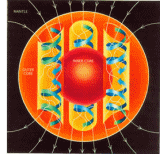
The inner core of the Earth
Earth

Earth is the third planet from the Sun. Earth is the largest of the terrestrial planets in the Solar System in diameter, mass and density. It is also referred to as the World and Wiktionary:Terra.Note that by International Astronomical Union convention, the term "Terra" is used for naming extensive land masses, rather...
, its innermost part as detected by seismological studies
Seismology

Seismology is the scientific study of earthquakes and the propagation of Linear elasticity#Elastic waves through the Earth. The field also includes studies of earthquake effects, such as tsunamis as well as diverse seismic sources such as volcanic, tectonic, oceanic, atmospheric, and artificial processes ....
, is a primarily solid sphere
Sphere

A sphere is a symmetrical geometrical object. In non-mathematical usage, the term is used to refer either to a round ball or to its two-dimensional surface....
 about in radius, only about 70% that of the Moon
Moon

The Moon is Earth's only natural satellite and the List of natural satellites by diameter satellite in the Solar System. The average centre-to-centre distance from the Earth to the Moon is km, about thirty times the diameter of the Earth....
. It is believed to consist of an iron
Iron

Iron is a chemical element with the symbol Fe and atomic number 26. Iron is a Group 8 element and period 4 element. Iron is lustrous and silvery in color....
-nickel
Nickel

Nickel is a chemical element, with the chemical symbol Ni and atomic number 28. It is a silvery-white lustrous metal with a slight golden tinge....
 alloy
Alloy

An alloy is a partial or complete solid solution of one or more chemical element in a metallic matrix. Complete solid solution alloys give single solid phase microstructure, while partial solutions give two or more phases that may be homogeneous in distribution depending on thermal history....
, and it may have a temperature similar to the Sun
Sun

The Sun , a G V star, is the star at the center of the Solar System. The Earth and other matter orbit the Sun, which by itself accounts for about 98.6% of the Solar System's mass....
's surface.

Discovery
The existence of an inner core distinct from the liquid outer core
Outer core

The outer core of the Earth is a liquid layer composed of iron and nickel above the solid inner core. Sulfur and oxygen could also be present....
 was discovered in 1936 by seismologist Inge Lehmann
Inge Lehmann

Inge Lehmann , Fellow of the Royal Society of London, was a Denmark seismology who, in 1936, argued that the Earth's core is not one single molten sphere, but that an inner core exists which has physical properties that are different from those of the outer core....
 using observations of earthquake-generated seismic wave
Seismic wave

Seismic waves are waves that travel through the Earth or other elastic body, for example as the result of an earthquake, explosion, or some other process that imparts forces to the body....
s that partly reflect from its boundary and can be detected by sensitive seismographs on the Earth's surface.

The outer core was believed to be liquid due to its inability to transmit elastic shear
Simple shear

Simple shear is a special case of deformation of a fluid where only one component of velocity vectors has a non-zero value:And the gradient of velocity is constant and perpendicular to the velocity itself:...
 waves; only compressional waves are observed to pass through it .


Discussion
Ask a question about 'Inner core'
Start a new discussion about 'Inner core'
Answer questions from other users
Full Discussion Forum


Recent Posts


Encyclopedia


The inner core of the Earth
Earth

Earth is the third planet from the Sun. Earth is the largest of the terrestrial planets in the Solar System in diameter, mass and density. It is also referred to as the World and Wiktionary:Terra.Note that by International Astronomical Union convention, the term "Terra" is used for naming extensive land masses, rather...
, its innermost part as detected by seismological studies
Seismology

Seismology is the scientific study of earthquakes and the propagation of Linear elasticity#Elastic waves through the Earth. The field also includes studies of earthquake effects, such as tsunamis as well as diverse seismic sources such as volcanic, tectonic, oceanic, atmospheric, and artificial processes ....
, is a primarily solid sphere
Sphere

A sphere is a symmetrical geometrical object. In non-mathematical usage, the term is used to refer either to a round ball or to its two-dimensional surface....
 about in radius, only about 70% that of the Moon
Moon

The Moon is Earth's only natural satellite and the List of natural satellites by diameter satellite in the Solar System. The average centre-to-centre distance from the Earth to the Moon is km, about thirty times the diameter of the Earth....
. It is believed to consist of an iron
Iron

Iron is a chemical element with the symbol Fe and atomic number 26. Iron is a Group 8 element and period 4 element. Iron is lustrous and silvery in color....
-nickel
Nickel

Nickel is a chemical element, with the chemical symbol Ni and atomic number 28. It is a silvery-white lustrous metal with a slight golden tinge....
 alloy
Alloy

An alloy is a partial or complete solid solution of one or more chemical element in a metallic matrix. Complete solid solution alloys give single solid phase microstructure, while partial solutions give two or more phases that may be homogeneous in distribution depending on thermal history....
, and it may have a temperature similar to the Sun
Sun

The Sun , a G V star, is the star at the center of the Solar System. The Earth and other matter orbit the Sun, which by itself accounts for about 98.6% of the Solar System's mass....
's surface.

Discovery


The existence of an inner core distinct from the liquid outer core
Outer core

The outer core of the Earth is a liquid layer composed of iron and nickel above the solid inner core. Sulfur and oxygen could also be present....
 was discovered in 1936 by seismologist Inge Lehmann
Inge Lehmann

Inge Lehmann , Fellow of the Royal Society of London, was a Denmark seismology who, in 1936, argued that the Earth's core is not one single molten sphere, but that an inner core exists which has physical properties that are different from those of the outer core....
 using observations of earthquake-generated seismic wave
Seismic wave

Seismic waves are waves that travel through the Earth or other elastic body, for example as the result of an earthquake, explosion, or some other process that imparts forces to the body....
s that partly reflect from its boundary and can be detected by sensitive seismographs on the Earth's surface.

The outer core was believed to be liquid due to its inability to transmit elastic shear
Simple shear

Simple shear is a special case of deformation of a fluid where only one component of velocity vectors has a non-zero value:And the gradient of velocity is constant and perpendicular to the velocity itself:...
 waves; only compressional waves are observed to pass through it . The solidity of the inner core has been difficult to establish, because the elastic shear waves that are expected to pass through it are very weak and difficult to detect. Dziewonski and Gilbert established the consistency of this hypothesis using normal modes of vibration of Earth caused by large earthquakes. Recent claims of detections of inner core transmitted shear waves were initially controversial but are now gaining acceptance.

Composition


Based on the abundance of chemical elements in the solar system
Solar System

The Solar System consists of the Sun and those Astronomical object bound to it by gravity: the eight planets and five dwarf planets, their 173 known Natural satellite, and billions of Small Solar System body....
, their physical properties, and other chemical constraints regarding the remainder of Earth's volume, the inner core is believed to be composed primarily of a nickel-iron alloy, with very small amounts of some other elements. Because it is less dense than pure iron, Francis Birch judged that the outer core contains about 10% of a mixture of lighter elements, although these are expected to be less abundant in the solid inner core.

Temperature


The temperature
Temperature

In physics, temperature is a physical property of a Physical system that underlies the common notions of hot and cold; something that feels hotter generally has the greater temperature....
 of the inner core can be estimated using experimental and theoretical constraints on the melting temperature of impure iron at the pressure (about 330 GPa) of the inner core boundary, yielding estimates of 5700 K
Kelvin

The kelvin is a Units of measurement of temperature and is one of the seven SI base units. The Kelvin scale is a Thermodynamic temperature scale where absolute zero, the theoretical absence of all thermal energy, is zero ....
  . The range of pressure in Earth's inner core is about 330 to 360 GPa
Pascal (unit)

The pascal is the SI derived unit of pressure, stress , Young's modulus and tensile strength. It is a measure of force per unit area i.e. equivalent to one newton per square meter or one joule per cubic meter....
 (over 3,000,000 atm
Atmosphere (unit)

The standard atmosphere is an international reference pressure defined as 101,325 Pascal and formerly used as unit of pressure . For practical purposes it has been replaced by the Bar which is 100,000 Pa....
) , and iron can only be solid at such high temperatures because its melting temperature increases dramatically at these high pressures.

History


J. A. Jacobs was the first to suggest that the inner core is freezing and growing out of the liquid outer core due to the gradual cooling of Earth's interior (about 100 degrees Celsius per billion years). Prior to the inner core's formation, the entire core was molten, and the age of the inner core is thought to lie between 2-4 billion years. Because it is younger than the age of Earth (about 4.5 billion years), the inner core cannot be a primordial feature inherited during the formation of the solar system.

Dynamics

Little is known about the process of growth of Earth's inner core. Because it is slowly cooling, many expected that the inner core would be very homogeneous
Homogeneity

Homogeneity means "being similar throughout".Homogeneity may also refer to:* Homogeneous , a variety of meanings* In statistics homogeneity can refer to...
 and clean. It was even suggested that Earth's inner core may be a single crystal
Crystal

A crystal or crystalline solid is a solid material whose constituent atoms, molecules, or ions are arranged in an orderly repeating pattern extending in all three spatial dimensions....
 of iron, however, this is at odds with the observed degree of disorder inside the inner core. Seismologists have revealed that the inner core is in fact rather messy and has some large scale structures such that seismic waves pass through it more rapidly in some directions than in others. The surface of the inner core exhibits rapid variations in properties at scales at least as small as 1 km. This is puzzling, since lateral temperature variations along the inner core boundary are known to be extremely small (this conclusion is confidently constrained by magnetic field
Magnetic field

A magnetism field is a vector field which can exert a magnetic force on moving electric charges and on magnetic dipoles . When placed in a magnetic field, magnetic dipoles tend to align their axes parallel to the magnetic field....
 observations). Recent discoveries suggest that the solid inner core itself is composed of layers, separated by a transition zone about 250 to 400 km thick. If the inner core grows by small frozen sediments falling onto its surface, then some liquid can also be trapped in the pore spaces and some of this residual fluid may still persist to some small degree in much of its interior.

Because the inner core is not rigidly connected to Earth's solid mantle
Mantle (geology)

The mantle is a part of an astronomical object. The interior of the Earth, similar to the other terrestrial planets, is chemically divided into layers....
, the possibility that it rotates
Rotation

A rotation is a movement of an object in a circular motion. A two-dimensional object rotates around a center of rotation. A Three-dimensional space object rotates around a line called an axis....
 slightly faster or slower than the rest of Earth has long been entertained. In the 1990s, seismologists made various claims about detecting this kind of super-rotation by observing changes in the characteristics of seismic waves passing through the inner core over several decades, using the aforementioned property that it transmits waves faster in some directions. Estimates of this super-rotation are around one degree of extra rotation per year, although others have concluded it is rotating more slowly than the rest of Earth by a similar amount.

Growth of the inner core is thought to play an important role in the generation of Earth's magnetic field
Earth's magnetic field

Earth's magnetic field is approximately a magnetic dipole, with one magnetic pole near the north pole and the other near the geographic south pole ....
 by dynamo
Dynamo

Dynamo or Dinamo may refer to:...
 action in the liquid outer core. This occurs mostly because it cannot dissolve the same amount of light elements as the outer core, and therefore freezing at the inner core boundary produces a residual liquid that contains more light elements than the overlying liquid. This causes it to become buoyant, and helps drive convection of the outer core. The existence of the inner core also changes the dynamic motions of liquid in the outer core as it grows, and may help fix the magnetic field since it is expected to be a great deal more resistant to flow than the outer core liquid (which is expected to be turbulent).

Speculation also continues that the inner core might have exhibited a variety of internal deformation
Deformation

In materials science, deformation is a change in the shape or size of an object due to an applied force . This can be a result of tensile strength forces, compressive strength forces, Simple shear, bending or torsion ....
 patterns. This may be necessary to explain why seismic waves pass more rapidly in some directions than in others. Because thermal convection alone appears to be improbable, any buoyant convection motions will have to be driven by variations in composition or abundance of liquid in its interior. S. Yoshida and colleagues proposed a novel mechanism whereby deformation of the inner core can be caused by a higher rate of freezing at the equator than at polar latitudes, and S. Karato proposed that changes in the magnetic field might also deform the inner core slowly over time.

See also

  • Structure of the Earth
    Structure of the Earth

    The interior structure of the Earth, similar to the other terrestrial planets, is layered. These layers can either be defined by their Chemical property or Rheology properties....
  • Travel to the Earth's core
  • Geodynamics
    Geodynamics

    Geodynamics is a subfield of geophysics dealing with dynamics of the Earth. Experts in geodynamics commonly use techniques such as geodetic GPS, InSAR, and seismology, to study the evolution of the Earth's Lithosphere, Convection#Mantle_convection and Earth's core....