
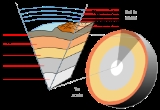
The
outer core of the
EarthEarth is the third planet from the Sun. It is the fifth largest of the eight planets in the solar system, and the largest of the terrestrial planets in the Solar System in terms of diameter, mass and density...
is a liquid layer about 2,260 km thick composed of
ironIron is a metallic chemical element with the symbol Fe and atomic number 26. Iron is a group 8 and period 4 element and is therefore classified as a transition metal. Iron and iron alloys are by far the most common metals and the most common ferromagnetic materials in everyday use...
and
nickelNickel is a chemical element, with the chemical symbol Ni and atomic number 28. It is a silvery-white lustrous metal with a slight golden tinge. It is one of the four ferromagnetic elements at about room temperature, other three being iron, cobalt and gadolinium...
which lies above the Earth's solid
inner coreThe inner core of the Earth, its innermost hottest part as detected by seismological studies, is a primarily solid sphere about in radius, only about 70% that of the Moon...
and below its
mantleThe mantle is a part of an astronomical object. The interior of the Earth, similar to the other terrestrial planets, is chemically divided into layers. The mantle is a highly viscous layer between the crust and the outer core. Earth's mantle is about 2,970 km thick rocky shell that...
. Its outer boundary lies approximately beneath the Earth's surface]. The transition between the inner core and outer core is located approximately 5,150 km beneath the Earth's surface.
The temperature of the outer core ranges from 4400 °C in the outer regions to 6100 °C near the inner core.
Discussion
Ask a question about 'Outer core'
Start a new discussion about 'Outer core'
Answer questions from other users
|
The
outer core of the
EarthEarth is the third planet from the Sun. It is the fifth largest of the eight planets in the solar system, and the largest of the terrestrial planets in the Solar System in terms of diameter, mass and density...
is a liquid layer about 2,260 km thick composed of
ironIron is a metallic chemical element with the symbol Fe and atomic number 26. Iron is a group 8 and period 4 element and is therefore classified as a transition metal. Iron and iron alloys are by far the most common metals and the most common ferromagnetic materials in everyday use...
and
nickelNickel is a chemical element, with the chemical symbol Ni and atomic number 28. It is a silvery-white lustrous metal with a slight golden tinge. It is one of the four ferromagnetic elements at about room temperature, other three being iron, cobalt and gadolinium...
which lies above the Earth's solid
inner coreThe inner core of the Earth, its innermost hottest part as detected by seismological studies, is a primarily solid sphere about in radius, only about 70% that of the Moon...
and below its
mantleThe mantle is a part of an astronomical object. The interior of the Earth, similar to the other terrestrial planets, is chemically divided into layers. The mantle is a highly viscous layer between the crust and the outer core. Earth's mantle is about 2,970 km thick rocky shell that...
. Its outer boundary lies approximately beneath the Earth's surface]. The transition between the inner core and outer core is located approximately 5,150 km beneath the Earth's surface.
The temperature of the outer core ranges from 4400 °C in the outer regions to 6100 °C near the inner core.
Eddy currentAn eddy current is an electrical phenomenon discovered by French physicist François Arago in 1824. It is caused when a conductor is exposed to a changing magnetic field due to relative motion of the field source and conductor; or due to variations of the field with time...
s in the nickel iron
fluidA fluid is a substance that continually deforms under an applied shear stress. All gases are fluids, but not all liquids are fluids. Fluids are a subset of the phases of matter and include liquids, gases, plasmas and, to some extent, plastic solids....
of the outer core are believed to influence the
Earth's magnetic fieldEarth's magnetic field is approximately a magnetic dipole, with the magnetic field S pole near the Earth's geographic north pole and the other magnetic field N pole near the Earth's geographic south pole...
. The outer core is not under enough pressure to be solid, so it is liquid even though it has a composition similar to that of the inner core. Sulfur and oxygen could also be present in the outer core.
Without the outer core, life on Earth would be very different. Scientists believe that convection of liquid metals in the outer core create the Earth's magnetic field. This magnetic field extends outward from the Earth for several thousand kilometers, and creates a protective bubble around the Earth that deflects the Sun's solar wind. Without this field, the solar wind would have blasted away our atmosphere, and Earth would be lifeless like Mars.