
Netjerikhet or
Djoser is the best-known
pharaohPharaoh is a title used in many modern discussions of the ancient Egyptian rulers of all periods. The title originates in the term "pr-aa" which means "great house" and describes the royal palace...
of the
Third dynasty of EgyptFor the Sumerian Renaissance, see Third Dynasty of Ur.The Third Dynasty of ancient Egypt is the first dynasty of the Old Kingdom. Other dynasties of the Old Kingdom include the Fourth, Fifth and Sixth...
. He commissioned his official,
ImhotepImhotep , fl. 27th century BC was an Egyptian polymath, who served under the Third Dynasty king Djoser as chancellor to the pharaoh and high priest of the sun god Ra at Heliopolis...
, to build the first of the
pyramidA pyramid is a structure whose outer surfaces are triangular and converge at a single point. The base of a pyramid can be trilateral, quadrilateral, or any polygon shape, meaning that a pyramid has at least three triangular surfaces...
s, a
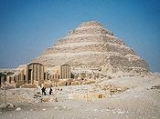
step pyramidThe Pyramid of Djoser , or step pyramid is an archeological remain in the Saqqara necropolis, Egypt, northwest of the city of Memphis. It was built during the 27th century BC for the burial of Pharaoh Djoser by Imhotep, his vizier...
for him at
SaqqaraSaqqara is a vast, ancient burial ground in Egypt, serving as the necropolis for the Ancient Egyptian capital, Memphis. Saqqara features numerous pyramids, including the world famous Step pyramid of Djoser, sometimes referred to as the Step Tomb due to its rectangular base, as well as a number of...
. Variants of his name include
Zoser,
Dzoser,
Zozer,
Dsr,
Djeser,
Djésèr,
Horus-Netjerikhet, and
Horus-Netjerichet.
There has been significant controversy about dating the reigns of the Old Kingdom, but radiocarbon dates now indicate that Djoser's reign began sometime between 2691 to 2625 BC.
The painted
limestoneLimestone is a sedimentary rock composed largely of the minerals calcite and aragonite, which are different crystal forms of calcium carbonate . Many limestones are composed from skeletal fragments of marine organisms such as coral or foraminifera....
statue of Djoser, now in the
Egyptian MuseumThe Museum of Egyptian Antiquities, known commonly as the Egyptian Museum, in Cairo, Egypt, is home to an extensive collection of ancient Egyptian antiquities. It has 120,000 items, with a representative amount on display, the remainder in storerooms....
in
CairoCairo , is the capital of Egypt and the largest city in the Arab world and Africa, and the 16th largest metropolitan area in the world. Nicknamed "The City of a Thousand Minarets" for its preponderance of Islamic architecture, Cairo has long been a centre of the region's political and cultural life...
, is the oldest known life-sized Egyptian statue. Today at the site in Saqqara where it was found, a plaster copy of the statue stands in place of the original. The statue was found during the Antiquities Service Excavations of 1924-1925.
In contemporary inscriptions, he is called
Netjerikhet, meaning "body of the gods." Later sources, which include a
New KingdomThe New Kingdom of Egypt, also referred to as the Egyptian Empire is the period in ancient Egyptian history between the 16th century BC and the 11th century BC, covering the Eighteenth, Nineteenth, and Twentieth Dynasties of Egypt....
reference to his construction, help confirm that Netjerikhet and Djoser are the same person.
While Manetho names
Necherophes and the Turin King List names Nebka as the first ruler of the Third dynasty, many Egyptologists now believe Djoser was first king of this
dynastyA dynasty is a sequence of rulers considered members of the same family. Historians traditionally consider many sovereign states' history within a framework of successive dynasties, e.g., China, Ancient Egypt and the Persian Empire...
, pointing out that the order in which some predecessors of Khufu are mentioned in the
Papyrus Westcar suggests Nebka should be placed between Djoser and
HuniHuni was the last Pharaoh of Egypt of the Third dynasty. He was the successor to Khaba.-Family:Huni was the father of Hetepheres I, the wife of Sneferu who was the first king of the Fourth Dynasty...
, not before Djoser. More significantly, the English Egyptologist
Toby WilkinsonToby A. H. Wilkinson is an English Egyptologist. He is a Fellow of Clare College, Cambridge, and an Honorary Research Fellow in the Department of Archaeology, University of Durham.-Selected works:...
has demonstrated that burial seals found at the entrance to
KhasekhemwyKhasekhemwy was the fifth and final king of the Second dynasty of Egypt. Little is known of Khasekhemwy, other than that he led several significant military campaigns and built several monuments, still extant, mentioning war against the Northerners...
's tomb in Abydos name only Djoser, rather than Nebka. This supports the view that it was Djoser who buried, and hence directly succeeded, Khasekhemwy, rather than Nebka.
Reign length
Manetho states Djoser ruled Egypt for twenty-nine years, while the Turin King List states it was only nineteen years. Because of his many substantial building projects, particularly at Saqqara, some scholars argue Djoser must have enjoyed a reign of nearly three decades. Manetho's figure appears to be more accurate, according to Wilkinson's analysis and reconstruction of the
Royal AnnalsThe Palermo Stone is a large fragment of a stele known as the Royal Annals of the Old Kingdom of Ancient Egypt. It contains records of the kings of Egypt from the first dynasty through the fifth dynasty....
. Wilkinson reconstructs the Annals as giving Djoser "
28 complete or partial years", noting that the cattle counts recorded on Palermo Stone
registerIn art and archaeology, a register is a vertical level in a work that consists of several levels, especially where the levels are clearly separated by lines; modern comic books typically use similar conventions...
V, and Cairo Fragment 1 register V, for the beginning and ending of Djoser's reign, would most likely indicate his regnal Years 1-5 and 19-28.
Reign
Djoser dispatched several military expeditions to the
Sinai PeninsulaThe Sinai Peninsula or Sinai is a triangular peninsula in Egypt about in area. It is situated between the Mediterranean Sea to the north, and the Red Sea to the south, and is the only part of Egyptian territory located in Asia as opposed to Africa, effectively serving as a land bridge between two...
, during which the local inhabitants were subdued. He also sent expeditions there to mine for valuable minerals such as
turquoiseTurquoise is an opaque, blue-to-green mineral that is a hydrous phosphate of copper and aluminium, with the chemical formula CuAl648·4. It is rare and valuable in finer grades and has been prized as a gem and ornamental stone for thousands of years owing to its unique hue...
and
copperCopper is a chemical element with the symbol Cu and atomic number 29. It is a ductile metal with very high thermal and electrical conductivity. Pure copper is soft and malleable; an exposed surface has a reddish-orange tarnish...
. This is known from inscriptions found in the desert there, sometimes displaying the banner of
SethSet was in Ancient Egyptian religion, a god of the desert, storms, and foreigners. In later myths he was also the god of darkness, and chaos...
alongside the symbols of
HorusHorus is one of the oldest and most significant deities in the Ancient Egyptian religion, who was worshipped from at least the late Predynastic period through to Greco-Roman times. Different forms of Horus are recorded in history and these are treated as distinct gods by Egyptologists...
, as had been more common under Khasekhemwy. The Sinai was also strategically important as a buffer between the
NileThe Nile is a major north-flowing river in North Africa, generally regarded as the longest river in the world. It is long. It runs through the ten countries of Sudan, South Sudan, Burundi, Rwanda, Democratic Republic of the Congo, Tanzania, Kenya, Ethiopia, Uganda and Egypt.The Nile has two major...
valley and Asia.
His most famous monument was his
step pyramidStep pyramids are structures which characterized several cultures throughout history, in several locations throughout the world. These pyramids typically are large and made of several layers of stone...
, which entailed the construction of several
mastabaA mastaba, or "pr-djt" , is a type of ancient Egyptian tomb in the form of a flat-roofed, rectangular structure with outward sloping sides that marked the burial site of many eminent Egyptians of Egypt's ancient period...
tombs one over another. These forms would eventually lead to the standard pyramid tomb in the later
Old KingdomOld Kingdom is the name given to the period in the 3rd millennium BC when Egypt attained its first continuous peak of civilization in complexity and achievement – the first of three so-called "Kingdom" periods, which mark the high points of civilization in the lower Nile Valley .The term itself was...
. Manetho, many centuries later, alludes to architectural advances of this reign, mentioning that "Tosorthros" discovered how to build with hewn stone, in addition to being remembered as the physician Aesculapius, and for introducing some reforms in the writing system. Modern scholars think that Manetho originally ascribed (or meant to ascribe) these feats to
Imuthes, who was later deified as
Aesculapius by the Greeks and Romans, and who corresponds to
ImhotepImhotep , fl. 27th century BC was an Egyptian polymath, who served under the Third Dynasty king Djoser as chancellor to the pharaoh and high priest of the sun god Ra at Heliopolis...
, the famous minister of Djoser who engineered the Step Pyramid's construction.
Some fragmentary reliefs found at
HeliopolisHeliopolis was one of the oldest cities of ancient Egypt, the capital of the 13th Lower Egyptian nome that was located five miles east of the Nile to the north of the apex of the Nile Delta...
and
GebeleinGebelein is a town in Egypt. It is located on the Nile, about 40 km south of Thebes, in Qena Governorate.The modern geographic area is known as Naga el-Gherira.-Archaeology:...
mention Djoser's name and suggest he commissioned construction projects in those cities. Also, he may have fixed the southern boundary of his kingdom at the First Cataract. An inscription known as the Famine Stela and claiming to date to the reign of Djoser, but probably created during the
Ptolemaic DynastyThe Ptolemaic dynasty, was a Macedonian Greek royal family which ruled the Ptolemaic Empire in Egypt during the Hellenistic period. Their rule lasted for 275 years, from 305 BC to 30 BC...
, relates how Djoser rebuilt the temple of Khnum on the island of
ElephantineElephantine is an island in the River Nile, located just downstream of the First Cataract at the southern border of Ancient Egypt. This region is referred to as Upper Egypt because the land is higher than that near the Mediterranean coast. The island may have received its name because it was a...
at the First Cataract, thus ending a seven-year famine in Egypt. Some consider this ancient inscription as a legend at the time it was inscribed. Nonetheless, it does show that more than two millennia after his reign, Egyptians still remembered Djoser.
Although he seems to have started an unfinished tomb at Abydos (Upper Egypt), Djoser was eventually buried in his famous pyramid at Saqqara in Lower Egypt. Since Khasekhemwy, a pharaoh from the 2nd dynasty, was the last pharaoh to be buried at Abydos, some Egyptologists infer that the shift to a more northerly capital was completed during Djoser's time.
Family
Because Queen
NimaethapNimaethap was a Queen of Ancient Egypt at the end of the Second Dynasty.- Biography :Nimaethap was possibly the wife of Pharaoh Khasekhemwy and the mother of Djoser, the first Pharaoh of the Third dynasty of Egypt...
, the wife of Khasekhemwy, the last king of the
Second dynasty of EgyptThe second dynasty of ancient Egypt is often combined with Dynasty I under the group title Early Dynastic Period. It dates approximately from 2890 to 2686 BC. The capital at that time was Thinis.-Rulers:...
, is mentioned on a jar sealing of Khasekhemwy with the title "Mother of the King's children", some writers argue she was Djoser's mother and Khasekhemwy was his father. This is also suggested by another jar sealing, dating to Djoser's reign, calling her "Mother of the King of the Two Lands". Her cult seems to have still been active in the later reign of
SneferuSneferu, also spelled as Snephru, Snefru or Snofru , was the founder of the Fourth dynasty of Egypt. Estimates of his reign vary, with for instance The Oxford History of Ancient Egypt suggesting a reign from around 2613 BC to 2589 BC, a reign of 24 years, while Rolf Krauss suggests a 30-year reign...
.
HetephernebtiHetephernebti was a queen of the third dynasty of ancient Egypt. She was the only known wife of Pharaoh Djoser.Hetephernebti and a King's Daughter Inetkaes were named on stelae found around Djoser's Sakkara pyramid complex and on a Heliopolis relief showing Djoser accompanied by the two of...
is identified as one of Djoser's queens "on a series of boundary stela from the Step Pyramid enclosure (now in various museums) and a fragment of relief from a building at Hermopolis" currently in the Egyptian museum of Turin.
Inetkawes was their only daughter known by name. There was also a third royal female attested during Djoser's reign, but her name is destroyed. The relationship between Djoser and his successor,
SekhemkhetSekhemkhet was a Pharaoh in Egypt during the Third dynasty. According to the Manethonian tradition, a king known as Tyris reigned for a relatively brief period of seven years, and modern scholars believe Djoserty and Sekhemkhet are the same person...
, is not known, and the date of his death is uncertain.