

Alkaline earth metal

Encyclopedia
| Group | 2 | |
|---|---|---|
| Period | 2 Period 2 element A period 2 element is one of the chemical elements in the second row of the periodic table. The periodic table is laid out in rows to illustrate recurring trends in the chemical behavior of the elements as their atomic number increases; a new row is started when chemical behavior begins to... |
|
| 3 Period 3 element A period 3 element is one of the chemical elements in the third row of the periodic table of the chemical elements. The periodic table is laid out in rows to illustrate recurring trends in the chemical behaviour of the elements as their atomic number increases: a new row is begun when chemical... |
||
| 4 Period 4 element A period 4 element is one of the chemical elements in the fourth row of the periodic table of the elements. The periodic table is laid out in rows to illustrate recurring trends in the chemical behaviour of the elements as their atomic number increases: a new row is begun when chemical behaviour... |
||
| 5 Period 5 element A period 5 element is one of the chemical elements in the fifth row of the periodic table of the elements. The periodic table is laid out in rows to illustrate recurring trends in the chemical behaviour of the elements as their atomic number increases: a new row is begun when chemical behaviour... |
||
| 6 Period 6 element A period 6 element is one of the chemical elements in the sixth row of the periodic table of the elements, including the lanthanides... |
||
| 7 Period 7 element A period 7 element is one of the chemical elements in the seventh row of the periodic table of the chemical elements. The periodic table is laid out in rows to illustrate recurring trends in the chemical behaviour of the elements as their atomic number increases: a new row is begun when chemical... |
The alkaline earth metals are a group in the periodic table
Periodic table
The periodic table of the chemical elements is a tabular display of the 118 known chemical elements organized by selected properties of their atomic structures. Elements are presented by increasing atomic number, the number of protons in an atom's atomic nucleus...
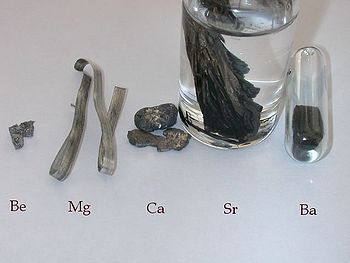
. In the modern IUPAC nomenclature, the alkaline earth metals are called the group 2 elements. Previously, they were called the Group IIA elements . The alkaline earth metals contain beryllium
Beryllium
Beryllium is the chemical element with the symbol Be and atomic number 4. It is a divalent element which occurs naturally only in combination with other elements in minerals. Notable gemstones which contain beryllium include beryl and chrysoberyl...
(Be), magnesium
Magnesium
Magnesium is a chemical element with the symbol Mg, atomic number 12, and common oxidation number +2. It is an alkaline earth metal and the eighth most abundant element in the Earth's crust and ninth in the known universe as a whole...
(Mg), calcium
Calcium
Calcium is the chemical element with the symbol Ca and atomic number 20. It has an atomic mass of 40.078 amu. Calcium is a soft gray alkaline earth metal, and is the fifth-most-abundant element by mass in the Earth's crust...
(Ca), strontium
Strontium
Strontium is a chemical element with the symbol Sr and the atomic number 38. An alkaline earth metal, strontium is a soft silver-white or yellowish metallic element that is highly reactive chemically. The metal turns yellow when exposed to air. It occurs naturally in the minerals celestine and...
(Sr), barium
Barium
Barium is a chemical element with the symbol Ba and atomic number 56. It is the fifth element in Group 2, a soft silvery metallic alkaline earth metal. Barium is never found in nature in its pure form due to its reactivity with air. Its oxide is historically known as baryta but it reacts with...
(Ba) and radium
Radium
Radium is a chemical element with atomic number 88, represented by the symbol Ra. Radium is an almost pure-white alkaline earth metal, but it readily oxidizes on exposure to air, becoming black in color. All isotopes of radium are highly radioactive, with the most stable isotope being radium-226,...
(Ra). (Although helium
Helium
Helium is the chemical element with atomic number 2 and an atomic weight of 4.002602, which is represented by the symbol He. It is a colorless, odorless, tasteless, non-toxic, inert, monatomic gas that heads the noble gas group in the periodic table...
(He) is occasionally considered to be a group 2 element, for example, in the extended periodic table and Janet periodic table, it never exhibits behaviour comparable to the alkaline earth metals.) The group lies in the s-block
S-block
The s-block of the periodic table of elements consists of the first two groups: the alkali metals and alkaline earth metals, plus hydrogen and helium.Except in hydrogen and helium, these electrons are very easily lost to form positive ions...
of the periodic table.
This specific group in the periodic table owes its name to their oxides that simply give basic alkaline solutions. These oxides melt at such high temperature that they remain solids ("earths") in fires. The alkaline earth metals provide a good example of group trends in properties in the periodic table, with well-characterized homologous
Homology (chemistry)
In chemistry, homology refers to the appearance of homologues. A homologue is a compound belonging to a series of compounds differing from each other by a repeating unit, such as a methylene group, a peptide residue, etcetera....
behavior down the group. With the exception of beryllium
Beryllium
Beryllium is the chemical element with the symbol Be and atomic number 4. It is a divalent element which occurs naturally only in combination with other elements in minerals. Notable gemstones which contain beryllium include beryl and chrysoberyl...
and magnesium
Magnesium
Magnesium is a chemical element with the symbol Mg, atomic number 12, and common oxidation number +2. It is an alkaline earth metal and the eighth most abundant element in the Earth's crust and ninth in the known universe as a whole...
, the metals have a distinguishable flame color, orange for calcium
Calcium
Calcium is the chemical element with the symbol Ca and atomic number 20. It has an atomic mass of 40.078 amu. Calcium is a soft gray alkaline earth metal, and is the fifth-most-abundant element by mass in the Earth's crust...
, bright red for strontium
Strontium
Strontium is a chemical element with the symbol Sr and the atomic number 38. An alkaline earth metal, strontium is a soft silver-white or yellowish metallic element that is highly reactive chemically. The metal turns yellow when exposed to air. It occurs naturally in the minerals celestine and...
, green for barium
Barium
Barium is a chemical element with the symbol Ba and atomic number 56. It is the fifth element in Group 2, a soft silvery metallic alkaline earth metal. Barium is never found in nature in its pure form due to its reactivity with air. Its oxide is historically known as baryta but it reacts with...
and crimson red for radium
Radium
Radium is a chemical element with atomic number 88, represented by the symbol Ra. Radium is an almost pure-white alkaline earth metal, but it readily oxidizes on exposure to air, becoming black in color. All isotopes of radium are highly radioactive, with the most stable isotope being radium-226,...
.
All of the alkaline earth metals discovered, as of 2011, are naturally occurring (see abundance of the chemical elements
Abundance of the chemical elements
The abundance of a chemical element measures how relatively common the element is, or how much of the element is present in a given environment by comparison to all other elements...
for references), and share similar properties: they are all rather reactive metals under standard conditions. So far, experiments have been conducted to attempt the synthesis of the next member of the group, unbinilium
Unbinilium
Unbinilium , also called eka-radium or element 120, is the temporary, systematic element name of a hypothetical chemical element in the periodic table that has the temporary symbol Ubn and has the atomic number 120....
(Ubn), but these have all met with failure. However, since unbinilium is the second period 8 element
Period 8 element
A period 8 element is any one of 50 hypothetical chemical elements belonging to an eighth period of the periodic table of the elements. They may be referred to using IUPAC systematic element names. None of these elements have been created, and it is possible that none have isotopes with stable...
and only the second element on the periodic table that has not been discovered yet, it is likely to be discovered in the near future. It is also possible that ununhexium
Ununhexium
Ununhexium is the temporary name of a synthetic superheavy element with the temporary symbol Uuh and atomic number 116. There is no proposed name yet although moscovium has been discussed in the media.It is placed as the heaviest member of group 16 although a sufficiently stable isotope is...
(Uuh), which has been synthesised in 2002, is the next alkaline earth metal.
Like other groups, the members of this family show patterns in its electron configuration, especially the outermost shells resulting in trends in chemical behavior:
| Z Atomic number In chemistry and physics, the atomic number is the number of protons found in the nucleus of an atom and therefore identical to the charge number of the nucleus. It is conventionally represented by the symbol Z. The atomic number uniquely identifies a chemical element... | Element Chemical element A chemical element is a pure chemical substance consisting of one type of atom distinguished by its atomic number, which is the number of protons in its nucleus. Familiar examples of elements include carbon, oxygen, aluminum, iron, copper, gold, mercury, and lead.As of November 2011, 118 elements... | No. of electrons/shell Electron shell An electron shell may be thought of as an orbit followed by electrons around an atom's nucleus. The closest shell to the nucleus is called the "1 shell" , followed by the "2 shell" , then the "3 shell" , and so on further and further from the nucleus. The shell letters K,L,M,..... |
|---|---|---|
| 4 | Beryllium | 2, 2 |
| 12 | Magnesium | 2, 8, 2 |
| 20 | Calcium | 2, 8, 8, 2 |
| 38 | Strontium | 2, 8, 18, 8, 2 |
| 56 | Barium | 2, 8, 18, 18, 8, 2 |
| 88 | Radium | 2, 8, 18, 32, 18, 8, 2 |
The alkaline earth metals are silver colored, soft metal
Metal
A metal , is an element, compound, or alloy that is a good conductor of both electricity and heat. Metals are usually malleable and shiny, that is they reflect most of incident light...
s, which react readily with halogen
Halogen
The halogens or halogen elements are a series of nonmetal elements from Group 17 IUPAC Style of the periodic table, comprising fluorine , chlorine , bromine , iodine , and astatine...
s to form ionic salts, and with water
Water
Water is a chemical substance with the chemical formula H2O. A water molecule contains one oxygen and two hydrogen atoms connected by covalent bonds. Water is a liquid at ambient conditions, but it often co-exists on Earth with its solid state, ice, and gaseous state . Water also exists in a...
, though not as rapidly as the alkali metal
Alkali metal
The alkali metals are a series of chemical elements in the periodic table. In the modern IUPAC nomenclature, the alkali metals comprise the group 1 elements, along with hydrogen. The alkali metals are lithium , sodium , potassium , rubidium , caesium , and francium...
s, to form strong alkali
Alkali
In chemistry, an alkali is a basic, ionic salt of an alkali metal or alkaline earth metal element. Some authors also define an alkali as a base that dissolves in water. A solution of a soluble base has a pH greater than 7. The adjective alkaline is commonly used in English as a synonym for base,...
ne (basic
Base (chemistry)
For the term in genetics, see base A base in chemistry is a substance that can accept hydrogen ions or more generally, donate electron pairs. A soluble base is referred to as an alkali if it contains and releases hydroxide ions quantitatively...
) hydroxide
Hydroxide
Hydroxide is a diatomic anion with chemical formula OH−. It consists of an oxygen and a hydrogen atom held together by a covalent bond, and carrying a negative electric charge. It is an important but usually minor constituent of water. It functions as a base, as a ligand, a nucleophile, and a...
s. For example, where lithium
Lithium
Lithium is a soft, silver-white metal that belongs to the alkali metal group of chemical elements. It is represented by the symbol Li, and it has the atomic number 3. Under standard conditions it is the lightest metal and the least dense solid element. Like all alkali metals, lithium is highly...
, sodium
Sodium
Sodium is a chemical element with the symbol Na and atomic number 11. It is a soft, silvery-white, highly reactive metal and is a member of the alkali metals; its only stable isotope is 23Na. It is an abundant element that exists in numerous minerals, most commonly as sodium chloride...
and potassium
Potassium
Potassium is the chemical element with the symbol K and atomic number 19. Elemental potassium is a soft silvery-white alkali metal that oxidizes rapidly in air and is very reactive with water, generating sufficient heat to ignite the hydrogen emitted in the reaction.Potassium and sodium are...
react with water at room temperature, magnesium
Magnesium
Magnesium is a chemical element with the symbol Mg, atomic number 12, and common oxidation number +2. It is an alkaline earth metal and the eighth most abundant element in the Earth's crust and ninth in the known universe as a whole...
reacts only with steam
Steam
Steam is the technical term for water vapor, the gaseous phase of water, which is formed when water boils. In common language it is often used to refer to the visible mist of water droplets formed as this water vapor condenses in the presence of cooler air...
and calcium
Calcium
Calcium is the chemical element with the symbol Ca and atomic number 20. It has an atomic mass of 40.078 amu. Calcium is a soft gray alkaline earth metal, and is the fifth-most-abundant element by mass in the Earth's crust...
with hot water:
- Mg + 2 H2O → Mg(OH)2 + H2
Beryllium
Beryllium
Beryllium is the chemical element with the symbol Be and atomic number 4. It is a divalent element which occurs naturally only in combination with other elements in minerals. Notable gemstones which contain beryllium include beryl and chrysoberyl...
is an exception: It does not react with water or steam, and its halides are covalent.
All the alkaline earth metals have two electron
Electron
The electron is a subatomic particle with a negative elementary electric charge. It has no known components or substructure; in other words, it is generally thought to be an elementary particle. An electron has a mass that is approximately 1/1836 that of the proton...
s in their valence shell, so the energetically preferred state of achieving a filled electron shell
Electron shell
An electron shell may be thought of as an orbit followed by electrons around an atom's nucleus. The closest shell to the nucleus is called the "1 shell" , followed by the "2 shell" , then the "3 shell" , and so on further and further from the nucleus. The shell letters K,L,M,.....
is to lose two electrons to form doubly charged
Electric charge
Electric charge is a physical property of matter that causes it to experience a force when near other electrically charged matter. Electric charge comes in two types, called positive and negative. Two positively charged substances, or objects, experience a mutual repulsive force, as do two...
positive ion
Ion
An ion is an atom or molecule in which the total number of electrons is not equal to the total number of protons, giving it a net positive or negative electrical charge. The name was given by physicist Michael Faraday for the substances that allow a current to pass between electrodes in a...
s.
The alkaline earth metals are named after their oxide
Oxide
An oxide is a chemical compound that contains at least one oxygen atom in its chemical formula. Metal oxides typically contain an anion of oxygen in the oxidation state of −2....
s, the alkaline earths, whose old-fashioned names were beryllia, magnesia
Magnesium oxide
Magnesium oxide , or magnesia, is a white hygroscopic solid mineral that occurs naturally as periclase and is a source of magnesium . It has an empirical formula of and consists of a lattice of Mg2+ ions and O2– ions held together by ionic bonds...
, lime
Calcium oxide
Calcium oxide , commonly known as quicklime or burnt lime, is a widely used chemical compound. It is a white, caustic, alkaline crystalline solid at room temperature....
, strontia and baryta. These oxides are basic (alkaline) when combined with water. "Earth" is an old term applied by early chemists to nonmetallic substances that are insoluble in water and resistant to heating—properties shared by these oxides. The realization that these earths were not elements but compound
Chemical compound
A chemical compound is a pure chemical substance consisting of two or more different chemical elements that can be separated into simpler substances by chemical reactions. Chemical compounds have a unique and defined chemical structure; they consist of a fixed ratio of atoms that are held together...
s is attributed to the chemist Antoine Lavoisier
Antoine Lavoisier
Antoine-Laurent de Lavoisier , the "father of modern chemistry", was a French nobleman prominent in the histories of chemistry and biology...
. In his Traité Élémentaire de Chimie
Traité Élémentaire de Chimie
Traité élémentaire de chimie is an influential textbook written by Antoine Lavoisier published in 1789 and translated into English by Robert Kerr in 1790.The book is considered to be the first modern chemical textbook...
(Elements of Chemistry) of 1789 he called them salt-forming earth elements. Later, he suggested that the alkaline earths might be metal oxides, but admitted that this was mere conjecture. In 1808, acting on Lavoisier's idea, Humphry Davy
Humphry Davy
Sir Humphry Davy, 1st Baronet FRS MRIA was a British chemist and inventor. He is probably best remembered today for his discoveries of several alkali and alkaline earth metals, as well as contributions to the discoveries of the elemental nature of chlorine and iodine...
became the first to obtain samples of the metals by electrolysis
Electrolysis
In chemistry and manufacturing, electrolysis is a method of using a direct electric current to drive an otherwise non-spontaneous chemical reaction...
of their molten earths.
Biological occurrences
- Beryllium's low aqueous solubility means it is rarely available to biological systems; it has no known role in living organisms, and when encountered by them, is generally highly toxic.
- Magnesium and calcium are ubiquitous and essential to all known living organisms. They are involved in more than one role, with, for example, Mg/Ca ion pumps playing a role in some cellular processes, magnesium functioning as the active center in some enzymes, and calcium salts taking a structural role (e.g. boneBoneBones are rigid organs that constitute part of the endoskeleton of vertebrates. They support, and protect the various organs of the body, produce red and white blood cells and store minerals. Bone tissue is a type of dense connective tissue...
s).
- Strontium and barium have a lower availability in the biosphere. Strontium plays an important role in marine aquatic life, especially hard corals. They use strontium to build their exoskeletonExoskeletonAn exoskeleton is the external skeleton that supports and protects an animal's body, in contrast to the internal skeleton of, for example, a human. In popular usage, some of the larger kinds of exoskeletons are known as "shells". Examples of exoskeleton animals include insects such as grasshoppers...
. These elements have some uses in medicine, for example "barium mealBarium mealA barium meal, also known as an upper gastrointestinal series is a procedure in which radiographs of the esophagus, stomach and duodenum are taken after barium sulfate is ingested by a patient...
s" in radio graphic imaging, whilst strontium compounds are employed in some toothpasteToothpasteToothpaste is a paste or gel dentifrice used with a toothbrush as an accessory to clean and maintain the aesthetics and health of teeth. Toothpaste is used to promote oral hygiene: it serves as an abrasive that aids in removing the dental plaque and food from the teeth, assists in suppressing...
s.
- Radium has a low availability and is highly radioactive, making it toxic to life.
Comparison of the physical properties and chemical properties between alkaline earth and alkali metals
Just like their names, they do not differ completely. The main difference is the electron configuration, which is ns2 for alkaline earth metals and ns1 for alkali metals. For the alkaline earth metals, there are two electrons that are available to form a metallic bond, and the nucleus contains an additional positive charge. Also, the elements of group 2A (alkaline earth) have much higher melting points and boiling points compared to those of group 1A (alkali metals). The alkali also have a softer and more lighweight figure whereas the alkaline earth metals are much harder and denser.The second valence electron is very important when it comes to comparing chemical properties of the alkaline earth and the alkali metals. The second valence electron is in the same “sublevel” as the first valence electron. Therefore, the Zeff is much greater. This means that the elements of the group 2A contain a smaller atomic radius and much higher ionization energy than the group 1A. Even though the group 2A contains much higher ionization energy, they still form an ionic compound with 2+ cations. Beryllium, however, behaves differently. This is because in order to remove two electrons from this particular atom, it requires significantly more energy. It never forms Be2+ and its bonds are polar covalent.
Beryllium
As mentioned earlier, Be is “special”; it behaves differently. If the Be2+ ion did exist, it would polarize electron clouds that are near it very strongly and would cause extensive orbital overlapOrbital overlap
Orbital overlap was an idea first introduced by Linus Pauling to explain the molecular bond angles observed through experimentation and is the basis for the concept of orbital hybridisation. s orbitals are spherical and have no directionality while p orbitals are oriented 90° to one another...
, since Be has a high charge density. All compounds that include Be have a covalent bond. Even the compound BeF2 , which is the most ionic Be compound, has a low melting point and a low electrical conductivity when melted.
Important reactions and compounds
Reactions:Note: E = elements that act as reducing agents
1. The metals reduce halogens to form ionic halides: E(s) + X2 → EX2 (s) where X = F, Cl, Br or I
2. The metals reduce O2 to form the oxides: 2E(s) + O2 → 2EO(s)
3. The larger metals react with water to produce hydrogen gas: E(s) + 2H2O(l) → E2+(aq) + 2OH-aq + H2 (g) where E = Ca, Sr or Ba
Compounds
1. Alkylmagnesium halides (RMgX where R = hydrocarbon group and X = halogen). They are used to synthetise organic compounds.
Here’s an example: 3RMgCl + SnCl4 → 3MgCl2 + R3SnCl
2. Magnesium oxide (MgO). It is used as a material to refract furnace brick and wire insulation (melting point of 2852°C).
3. Calcium carbonate (CaCO3). It is mainly used in the construction industry and for making limestone, marble, chalk, and coral.