

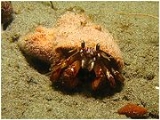
Hermit crab

Encyclopedia
Hermit crabs are decapod
crustacean
s of the superfamily Paguroidea. Most of the 1100 species possess an asymmetrical abdomen which is concealed in an empty gastropod shell
that is carried around by the hermit crab.
have long, spirally curved abdomen
s, which are soft, unlike the hard, calcified abdomens seen in related crustaceans. The vulnerable abdomen is protected from predators by a salvaged empty seashell
carried by the hermit crab, into which its whole body can retract. Most frequently hermit crabs use the shells of sea snail
s (although the shells of bivalves and scaphopods and even hollow pieces of wood and stone are used by some species). The tip of the hermit crab's abdomen is adapted to clasp strongly onto the columella of the snail shell.
As the hermit crab grows in size, it has to find a larger shell and abandon the previous one. This habit of living in a second hand
shell gives rise to the popular name "hermit crab", by analogy to a hermit
who lives alone. Several hermit crab species, both terrestrial and marine, use "vacancy chains" to find new shells: when a new, bigger shell becomes available, hermit crabs gather around it and form a kind of queue from largest to smallest. When the largest crab moves into the new shell, the second biggest crab moves into the newly vacated shell, thereby making its previous shell available to the third crab, and so on.
Most species are aquatic
and live in varying depths of saltwater, from shallow reefs and shorelines to deep sea bottoms. Tropical areas host some terrestrial species
, though even those have aquatic larvae and therefore need access to water for reproduction.
A few species do not use a "mobile home" and inhabit immobile structures left by polychaete
worms, vermetid
gastropods, coral
s and sponges.
 As hermit crabs grow they require larger shells. Since suitable intact gastropod shell
s are sometimes a limited resource, there is often vigorous competition among hermit crabs for shells. The availability of empty shells at any given place depends on the relative abundance of gastropods and hermit crabs, matched for size. An equally important issue is the population of organisms that prey upon gastropods and leave the shells intact. Hermit crabs that are kept together may fight or kill a competitor to gain access to the shell they favour. However, if the crabs vary significantly in size, the occurrence of fights over empty shells will decrease or remain non-existent.
A hermit crab with a shell that is too small cannot grow as fast as those with well-fitting shells, and is more likely to be eaten if it cannot retract completely into the shell.
For some larger marine
species, supporting one or more sea anemones on the shell can scare away predators. The sea anemone benefits, because it is in position to consume fragments of the hermit crab's meals.
only a few millimetres long to Coenobita brevimanus
, which can approach the size of a coconut. The shell-less hermit crab Birgus latro (coconut crab) is the world's largest terrestrial invertebrate
.
The young develop in stages, with the first two (the nauplius and protozoea) occurring inside the egg. Most hermit crab larvae hatch at the third stage, the zoea. This is a larval stage wherein the crab has several long spines, a long narrow abdomen, and large fringed antennae. After several zoeal moults, this is followed by the final larval stage, the megalopa stage.
s and porcelain crab
s than they are to true crab
s. The king crab
s in the family Lithodidae were formerly considered to be derived hermit crabs, but are now placed in a separate superfamily.
Six families are recognised in the superfamily Paguroidea, containing around 1100 species in total in 120 genera.
hermit crabs using gastropod shell
s stretches back to the Late Cretaceous
. Before that time, at least some hermit crabs used ammonite
s' shells instead, as shown by a specimen of Palaeopagurus vandenengeli
from the Speeton Clay
, Yorkshire
, UK
from the Lower Cretaceous.
 Several marine species of hermit crabs are common in the marine aquarium
trade. Of the approximately 15 terrestrial species
in the world, the following are commonly kept as pets: Caribbean hermit crab
(Coenobita clypeatus), Australian land hermit crab
(Coenobita variabilis), and the Ecuadorian hermit crab
(Coenobita compressus). Other species, such as Coenobita brevimanus, Coenobita rugosus, Coenobita perlatus or Coenobita cavipes, are less common but growing in availability and popularity as pets.
These omnivorous or herbivorous species can be useful in the household aquarium as scavenger
s, because they eat algae
and debris
.
Hermit crabs are often seen as a "throwaway pet" that would live only a few months, but species such as Coenobita clypeatus have a 23 year lifespan if properly treated, and some have lived longer than 32 years.
In general, and despite their moniker, hermit crabs are social animals that do best in groups. In the wild they can be found in colonies of a hundred or more. Therefore, many sellers encourage the purchase of more than one crab. They also require a temperature and humidity-controlled environment, and adequate substrate that is deep enough to allow them to completely bury themselves while moulting
.
Decapoda
The decapods or Decapoda are an order of crustaceans within the class Malacostraca, including many familiar groups, such as crayfish, crabs, lobsters, prawns and shrimp. Most decapods are scavengers. It is estimated that the order contains nearly 15,000 species in around 2,700 genera, with...
crustacean
Crustacean
Crustaceans form a very large group of arthropods, usually treated as a subphylum, which includes such familiar animals as crabs, lobsters, crayfish, shrimp, krill and barnacles. The 50,000 described species range in size from Stygotantulus stocki at , to the Japanese spider crab with a leg span...
s of the superfamily Paguroidea. Most of the 1100 species possess an asymmetrical abdomen which is concealed in an empty gastropod shell
Gastropod shell
The gastropod shell is a shell which is part of the body of a gastropod or snail, one kind of mollusc. The gastropod shell is an external skeleton or exoskeleton, which serves not only for muscle attachment, but also for protection from predators and from mechanical damage...
that is carried around by the hermit crab.
Description
Most speciesSpecies
In biology, a species is one of the basic units of biological classification and a taxonomic rank. A species is often defined as a group of organisms capable of interbreeding and producing fertile offspring. While in many cases this definition is adequate, more precise or differing measures are...
have long, spirally curved abdomen
Abdomen
In vertebrates such as mammals the abdomen constitutes the part of the body between the thorax and pelvis. The region enclosed by the abdomen is termed the abdominal cavity...
s, which are soft, unlike the hard, calcified abdomens seen in related crustaceans. The vulnerable abdomen is protected from predators by a salvaged empty seashell
Seashell
A seashell or sea shell, also known simply as a shell, is a hard, protective outer layer created by an animal that lives in the sea. The shell is part of the body of the animal. Empty seashells are often found washed up on beaches by beachcombers...
carried by the hermit crab, into which its whole body can retract. Most frequently hermit crabs use the shells of sea snail
Snail
Snail is a common name applied to most of the members of the molluscan class Gastropoda that have coiled shells in the adult stage. When the word is used in its most general sense, it includes sea snails, land snails and freshwater snails. The word snail without any qualifier is however more often...
s (although the shells of bivalves and scaphopods and even hollow pieces of wood and stone are used by some species). The tip of the hermit crab's abdomen is adapted to clasp strongly onto the columella of the snail shell.
As the hermit crab grows in size, it has to find a larger shell and abandon the previous one. This habit of living in a second hand
Second Hand
Second Hand is the title of an album by Mark Heard, released in 1991, on Heard's own Fingerprint Records. The album was listed at #4 in the book CCM Presents: The 100 Greatest Albums in Christian Music ....
shell gives rise to the popular name "hermit crab", by analogy to a hermit
Hermit
A hermit is a person who lives, to some degree, in seclusion from society.In Christianity, the term was originally applied to a Christian who lives the eremitic life out of a religious conviction, namely the Desert Theology of the Old Testament .In the...
who lives alone. Several hermit crab species, both terrestrial and marine, use "vacancy chains" to find new shells: when a new, bigger shell becomes available, hermit crabs gather around it and form a kind of queue from largest to smallest. When the largest crab moves into the new shell, the second biggest crab moves into the newly vacated shell, thereby making its previous shell available to the third crab, and so on.
Most species are aquatic
Aquatic animal
An aquatic animal is an animal, either vertebrate or invertebrate, which lives in water for most or all of its life. It may breathe air or extract its oxygen from that dissolved in water through specialised organs called gills, or directly through its skin. Natural environments and the animals that...
and live in varying depths of saltwater, from shallow reefs and shorelines to deep sea bottoms. Tropical areas host some terrestrial species
Terrestrial animal
Terrestrial animals are animals that live predominantly or entirely on land , as compared with aquatic animals, which live predominantly or entirely in the water , or amphibians, which rely on a combination of aquatic and terrestrial habitats...
, though even those have aquatic larvae and therefore need access to water for reproduction.
A few species do not use a "mobile home" and inhabit immobile structures left by polychaete
Polychaete
The Polychaeta or polychaetes are a class of annelid worms, generally marine. Each body segment has a pair of fleshy protrusions called parapodia that bear many bristles, called chaetae, which are made of chitin. Indeed, polychaetes are sometimes referred to as bristle worms. More than 10,000...
worms, vermetid
Vermetidae
Vermetidae, common name the worm snails or worm shells, is a taxonomic family of small to medium-sized sea snails, marine gastropod molluscs in the clade Littorinimorpha....
gastropods, coral
Coral
Corals are marine animals in class Anthozoa of phylum Cnidaria typically living in compact colonies of many identical individual "polyps". The group includes the important reef builders that inhabit tropical oceans and secrete calcium carbonate to form a hard skeleton.A coral "head" is a colony of...
s and sponges.
Shells and shell competition
Gastropod shell
The gastropod shell is a shell which is part of the body of a gastropod or snail, one kind of mollusc. The gastropod shell is an external skeleton or exoskeleton, which serves not only for muscle attachment, but also for protection from predators and from mechanical damage...
s are sometimes a limited resource, there is often vigorous competition among hermit crabs for shells. The availability of empty shells at any given place depends on the relative abundance of gastropods and hermit crabs, matched for size. An equally important issue is the population of organisms that prey upon gastropods and leave the shells intact. Hermit crabs that are kept together may fight or kill a competitor to gain access to the shell they favour. However, if the crabs vary significantly in size, the occurrence of fights over empty shells will decrease or remain non-existent.
A hermit crab with a shell that is too small cannot grow as fast as those with well-fitting shells, and is more likely to be eaten if it cannot retract completely into the shell.
For some larger marine
Marine (ocean)
Marine is an umbrella term. As an adjective it is usually applicable to things relating to the sea or ocean, such as marine biology, marine ecology and marine geology...
species, supporting one or more sea anemones on the shell can scare away predators. The sea anemone benefits, because it is in position to consume fragments of the hermit crab's meals.
Development and reproduction
Hermit crab species range in size and shape, from species with a carapaceCarapace
A carapace is a dorsal section of the exoskeleton or shell in a number of animal groups, including arthropods such as crustaceans and arachnids, as well as vertebrates such as turtles and tortoises. In turtles and tortoises, the underside is called the plastron.-Crustaceans:In crustaceans, the...
only a few millimetres long to Coenobita brevimanus
Coenobita brevimanus
Coenobita brevimanus is a species of land hermit crab native to the east coast of Africa and the south west Pacific Ocean. Adults of this species can be larger than any other species from the genus Coenobita, weighing up to ....
, which can approach the size of a coconut. The shell-less hermit crab Birgus latro (coconut crab) is the world's largest terrestrial invertebrate
Invertebrate
An invertebrate is an animal without a backbone. The group includes 97% of all animal species – all animals except those in the chordate subphylum Vertebrata .Invertebrates form a paraphyletic group...
.
The young develop in stages, with the first two (the nauplius and protozoea) occurring inside the egg. Most hermit crab larvae hatch at the third stage, the zoea. This is a larval stage wherein the crab has several long spines, a long narrow abdomen, and large fringed antennae. After several zoeal moults, this is followed by the final larval stage, the megalopa stage.
Classification
Hermit crabs are more closely related to squat lobsterSquat lobster
Squat lobsters are decapod crustaceans of the families Galatheidae, Chirostylidae and Kiwaidae, including the common genera Galathea and Munida. They are not lobsters at all, but are more closely related to porcelain crabs, hermit crabs and then, more distantly, true crabs...
s and porcelain crab
Porcelain crab
Porcelain crabs are decapod crustaceans in the widespread family Porcellanidae, which superficially resemble true crabs. They are typically less than wide, and have flattened bodies as an adaptation for living in rock crevices...
s than they are to true crab
Crab
True crabs are decapod crustaceans of the infraorder Brachyura, which typically have a very short projecting "tail" , or where the reduced abdomen is entirely hidden under the thorax...
s. The king crab
King crab
King crabs, also called stone crabs, are a superfamily of crab-like decapod crustaceans chiefly found in cold seas. Because of their large size and the taste of their meat, many species are widely caught and sold as food, the most common being the red king crab, Paralithodes camtschaticus.King...
s in the family Lithodidae were formerly considered to be derived hermit crabs, but are now placed in a separate superfamily.
Six families are recognised in the superfamily Paguroidea, containing around 1100 species in total in 120 genera.
- CoenobitidaeCoenobitidaeCoenobitidae are a family of hermit crabs, widely known for their terrestrial habits. There are 17 species in two genera:*Coenobita Latreille, 1829*Coenobita brevimanus Dana, 1852*Coenobita carnescens Dana, 1851...
Dana, 1851 – 2 genera: terrestrial hermit crabsCoenobitaThe genus Coenobita contains the sixteen species of terrestrial hermit crabs. The majority of the species are found in the Indo-Pacific region, with only one species in West Africa, one species occurring along the western Atlantic Ocean, and one species occurring on the Pacific coast of the Americas...
and the coconut crabCoconut crabThe coconut crab, Birgus latro, is a species of terrestrial hermit crab, also known as the robber crab or palm thief. It is the largest land-living arthropod in the world, and is probably at the upper size limit of terrestrial animals with exoskeletons in today's atmosphere at a weight of up to... - Diogenidae Ortmann, 1892 – 20 genera of "left-handed hermit crabs"
- PaguridaePaguridaePaguridae is a family of hermit crabs of the order Decapoda. It contains 542 species in over 70 genera:*Acanthopagurus de Saint Laurent, 1968*Agaricochirus McLaughlin, 1981*Alainopaguroides McLaughlin, 1997...
Latreille, 1802 – 76 genera - ParapaguridaeParapaguridaeParapaguridae is a family of terrestrial hermit crabs. They have gill chambers that function as lungs. Some genera, such as Bivalvopagurus and Tylaspis, do not inhabit shells...
Smith, 1882 – 10 genera - PylochelidaePylochelidaePylochelidae is a family of hermit crabs. Its members are commonly called the symmetrical hermit crabs. They live in all the world's oceans, except the Arctic and the Antarctic, at depths of up to...
Bate, 1888 – 10 genera of "symmetrical hermit crabs" - PylojacquesidaePylojacquesidaePylojacquesidae is a small family of hermit crabs, comprising only two species in two genera. The family was erected in 2001, after two specimens at at the were recognised as being quite distinct from other described hermit crabs...
McLaughlin & Lemaitre, 2001 – 2 genera
Fossil record
The fossil record of in situIn situ
In situ is a Latin phrase which translated literally as 'In position'. It is used in many different contexts.-Aerospace:In the aerospace industry, equipment on board aircraft must be tested in situ, or in place, to confirm everything functions properly as a system. Individually, each piece may...
hermit crabs using gastropod shell
Gastropod shell
The gastropod shell is a shell which is part of the body of a gastropod or snail, one kind of mollusc. The gastropod shell is an external skeleton or exoskeleton, which serves not only for muscle attachment, but also for protection from predators and from mechanical damage...
s stretches back to the Late Cretaceous
Late Cretaceous
The Late Cretaceous is the younger of two epochs into which the Cretaceous period is divided in the geologic timescale. Rock strata from this epoch form the Upper Cretaceous series...
. Before that time, at least some hermit crabs used ammonite
Ammonite
Ammonite, as a zoological or paleontological term, refers to any member of the Ammonoidea an extinct subclass within the Molluscan class Cephalopoda which are more closely related to living coleoids Ammonite, as a zoological or paleontological term, refers to any member of the Ammonoidea an extinct...
s' shells instead, as shown by a specimen of Palaeopagurus vandenengeli
Palaeopagurus
Palaeopagurus is an extinct genus of hermit crab from the Lower Cretaceous....
from the Speeton Clay
Speeton
Speeton is a village in the civil parish of Reighton, in North Yorkshire, England. It lies near the edge of the coastal cliffs midway between Filey and Bridlington....
, Yorkshire
Yorkshire
Yorkshire is a historic county of northern England and the largest in the United Kingdom. Because of its great size in comparison to other English counties, functions have been increasingly undertaken over time by its subdivisions, which have also been subject to periodic reform...
, UK
United Kingdom
The United Kingdom of Great Britain and Northern IrelandIn the United Kingdom and Dependencies, other languages have been officially recognised as legitimate autochthonous languages under the European Charter for Regional or Minority Languages...
from the Lower Cretaceous.
As pets
Marine aquarium
A marine aquarium is an aquarium that keeps marine plants and animals in a contained environment. Marine aquaria are further subdivided by hobbyists into fish only , fish only with live rock , and reef aquaria. Fish only tanks often showcase large or aggressive marine fish species and generally...
trade. Of the approximately 15 terrestrial species
Coenobita
The genus Coenobita contains the sixteen species of terrestrial hermit crabs. The majority of the species are found in the Indo-Pacific region, with only one species in West Africa, one species occurring along the western Atlantic Ocean, and one species occurring on the Pacific coast of the Americas...
in the world, the following are commonly kept as pets: Caribbean hermit crab
Caribbean hermit crab
The Caribbean hermit crab, Coenobita clypeatus, also known as the soldier crab, the West Atlantic crab, the tree crab, and the purple pincher , is a species of land hermit crab native to the west Atlantic, Bahamas, Belize, southern Florida, Venezuela, the Virgin Islands, and the West Indies...
(Coenobita clypeatus), Australian land hermit crab
Australian land hermit crab
The Australian land hermit crab is a terrestrial hermit crab species, native to Australia. It is a nocturnal, omnivorous crustacean...
(Coenobita variabilis), and the Ecuadorian hermit crab
Ecuadorian hermit crab
The Ecuadorian hermit crab also known as the Pacific hermit crab is a species of land hermit crab. It is one of the two land hermit crabs commonly sold in North America, including the United States, as a pet, the other being the Caribbean hermit crab .- Features and identification :Coenobita...
(Coenobita compressus). Other species, such as Coenobita brevimanus, Coenobita rugosus, Coenobita perlatus or Coenobita cavipes, are less common but growing in availability and popularity as pets.
These omnivorous or herbivorous species can be useful in the household aquarium as scavenger
Scavenger
Scavenging is both a carnivorous and herbivorous feeding behavior in which individual scavengers search out dead animal and dead plant biomass on which to feed. The eating of carrion from the same species is referred to as cannibalism. Scavengers play an important role in the ecosystem by...
s, because they eat algae
Algae
Algae are a large and diverse group of simple, typically autotrophic organisms, ranging from unicellular to multicellular forms, such as the giant kelps that grow to 65 meters in length. They are photosynthetic like plants, and "simple" because their tissues are not organized into the many...
and debris
Debris
Debris is rubble, wreckage, ruins, litter and discarded garbage/refuse/trash, scattered remains of something destroyed, or, in geology, large rock fragments left by a melting glacier etc. The singular form of debris is debris...
.
Hermit crabs are often seen as a "throwaway pet" that would live only a few months, but species such as Coenobita clypeatus have a 23 year lifespan if properly treated, and some have lived longer than 32 years.
In general, and despite their moniker, hermit crabs are social animals that do best in groups. In the wild they can be found in colonies of a hundred or more. Therefore, many sellers encourage the purchase of more than one crab. They also require a temperature and humidity-controlled environment, and adequate substrate that is deep enough to allow them to completely bury themselves while moulting
Ecdysis
Ecdysis is the moulting of the cuticula in many invertebrates. This process of moulting is the defining feature of the clade Ecdysozoa, comprising the arthropods, nematodes, velvet worms, horsehair worms, rotifers, tardigrades and Cephalorhyncha...
.