

Heraion of Perachora

Encyclopedia
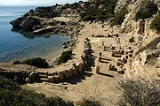
The Heraion of Perachora was a sanctuary of the goddess Hera
situated in a small cove of the Corinthian gulf at the end of the Perachora peninsula. In addition to a temple of Hera of unusual construction and antiquity, the remains of a number of other structures have also been found, including a L-shaped stoa, a large cistern, dining rooms, and a second potential temple. The Sanctuary of Hera at Perchora is located 14.2 km NNW of Ancient Corinth, and 75.9 km W of Athens
. Although there is debate between Argos
, Megara
and Corinth, the sanctuary was probably under the control of Corinth, as it faced the harbors of that powerful city across the Corinthian gulf. Cult activity at the site continued from perhaps the 9th century BCE to 146 BCE, when the Roman general Mummius
sacked Corinth during the war with the Achaean League
. In the Roman period, domestic structures were built on the site, indicating that the area was no longer a sanctuary. This site is significant for the study of the origins of Greek temple architecture and rural cults.
that Medea
buried her murdered children at a sanctuary of Hera Akraia as she fled from Corinth. This may be a reference to this site. Herodotus
tells the story of Periander
stripping the clothes off of the Corinthian women at a sanctuary of Hera. In the 1st century CE, the Greek historian Strabo
wrote that there was an oracle associated with the sanctuary.
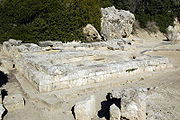 The earliest structure at the site was an apsidal building of perhaps the late 9th century BCE, which is thought to resemble the house-temple models known from the Argive Heraion. On that analogy, it would have had a high-peaked rook, covered perhaps in thatch. There were Early Helladic sherds under this structure.
In the 6th BCE, a Doric order tetrastyle-prostyle
temple (c. 10 by 30m) was built a little to the west of the apsidal structure. The epithet Akraia refers to the position of the sanctuary at the point of the peninsula. The cella
of this temple was divided into three aisles – a highly unusual design. There was a wall to divide the west end of the cella and a screen in front of the cult statue. Evidence for the reuse of some blocks may indicate that there was a prior phase of the structure in the 7th BCE. The roof of this temple was in marble. No evidence has yet been found of pedimental sculptures.
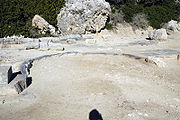 The Doric order triglyph and metope frieze may have only extended along the eastern face, as few of the elements of this survive. The metopes were c. 15 cm thick and slotted into the triglyph blocks rather than forming a single block with them, as is more typical. Roughly in the center of the southern side of the temple was a c. 4.5m diameter limekiln used to reduce the marble of the temple (and of the sanctuary generally) into lime
for the construction of the Hexamilion wall
across the Isthmus of Corinth
in the 5th century CE. Scorch mark remain visible on the stones of the temple around a circular area where the heat of the limekiln caused the breakdown of the underlying stones.
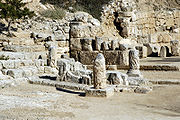 Fifteen meters east of the Temple of Hera Akraia, there was a stone altar decorated with a triglyph and metope frieze dating from the early 4th century BCE. This altar measured c. 2.5 by 4m. In the late 4th BCE Ionic columns were added to the corners, perhaps for a canopy.
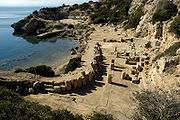 Immediately east of the altar was a two-storied stoa
with an L-shaped plan, also though to date to the late 4th BCE. The eastern arm of the stoa was c. 16.5m north to south and c. 5.5m in depth, while the northern arm of the stoa was c. 17.5m east to west and c. 5m in depth. The lower level employed an external colonnade of the Doric order
, while the upper floor used the Ionic order
. This is the first known example of this combination. The stairs to the second floor are not preserved. A water channel extended to this structure from the hydraulic system east of the sanctuary.
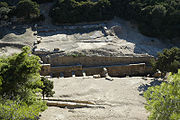 Immediately south of the cistern was a double dining room, probably associated with the cult activity at the site. This structure was initially identified as a Hellenistic house, but the cuttings for the legs of the dining couches make the identification as a dining room secure. Tomlinson proposes before 490 BCE as the date for this structure.
vessels) were found within this structure. This structure is now backfilled.
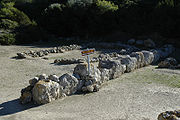 Around seventy-five metres east of the Cistern lie the remains of a structure that dates perhaps to the 6th century BCE. During excavation a bronze bull was discovered, inscribed with Sikyonian letters and dating to the end of the 6th BCE. There was a hearth at the centre of the building. It may have been a house-temple or a dining room, as evidenced by spits for roasting meat found inside. Many diagrams and reconstructions of this structure show a door in the western side-wall; the gap in the stones, however, may have been created by a trial trench dug by an earlier excavator.
The "Temple of Hera Limenaia" was named by the original excavator, Payne, on the basis of an apparent inscribed dedication to "Hera Limenaia." For some time, scholars supposed that two separate cult centers existed at Perachora. John Salmon, inter alia, has argued convincingly that Hera's cult title at Perachora was Akraia, while Limenaia was a secondary epithet. More recently, Blanche Menadier has compared the epithet Limenaia to the Homeric epithet Leukolenos, also attested epigraphically at Perachora.
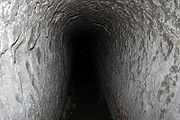 750m ENE of the sanctuary, there was a series of massive cisterns, reached by a rock-cut stairway extending c. 50m down into the bedrock. The opening of the stairway is 64m NW of the openings of the cisterns. The descent is steep and the steps are not all well-preserved. There are cuttings for a parapet wall around the vertiginous upper openings of the cisterns to prevent falls. It has been proposed that the water was raised from the cisterns to the water channel by the use of large human-powered waterwheels.
fountain house at Corinth. This structure was later incorporated into a rural villa in the Roman period. This fountain house is thought to date to the same time as the L-shaped stoa, which is the ultimate destination of the water of the system.
at Brauron
in relation to the religion of Athens, the sanctuary of Hera at Perachora is important or the study of rural cult in the Corinthia. The unusual plan of the 6th century BCE temple of Hera Akraia coupled with its location on the remains of a 9th BCE apsidal structure are of interest to the study of the development of the Greek temple as an architectural and cultic form. While it has been proposed that the cult of Hera Akraia had chthonic
elements, this idea has not been generally accepted. The reference in Strabo to an oracle may fit with the idea that the children of Medea were buried at the site, and thus explain any chthonic elements to the cult as pertaining to a heroon
.
Hera
Hera was the wife and one of three sisters of Zeus in the Olympian pantheon of Greek mythology and religion. Her chief function was as the goddess of women and marriage. Her counterpart in the religion of ancient Rome was Juno. The cow and the peacock were sacred to her...
situated in a small cove of the Corinthian gulf at the end of the Perachora peninsula. In addition to a temple of Hera of unusual construction and antiquity, the remains of a number of other structures have also been found, including a L-shaped stoa, a large cistern, dining rooms, and a second potential temple. The Sanctuary of Hera at Perchora is located 14.2 km NNW of Ancient Corinth, and 75.9 km W of Athens
Athens
Athens , is the capital and largest city of Greece. Athens dominates the Attica region and is one of the world's oldest cities, as its recorded history spans around 3,400 years. Classical Athens was a powerful city-state...
. Although there is debate between Argos
Argos
Argos is a city and a former municipality in Argolis, Peloponnese, Greece. Since the 2011 local government reform it is part of the municipality Argos-Mykines, of which it is a municipal unit. It is 11 kilometres from Nafplion, which was its historic harbour...
, Megara
Megara
Megara is an ancient city in Attica, Greece. It lies in the northern section of the Isthmus of Corinth opposite the island of Salamis, which belonged to Megara in archaic times, before being taken by Athens. Megara was one of the four districts of Attica, embodied in the four mythic sons of King...
and Corinth, the sanctuary was probably under the control of Corinth, as it faced the harbors of that powerful city across the Corinthian gulf. Cult activity at the site continued from perhaps the 9th century BCE to 146 BCE, when the Roman general Mummius
Lucius Mummius Achaicus
Lucius Mummius , was a Roman statesman and general, also known as Leucius Mommius. He later received the agnomen Achaicus after conquering Greece.-Praetor:...
sacked Corinth during the war with the Achaean League
Achaean League
The Achaean League was a Hellenistic era confederation of Greek city states on the northern and central Peloponnese, which existed between 280 BC and 146 BC...
. In the Roman period, domestic structures were built on the site, indicating that the area was no longer a sanctuary. This site is significant for the study of the origins of Greek temple architecture and rural cults.
Mythology and history
There is a legend recounted in EuripidesEuripides
Euripides was one of the three great tragedians of classical Athens, the other two being Aeschylus and Sophocles. Some ancient scholars attributed ninety-five plays to him but according to the Suda it was ninety-two at most...
that Medea
Medea
Medea is a woman in Greek mythology. She was the daughter of King Aeëtes of Colchis, niece of Circe, granddaughter of the sun god Helios, and later wife to the hero Jason, with whom she had two children, Mermeros and Pheres. In Euripides's play Medea, Jason leaves Medea when Creon, king of...
buried her murdered children at a sanctuary of Hera Akraia as she fled from Corinth. This may be a reference to this site. Herodotus
Herodotus
Herodotus was an ancient Greek historian who was born in Halicarnassus, Caria and lived in the 5th century BC . He has been called the "Father of History", and was the first historian known to collect his materials systematically, test their accuracy to a certain extent and arrange them in a...
tells the story of Periander
Periander
Periander was the second tyrant of Corinth, Greece in the 7th century BC. He was the son of the first tyrant, Cypselus. Periander succeeded his father in 627 BC. He died in 585 BC....
stripping the clothes off of the Corinthian women at a sanctuary of Hera. In the 1st century CE, the Greek historian Strabo
Strabo
Strabo, also written Strabon was a Greek historian, geographer and philosopher.-Life:Strabo was born to an affluent family from Amaseia in Pontus , a city which he said was situated the approximate equivalent of 75 km from the Black Sea...
wrote that there was an oracle associated with the sanctuary.
Archaeology
The known structures of the sanctuary cover a rectangle approximately 45m NS and 245m EW. The sanctuary wrapped around a small cove and extended toward the east uphill along a ridge. The structures will be discussed in order from west to east.West court
At the extreme SW end of the sanctuary, there is a polygonal area of roughly 25 by 25m largely cut into the rock beside the cove. This structure has been variously termed the agora, or the west court. This structure may date to the 6th century BCE and thus be contemporary with the Temple of Hera Akraia. It appears to have been destroyed in the 4th BCE; it has been proposed that the L-shaped stoa took over its function. There appear to have been colonnades on the western and southern sides. There are remains of a house from the Roman period roughly at the center of the area.Apsidal structure and temple of Hera Akraia
In the 6th BCE, a Doric order tetrastyle-prostyle
Prostyle
Prostyle is an architectural term defining free standing columns across the front of a building, as often in a portico. The term is often used as an adjective when referring to the portico of a classical building which projects from the main structure...
temple (c. 10 by 30m) was built a little to the west of the apsidal structure. The epithet Akraia refers to the position of the sanctuary at the point of the peninsula. The cella
Cella
A cella or naos , is the inner chamber of a temple in classical architecture, or a shop facing the street in domestic Roman architecture...
of this temple was divided into three aisles – a highly unusual design. There was a wall to divide the west end of the cella and a screen in front of the cult statue. Evidence for the reuse of some blocks may indicate that there was a prior phase of the structure in the 7th BCE. The roof of this temple was in marble. No evidence has yet been found of pedimental sculptures.
Calcium oxide
Calcium oxide , commonly known as quicklime or burnt lime, is a widely used chemical compound. It is a white, caustic, alkaline crystalline solid at room temperature....
for the construction of the Hexamilion wall
Hexamilion wall
The Hexamilion wall is a defensive wall constructed across the Isthmus of Corinth guarding the only land route into the Peloponnese peninsula from mainland Greece.- Early fortifications :...
across the Isthmus of Corinth
Isthmus of Corinth
The Isthmus of Corinth is the narrow land bridge which connects the Peloponnese peninsula with the rest of the mainland of Greece, near the city of Corinth. The word "isthmus" comes from the Ancient Greek word for "neck" and refers to the narrowness of the land. The Isthmus was known in the ancient...
in the 5th century CE. Scorch mark remain visible on the stones of the temple around a circular area where the heat of the limekiln caused the breakdown of the underlying stones.
Triglyph and metope altar
L-shaped stoa
Stoa
Stoa in Ancient Greek architecture; covered walkways or porticos, commonly for public usage. Early stoae were open at the entrance with columns, usually of the Doric order, lining the side of the building; they created a safe, enveloping, protective atmosphere.Later examples were built as two...
with an L-shaped plan, also though to date to the late 4th BCE. The eastern arm of the stoa was c. 16.5m north to south and c. 5.5m in depth, while the northern arm of the stoa was c. 17.5m east to west and c. 5m in depth. The lower level employed an external colonnade of the Doric order
Doric order
The Doric order was one of the three orders or organizational systems of ancient Greek or classical architecture; the other two canonical orders were the Ionic and the Corinthian.-History:...
, while the upper floor used the Ionic order
Ionic order
The Ionic order forms one of the three orders or organizational systems of classical architecture, the other two canonic orders being the Doric and the Corinthian...
. This is the first known example of this combination. The stairs to the second floor are not preserved. A water channel extended to this structure from the hydraulic system east of the sanctuary.
Double-apsidal cistern
Around thirty-five metres east of the L-shaped stoa, there was a c. 6 by 21m cistern with each end rounded off into an apsidal shape. Stone internal piers supported the vaults for the roof. On the eastern end of the structure there was a settling tank of c. 3 by 5m. Ten metres to the NE of the settling tank there was a diversion point in the water channel with one branch directed to the cistern and the other to the L-shaped stoa. The excavator dates the cistern to within the 6th to the 4th centuries BCE.Dining rooms
Sacred pool
Around 30m east of the cistern, was a pool c. 2m deep though to perhaps have a sacred function within the cult. Significant numbers of mesomphalic phiales (libationLibation
A libation is a ritual pouring of a liquid as an offering to a god or spirit or in memory of those who have died. It was common in many religions of antiquity and continues to be offered in various cultures today....
vessels) were found within this structure. This structure is now backfilled.
Temple of Hera Limenaia
The "Temple of Hera Limenaia" was named by the original excavator, Payne, on the basis of an apparent inscribed dedication to "Hera Limenaia." For some time, scholars supposed that two separate cult centers existed at Perachora. John Salmon, inter alia, has argued convincingly that Hera's cult title at Perachora was Akraia, while Limenaia was a secondary epithet. More recently, Blanche Menadier has compared the epithet Limenaia to the Homeric epithet Leukolenos, also attested epigraphically at Perachora.
Remains outside the sanctuary
Remains are known to extend for 1.7 km eastward from the Sanctuary to a lagoon. The best preserved of these constitute an extensive hydraulic system.Rock-cut cisterns
Fountain house
540m ENE of the sanctuary, there was a hexastyle-prostyle fountain house (having six columns in its facade). Behind the facade there were three rock-cut basins, similar to the PirenePirene
In Greek mythology, Pirene or Peirene , a nymph, was either the daughter of the river god Asopus, Laconian king Oebalus, or the River God Achelous, depending on different sources. By Poseidon she became the mother of Lecheas and Cenchrias...
fountain house at Corinth. This structure was later incorporated into a rural villa in the Roman period. This fountain house is thought to date to the same time as the L-shaped stoa, which is the ultimate destination of the water of the system.
Aqueduct
Water channels join the upper cisterns to the fountain house and the fountain house to the cistern of the sanctuary and the L-shaped stoa. At intervals there were settling basins along the water conduit, including one immediately above the fountain house.Significance of the site
As is the case for the rural sanctuary of ArtemisArtemis
Artemis was one of the most widely venerated of the Ancient Greek deities. Her Roman equivalent is Diana. Some scholars believe that the name and indeed the goddess herself was originally pre-Greek. Homer refers to her as Artemis Agrotera, Potnia Theron: "Artemis of the wildland, Mistress of Animals"...
at Brauron
Brauron
The sanctuary of Artemis at Brauron is an early sacred site on the eastern coast of Attica near the Aegean Sea in a small inlet. The inlet has silted up since ancient times, pushing the current shoreline farther from the site...
in relation to the religion of Athens, the sanctuary of Hera at Perachora is important or the study of rural cult in the Corinthia. The unusual plan of the 6th century BCE temple of Hera Akraia coupled with its location on the remains of a 9th BCE apsidal structure are of interest to the study of the development of the Greek temple as an architectural and cultic form. While it has been proposed that the cult of Hera Akraia had chthonic
Chthonic
Chthonic designates, or pertains to, deities or spirits of the underworld, especially in relation to Greek religion. The Greek word khthon is one of several for "earth"; it typically refers to the interior of the soil, rather than the living surface of the land or the land as territory...
elements, this idea has not been generally accepted. The reference in Strabo to an oracle may fit with the idea that the children of Medea were buried at the site, and thus explain any chthonic elements to the cult as pertaining to a heroon
Heroon
A heroon , also called heroum, was a shrine dedicated to an ancient Greek or Roman hero and used for the commemoration or cult worship of the hero. It was often erected over his supposed tomb or cenotaph....
.
Ancient sources
- Euripides, Medea 1378-1383
- Herodotus 5.92
- Xenophon Hellenica IV.5
- Livy XXXII.23
- Plutarch Q.G. 17
- Plutarch, Life of Kleomenes III.814
- Strabo 8.6.22