

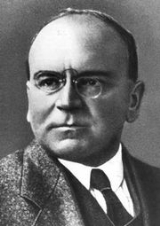
Heinrich Otto Wieland

Encyclopedia
Heinrich Otto Wieland was a German
chemist
. He won the 1927 Nobel Prize in Chemistry
for his research into the bile acid
s. In 1901 Wieland received his doctorate at the University of Munich while studying under Johannes Thiele
. In 1904 he completed his habilitation
, then continued to teach at the university and starting in 1907 was a consultant for Boehringer-Ingelheim
. In 1914 he became associate professor for special topics in organic chemistry, and director of the Organic Division of the State Laboratory in Munich. From 1917 to 1918 Wieland worked in the service of the (KWI) Kaiser Wilhelm Institute for Physical Chemistry and Elektrochemistry in Dahlem
then led by Fritz Haber
as an alternative to regular military service. There he was involved in weapons research for instance finding new synthetic routes for mustard gas. He is also credited with the first synthesis of Adamsite
.
From 1913 to 1921, he was Professor at the Technical University of Munich
. He then moved to the University of Freiburg
as successor of Ludwig Gattermann
(he also assumed responsibility for Gattermanns famous cookbook). In Freiburg he started working on toad poisons and bile acids. In association with Boehringer-Ingelheim he worked on synthetic alkaloids such as morphine
and strychnine
In 1925 Wieland succeeded Richard Willstätter
as Chemistry Professor at the University of Munich.
In 1941, Wieland isolated the toxin alpha-amanitin
, the principal active agent of one of the world's most poisonous mushrooms Amanita phalloides.
Wieland tried successfully to protect people, especially Jewish students, who were "racially burdened" after the Nuremberg Laws
. Students who were expelled because they were "racially burdened" could stay in Heinrich Wieland's group as chemists or as "Gäste des Geheimrats" (guests of the privy councillor). After collecting money for Kurt Huber
's widow Clara Huber, Hans Conrad Leipelt
, a student of Wieland, was sentenced to death.
. From 1915 to the end of 1920, he was advisor at Boehringer-Ingelheim and during this time he established the first scientific department of the company.
Eva Wieland, Heinrich Wieland's daughter, was married to Feodor Lynen
on 14 May 1937.
has been awarded annually to promote research on chemistry, biochemistry, physiology and clinical medicine of lipids and related substances. The prize is among the most treasured international science awards and has a successful history of over 40 years. To date it has been presented to 58 scientists. The Heinrich Wieland Prize is sponsored by Boehringer Ingelheim and awarded by an independent Board of Trustees.
Germany
Germany , officially the Federal Republic of Germany , is a federal parliamentary republic in Europe. The country consists of 16 states while the capital and largest city is Berlin. Germany covers an area of 357,021 km2 and has a largely temperate seasonal climate...
chemist
Chemist
A chemist is a scientist trained in the study of chemistry. Chemists study the composition of matter and its properties such as density and acidity. Chemists carefully describe the properties they study in terms of quantities, with detail on the level of molecules and their component atoms...
. He won the 1927 Nobel Prize in Chemistry
Nobel Prize in Chemistry
The Nobel Prize in Chemistry is awarded annually by the Royal Swedish Academy of Sciences to scientists in the various fields of chemistry. It is one of the five Nobel Prizes established by the will of Alfred Nobel in 1895, awarded for outstanding contributions in chemistry, physics, literature,...
for his research into the bile acid
Bile acid
Bile acids are steroid acids found predominantly in the bile of mammals. Bile salts are bile acids compounded with a cation, usually sodium. In humans, the salts of taurocholic acid and glycocholic acid represent approximately eighty percent of all bile salts. The two major bile acids are cholic...
s. In 1901 Wieland received his doctorate at the University of Munich while studying under Johannes Thiele
Johannes Thiele (chemist)
Friedrich Karl Johannes Thiele was a German chemist and a prominent professor at several universities, including those in Munich and Strasbourg. He developed many laboratory techniques related to isolation of organic compounds...
. In 1904 he completed his habilitation
Habilitation
Habilitation is the highest academic qualification a scholar can achieve by his or her own pursuit in several European and Asian countries. Earned after obtaining a research doctorate, such as a PhD, habilitation requires the candidate to write a professorial thesis based on independent...
, then continued to teach at the university and starting in 1907 was a consultant for Boehringer-Ingelheim
Boehringer-Ingelheim
C.H. Boehringer Sohn AG & Ko. KG is the parent company of Boehringer Ingelheim, which was founded in 1885 by Albert Boehringer in Ingelheim am Rhein. The Boehringer Ingelheim group is one of the world's 20 leading pharmaceutical companies. Headquartered in Ingelheim, Germany, it operates globally...
. In 1914 he became associate professor for special topics in organic chemistry, and director of the Organic Division of the State Laboratory in Munich. From 1917 to 1918 Wieland worked in the service of the (KWI) Kaiser Wilhelm Institute for Physical Chemistry and Elektrochemistry in Dahlem
Dahlem (Berlin)
Dahlem is a locality of the Steglitz-Zehlendorf borough in southwestern Berlin. Until Berlin's 2001 administrative reform it was a part of the former borough of Zehlendorf. Dahlem is one of the most affluent parts of the city and home to the main campus of the Free University of Berlin with the...
then led by Fritz Haber
Fritz Haber
Fritz Haber was a German chemist, who received the Nobel Prize in Chemistry in 1918 for his development for synthesizing ammonia, important for fertilizers and explosives. Haber, along with Max Born, proposed the Born–Haber cycle as a method for evaluating the lattice energy of an ionic solid...
as an alternative to regular military service. There he was involved in weapons research for instance finding new synthetic routes for mustard gas. He is also credited with the first synthesis of Adamsite
Adamsite
Adamsite or DM is an organic compound; technically, an arsenical diphenylaminechlorarsine, that can be used as a riot control agent. DM belongs to the group of chemical warfare agents known as vomiting agents or sneeze gases...
.
From 1913 to 1921, he was Professor at the Technical University of Munich
Technical University of Munich
The Technische Universität München is a research university with campuses in Munich, Garching, and Weihenstephan...
. He then moved to the University of Freiburg
University of Freiburg
The University of Freiburg , sometimes referred to in English as the Albert Ludwig University of Freiburg, is a public research university located in Freiburg im Breisgau, Baden-Württemberg, Germany.The university was founded in 1457 by the Habsburg dynasty as the...
as successor of Ludwig Gattermann
Ludwig Gattermann
Ludwig Gattermann was a German chemist who contributed significantly to both organic and inorganic chemistry.- Early life :...
(he also assumed responsibility for Gattermanns famous cookbook). In Freiburg he started working on toad poisons and bile acids. In association with Boehringer-Ingelheim he worked on synthetic alkaloids such as morphine
Morphine
Morphine is a potent opiate analgesic medication and is considered to be the prototypical opioid. It was first isolated in 1804 by Friedrich Sertürner, first distributed by same in 1817, and first commercially sold by Merck in 1827, which at the time was a single small chemists' shop. It was more...
and strychnine
Strychnine
Strychnine is a highly toxic , colorless crystalline alkaloid used as a pesticide, particularly for killing small vertebrates such as birds and rodents. Strychnine causes muscular convulsions and eventually death through asphyxia or sheer exhaustion...
In 1925 Wieland succeeded Richard Willstätter
Richard Willstätter
Richard Martin Willstätter was a German organic chemist whose study of the structure of plant pigments, chlorophyll included, won him the 1915 Nobel Prize for Chemistry. Willstätter invented paper chromatography independently of Mikhail Tsvet.-Biography:Willstätter was born in to a Jewish family...
as Chemistry Professor at the University of Munich.
In 1941, Wieland isolated the toxin alpha-amanitin
Alpha-amanitin
alpha-Amanitin or α-amanitin is a cyclic peptide of eight amino acids. It is possibly the most deadly of all the amatoxins, toxins found in several species of the Amanita genus of mushrooms, one being the Death cap as well as the Destroying angel, a complex of similar species, principally A....
, the principal active agent of one of the world's most poisonous mushrooms Amanita phalloides.
Wieland tried successfully to protect people, especially Jewish students, who were "racially burdened" after the Nuremberg Laws
Nuremberg Laws
The Nuremberg Laws of 1935 were antisemitic laws in Nazi Germany introduced at the annual Nuremberg Rally of the Nazi Party. After the takeover of power in 1933 by Hitler, Nazism became an official ideology incorporating scientific racism and antisemitism...
. Students who were expelled because they were "racially burdened" could stay in Heinrich Wieland's group as chemists or as "Gäste des Geheimrats" (guests of the privy councillor). After collecting money for Kurt Huber
Kurt Huber
Kurt Huber was a member of the White Rose group, which carried out resistance against Nazi Germany.-Early life:...
's widow Clara Huber, Hans Conrad Leipelt
Hans Conrad Leipelt
Hans Conrad Leipelt was a member of the White Rose resistance group in Nazi Germany.Leipelt was born in Vienna. His father was a graduate in civil engineering, and his mother a chemist from a Christian family with Jewish roots...
, a student of Wieland, was sentenced to death.
Family
Heinrichs father, Theodor Wieland (1846–1928) was a pharmacist with a doctorate in chemistry. He owned a gold and silver refinery in Pforzheim. Heinrich Wieland was a cousin of Helene Boehringer, the wife of Albert Boehringer, who was the founder of Boehringer-IngelheimBoehringer-Ingelheim
C.H. Boehringer Sohn AG & Ko. KG is the parent company of Boehringer Ingelheim, which was founded in 1885 by Albert Boehringer in Ingelheim am Rhein. The Boehringer Ingelheim group is one of the world's 20 leading pharmaceutical companies. Headquartered in Ingelheim, Germany, it operates globally...
. From 1915 to the end of 1920, he was advisor at Boehringer-Ingelheim and during this time he established the first scientific department of the company.
Eva Wieland, Heinrich Wieland's daughter, was married to Feodor Lynen
Feodor Felix Konrad Lynen
Feodor Felix Konrad Lynen was a German biochemist.- Biography :Feodor Lynen was born in Munich, Germany on 6 April 1911. He started his studies at the chemistry department of Munich University in 1930 and graduated in March 1937 under Heinrich Wieland with the work: "On the Toxic Substances in...
on 14 May 1937.
Heinrich Wieland Prize
Since 1964, the Heinrich Wieland PrizeHeinrich Wieland Prize
The Heinrich Wieland Prize is an annual science award for research on lipids in the fields of chemistry, biochemistry, physiology and clinical medicine. It is sponsored by Boehringer Ingelheim, and awarded by a board of trustees...
has been awarded annually to promote research on chemistry, biochemistry, physiology and clinical medicine of lipids and related substances. The prize is among the most treasured international science awards and has a successful history of over 40 years. To date it has been presented to 58 scientists. The Heinrich Wieland Prize is sponsored by Boehringer Ingelheim and awarded by an independent Board of Trustees.
External links
- http://nobelprize.org/nobel_prizes/chemistry/laureates/1927/wieland-bio.html