
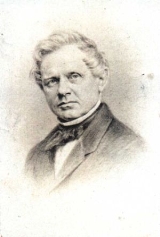
Heinrich Gustav Magnus (2 May 1802 – 4 April 1870) was a
GermanGermany , officially the Federal Republic of Germany , is a country in Central Europe. It is bordered to the north by the North Sea, Denmark, and the Baltic Sea; to the east by Poland and the Czech Republic; to the south by Austria and Switzerland; and to the west by France, Luxembourg, Belgium,...
chemistA chemist is a scientist trained in the science of chemistry. Chemists study the composition of matter and its properties such as density, acidity, size and shape. Chemists carefully describe the properties they study in terms of quantities, with detail on the level of molecules and their component...
and
physicistA physicist is a scientist who studies or practices physics. Physicists study a wide range of physical phenomena in many branches of physics spanning all length scales: from sub-atomic particles of which all ordinary matter is made to the behavior of the material Universe as a whole...
. The
Magnus effectThe Magnus effect is the phenomenon whereby a spinning object flying in a fluid creates a whirlpool of fluid around itself, and experiences a force perpendicular to the line of motion...
was named after him.
He was born in
BerlinBerlin is the capital city and one of sixteen states of Germany. With a population of 3.4 million within its city limits, Berlin is Germany's largest city. It is the second most populous city and the eighth most populous urban area in the European Union...
. His father was a wealthy merchant; and of his five brothers one,
EduardEduard Magnus was a German painter.Magnus was born in Berlin, and studied simultaneously at the Berlin Academy of Art, Bauakademie, and University of Berlin. He later traveled to Paris and Italy, returning to Germany in 1829. He went to Italy again in 1831, and traveled through Paris and England...
(1799-1872), became a celebrated painter. After studying at Berlin, he went to Stockholm to work under
BerzeliusFriherre Jöns Jacob Berzelius was a Swedish chemist. He worked out the modern technique of chemical formula notation, and is together with John Dalton, Antoine Lavoisier, and Robert Boyle considered a father of modern chemistry.-Career:Berzelius was born at Väversunda in Östergötland in Sweden. He...
, and later to
ParisParis is the capital of France and the country's most populous city. It is situated on the river Seine, in northern France, at the heart of the Île-de-France region...
, where he studied for a while under
Gay-LussacJoseph Louis Gay-Lussac was a French chemist and physicist. He is known mostly for two laws related to gases, and for his work on alcohol-water mixtures, which led to the degrees Gay-Lussac used to measure alcoholic beverages in many countries.- Biography :Gay-Lussac was born at...
and
ThénardLouis Jacques Thénard , was a French chemist.His father, a poor peasant, managed to have him educated at the academy of Sens, and sent him at the age of sixteen to study pharmacy in Paris. There he attended the lectures of Antoine François Fourcroy and Louis Nicolas Vauquelin...
. In 1831 he returned to Berlin as lecturer on technology and physics at the university.
Heinrich Gustav Magnus (2 May 1802 – 4 April 1870) was a
GermanGermany , officially the Federal Republic of Germany , is a country in Central Europe. It is bordered to the north by the North Sea, Denmark, and the Baltic Sea; to the east by Poland and the Czech Republic; to the south by Austria and Switzerland; and to the west by France, Luxembourg, Belgium,...
chemistA chemist is a scientist trained in the science of chemistry. Chemists study the composition of matter and its properties such as density, acidity, size and shape. Chemists carefully describe the properties they study in terms of quantities, with detail on the level of molecules and their component...
and
physicistA physicist is a scientist who studies or practices physics. Physicists study a wide range of physical phenomena in many branches of physics spanning all length scales: from sub-atomic particles of which all ordinary matter is made to the behavior of the material Universe as a whole...
. The
Magnus effectThe Magnus effect is the phenomenon whereby a spinning object flying in a fluid creates a whirlpool of fluid around itself, and experiences a force perpendicular to the line of motion...
was named after him.
He was born in
BerlinBerlin is the capital city and one of sixteen states of Germany. With a population of 3.4 million within its city limits, Berlin is Germany's largest city. It is the second most populous city and the eighth most populous urban area in the European Union...
. His father was a wealthy merchant; and of his five brothers one,
EduardEduard Magnus was a German painter.Magnus was born in Berlin, and studied simultaneously at the Berlin Academy of Art, Bauakademie, and University of Berlin. He later traveled to Paris and Italy, returning to Germany in 1829. He went to Italy again in 1831, and traveled through Paris and England...
(1799-1872), became a celebrated painter. After studying at Berlin, he went to Stockholm to work under
BerzeliusFriherre Jöns Jacob Berzelius was a Swedish chemist. He worked out the modern technique of chemical formula notation, and is together with John Dalton, Antoine Lavoisier, and Robert Boyle considered a father of modern chemistry.-Career:Berzelius was born at Väversunda in Östergötland in Sweden. He...
, and later to
ParisParis is the capital of France and the country's most populous city. It is situated on the river Seine, in northern France, at the heart of the Île-de-France region...
, where he studied for a while under
Gay-LussacJoseph Louis Gay-Lussac was a French chemist and physicist. He is known mostly for two laws related to gases, and for his work on alcohol-water mixtures, which led to the degrees Gay-Lussac used to measure alcoholic beverages in many countries.- Biography :Gay-Lussac was born at...
and
ThénardLouis Jacques Thénard , was a French chemist.His father, a poor peasant, managed to have him educated at the academy of Sens, and sent him at the age of sixteen to study pharmacy in Paris. There he attended the lectures of Antoine François Fourcroy and Louis Nicolas Vauquelin...
. In 1831 he returned to Berlin as lecturer on technology and physics at the university. In 1834 he became assistant professor of physics and technology in the university there, and in 1845 was appointed professor.
As a teacher his success was rapid and extraordinary. His lucid style and the perfection of his experimental demonstrations drew to his lectures a crowd of enthusiastic scholars, on whom he impressed the importance of applied science by conducting them round the factories and workshops of the city; and he further found time to hold weekly colloquies on physical questions at his house with a small circle of young students.
From 1827 to 1833 he was occupied mainly with chemical researches, which resulted in the discovery of the first of the
platinoPlatinum is a chemical element with the chemical symbol Pt and an atomic number of 78. Its name is derived from the Spanish term platina del Pinto, which is literally translated into "little silver of the Pinto River." It is in Group 10 of the periodic table of elements...
-
ammoniumThe ammonium cation is a positively charged polyatomic cation of the chemical formula NH. It has a formula weight of 18.05 and is formed by the protonation of ammonia...
compounds (Magnus's green salt is [Pt(NH
3)
4][PtCl
4]), of sulphovinic acids,
ethionic acidEthionine is a non-proteinogenic amino acid structurally related to methionine, with an ethyl group in place of the methyl group.Ethionine is an antimetabolite and methionine antagonist. It prevents amino acid incorporation into proteins and interferes with cellular use of adenosine triphosphate...
s and isethionic acids and their salts, and, in conjunction with CF Ammermüller, of
periodic acidPeriodic acid, or iodic acid is an oxoacid of iodine having chemical formula HIO
4 or H
5IO
6.In dilute solution, periodic acid exists as H
+ and IO
4−. When more concentrated, orthoperiodic acid, H
5IO
6, is formed. ...
.
Among other subjects at which he subsequently worked were the diminution in density produced in
garnetThe garnet group includes a group of minerals that have been used since the Bronze Age as gemstones and abrasives. The name "garnet" may come from either the Middle English word gernet meaning 'dark red', or the Latin granatus , possibly a reference to the Punica granatum , a plant with red seeds...
and
vesuvianiteVesuvianite, also known as idocrase is a green, brown, yellow, or blue silicate mineral. Vesuvianite occurs as tetragonal crystals in skarn deposits and limestones that have been subjected to contact metamorphism...
by melting, the absorption of gases in
bloodBlood is a specialized bodily fluid that delivers necessary substances to the body's cells — such as nutrients and oxygen — and transports waste products away from those same cells....
(1837–1845), the expansion of gases by heat (1841–1844), the vapour pressures of water and various solutions (1844–1854),
thermoelectricityThermoelectricity refers to a class of phenomena in which a temperature difference creates an electric potential or an electric potential creates a temperature difference. In modern technical usage, the term almost always refers collectively to the Seebeck effect, Peltier effect, and the Thomson...
(1851),
electrolysisIn chemistry and manufacturing, electrolysis is a method of using an electric current to drive an otherwise non-spontaneous chemical reaction. Electrolysis is commercially highly important as a stage in the separation of elements from naturally-occurring sources such as ores using an electrolytic...
(1856),
inductionElectromagnetic induction is the production of voltage across a conductor situated in a changing magnetic field or a conductor moving through a stationary magnetic field....
of currents (1858-1861), conduction of heat in gases (1860), polarization of heat (1866–1868) and the deflection of projectiles from firearms. From 1861 onwards he devoted much attention to the question of
diathermancyDiathermancy is the property of some fluids to get sun rays through them without being heated. Therefore, a diathermanous fluid is Permeable by heat rays). Atmospheric air is diathermanous, therefore, air it is not heated by sunshine...
in gases and vapours, especially to the behaviour in this respect of dry and moist air, and to the thermal effects produced by the
condensationCondensation is the change of the physical state of aggregation of matter from gaseous phase into liquid phase and the reverse of evaporation. When the transition happens from the gaseous phase into the solid phase directly, bypassing the liquid phase, the change is called deposition...
of moisture on solid surfaces.
In 1834 Magnus was elected extraordinary, and in 1845 ordinary professor at Berlin. He was three times elected dean of the faculty, in 1847, 1858 and 1863; and in 1861, rector magnificus. His great reputation led to his being entrusted by the government with several missions; in 1865 he represented
PrussiaPrussia was a historic state originating out of the Duchy of Prussia and the Margraviate of Brandenburg. For centuries this state had substantial influence on German and European history...
in the conference called at Frankfurt am Main to introduce a uniform
metric systemThe metric system is an international decimalised system of measurement, first adopted by France in 1791, that is the common system of measuring units used by most of the world. It exists in several variations, with different choices of fundamental units, though the choice of base units does not...
of weights and measures into Germany. For forty-five years his labor was incessant; his first memoir was published in 1825 when he was yet a student; his last appeared shortly after his death. He married in 1840 Bertha Humblot, of a French
HuguenotThe Huguenots were members of the Protestant Reformed Church of France from the sixteenth to the eighteenth centuries. Since the eighteenth century, Huguenots have been commonly designated "French Protestants", the title being suggested by their German co-religionists or "Calvinists"...
family settled in Berlin, by whom he left a son and two daughters.
External links
- Short biography and bibliography in the Virtual Laboratory
The online project Virtual Laboratory. Essays and Resources on the Experimentalization of Life, 1830-1930, located at the Max Planck Institute for the History of Science, is dedicated to research in the history of the experimentalization of life...
of the Max Planck Institute for the History of ScienceThe Max Planck Institute for the History of Science in Berlin was established in March 1994. Its research is primarily devoted to a theoretically oriented history of science, principally of the natural sciences, but with methodological perspectives drawn from the cognitive sciences and from...