


Epidermal growth factor

Encyclopedia
Epidermal growth factor or EGF is a growth factor
that plays an important role in the regulation of cell growth
, proliferation
, and differentiation
by binding to its receptor EGFR
. Human EGF is a 6045-Da protein
with 53 amino acid residues
and three intramolecular disulfide bond
s.
of Vanderbilt University
a Nobel Prize in Physiology and Medicine in 1986 and was patented for cosmetic use by Greg Brown in 1989.
, also plays an important physiological role in the maintenance of oro-esophageal and gastric tissue integrity. The biological effects of salivary EGF include healing of oral and gastroesophageal ulcers, inhibition of gastric acid secretion, stimulation of DNA synthesis as well as mucosal protection from intraluminal injurious factors such as gastric acid, bile acids, pepsin, and trypsin and to physical, chemical and bacterial agents.
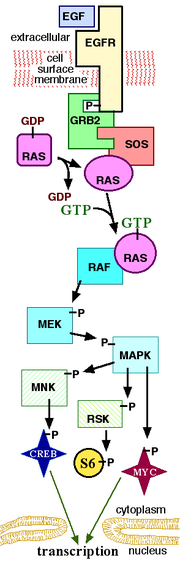 EGF acts by binding with high affinity to epidermal growth factor receptor
(EGFR) on the cell surface and stimulating the intrinsic protein-tyrosine kinase activity of the receptor (see the second diagram). The tyrosine kinase
activity, in turn, initiates a signal transduction
cascade that results in a variety of biochemical
changes within the cell - a rise in intracellular calcium
levels, increased glycolysis
and protein synthesis, and increases in the expression
of certain gene
s including the gene for EGFR - that ultimately lead to DNA synthesis
and cell proliferation.
. Members of this protein family have highly similar structural and functional characteristics. Besides EGF itself other family members include:
All family members contain one or more repeats of the conserved
amino acid sequence:
C
X7C
X4-5C
X10-13C
XC
X8G
XR
C
Where X represents any amino acid
.
This sequence contains 6 cysteine
residues that form three intramolecular disulfide bond
s. Disulfide bond formation generates three structural loops that are essential for high-affinity binding between members of the EGF-family and their cell-surface receptors.
with Epidermal growth factor receptor
and PIK3R2
.
Growth factor
A growth factor is a naturally occurring substance capable of stimulating cellular growth, proliferation and cellular differentiation. Usually it is a protein or a steroid hormone. Growth factors are important for regulating a variety of cellular processes....
that plays an important role in the regulation of cell growth
Cell growth
The term cell growth is used in the contexts of cell development and cell division . When used in the context of cell division, it refers to growth of cell populations, where one cell grows and divides to produce two "daughter cells"...
, proliferation
Cell growth
The term cell growth is used in the contexts of cell development and cell division . When used in the context of cell division, it refers to growth of cell populations, where one cell grows and divides to produce two "daughter cells"...
, and differentiation
Cellular differentiation
In developmental biology, cellular differentiation is the process by which a less specialized cell becomes a more specialized cell type. Differentiation occurs numerous times during the development of a multicellular organism as the organism changes from a simple zygote to a complex system of...
by binding to its receptor EGFR
Epidermal growth factor receptor
The epidermal growth factor receptor is the cell-surface receptor for members of the epidermal growth factor family of extracellular protein ligands...
. Human EGF is a 6045-Da protein
Protein
Proteins are biochemical compounds consisting of one or more polypeptides typically folded into a globular or fibrous form, facilitating a biological function. A polypeptide is a single linear polymer chain of amino acids bonded together by peptide bonds between the carboxyl and amino groups of...
with 53 amino acid residues
Amino acid
Amino acids are molecules containing an amine group, a carboxylic acid group and a side-chain that varies between different amino acids. The key elements of an amino acid are carbon, hydrogen, oxygen, and nitrogen...
and three intramolecular disulfide bond
Disulfide bond
In chemistry, a disulfide bond is a covalent bond, usually derived by the coupling of two thiol groups. The linkage is also called an SS-bond or disulfide bridge. The overall connectivity is therefore R-S-S-R. The terminology is widely used in biochemistry...
s.
History
The discovery of EGF won Stanley CohenStanley Cohen
Stan Cohen may refer to:* Stanley Cohen , American Nobel Prize Laureate in Physiology and Medicine* Stan Cohen , British Labour politician...
of Vanderbilt University
Vanderbilt University
Vanderbilt University is a private research university located in Nashville, Tennessee, United States. Founded in 1873, the university is named for shipping and rail magnate "Commodore" Cornelius Vanderbilt, who provided Vanderbilt its initial $1 million endowment despite having never been to the...
a Nobel Prize in Physiology and Medicine in 1986 and was patented for cosmetic use by Greg Brown in 1989.
Function
EGF results in cellular proliferation, differentiation, and survival. EGF is a low-molecular-weight polypeptide first purified from the mouse submandibular gland, but since then found in many human tissues including submandibular gland, parotid gland. Salivary EGF, which seems also regulated by dietary inorganic iodineIodine
Iodine is a chemical element with the symbol I and atomic number 53. The name is pronounced , , or . The name is from the , meaning violet or purple, due to the color of elemental iodine vapor....
, also plays an important physiological role in the maintenance of oro-esophageal and gastric tissue integrity. The biological effects of salivary EGF include healing of oral and gastroesophageal ulcers, inhibition of gastric acid secretion, stimulation of DNA synthesis as well as mucosal protection from intraluminal injurious factors such as gastric acid, bile acids, pepsin, and trypsin and to physical, chemical and bacterial agents.
Biological Sources
Epidermal growth factor can be found in human platelets, macrophages, urine, saliva, milk, and plasma.Mechanism
Epidermal growth factor receptor
The epidermal growth factor receptor is the cell-surface receptor for members of the epidermal growth factor family of extracellular protein ligands...
(EGFR) on the cell surface and stimulating the intrinsic protein-tyrosine kinase activity of the receptor (see the second diagram). The tyrosine kinase
Tyrosine kinase
A tyrosine kinase is an enzyme that can transfer a phosphate group from ATP to a protein in a cell. It functions as an "on" or "off" switch in many cellular functions....
activity, in turn, initiates a signal transduction
Signal transduction
Signal transduction occurs when an extracellular signaling molecule activates a cell surface receptor. In turn, this receptor alters intracellular molecules creating a response...
cascade that results in a variety of biochemical
Biochemistry
Biochemistry, sometimes called biological chemistry, is the study of chemical processes in living organisms, including, but not limited to, living matter. Biochemistry governs all living organisms and living processes...
changes within the cell - a rise in intracellular calcium
Calcium
Calcium is the chemical element with the symbol Ca and atomic number 20. It has an atomic mass of 40.078 amu. Calcium is a soft gray alkaline earth metal, and is the fifth-most-abundant element by mass in the Earth's crust...
levels, increased glycolysis
Glycolysis
Glycolysis is the metabolic pathway that converts glucose C6H12O6, into pyruvate, CH3COCOO− + H+...
and protein synthesis, and increases in the expression
Gene expression
Gene expression is the process by which information from a gene is used in the synthesis of a functional gene product. These products are often proteins, but in non-protein coding genes such as ribosomal RNA , transfer RNA or small nuclear RNA genes, the product is a functional RNA...
of certain gene
Gene
A gene is a molecular unit of heredity of a living organism. It is a name given to some stretches of DNA and RNA that code for a type of protein or for an RNA chain that has a function in the organism. Living beings depend on genes, as they specify all proteins and functional RNA chains...
s including the gene for EGFR - that ultimately lead to DNA synthesis
DNA replication
DNA replication is a biological process that occurs in all living organisms and copies their DNA; it is the basis for biological inheritance. The process starts with one double-stranded DNA molecule and produces two identical copies of the molecule...
and cell proliferation.
EGF-family
EGF is the founding member of the EGF-family of proteinsEGF-like domain
EGF-like domain is an evolutionary conserved protein domain, of about thirty to forty amino-acid residues long, which was found in a large number of mostly animal proteins. All these repeats are found in the extracellular domain of membrane-bound proteins or in proteins known to be secreted...
. Members of this protein family have highly similar structural and functional characteristics. Besides EGF itself other family members include:
- Heparin-binding EGF-like growth factorHeparin-binding EGF-like growth factorHeparin-binding EGF-like growth factor is a member of the EGF family of proteins. It has been shown to play a role in wound healing, cardiac hypertrophy and heart development and function.-Interactions:...
(HB-EGF) - transforming growth factor-αTGF alphaTransforming growth factor alpha is upregulated in some human cancers. It is produced in macrophages, brain cells, and keratinocytes, and induces epithelial development. It is closely related to EGF, and can also bind to the EGF receptor with similar effects...
(TGF-α) - AmphiregulinAmphiregulinAmphiregulin, also known as AREG, is a protein which in humans is encoded by the AREG gene.- Function:The protein encoded by this gene is a member of the epidermal growth factor family. It is an autocrine growth factor as well as a mitogen for astrocytes, Schwann cells, and fibroblasts...
(AR) - EpiregulinEpiregulinEpiregulin is a protein that in humans is encoded by the EREG gene.- Structure :Epiregulin consists of 46 amino acid residues. Its secondary structure contains approximately 30 percent of β-sheet in the strand. Some of the residues form loops and turns due to the hydrogen bonding...
(EPR) - EpigenEpigenEpigen is a member of the epidermal growth factor family....
- BetacellulinBetacellulinBetacellulin is a protein that in humans is encoded by the BTC gene located on chromosome 4 at locus 4q13-q21. Betacellulin is a member of the EGF family of growth factors. It is synthesized primarily as a transmembrane precursor, which is then processed to mature molecule by proteolytic events...
(BTC) - neuregulin-1 (NRG1)
- neuregulin-2NeuregulinThe Neuregulins are a family of four structurally-related proteins that are part of the EGF family of proteins. These proteins have been shown to have diverse functions in the development of the nervous system and play multiple essential roles in vertebrate embryogenesis including: cardiac...
(NRG2) - neuregulin-3NeuregulinThe Neuregulins are a family of four structurally-related proteins that are part of the EGF family of proteins. These proteins have been shown to have diverse functions in the development of the nervous system and play multiple essential roles in vertebrate embryogenesis including: cardiac...
(NRG3) - neuregulin-4NeuregulinThe Neuregulins are a family of four structurally-related proteins that are part of the EGF family of proteins. These proteins have been shown to have diverse functions in the development of the nervous system and play multiple essential roles in vertebrate embryogenesis including: cardiac...
(NRG4).
All family members contain one or more repeats of the conserved
Conserved sequence
In biology, conserved sequences are similar or identical sequences that occur within nucleic acid sequences , protein sequences, protein structures or polymeric carbohydrates across species or within different molecules produced by the same organism...
amino acid sequence:
C
Cysteine
Cysteine is an α-amino acid with the chemical formula HO2CCHCH2SH. It is a non-essential amino acid, which means that it is biosynthesized in humans. Its codons are UGU and UGC. The side chain on cysteine is thiol, which is polar and thus cysteine is usually classified as a hydrophilic amino acid...
X7C
Cysteine
Cysteine is an α-amino acid with the chemical formula HO2CCHCH2SH. It is a non-essential amino acid, which means that it is biosynthesized in humans. Its codons are UGU and UGC. The side chain on cysteine is thiol, which is polar and thus cysteine is usually classified as a hydrophilic amino acid...
X4-5C
Cysteine
Cysteine is an α-amino acid with the chemical formula HO2CCHCH2SH. It is a non-essential amino acid, which means that it is biosynthesized in humans. Its codons are UGU and UGC. The side chain on cysteine is thiol, which is polar and thus cysteine is usually classified as a hydrophilic amino acid...
X10-13C
Cysteine
Cysteine is an α-amino acid with the chemical formula HO2CCHCH2SH. It is a non-essential amino acid, which means that it is biosynthesized in humans. Its codons are UGU and UGC. The side chain on cysteine is thiol, which is polar and thus cysteine is usually classified as a hydrophilic amino acid...
XC
Cysteine
Cysteine is an α-amino acid with the chemical formula HO2CCHCH2SH. It is a non-essential amino acid, which means that it is biosynthesized in humans. Its codons are UGU and UGC. The side chain on cysteine is thiol, which is polar and thus cysteine is usually classified as a hydrophilic amino acid...
X8G
Glycine
Glycine is an organic compound with the formula NH2CH2COOH. Having a hydrogen substituent as its 'side chain', glycine is the smallest of the 20 amino acids commonly found in proteins. Its codons are GGU, GGC, GGA, GGG cf. the genetic code.Glycine is a colourless, sweet-tasting crystalline solid...
XR
Arginine
Arginine is an α-amino acid. The L-form is one of the 20 most common natural amino acids. At the level of molecular genetics, in the structure of the messenger ribonucleic acid mRNA, CGU, CGC, CGA, CGG, AGA, and AGG, are the triplets of nucleotide bases or codons that codify for arginine during...
C
Cysteine
Cysteine is an α-amino acid with the chemical formula HO2CCHCH2SH. It is a non-essential amino acid, which means that it is biosynthesized in humans. Its codons are UGU and UGC. The side chain on cysteine is thiol, which is polar and thus cysteine is usually classified as a hydrophilic amino acid...
Where X represents any amino acid
Amino acid
Amino acids are molecules containing an amine group, a carboxylic acid group and a side-chain that varies between different amino acids. The key elements of an amino acid are carbon, hydrogen, oxygen, and nitrogen...
.
This sequence contains 6 cysteine
Cysteine
Cysteine is an α-amino acid with the chemical formula HO2CCHCH2SH. It is a non-essential amino acid, which means that it is biosynthesized in humans. Its codons are UGU and UGC. The side chain on cysteine is thiol, which is polar and thus cysteine is usually classified as a hydrophilic amino acid...
residues that form three intramolecular disulfide bond
Disulfide bond
In chemistry, a disulfide bond is a covalent bond, usually derived by the coupling of two thiol groups. The linkage is also called an SS-bond or disulfide bridge. The overall connectivity is therefore R-S-S-R. The terminology is widely used in biochemistry...
s. Disulfide bond formation generates three structural loops that are essential for high-affinity binding between members of the EGF-family and their cell-surface receptors.
EGF therapy
Because of the increased risk of cancer by EGF, inhibiting it decreases cancer risk. Such medications are so far mainly based on inhibiting the EGF receptor. Monoclonal antibodies are potential substances for this purpose.Interactions
Epidermal growth factor has been shown to interactProtein-protein interaction
Protein–protein interactions occur when two or more proteins bind together, often to carry out their biological function. Many of the most important molecular processes in the cell such as DNA replication are carried out by large molecular machines that are built from a large number of protein...
with Epidermal growth factor receptor
Epidermal growth factor receptor
The epidermal growth factor receptor is the cell-surface receptor for members of the epidermal growth factor family of extracellular protein ligands...
and PIK3R2
PIK3R2
Phosphatidylinositol 3-kinase regulatory subunit beta is an enzyme that in humans is encoded by the PIK3R2 gene.-Interactions:PIK3R2 has been shown to interact with FYN, HER2/neu, Epidermal growth factor, Cbl gene, PIK3CD, CRKL and Macrophage colony-stimulating factor.-Further reading:...
.
External links
- Shaanxi Zhongbang Pharma-Tech Co., Ltd.-Supply of Epidermal Growth Factor
- EGF at the Human Protein Reference Database.
- EGF model in BioModels database