


Haakon the Red

Encyclopedia
Håkan the Red was a king of Sweden
reigning for about a decade in the second half of the 11th century. There is little information on him, and it is mostly contradictory. Nothing is known about his reign.
Swedish historian Adolf Schück has asserted that, rather than Blot-Sweyn
being an individual king, there are indications that that may have been another name for King Håkan..
His cognomen the Red comes from the regnal
list of the Westrogothic law, written in early 13th century. The same source claims that he was born in Levene
, in Västergötland
.
(succeeding Halsten Stenkilsson also known as Halsten), and from 1075 in Uppland
too (succeeding Anund Gårdske
). The regnal line in Nationalencyklopedin
omits Anund Gårdske
and presents Håkan as successor of Halsten Stenkilsson. Nationalencyclopedin also suggests that he may have ruled jointly with Inge the Elder in the 1080s. A papal letter from Gregory VII
is addressed to Inge together with either Håkan or Halsten Stenkilsson as kings of the västgötar
, ordering them to collect tithe
and send priests to Rome to educate themselves.
According to Encyclopædia Britannica
: "At the end of the Viking Age
[approximately 1050], Sweden remained a loose federation of provinces. The old family of kings died out in 1060; after the death of the last of these kings' son-in-law, Stenkil, in 1066, a civil war broke out. Around 1080 Stenkil's sons, Ingi and Halsten, ruled, [...]." If "civil war" is an appropriate characterisation of the period from 1066 to 1080, the rulers of that epoch would be in the grey area between "king" and "warlord
". Describing this period for Sweden as a whole in a linear translatio imperii
kind of regnal succession, can then only be achieved at least partially based on speculative historical reconstruction
, which appears to have happened in diverging directions from the early 13th century on, at the latest.
's History of the Archbishops of Hamburg-Bremen (written 1070s–early 1080s) says that Håkan was elected king after Stenkil's son Halsten had been deposed, and after Anund Gårdske
also had been rejected.
's Heimskringla
(1225), he is given as the successor of Stenkil (who died in 1066):
Similarly, in Hervarar saga
(13th century):
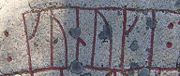
Presumably it was Håkan the Red who ordered the carving of a runestone found in Hovgården
(Adelsö
island in Lake Mälaren, Uppland
, Sweden
). The Rundata
catalog number of this runestone is U 11
.
Monarch of Sweden
The monarchy of Sweden is the constitutional monarchy of the Kingdom of Sweden. The present monarch, Carl XVI Gustaf, has reigned since 15 September 1973. He and his immediate family undertake various official, ceremonial and representational duties...
reigning for about a decade in the second half of the 11th century. There is little information on him, and it is mostly contradictory. Nothing is known about his reign.
Swedish historian Adolf Schück has asserted that, rather than Blot-Sweyn
Blot-Sweyn
Sweyn was a Swedish king c. 1080, who replaced his Christian brother-in-law Inge as King of Sweden, when Inge had refused to administer the blóts at the Temple at Uppsala. There is no mention of Sweyn in the regnal list of the Westrogothic law, which suggests that his rule did not reach...
being an individual king, there are indications that that may have been another name for King Håkan..
His cognomen the Red comes from the regnal
Reign
A reign is the term used to describe the period of a person's or dynasty's occupation of the office of monarch of a nation or of a people . In most hereditary monarchies and some elective monarchies A reign is the term used to describe the period of a person's or dynasty's occupation of the office...
list of the Westrogothic law, written in early 13th century. The same source claims that he was born in Levene
Levene
- People :*Phoebus Levene, , biochemist who identified the components of DNA*Keith Levene, , English guitarist and songwriter*Sam Levene, , American stage and film actor...
, in Västergötland
Västergötland
', English exonym: West Gothland, is one of the 25 traditional non-administrative provinces of Sweden , situated in the southwest of Sweden. In older English literature one may also encounter the Latinized version Westrogothia....
.
Succession sequence
Despite contradiction in the sources, Håkan's position as a successor of Stenkil in the line of Swedish kings is generally accepted as correct. He would have reigned from 1070 in some areas of SwedenSweden
Sweden , officially the Kingdom of Sweden , is a Nordic country on the Scandinavian Peninsula in Northern Europe. Sweden borders with Norway and Finland and is connected to Denmark by a bridge-tunnel across the Öresund....
(succeeding Halsten Stenkilsson also known as Halsten), and from 1075 in Uppland
Uppland
Uppland is a historical province or landskap on the eastern coast of Sweden, just north of Stockholm, the capital. It borders Södermanland, Västmanland and Gästrikland. It is also bounded by lake Mälaren and the Baltic sea...
too (succeeding Anund Gårdske
Anund Gårdske
Anund Gårdske or Anund of Gårdarike, English exonym: Anwynd, was the king of Sweden c. 1070 according to Adam of Bremen's Gesta Hammaburgensis ecclesiae pontificum. According to this source, Anund came from Kievan Rus', presumably from Aldeigjuborg. Gårdske means that he came from Gardariki which...
). The regnal line in Nationalencyklopedin
Nationalencyklopedin
Nationalencyklopedin is the most comprehensive contemporary Swedish language encyclopedia, initiated by a favourable loan from the Government of Sweden of 17 million Swedish kronor in 1980, which was repaid by December 1990...
omits Anund Gårdske
Anund Gårdske
Anund Gårdske or Anund of Gårdarike, English exonym: Anwynd, was the king of Sweden c. 1070 according to Adam of Bremen's Gesta Hammaburgensis ecclesiae pontificum. According to this source, Anund came from Kievan Rus', presumably from Aldeigjuborg. Gårdske means that he came from Gardariki which...
and presents Håkan as successor of Halsten Stenkilsson. Nationalencyclopedin also suggests that he may have ruled jointly with Inge the Elder in the 1080s. A papal letter from Gregory VII
Pope Gregory VII
Pope St. Gregory VII , born Hildebrand of Sovana , was Pope from April 22, 1073, until his death. One of the great reforming popes, he is perhaps best known for the part he played in the Investiture Controversy, his dispute with Henry IV, Holy Roman Emperor affirming the primacy of the papal...
is addressed to Inge together with either Håkan or Halsten Stenkilsson as kings of the västgötar
Västergötland
', English exonym: West Gothland, is one of the 25 traditional non-administrative provinces of Sweden , situated in the southwest of Sweden. In older English literature one may also encounter the Latinized version Westrogothia....
, ordering them to collect tithe
Tithe
A tithe is a one-tenth part of something, paid as a contribution to a religious organization or compulsory tax to government. Today, tithes are normally voluntary and paid in cash, cheques, or stocks, whereas historically tithes were required and paid in kind, such as agricultural products...
and send priests to Rome to educate themselves.
According to Encyclopædia Britannica
Encyclopædia Britannica
The Encyclopædia Britannica , published by Encyclopædia Britannica, Inc., is a general knowledge English-language encyclopaedia that is available in print, as a DVD, and on the Internet. It is written and continuously updated by about 100 full-time editors and more than 4,000 expert...
: "At the end of the Viking Age
Viking Age
Viking Age is the term for the period in European history, especially Northern European and Scandinavian history, spanning the late 8th to 11th centuries. Scandinavian Vikings explored Europe by its oceans and rivers through trade and warfare. The Vikings also reached Iceland, Greenland,...
[approximately 1050], Sweden remained a loose federation of provinces. The old family of kings died out in 1060; after the death of the last of these kings' son-in-law, Stenkil, in 1066, a civil war broke out. Around 1080 Stenkil's sons, Ingi and Halsten, ruled, [...]." If "civil war" is an appropriate characterisation of the period from 1066 to 1080, the rulers of that epoch would be in the grey area between "king" and "warlord
Warlord
A warlord is a person with power who has both military and civil control over a subnational area due to armed forces loyal to the warlord and not to a central authority. The term can also mean one who espouses the ideal that war is necessary, and has the means and authority to engage in war...
". Describing this period for Sweden as a whole in a linear translatio imperii
Translatio imperii
Translatio imperii, Latin for "transfer of rule", is a concept invented in the Middle Ages for describing history as a linear succession of transfers of imperium, that is of supreme power concentrated with a series of single rulers .-Origin:...
kind of regnal succession, can then only be achieved at least partially based on speculative historical reconstruction
Historical revisionism
In historiography, historical revisionism is the reinterpretation of orthodox views on evidence, motivations, and decision-making processes surrounding a historical event...
, which appears to have happened in diverging directions from the early 13th century on, at the latest.
Adam of Bremen
A scholion in Adam of BremenAdam of Bremen
Adam of Bremen was a German medieval chronicler. He lived and worked in the second half of the eleventh century. He is most famous for his chronicle Gesta Hammaburgensis Ecclesiae Pontificum .-Background:Little is known of his life other than hints from his own chronicles...
's History of the Archbishops of Hamburg-Bremen (written 1070s–early 1080s) says that Håkan was elected king after Stenkil's son Halsten had been deposed, and after Anund Gårdske
Anund Gårdske
Anund Gårdske or Anund of Gårdarike, English exonym: Anwynd, was the king of Sweden c. 1070 according to Adam of Bremen's Gesta Hammaburgensis ecclesiae pontificum. According to this source, Anund came from Kievan Rus', presumably from Aldeigjuborg. Gårdske means that he came from Gardariki which...
also had been rejected.
Regnal list of the Westrogothic law
According to the regnal list of the Westrogothic law, Håkan the Red would have ruled 13 years, as Stenkil's predecessor.Sagas
In Magnus Barefoot's Saga, a part of Snorri SturlusonSnorri Sturluson
Snorri Sturluson was an Icelandic historian, poet, and politician. He was twice elected lawspeaker at the Icelandic parliament, the Althing...
's Heimskringla
Heimskringla
Heimskringla is the best known of the Old Norse kings' sagas. It was written in Old Norse in Iceland by the poet and historian Snorri Sturluson ca. 1230...
(1225), he is given as the successor of Stenkil (who died in 1066):
Steinkel, the Swedish king, died about the same time as the two Haralds fell, and the king who came after him in
Svithjod was called Håkan. Afterwards IngeInge I of SwedenInge the Elder was a King of Sweden.-Biography:Inge was the son of the former King Stenkil and a Swedish princess. Inge shared the rule of the kingdom with his probably elder brother Halsten Stenkilsson, but little is known with certainty of Inge's reign...
, a son of Steinkel,
was king, [...]
Similarly, in Hervarar saga
Hervarar saga
Hervarar saga ok Heiðreks is a legendary saga from the 13th century combining matter from several older sagas. It is a valuable saga for several different reasons beside its literary qualities. It contains traditions of wars between Goths and Huns, from the 4th century, and the last part is used as...
(13th century):
Steinkel had a son called Ingi, who became King of Sweden after Håkan.
Runestone
Presumably it was Håkan the Red who ordered the carving of a runestone found in Hovgården
Hovgården
Hovgården is an archaeological site on the Lake Mälaren island of Adelsö in Ekerö Municipality in central-eastern Sweden. During the Viking Age, the centre of the prospering Mälaren Valley was the settlement Birka, founded in the mid-8th century and abandoned in the late 10th century and located...
(Adelsö
Adelsö
Adelsö is an island in the middle of Lake Mälaren in Sweden, near southern and northern Björkfjärden. The administrative center of the important Viking settlement Birka was situated at Hovgården on Adelsö.-Geography:...
island in Lake Mälaren, Uppland
Uppland
Uppland is a historical province or landskap on the eastern coast of Sweden, just north of Stockholm, the capital. It borders Södermanland, Västmanland and Gästrikland. It is also bounded by lake Mälaren and the Baltic sea...
, Sweden
Sweden
Sweden , officially the Kingdom of Sweden , is a Nordic country on the Scandinavian Peninsula in Northern Europe. Sweden borders with Norway and Finland and is connected to Denmark by a bridge-tunnel across the Öresund....
). The Rundata
Rundata
The Scandinavian Runic-text Data Base is a project involving the creation and maintenance of a database of runic inscriptions. The project's goal is to comprehensively catalog runestones in a machine-readable way for future research...
catalog number of this runestone is U 11
Uppland Rune Inscription 11
U 11 is the Rundata designation for a runestone that is located near the ruins of the old king's dwelling at Alsnö hus near Hovgården on the island of Adelsö in Sweden.-Description:...
.