

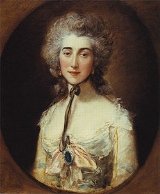
Grace Elliott

Encyclopedia

Scotland
Scotland is a country that is part of the United Kingdom. Occupying the northern third of the island of Great Britain, it shares a border with England to the south and is bounded by the North Sea to the east, the Atlantic Ocean to the north and west, and the North Channel and Irish Sea to the...
socialite
Socialite
A socialite is a person who participates in social activities and spends a significant amount of time entertaining and being entertained at fashionable upper-class events....
and courtesan
Courtesan
A courtesan was originally a female courtier, which means a person who attends the court of a monarch or other powerful person.In feudal society, the court was the centre of government as well as the residence of the monarch, and social and political life were often completely mixed together...
who was resident in Paris at the time of the French Revolution
French Revolution
The French Revolution , sometimes distinguished as the 'Great French Revolution' , was a period of radical social and political upheaval in France and Europe. The absolute monarchy that had ruled France for centuries collapsed in three years...
and an eyewitness to events. She was once mistress of the Duke of Orléans, who was cousin to King Louis XVI.
She was arrested and held awaiting death by guillotine
Guillotine
The guillotine is a device used for carrying out :executions by decapitation. It consists of a tall upright frame from which an angled blade is suspended. This blade is raised with a rope and then allowed to drop, severing the head from the body...
but was released after the death of Robespierre. She wrote an autobiographical account of her experiences entitled Ma Vie Sous La Révolution published posthumously in 1859.
Early life
Grace Dalrymple was born in her maternal grandparents' house in Edinburgh, the youngest daughter of advocateAdvocate
An advocate is a term for a professional lawyer used in several different legal systems. These include Scotland, South Africa, India, Scandinavian jurisdictions, Israel, and the British Crown dependencies of Jersey, Guernsey and the Isle of Man...
and poet Hew Dalrymple
Hew Dalrymple (advocate)
Captain Hew Dalrymple, sometimes spelt Hugh was a Scottish advocate and poet who served as Attorney-General of Grenada.His youngest daughter was the courtesan Grace Elliott.Dalrymple graduated LLD in 1771...
(died 1774) and Grisel Craw (died 1765). Her parents separated when she was an infant and she was placed in a French convent where she grew up.
On her return to Scotland her father introduced her into Edinburgh society, where she became renowned for her beauty. She took great lengths to dress and act accordingly, while becoming educated and staying abreast in world events. As recorded in art from the time, she was remarkably attractive, with beautiful facial features and an appealing figure. All of these attributes, along with her intelligence, became her trademark and helped her greatly when she entered into the life of courtesan to royalty
She married the extremely rich physician John Elliott, more than 20 years her senior, in 1771, becoming Mrs Grace Elliott. However in 1774 she fled Edinburgh with Lord Valentia
Arthur Annesley, 1st Earl of Mountnorris
Arthur Annesley, 1st Earl of Mountnorris FRS was an Irish peer.He was the son of Richard Annesley, 6th Earl of Anglesey, and the Countess Juliana Donovan, who belonged to the junior sept of the O'Donovans of Clan Loughlin, the Donovans of Ballymore in County Wexford...
after a scandal. Her own account would put her at 9 years old, but this is not believed to be true, and it is more likely she was entering her teen years.
She eventually received a divorce settlement and £12,000 in damages. However her brother kidnapped her and had her confined to another French convent.
Life as a courtesan in England
Lord CholmondeleyGeorge Cholmondeley, 1st Marquess of Cholmondeley
George James Cholmondeley, 1st Marquess of Cholmondeley KG, GCH, PC , styled Viscount Malpas between 1764 and 1770 and known as The Earl of Cholmondeley between 1770 and 1815, was a British peer and politician.-Background and education:...
, one of her many benefactors, rescued her and brought her back to London where she became mistress and courtesan to several prominent and wealthy men.
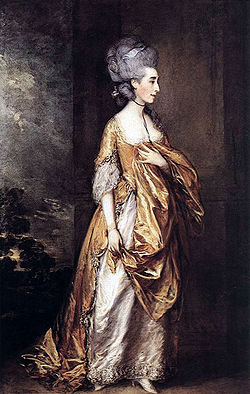
Thomas Gainsborough
Thomas Gainsborough
Thomas Gainsborough was an English portrait and landscape painter.-Suffolk:Thomas Gainsborough was born in Sudbury, Suffolk. He was the youngest son of John Gainsborough, a weaver and maker of woolen goods. At the age of thirteen he impressed his father with his penciling skills so that he let...
painted her portrait in 1778 and this is now on display in the New York Metropolitan Museum of Art. In 1782, she had a quiet and short intrigue with the Prince of Wales
Prince of Wales
Prince of Wales is a title traditionally granted to the heir apparent to the reigning monarch of the United Kingdom of Great Britain and Northern Ireland and the 15 other independent Commonwealth realms...
(afterwards George IV
George IV of the United Kingdom
George IV was the King of the United Kingdom of Great Britain and Ireland and also of Hanover from the death of his father, George III, on 29 January 1820 until his own death ten years later...
), and gave birth to a daughter who used the name Georgina Seymour (1782–1813) but was baptised at St Marylebone as 'Georgina Frederica Augusta Elliott Daughter of His Royal Highness George Prince of Wales & Grace Elliott'. Grace was being kept by Lord Cholmondeley but declared that the Prince was the father of her child and the Morning Post said in January 1782 that he admitted responsibility. However, when the child, which was very dark, was first shown to the Prince he is said to have remarked, "To convince me that this is my girl they must first prove that black is white". The Prince and many others regarded Lord Cholmondeley as the father, though the Prince's friends said that Charles William Wyndham (brother of Lord Egremont), whom she was thought to resemble, claimed paternity. Yet others thought she might have been fathered by George Selwyn. Lord Cholmondeley brought up the girl and, after her early death in 1813, looked after her only child.
France, Louis-Philippe d'Orléans and imprisonment
Louis Philippe II, Duke of Orléans
Louis Philippe Joseph d'Orléans commonly known as Philippe, was a member of a cadet branch of the House of Bourbon, the ruling dynasty of France. He actively supported the French Revolution and adopted the name Philippe Égalité, but was nonetheless guillotined during the Reign of Terror...
in 1784. The couple started an affair and in 1786 Grace settled in Paris
Paris
Paris is the capital and largest city in France, situated on the river Seine, in northern France, at the heart of the Île-de-France region...
. She remained there throughout the revolution
French Revolution
The French Revolution , sometimes distinguished as the 'Great French Revolution' , was a period of radical social and political upheaval in France and Europe. The absolute monarchy that had ruled France for centuries collapsed in three years...
. The duc sided with the revolutionaries, took the name Philippe Égalité, voted for the execution of his cousin, the King
Louis XVI of France
Louis XVI was a Bourbon monarch who ruled as King of France and Navarre until 1791, and then as King of the French from 1791 to 1792, before being executed in 1793....
and whipped up hatred against Louis's wife, Marie Antoinette
Marie Antoinette
Marie Antoinette ; 2 November 1755 – 16 October 1793) was an Archduchess of Austria and the Queen of France and of Navarre. She was the fifteenth and penultimate child of Holy Roman Empress Maria Theresa and Holy Roman Emperor Francis I....
. Grace, on the other hand, supported the monarchy and she became a devoted follower of Louis XVI
Louis XVI of France
Louis XVI was a Bourbon monarch who ruled as King of France and Navarre until 1791, and then as King of the French from 1791 to 1792, before being executed in 1793....
and his family. His execution in 1793 devastated her.
France was plunged into a reign of terror
Reign of Terror
The Reign of Terror , also known simply as The Terror , was a period of violence that occurred after the onset of the French Revolution, incited by conflict between rival political factions, the Girondins and the Jacobins, and marked by mass executions of "enemies of...
and paranoia gripped the people. Despite his support for the revolution, the duke was executed because of his royal blood (he was descended from Louis XIII
Louis XIII of France
Louis XIII was a Bourbon monarch who ruled as King of France and of Navarre from 1610 to 1643.Louis was only eight years old when he succeeded his father. His mother, Marie de Medici, acted as regent during Louis' minority...
). Grace was imprisoned, even though her affair with the duc was long over, due to a suspect letter in her possession from Charles James Fox
Charles James Fox
Charles James Fox PC , styled The Honourable from 1762, was a prominent British Whig statesman whose parliamentary career spanned thirty-eight years of the late 18th and early 19th centuries and who was particularly noted for being the arch-rival of William Pitt the Younger...
. She was a known royalist, and British as well. She was also suspected of having helped a fellow royalist, the Marquis de Champcenetz
Marquis de Champcenetz
Louis René Quentin de Richebourg, marquis de Champcenetz was governor of the Tuileries Palace at the time of the French Revolution. He was the father of his namesake, the journalist Louis René Quentin de Richebourg de Champcenetz. He was the personal enemy of Louis Philippe, who nevertheless...
, escape the death sentence in Paris. She shared a cell with Madame du Barry
Madame du Barry
Jeanne Bécu, comtesse du Barry was the last Maîtresse-en-titre of Louis XV of France and one of the victims of the Reign of Terror during the French Revolution.-Early life:...
, who had once been the mistress of King Louis XV
Louis XV of France
Louis XV was a Bourbon monarch who ruled as King of France and of Navarre from 1 September 1715 until his death. He succeeded his great-grandfather at the age of five, his first cousin Philippe II, Duke of Orléans, served as Regent of the kingdom until Louis's majority in 1723...
. The charge against her, of possessing a letter from an Englishman, was dropped on the grounds that it had not been opened (Elliot was merely to relay it to French Admiral Latouche-Treville) and that, when the jury opened it, it commended the French Navy's recent victory at Naples and the glory of the revolution.
Whilst in this prison, they heard the news that Marie Antoinette had been executed on 16 October 1793. Grace later wrote that the queen's "greatness and courage" inspired all the prisoners to try to follow her example and meet their deaths with dignity.
Unfortunately many of the above stories come from Grace's own highly coloured, exaggerated and partly fictional Journal of my life during the French Revolution (London: Richard Bentley, 1859) and the historian Horace Bleackley has shown that large sections of the journal have no basis in truth. She was never, for instance, in prison with Madame du Barry, and the records only show that she was imprisoned from December 1793 to 4 October 1794. Bleackley considered the beauty of 'Dally the Tall' as by no means superlative.
Later life
Although many of her friends met their deaths including Madame du BarryMadame du Barry
Jeanne Bécu, comtesse du Barry was the last Maîtresse-en-titre of Louis XV of France and one of the victims of the Reign of Terror during the French Revolution.-Early life:...
, Grace did not. She narrowly avoided death and was released after the Reign of Terror came to an end. In total she had been confined to four different prisons by the republican government.
In later years, rumour had it that she became courtesan to Napoleon Bonaparte, but had rejected his offer of marriage. She died a wealthy woman at Ville d'Avray, in present day Hauts-de-Seine
Hauts-de-Seine
Hauts-de-Seine is designated number 92 of the 101 départements in France. It is part of the Île-de-France region, and covers the western inner suburbs of Paris...
in 1823, while mistress of the commune's mayor
Mayor
In many countries, a Mayor is the highest ranking officer in the municipal government of a town or a large urban city....
.
Film
A dramatic portrayal of part of her life is contained in the film The Lady And The DukeThe Lady And The Duke
The Lady and the Duke is a 2001 feature film by French director Éric Rohmer.The film was inspired by Ma vie sous la révolution, the colourful memoirs of Grace Elliott, an Edinburgh-born royalist caught up in the political intrigue following the French Revolution...
(French title L'Anglaise et le duc) by director Éric Rohmer
Éric Rohmer
Éric Rohmer was a French film director, film critic, journalist, novelist, screenwriter and teacher. A figure in the post-war New Wave cinema, he was a former editor of Cahiers du cinéma....
, France, 2001. English actress Lucy Russell
Lucy Russell (actress)
Lucy Russell is an English actress, possibly best known for starring as Grace Elliott in Éric Rohmer's L'Anglaise et le duc . Her first starring role was in Christopher Nolan's Following...
played Grace and Jean-Claude Dreyfus
Jean-Claude Dreyfus
Jean-Claude Dreyfus is a French actor. He began his career in film acting in 1973 in the film Comment réussir quand on est con et pleurnichard. Dreyfus is notable for his portrayal of a butcher in the black comedy Delicatessen by Marc Caro and Jean-Pierre Jeunet...
played the Duke of Orleans.
External links
- During the Reign of Terror: Journal of My Life During the French Revolution, fulltext of Grace Dalrymple Elliott's autobiography, 1910 edition - at The Internet Archive
- During the Reign of Terror: Journal of My Life During the French Revolution, fulltext of Grace Dalrymple Elliott's autobiography, 1859 edition - at Google Books
- Grace Elliott's portrait by Thomas Gainsborough at the New York Metropolitan Museum of Art