

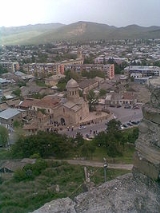
Gori, Georgia

Encyclopedia
Gori is a city in eastern Georgia
, which serves as the regional
capital of Shida Kartli
and the centre of the homonymous administrative district. The name is from Georgian gora (გორა), that is, "heap", or "hill". As of 2002, it had a population of 49,500.
Gori was an important military stronghold in the Middle Ages and maintains a strategic importance due to its location on the principal highway connecting eastern and western parts of Georgia. In the course of its history, Gori has been invaded by the armies of regional powers several times. The city was occupied by Russian troops
during the 2008 South Ossetian War.
Gori is also known as the birthplace of the Soviet
leader Joseph Stalin
and ballistic missile designer Alexander Nadiradze
.
, at the confluence of the rivers Mtkvari and Greater Liakhvi, 588 metres (1,929.1 ft) above sea level. The climate is transitional from moderately warm steppe to moderately humid. Summer is usually hot. The average annual temperature is 10.9 °C (51.6 °F), minimal in January (-1.2 °C) and maximal in August (22.5 °C (72.5 °F)). The maximum precipitation falls in May (76 mm (3 in)) and minimum in August (34 mm (1.3 in)) and January (30 mm (1.2 in)).
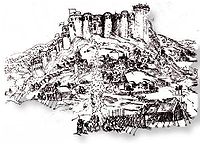 The territory of Gori has been populated since the early Bronze Age
. According to the medieval Georgian chronicles, the town of Gori was founded by King David IV
(r. 1089-1125) who settled refugees from Armenia
there. However, the fortress of Gori (Goris-Tsikhe
), appears to have been in use already in the 7th century, and archaeological evidence indicates the existence of an urban community in Classical Antiquity
. In 1299, Gori was captured by the Alan
tribesmen fleeing the Mongol conquest of their original homeland in the North Caucasus
. The Georgian king George V
recovered the town in 1320, pushing the Alans back over the Caucasus mountains
.
With the downfall of the medieval Georgian kingdom, Gori – strategically located at the crossroads of major transit routes – was frequently targeted by foreign invaders, and changed its masters on several occasions. It was first taken and sacked by Uzun Hassan
of the Ak Koyunlu
in 1477, followed by Tahmasp I of Persia
in the mid-16th century. By the end of that century, Gori passed to the Ottomans
and became their major outpost in Georgia until being recovered by the Georgians under Simon I of Kartli
after heavy fighting in 1599. The town was once again garrisoned by the Persians under Shah Abbas I in 1614.
Following successive occupations by the Ottomans (1723–35) and Persians (1735-40s), Gori returned to the Georgian control under the kings Teimuraz II
and Erekle II
whose efforts helped to advance economy and culture in the town. Following the Russian
annexation of Georgia, Gori was granted the status of a town within the Tiflis Governorate
in 1801. It grew in size and population throughout the 19th century, but was destroyed in the 1920 earthquake
. An important industrial center in Soviet times, Gori suffered from an economic collapse and the outflow of population during the years of a post-Soviet crisis of the 1990s.
Gori is close to the Georgian-Ossetian conflict
zone. It is connected to breakaway South Ossetia
's capital Tskhinvali
via a railroad spur which has been defunct since the early 1990s. In the 2000s, Georgia has increased military infrastructure in and around the city. Thus, the Central Military Hospital was relocated from Tbilisi to Gori and reequipped in October 2006. On January 18, 2008, Georgia’s second NATO-standard military base to accommodate the 1st Infantry Brigade (Georgia) of the Georgian Ground Forces was established at Gori.
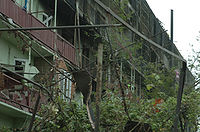 In the 2008 South Ossetian War, the base came under aerial attack by the Russian Air Force
from the outset of the conflict, and was abandoned between August 9 and August 12, 2008 due to the lack of effective anti aircraft defences. Residential districts of Gori were also hit by the airstrikes, resulting in civilian injuries and deaths. Human Rights Watch
(HRW) claimed that Russian forces had indiscriminately deployed cluster bombs in civilian areas around Gori. According to HRW, on August 12 Russian planes dropped cluster bombs in the center of Gori, killing 11 civilians and wounding dozens more. Russian military officials deny using cluster munitions in the conflict, calling the HRW assertion "slanderous" and questioning the HRW's objectivity. Numerous unexploded "bomblets" have been found by locals and HRW employees. Georgia's government has officially recognized the use of cluster bombs during the conflict.
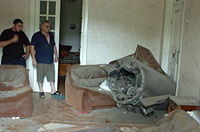 By August 11, Georgian military personnel and most residents had fled the city, which was then captured and occupied
by the Russian military
and South Ossetian separatist militia
. HRW accused the militia of unleashing a campaign of looting
, arson
, kidnapping
and other attacks against the remaining civilian population. The Russian and South Ossetian forces withdrew from the city on August 22, 2008.
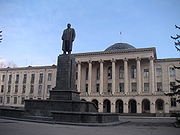
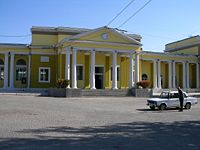 Gori and its environs house several notable cultural and historical landmarks. Although for many foreigners Gori is principally known as the birthplace of Joseph Stalin
, in Georgian historical memory the city has long been associated with its citadel, the Gori Fortress, which is built on a cliffy hill overlooking the central part of the modern city. On another hill stands the 18th century St. George's church of Gorijvari, a popular place of pilgrimage. The ancient rock-hewn town of Uplistsikhe
and the 7th century Ateni Sioni Church
are located not far from Gori.
Stalin's association with the city is emphasized by the Joseph Stalin Museum
in downtown Gori and, until recently, the Stalin monument in front of the Gori City Hall
, one of the few such monuments to survive Nikita Khrushchev
's de-Stalinization
program. The monument was a source of controversy in a newly independent Georgia in the 1990s, but for several years the post-communist government acceded to the Gori citizens' request and left the statue untouched. It was ultimately removed to the Joseph Stalin Museum in June 2010.
Georgia (country)
Georgia is a sovereign state in the Caucasus region of Eurasia. Located at the crossroads of Western Asia and Eastern Europe, it is bounded to the west by the Black Sea, to the north by Russia, to the southwest by Turkey, to the south by Armenia, and to the southeast by Azerbaijan. The capital of...
, which serves as the regional
Mkhare
Mkhare is a subdivision in the country of Georgia. It is usually translated as region.The country is divided, according to the Presidential decrees from 1994 to 1996, into regions on a provisional basis until the secessionist conflicts in Abkhazia and South Ossetia are resolved...
capital of Shida Kartli
Shida Kartli
Shida Kartli is a region in Georgia. It consists of the following districts: Gori, Kaspi, Kareli, Java, Khashuri.The northern part of the region, namely Java, and northern territories of Kareli and Gori, is controlled by the authorities of the self-proclaimed republic of South Ossetia since...
and the centre of the homonymous administrative district. The name is from Georgian gora (გორა), that is, "heap", or "hill". As of 2002, it had a population of 49,500.
Gori was an important military stronghold in the Middle Ages and maintains a strategic importance due to its location on the principal highway connecting eastern and western parts of Georgia. In the course of its history, Gori has been invaded by the armies of regional powers several times. The city was occupied by Russian troops
Occupation of Gori
Occupation of Gori was the takeover of the Georgian city of Gori and its surrounding villages by Russian military forces, which commenced on August 13, 2008 as part of the 2008 South Ossetian War, and ended with the withdrawal of Russian units from the city by 22 August 2008.-Background and initial...
during the 2008 South Ossetian War.
Gori is also known as the birthplace of the Soviet
Soviet Union
The Soviet Union , officially the Union of Soviet Socialist Republics , was a constitutionally socialist state that existed in Eurasia between 1922 and 1991....
leader Joseph Stalin
Joseph Stalin
Joseph Vissarionovich Stalin was the Premier of the Soviet Union from 6 May 1941 to 5 March 1953. He was among the Bolshevik revolutionaries who brought about the October Revolution and had held the position of first General Secretary of the Communist Party of the Soviet Union's Central Committee...
and ballistic missile designer Alexander Nadiradze
Alexander Nadiradze
Alexander Davidovich Nadiradze was a famous Soviet missile engineer. He was the main designer of the first Soviet mobile ICBM RT-21 Temp 2S , intermediate range ballistic missile RSD-10 Pioneer and RT-2PM Topol...
.
Geography and climate
Gori is located 76 kilometres (47.2 mi) west of Georgia's capital TbilisiTbilisi
Tbilisi is the capital and the largest city of Georgia, lying on the banks of the Mt'k'vari River. The name is derived from an early Georgian form T'pilisi and it was officially known as Tiflis until 1936...
, at the confluence of the rivers Mtkvari and Greater Liakhvi, 588 metres (1,929.1 ft) above sea level. The climate is transitional from moderately warm steppe to moderately humid. Summer is usually hot. The average annual temperature is 10.9 °C (51.6 °F), minimal in January (-1.2 °C) and maximal in August (22.5 °C (72.5 °F)). The maximum precipitation falls in May (76 mm (3 in)) and minimum in August (34 mm (1.3 in)) and January (30 mm (1.2 in)).
History
Bronze Age
The Bronze Age is a period characterized by the use of copper and its alloy bronze as the chief hard materials in the manufacture of some implements and weapons. Chronologically, it stands between the Stone Age and Iron Age...
. According to the medieval Georgian chronicles, the town of Gori was founded by King David IV
David IV of Georgia
David IV "the Builder", also known as David II , of the Bagrationi dynasty, was a king of Georgia from 1089 until his death in 1125....
(r. 1089-1125) who settled refugees from Armenia
Armenia
Armenia , officially the Republic of Armenia , is a landlocked mountainous country in the Caucasus region of Eurasia...
there. However, the fortress of Gori (Goris-Tsikhe
Goris-Tsikhe
Gori Fortress is a medieval citadel in Georgia, standing above the city of Gori on a rocky hill.The fortress first appears in the 13th century records but archaeological evidence shows that the area had already been fortified in the last centuries BC. The fortress controlled major strategic and...
), appears to have been in use already in the 7th century, and archaeological evidence indicates the existence of an urban community in Classical Antiquity
Classical antiquity
Classical antiquity is a broad term for a long period of cultural history centered on the Mediterranean Sea, comprising the interlocking civilizations of ancient Greece and ancient Rome, collectively known as the Greco-Roman world...
. In 1299, Gori was captured by the Alan
Alania
Alania may refer to:*Alania, the medieval state of the Alans or Alani people in the North Caucasus*The short name of the modern North Ossetia-Alania, one of the Caucasian republics in the Russian Federation...
tribesmen fleeing the Mongol conquest of their original homeland in the North Caucasus
North Caucasus
The North Caucasus is the northern part of the Caucasus region between the Black and Caspian Seas and within European Russia. The term is also used as a synonym for the North Caucasus economic region of Russia....
. The Georgian king George V
George V of Georgia
George V, the "Brilliant" was King of Georgia from 1299 to 1302 and again from 1314 until his death. A flexible and far-sighted politician, he recovered Georgia from a century-long Mongol domination, restoring the country’s previous strength and Christian culture.-Reign:George was born to King...
recovered the town in 1320, pushing the Alans back over the Caucasus mountains
Caucasus Mountains
The Caucasus Mountains is a mountain system in Eurasia between the Black Sea and the Caspian Sea in the Caucasus region .The Caucasus Mountains includes:* the Greater Caucasus Mountain Range and* the Lesser Caucasus Mountains....
.
With the downfall of the medieval Georgian kingdom, Gori – strategically located at the crossroads of major transit routes – was frequently targeted by foreign invaders, and changed its masters on several occasions. It was first taken and sacked by Uzun Hassan
Uzun Hassan
Uzun Hasan or Hassan , Sultan of the Aq Qoyunlu dynasty, or White Sheep Turkmen. Hassan ruled in parts of present-day western Iran, Iraq, Turkey, Azerbaijan and Armenia between 1453 and 1478....
of the Ak Koyunlu
Ak Koyunlu
The Aq Qoyunlu or Ak Koyunlu, also called the White Sheep Turkomans , was an Sunni Oghuz Turkic tribal federation that ruled parts of present-day Eastern Turkey, Armenia, Azerbaijan, northern Iraq, and Iran from 1378 to 1508.-History:According to chronicles from the Byzantine Empire, the Aq Qoyunlu...
in 1477, followed by Tahmasp I of Persia
Tahmasp I
Tahmasp or Tahmasb I was an influential Shah of Iran, who enjoyed the longest reign of any member of the Safavid dynasty...
in the mid-16th century. By the end of that century, Gori passed to the Ottomans
Ottoman Empire
The Ottoman EmpireIt was usually referred to as the "Ottoman Empire", the "Turkish Empire", the "Ottoman Caliphate" or more commonly "Turkey" by its contemporaries...
and became their major outpost in Georgia until being recovered by the Georgians under Simon I of Kartli
Simon I of Kartli
Simon I also known as Svimon , of the Bagrationi dynasty, was a Georgian king of Kartli from 1556 to 1569 and again from 1578 to 1599...
after heavy fighting in 1599. The town was once again garrisoned by the Persians under Shah Abbas I in 1614.
Following successive occupations by the Ottomans (1723–35) and Persians (1735-40s), Gori returned to the Georgian control under the kings Teimuraz II
Teimuraz II
Teimuraz II , of the Bagrationi dynasty, was a king of Kakheti, eastern Georgia, from 1732 to 1744, then of Kartli from 1744 until his death.- Life :...
and Erekle II
Erekle II
Erekle II was a Georgian monarch of the Bagrationi Dynasty, reigning as the king of Kakheti from 1744 to 1762, and of Kartli and Kakheti from 1762 until 1798. In the contemporary Persian sources he is referred to as Erekli Khan, while Russians knew him as Irakli...
whose efforts helped to advance economy and culture in the town. Following the Russian
Russian Empire
The Russian Empire was a state that existed from 1721 until the Russian Revolution of 1917. It was the successor to the Tsardom of Russia and the predecessor of the Soviet Union...
annexation of Georgia, Gori was granted the status of a town within the Tiflis Governorate
Tiflis Governorate
Tiflis Governorate was one of the guberniyas of the Russian Empire with its centre in Tiflis . In 1897 it constituted 44,607 sq. kilometres in area and had a population of 1,051,032 inhabitants...
in 1801. It grew in size and population throughout the 19th century, but was destroyed in the 1920 earthquake
1920 Gori earthquake
The Gori earthquake with the surface wave magnitude of 6.2 hit the town of Gori and its district, the Democratic Republic of Georgia, on February 20, 1920, inflicted heavy damage to the area and causing 114 deaths....
. An important industrial center in Soviet times, Gori suffered from an economic collapse and the outflow of population during the years of a post-Soviet crisis of the 1990s.
Gori is close to the Georgian-Ossetian conflict
Georgian-Ossetian conflict
The Georgian–Ossetian conflict refers to the ethno-political conflict in Georgia's autonomous region of South Ossetia, which evolved in 1989 and developed into a 1991–1992 South Ossetia War. Despite a declared ceasefire and numerous peace efforts, the conflict remains unresolved, and minor armed...
zone. It is connected to breakaway South Ossetia
South Ossetia
South Ossetia or Tskhinvali Region is a disputed region and partly recognized state in the South Caucasus, located in the territory of the South Ossetian Autonomous Oblast within the former Georgian Soviet Socialist Republic....
's capital Tskhinvali
Tskhinvali
Tskhinvali , is the capital of South Ossetia, a disputed region which has been recognised as an independent Republic by Russia, Venezuela, Nicaragua and Nauru, and is regarded by Georgia and the rest of the world as part of the Shida Kartli region within Georgian sovereign territory.It is located...
via a railroad spur which has been defunct since the early 1990s. In the 2000s, Georgia has increased military infrastructure in and around the city. Thus, the Central Military Hospital was relocated from Tbilisi to Gori and reequipped in October 2006. On January 18, 2008, Georgia’s second NATO-standard military base to accommodate the 1st Infantry Brigade (Georgia) of the Georgian Ground Forces was established at Gori.
2008 conflict
Russian Air Force
The Russian Air Force is the air force of Russian Military. It is currently under the command of Colonel General Aleksandr Zelin. The Russian Navy has its own air arm, the Russian Naval Aviation, which is the former Soviet Aviatsiya Voyenno Morskogo Flota , or AV-MF).The Air Force was formed from...
from the outset of the conflict, and was abandoned between August 9 and August 12, 2008 due to the lack of effective anti aircraft defences. Residential districts of Gori were also hit by the airstrikes, resulting in civilian injuries and deaths. Human Rights Watch
Human Rights Watch
Human Rights Watch is an international non-governmental organization that conducts research and advocacy on human rights. Its headquarters are in New York City and it has offices in Berlin, Beirut, Brussels, Chicago, Geneva, Johannesburg, London, Los Angeles, Moscow, Paris, San Francisco, Tokyo,...
(HRW) claimed that Russian forces had indiscriminately deployed cluster bombs in civilian areas around Gori. According to HRW, on August 12 Russian planes dropped cluster bombs in the center of Gori, killing 11 civilians and wounding dozens more. Russian military officials deny using cluster munitions in the conflict, calling the HRW assertion "slanderous" and questioning the HRW's objectivity. Numerous unexploded "bomblets" have been found by locals and HRW employees. Georgia's government has officially recognized the use of cluster bombs during the conflict.
Occupation of Gori
Occupation of Gori was the takeover of the Georgian city of Gori and its surrounding villages by Russian military forces, which commenced on August 13, 2008 as part of the 2008 South Ossetian War, and ended with the withdrawal of Russian units from the city by 22 August 2008.-Background and initial...
by the Russian military
Armed Forces of the Russian Federation
The Armed Forces of the Russian Federation are the military services of Russia, established after the break-up of the Soviet Union. On 7 May 1992 Boris Yeltsin signed a decree establishing the Russian Ministry of Defence and placing all Soviet Armed Forces troops on the territory of the RSFSR...
and South Ossetian separatist militia
Military of South Ossetia
The Military of South Ossetia is the military of the breakaway republic of South Ossetia, whose independence is recognized by Russia, Nicaragua, Venezuela, and Nauru but whom Georgia considers to be a Russian-Occupied Territory...
. HRW accused the militia of unleashing a campaign of looting
Looting
Looting —also referred to as sacking, plundering, despoiling, despoliation, and pillaging—is the indiscriminate taking of goods by force as part of a military or political victory, or during a catastrophe, such as during war, natural disaster, or rioting...
, arson
Arson
Arson is the crime of intentionally or maliciously setting fire to structures or wildland areas. It may be distinguished from other causes such as spontaneous combustion and natural wildfires...
, kidnapping
Kidnapping
In criminal law, kidnapping is the taking away or transportation of a person against that person's will, usually to hold the person in false imprisonment, a confinement without legal authority...
and other attacks against the remaining civilian population. The Russian and South Ossetian forces withdrew from the city on August 22, 2008.
Demographics
| Year | 1865 | 1897 | 1914 | 1977 | 1989 | 2002 |
|---|---|---|---|---|---|---|
| Population | 5,100 | 10,500 | 25,700 | 54,100 | 68,924 | 49,522 |
Landmarks
Joseph Stalin
Joseph Vissarionovich Stalin was the Premier of the Soviet Union from 6 May 1941 to 5 March 1953. He was among the Bolshevik revolutionaries who brought about the October Revolution and had held the position of first General Secretary of the Communist Party of the Soviet Union's Central Committee...
, in Georgian historical memory the city has long been associated with its citadel, the Gori Fortress, which is built on a cliffy hill overlooking the central part of the modern city. On another hill stands the 18th century St. George's church of Gorijvari, a popular place of pilgrimage. The ancient rock-hewn town of Uplistsikhe
Uplistsikhe
Uplistsikhe is an ancient rock-hewn town in eastern Georgia, some 10 kilometers east of the town of Gori, Shida Kartli.Built on a high rocky left bank of the Mtkvari River, it contains various structures dating from the Early Iron Age to the Late Middle Ages, and is notable for the unique...
and the 7th century Ateni Sioni Church
Ateni Sioni Church
The Ateni Sioni Church is an early 7th-century Georgian Orthodox church some south of the city of Gori, Georgia. It stands in a setting of the Tana River valley known not only for its historical monuments but also for its picturesque landscapes and wine...
are located not far from Gori.
Stalin's association with the city is emphasized by the Joseph Stalin Museum
Joseph Stalin Museum, Gori
thumb|right|The Joseph Stalin Museum in Gori- in the foreground, the house where Stalin was bornThe Joseph Stalin Museum is a museum in Gori, Georgia dedicated to the life of Joseph Stalin, the leader of the Soviet Union, who was born in Gori.-Organization:...
in downtown Gori and, until recently, the Stalin monument in front of the Gori City Hall
Gori City Hall
Gori City Hall is an administrative building of Gori, Georgia, a city in eastern Georgia, which serves as the regional capital of Shida Kartli. According to media reports, the hall has been a target of shelling by Russian troops during the 2008 Russian Georgian War. Until 2010, there was a...
, one of the few such monuments to survive Nikita Khrushchev
Nikita Khrushchev
Nikita Sergeyevich Khrushchev led the Soviet Union during part of the Cold War. He served as First Secretary of the Communist Party of the Soviet Union from 1953 to 1964, and as Chairman of the Council of Ministers, or Premier, from 1958 to 1964...
's de-Stalinization
De-Stalinization
De-Stalinization refers to the process of eliminating the cult of personality, Stalinist political system and the Gulag labour-camp system created by Soviet leader Joseph Stalin. Stalin was succeeded by a collective leadership after his death in March 1953...
program. The monument was a source of controversy in a newly independent Georgia in the 1990s, but for several years the post-communist government acceded to the Gori citizens' request and left the statue untouched. It was ultimately removed to the Joseph Stalin Museum in June 2010.