

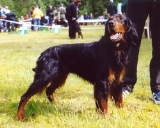
Gordon Setter

Encyclopedia
A Gordon Setter is a large breed
of dog
, a member of the setter
family that also includes both the better-known Irish Setter
and the English Setter
. Setter breeds are classified as members of either the Sporting or Gundog Group depending on the national kennel club or council. The original purpose of the breed was to hunt gamebirds. Their quarry in the United Kingdom, may be partridge
or grouse
, pheasant
, ptarmigan, blackgame, snipe
or woodcock
: whilst overseas bird dogs are worked on quail
, willow grouse
, sand grouse, guinea fowl, sagehen, francolin
and any other bird that will sit to a dog - that is to say, will attempt to avoid a potential predator by concealment rather than by taking to the wing at the first sign of danger. It is this combination of a bird that will sit fast in front of a dog that will remain on point that makes bird dog work possible.
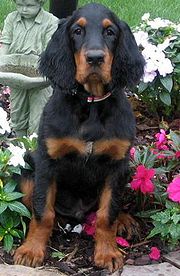 Gordon setters, also known as "black and tans," have a coal-black coat with distinctive markings of a rich chestnut
or mahogany
colour on their paws and lower legs, vents, throat, and muzzles; one spot above each eye; and two spots on their chest. A small amount of white is allowed on the chest. Although uncommon, red Gordons are occasionally born to normal-coloured parents, the result of expression of a recessive red gene. Predominantly tan, red, or buff dogs are ineligible for showing. A Gordon's coat is straight or slightly waved (but not curly), long and silky, with chest, stomach, ear, leg, and tail feathering. According to the AKC breed standard, "the bearing is intelligent, noble, and dignified." They are the heaviest of the setter breeds, with males reaching 27 inches at the withers
and up to 80 pounds in weight.
Gordons were bred to run, and require 60 to 80 minutes of vigorous exercise daily. Young dogs should not be over-exercised or begin agility training
until they are at least 18 months old, to avoid joint problems later in life. Because of their hunting instincts, Gordons should not be allowed to roam freely if unsupervised, as they are apt to wander into a potentially dangerous traffic situation while following a scent.
, gastric torsion (bloat) and eye diseases such as progressive retinal atrophy
(PRA), and cataracts. Life expectancy for the breed is generally about 10 to 12 years.
At the beginning of 2009, a report was issued to all of the Breed Clubs in the UK concerning cases of late onset PRA in Gordon Setters.
On March 14, 2011, Animal Health Trust (AHT) made a DNA test available. The mutation is termed rcd4 (for rod-cone degeneration 4) to distinguish it from other, previously described forms of rod-cone degeneration. It is recessive, and 19 out of the 21 Gordons in their study who had clinical signs of PRA were homozygous for this mutation, indicating it is the major cause of PRA in the breed.
As many as 50% of Gordon Setters may be carriers.
The Dog In Health & Disease - Longmans, Green & Co 1859
This is the title of the chapter covering pointers and setters in Stonehenge's work on dogs published around a hundred and fifty years ago. The term 'Gun Dogs' would pretty well cover all the dogs described in the chapter. Many of the gun dogs described by Stonehenge are no longer to be found in the United Kingdom or have been absorbed into one of the other breeds. The Russian Setter, the Welsh Setter, Northern Irish Water Spaniel, Southern Irish Water Spaniel and English Water Spaniel
, the Spanish Pointer and the Portuguese Pointer
have all disappeared in the past hundred and fifty years, and the pictures of some of the breeds that are still with us show considerable differences to the breed as we see them today.
Edward Laverick wrote in The Setter, published in 1872: 'the setter is but an improved spaniel'; while the Rev Pearce in The Dog, published in the same year, said, 'he is a direct descendant of the Spaniel: "a Setting Spaniel" was the first Setter'. Since then this is the generally agreed with conclusion that the Setter was primarily derived from the old Land Spaniel, so called so as to distinguish it from the Water Spaniel. It is however likely that outside crosses with Hounds or Pointers did influence its development. William Taplin in The Sportsman's Cabinet (1803–04) maintained that it was 'originally produced by a commixture between the Spanish pointer and the larger breed of the English spaniel'.
We now really need not to go back to the Spaniel and its specialised development into the setting-dog, as it was called, and can be found in the work by the famous French sportsman, Gaston de Foix
, Vicomte de Béarn (1331–91), who it is said owned about 1500 dogs 'brought from all countries of Europe' and was known as 'Gaston Phèbus' owing to his love for the chase. This work is called Livre de Chasse or Miroir de Phèbus, and was started in 1387. This work was the bases of The Master of Game
written between 1406 and 1413 by Edward III's grandson, Edward, second Duke of York, who acknowledged his debt to de Foix. Below is the main passage referring to the Spaniel and the Setting-dog, as republished in 1904:
'Another kind of dog is that is called falcon-dog or spaniel (espaignols in the French original ed.) because it comes from Spain, notwithstanding that there are many in other countries....
'A good spaniel should not be too rough, though his tail should be rough. The good qualities that such a dogs are these: They love well their masters and follow them without losing, although they be in a great crowd of men, and commonly they go before their master, running and wagging their tail, and raise or stat fowl and wild beasts. But their right craft is of the partridge and of the quail. It is good for a man that has a noble goshawk, or a tierecel, or a sparrowhawk
for the partridges to have such dogs; and also, when they are taught to be couchers (chiens couchants in the original French - ed.), they are good for taking partridge and quail with the net...' (Baillie-Grohman, p66).
The modern Gordon Setter is a predominantly black dog with rich tan marking on the muzzle, legs and chest. A little bigger and heavier than either the Irish or English, he is nevertheless descended from the same genetic mixing pot , which undoubtedly has its origins among those setting spaniels we met earlier. The Kennel Club
applied the name 'Gordon Setter' to the breed in 1924. Before that they were known as black and tan setters, and were found in many kennels beside those of the Alexander Gordon, 4th Duke of Gordon
(1743–1827). Indeed, as we shall see, there is plenty of evidence that the majority of the setters at Gordon Castle during the Duke's time were tri-coloured rather than pure black and tan.
The breed was brought to the United States by George Blunt and Daniel Webster in 1842, with the purchase of two dogs from the Duke's kennels. The American Kennel Club officially recognised the breed in 1892.
came to the forefront while the number of working Pointers
and Setters declined year after year.
Besides the modernisation of the style of shooting and the work required of gundogs, the situation was altered by the new developments that also took place in farming, which helped to bring about a marked reduction in the Partridge
population. This came about with the introduction of modernisation such as early cutting of silage
, the use of fast-moving mechanical equipment, the burning or ploughing of stubble-fields soon after harvest, the destruction of hedgerows and the use of chemical sprays for weed-killing. The hedgerows had provided shelter and nesting sites; the weeds and other herbage supplied food and cover; whilst the stubble-fields had been a primary source of winter food; so the partridges were deprived of some important assets, whilst the wide use of chemicals on the land exercised a direct harmful effect.
It will be obvious to the reader that these changes significantly affected the status of Setters and Pointers, not least that of the Gordon. Though often used as a general purpose gundog, the Gordon Setter is essentially a wide-ranging dog employed in the UK to locate Red Grouse
and Ptarmigan on the Scottish or North of England moors and partridges on the stubble-fields of the south of England. Up to the late 1930s most Gordons were kept for this type of work, so that the majority were to be found in Scotland and the north of England; but now they are more evenly distributed and there are no large working kennels.
The function of the Setter is well summarised by Captain Blaine as follows: ‘The work required of the setter and pointer differs from that of all other breeds of dog. It is their business to range and hunt independently for game, at a distance from the sportsman, using their own initiative and intelligence to find it, and having done so, to remain staunchly “on point” awaiting his approach. They must search for the body, and not for the foot scent, and be able to maintain a fast steady gallop for long periods without fatigue. For the purpose a dog should have independence of character, speed, endurance, and a sensitive nose, combined with natural ability for hunting the terrain, in the best method of finding game’ (Croxton Smith, 1932, p70).
Perhaps one of the best descriptions of the Setter at work in the field is a poem by the poet William Somerville (1675–1742) in the following lines:
‘When autumn smiles, all beauteous in decay,
And paints each chequered grove with various hues,
My setter ranges in the new shorn fields,
His nose in air erect; from ridge to ridge,
Panting, he bounds, his quartered ground divides
In equal intervals, nor careless leaves
One inch untried. At length the tainted gale
His nostrils wide inhale, quick joy elates
His beating heart, which, awed by discipline
Severe, he dares not own, but cautious creeps
Low-cowering, step by step; at last attains
His proper distance, there he stops at once,
And points with his instructive nose upon
The trembling prey. On wings of wind and upborne
The floating net unfolded flies; then drops,
And the poor fluttering captives rise in vain.’
, which was situated near Fochabers
, not far from the River Spey
and a few miles from the coast of Moray
. The exact date when this occurred is not known. A Colonel Thornton visited the place during his tour of the Highlands in 1786. He makes no mention of any kennel of Setters at that time, although he does note that ‘The Duke of Gordon still keeps up a diversion of falconry….I saw, also, here a true Highland greyhound, which is now become very scarce….’. The Duke was indeed devoted to country pursuits and was among the last of his day in Scotland to keep hawks and practise falconry; he was celebrated for his Scottish Deerhounds as well as his Setters. However all that can be inferred from the Colonel’s remarks is that there are unlikely to have been any Setters of note at the Castle in 1786. (Thornton, 1804, p 196).
There is much on record that seems reliable about the origin or derivation of the Duke of Gordon’s Setters, though verification at this late date is of course impossible. Most of this evidence comes from Samuel Brown, the Veterinary Surgeon of Melton Mowbray, who was a great authority on the breed. In a letter to ‘’The Field’’ of 12 November 1864 Samuel Brown stated: ‘An old gentleman sportsman, and one too who has shot over the same breed for fifty years and new them during his boyhood, assures me that the late Duke of Gordon, Marquis of Anglesey, and several other noblemen, had their original stock of setters from the late Mr Coke of Longford, and that the colour was usually black-white-and –tan. Mine are descended from the original breed of Mr Coke, the Gordon ‘’Regent’’ and ‘’Fan’’, and within the last five years from a black-white-and –tan bitch which I got direct from the Beaudesart kennel’ (i.e. the Marquees of Anglesey’s – Ed.). Five years late, in another letter to the same journal, the Rev F. W. Adye wrote: ‘Mr Brown was told by Mr Coke himself that he often sent dogs to the Duke of Gordon and received others in exchange, in order now and then to obtain fresh blood’ (‘’The Field,’’ 8 January 1870). These facts were well know to J. H. Walsh (‘Stonehenge’), Editor of ‘’The Field’’ and a leading authority on sporting dogs, for it is he who mentions in the first chapter of his book ‘’The Dogs of the British Islands’’ (1867) a Setter ‘from Mr Coke of Norfolk and doubtless related to the late Duke of Gordon’s kennel, as Mr Coke and the duke bred together and interchanged setters frequently’. Therefore it does appear to be reasonably established that Mr Coke provided most of the original Setters for the Duke’s kennel. The Rev Hutchinson, who wrote under the pseudonym ‘Sixty-one’, insisted that ‘the original setter taken or sent to Gordon Castle by the first Marquis of Anglesea’ (‘’The Field’’, 29 January 1870), however what has been seen is that, according to Samuel Brown’s ‘old gentleman sportsman’, the Marquees of Anglesey likewise had his original stock of Setters at Beaudesart from Mr Coke – probably, although this cannot be confirmed, some years before the Gordon Castle kennel was founded; for in 1869 the Beaudesart Setters were said to have been maintained ‘for sixty years pure and unmixed with any blood’ (‘’The Field’’, 11 December 1869). It is most unlikely that the Duke obtained his setters from only one source, we know that he interbreed with other kennels besides Mr Coke’s, notably with Lord Lovat’s.
Dog breed
Dog breeds are groups of closely related and visibly similar domestic dogs, which are all of the subspecies Canis lupus familiaris, having characteristic traits that are selected and maintained by humans, bred from a known foundation stock....
of dog
Dog
The domestic dog is a domesticated form of the gray wolf, a member of the Canidae family of the order Carnivora. The term is used for both feral and pet varieties. The dog may have been the first animal to be domesticated, and has been the most widely kept working, hunting, and companion animal in...
, a member of the setter
Setter
The setter is a type of gundog used most often for hunting game such as quail, pheasant, and grouse. A setter silently searches for game by scent. When prey is encountered the dog freezes rather than chasing after the game. Setters get their name from their distinctive stance; a sort of crouch...
family that also includes both the better-known Irish Setter
Irish Setter
The Irish Setter , is a setter, a breed of gundog and family dog. The term Irish Setter is commonly used to encompass the show-bred dog recognized by the American Kennel Club as well as the field-bred Red Setter recognised by the Field Dog Stud Book....
and the English Setter
English Setter
The English Setter is a breed of dog. It is part of the Setter family, which includes red Irish Setters, Irish Red and White Setters, and black-and-tan Gordon Setters. It is a gun dog, bred for a mix of endurance and athleticism.- Appearance :...
. Setter breeds are classified as members of either the Sporting or Gundog Group depending on the national kennel club or council. The original purpose of the breed was to hunt gamebirds. Their quarry in the United Kingdom, may be partridge
Partridge
Partridges are birds in the pheasant family, Phasianidae. They are a non-migratory Old World group.These are medium-sized birds, intermediate between the larger pheasants and the smaller quails. Partridges are native to Europe, Asia, Africa, and the Middle East...
or grouse
Grouse
Grouse are a group of birds from the order Galliformes. They are sometimes considered a family Tetraonidae, though the American Ornithologists' Union and many others include grouse as a subfamily Tetraoninae in the family Phasianidae...
, pheasant
Pheasant
Pheasants refer to some members of the Phasianinae subfamily of Phasianidae in the order Galliformes.Pheasants are characterised by strong sexual dimorphism, males being highly ornate with bright colours and adornments such as wattles and long tails. Males are usually larger than females and have...
, ptarmigan, blackgame, snipe
Snipe
A snipe is any of about 25 wading bird species in three genera in the family Scolopacidae. They are characterized by a very long, slender bill and crypsis plumage. The Gallinago snipes have a nearly worldwide distribution, the Lymnocryptes Jack Snipe is restricted to Asia and Europe and the...
or woodcock
Woodcock
The woodcocks are a group of seven or eight very similar living species of wading birds in the genus Scolopax. Only two woodcocks are widespread, the others being localized island endemics. Most are found in the Northern Hemisphere but a few range into Wallacea...
: whilst overseas bird dogs are worked on quail
Quail
Quail is a collective name for several genera of mid-sized birds generally considered in the order Galliformes. Old World quail are found in the family Phasianidae, while New World quail are found in the family Odontophoridae...
, willow grouse
Willow Grouse
The Willow Ptarmigan , also known as the Willow Grouse, is a bird of the grouse subfamily. It is a sedentary species, breeding in birch and other forests and moorlands in the tundra of Scandinavia, Siberia, Alaska, northern Canada, in particular the province of Newfoundland and Labrador...
, sand grouse, guinea fowl, sagehen, francolin
Francolin
Francolins are birds that traditionally have been placed in the genus Francolinus, but now commonly are divided into multiple genera , although some of the major taxonomic listing sources have yet to divide them. They are members of the pheasant family, Phasianidae...
and any other bird that will sit to a dog - that is to say, will attempt to avoid a potential predator by concealment rather than by taking to the wing at the first sign of danger. It is this combination of a bird that will sit fast in front of a dog that will remain on point that makes bird dog work possible.
Appearance
Chestnut
Chestnut , some species called chinkapin or chinquapin, is a genus of eight or nine species of deciduous trees and shrubs in the beech family Fagaceae, native to temperate regions of the Northern Hemisphere. The name also refers to the edible nuts they produce.-Species:The chestnut belongs to the...
or mahogany
Mahogany
The name mahogany is used when referring to numerous varieties of dark-colored hardwood. It is a native American word originally used for the wood of the species Swietenia mahagoni, known as West Indian or Cuban mahogany....
colour on their paws and lower legs, vents, throat, and muzzles; one spot above each eye; and two spots on their chest. A small amount of white is allowed on the chest. Although uncommon, red Gordons are occasionally born to normal-coloured parents, the result of expression of a recessive red gene. Predominantly tan, red, or buff dogs are ineligible for showing. A Gordon's coat is straight or slightly waved (but not curly), long and silky, with chest, stomach, ear, leg, and tail feathering. According to the AKC breed standard, "the bearing is intelligent, noble, and dignified." They are the heaviest of the setter breeds, with males reaching 27 inches at the withers
Withers
The withers is the ridge between the shoulder blades of a four-legged animal. In many species it is the tallest point of the body, and in horses and dogs it is the standard place to measure the animal's height .-Horses:The withers in horses are formed by the dorsal spinal processes of roughly the...
and up to 80 pounds in weight.
Temperament
The AKC describes the Gordon Setter temperament as "alert, gay, interested, and confident. He is fearless and willing, intelligent, and capable. He is loyal and affectionate, and strong-minded enough to stand the rigors of training." Gordons are intensely loyal to their owners; thrive in an attentive, loving environment; and are good family dogs. Puppies and adult dogs can be quite boisterous, and although they are patient by nature, may not be suitable for households with very young children. Gordons are sensitive and empathic, eager to learn, and need firm but gentle handling. Early socialisation and obedience training is important. They are known as great talkers. The breed is one of the slowest to mature, not hitting prime until three years of age or more, and will show puppy-like characteristics well into their older years.Gordons were bred to run, and require 60 to 80 minutes of vigorous exercise daily. Young dogs should not be over-exercised or begin agility training
Dog agility
Dog agility is a dog sport in which a handler directs a dog through an obstacle course in a race for both time and accuracy. Dogs run off-leash with no food or toys as incentives, and the handler can touch neither dog nor obstacles...
until they are at least 18 months old, to avoid joint problems later in life. Because of their hunting instincts, Gordons should not be allowed to roam freely if unsupervised, as they are apt to wander into a potentially dangerous traffic situation while following a scent.
Health
Although not as prone to hip dysplasia as many of the larger breeds, Gordons can suffer from the condition. Other health issues can include hypothyroidismHypothyroidism
Hypothyroidism is a condition in which the thyroid gland does not make enough thyroid hormone.Iodine deficiency is the most common cause of hypothyroidism worldwide but it can be caused by other causes such as several conditions of the thyroid gland or, less commonly, the pituitary gland or...
, gastric torsion (bloat) and eye diseases such as progressive retinal atrophy
Progressive retinal atrophy
Progressive retinal atrophy is a group of genetic diseases seen in certain breeds of dogs and, more rarely, cats. Similar to retinitis pigmentosa in humans, it is characterized by the bilateral degeneration of the retina, causing progressive vision loss culminating in blindness...
(PRA), and cataracts. Life expectancy for the breed is generally about 10 to 12 years.
At the beginning of 2009, a report was issued to all of the Breed Clubs in the UK concerning cases of late onset PRA in Gordon Setters.
On March 14, 2011, Animal Health Trust (AHT) made a DNA test available. The mutation is termed rcd4 (for rod-cone degeneration 4) to distinguish it from other, previously described forms of rod-cone degeneration. It is recessive, and 19 out of the 21 Gordons in their study who had clinical signs of PRA were homozygous for this mutation, indicating it is the major cause of PRA in the breed.
As many as 50% of Gordon Setters may be carriers.
Origins
Domesticated Dogs Finding Their Game By Scent, But Not Killing It, Being Chiefly Used In Aid Of The Gun.The Dog In Health & Disease - Longmans, Green & Co 1859
This is the title of the chapter covering pointers and setters in Stonehenge's work on dogs published around a hundred and fifty years ago. The term 'Gun Dogs' would pretty well cover all the dogs described in the chapter. Many of the gun dogs described by Stonehenge are no longer to be found in the United Kingdom or have been absorbed into one of the other breeds. The Russian Setter, the Welsh Setter, Northern Irish Water Spaniel, Southern Irish Water Spaniel and English Water Spaniel
English Water Spaniel
The English Water Spaniel is a breed of dog that has been extinct since the first part of the 20th century, with the last specimen seen in the 1930s. It was best known for its use in hunting waterfowl and for being able to dive as well as a duck...
, the Spanish Pointer and the Portuguese Pointer
Portuguese Pointer
A Portuguese Pointer, is a breed of dog developed as a gun dog. It is one of several pointing breeds and is mainly used in Red-legged Partridge hunting....
have all disappeared in the past hundred and fifty years, and the pictures of some of the breeds that are still with us show considerable differences to the breed as we see them today.
Edward Laverick wrote in The Setter, published in 1872: 'the setter is but an improved spaniel'; while the Rev Pearce in The Dog, published in the same year, said, 'he is a direct descendant of the Spaniel: "a Setting Spaniel" was the first Setter'. Since then this is the generally agreed with conclusion that the Setter was primarily derived from the old Land Spaniel, so called so as to distinguish it from the Water Spaniel. It is however likely that outside crosses with Hounds or Pointers did influence its development. William Taplin in The Sportsman's Cabinet (1803–04) maintained that it was 'originally produced by a commixture between the Spanish pointer and the larger breed of the English spaniel'.
We now really need not to go back to the Spaniel and its specialised development into the setting-dog, as it was called, and can be found in the work by the famous French sportsman, Gaston de Foix
Gaston III of Foix-Béarn
Gaston III/X of Foix-Béarn, also Gaston Fébus or Gaston Phoebus was the 11th count of Foix, and viscount of Béarn . Officially, he was Gaston III of Foix and Gaston X of Béarn.-Early life:...
, Vicomte de Béarn (1331–91), who it is said owned about 1500 dogs 'brought from all countries of Europe' and was known as 'Gaston Phèbus' owing to his love for the chase. This work is called Livre de Chasse or Miroir de Phèbus, and was started in 1387. This work was the bases of The Master of Game
The Master of Game
The Master of Game is a medieval book on hunting written by Edward of Norwich, 2nd Duke of York, between 1406 and 1413, of which 27 manuscripts survive. It is considered to be the oldest English-language book on hunting...
written between 1406 and 1413 by Edward III's grandson, Edward, second Duke of York, who acknowledged his debt to de Foix. Below is the main passage referring to the Spaniel and the Setting-dog, as republished in 1904:
'Another kind of dog is that is called falcon-dog or spaniel (espaignols in the French original ed.) because it comes from Spain, notwithstanding that there are many in other countries....
'A good spaniel should not be too rough, though his tail should be rough. The good qualities that such a dogs are these: They love well their masters and follow them without losing, although they be in a great crowd of men, and commonly they go before their master, running and wagging their tail, and raise or stat fowl and wild beasts. But their right craft is of the partridge and of the quail. It is good for a man that has a noble goshawk, or a tierecel, or a sparrowhawk
Accipiter
The genus Accipiter is a group of birds of prey in the family Accipitridae, many of which are named as goshawks and sparrowhawks. They can be anatomically distinguished from their relatives by the lack of a procoracoid foramen. Two small and aberrant species usually placed here do possess a large...
for the partridges to have such dogs; and also, when they are taught to be couchers (chiens couchants in the original French - ed.), they are good for taking partridge and quail with the net...' (Baillie-Grohman, p66).
The modern Gordon Setter is a predominantly black dog with rich tan marking on the muzzle, legs and chest. A little bigger and heavier than either the Irish or English, he is nevertheless descended from the same genetic mixing pot , which undoubtedly has its origins among those setting spaniels we met earlier. The Kennel Club
Kennel club
A kennel club is an organization for canine affairs that concerns itself with the breeding, showing and promotion of more than one breed of dog...
applied the name 'Gordon Setter' to the breed in 1924. Before that they were known as black and tan setters, and were found in many kennels beside those of the Alexander Gordon, 4th Duke of Gordon
Alexander Gordon, 4th Duke of Gordon
Alexander Gordon, 4th Duke of Gordon KT , styled Marquess of Huntly until 1752, was a Scottish nobleman, described by Kaimes as the "greatest subject in Britain", and was also known as the Cock o' the North, the traditional epithet attached to the chief of the Gordon clan.-Early life:Alexander...
(1743–1827). Indeed, as we shall see, there is plenty of evidence that the majority of the setters at Gordon Castle during the Duke's time were tri-coloured rather than pure black and tan.
The breed was brought to the United States by George Blunt and Daniel Webster in 1842, with the purchase of two dogs from the Duke's kennels. The American Kennel Club officially recognised the breed in 1892.
The Gordon Setter as a Gundog in the United Kingdom
Among the many changes which took place in sport and country affairs during the last century where those concerned with the method of shooting and consequent role of the gundog. These changes were accelerated after the Second World War, prior to which there were many ‘dogging moors’ in the north of the UK, especially in Scotland. Walking up game became largely superseded by driving and field-craft by marksmanship. The function of the gundog was as a result limited to the recovery of dead or wounded birds and – in the age of specialisation – this meant that the Labrador RetrieverLabrador Retriever
The Labrador Retriever is one of several kinds of retriever, a type of gun dog. A breed characteristic is webbed paws for swimming, useful for the breed's original purpose of retrieving fishing nets. The Labrador is the most popular breed of dog by registered ownership in Canada, the United...
came to the forefront while the number of working Pointers
Pointer (dog breed)
The Pointer, often called the English Pointer, is a breed of dog developed as a gun dog. It is one of several pointing breeds.-Appearance:...
and Setters declined year after year.
Besides the modernisation of the style of shooting and the work required of gundogs, the situation was altered by the new developments that also took place in farming, which helped to bring about a marked reduction in the Partridge
Partridge
Partridges are birds in the pheasant family, Phasianidae. They are a non-migratory Old World group.These are medium-sized birds, intermediate between the larger pheasants and the smaller quails. Partridges are native to Europe, Asia, Africa, and the Middle East...
population. This came about with the introduction of modernisation such as early cutting of silage
Silage
Silage is fermented, high-moisture fodder that can be fed to ruminants or used as a biofuel feedstock for anaerobic digesters. It is fermented and stored in a process called ensiling or silaging, and is usually made from grass crops, including corn , sorghum or other cereals, using the entire...
, the use of fast-moving mechanical equipment, the burning or ploughing of stubble-fields soon after harvest, the destruction of hedgerows and the use of chemical sprays for weed-killing. The hedgerows had provided shelter and nesting sites; the weeds and other herbage supplied food and cover; whilst the stubble-fields had been a primary source of winter food; so the partridges were deprived of some important assets, whilst the wide use of chemicals on the land exercised a direct harmful effect.
It will be obvious to the reader that these changes significantly affected the status of Setters and Pointers, not least that of the Gordon. Though often used as a general purpose gundog, the Gordon Setter is essentially a wide-ranging dog employed in the UK to locate Red Grouse
Red grouse
The Red Grouse is a medium sized bird of the grouse family which is found in heather moorland in Great Britain and Ireland. It is usually classified as a subspecies of the Willow Grouse but is sometimes considered to be a separate species Lagopus scoticus...
and Ptarmigan on the Scottish or North of England moors and partridges on the stubble-fields of the south of England. Up to the late 1930s most Gordons were kept for this type of work, so that the majority were to be found in Scotland and the north of England; but now they are more evenly distributed and there are no large working kennels.
The function of the Setter is well summarised by Captain Blaine as follows: ‘The work required of the setter and pointer differs from that of all other breeds of dog. It is their business to range and hunt independently for game, at a distance from the sportsman, using their own initiative and intelligence to find it, and having done so, to remain staunchly “on point” awaiting his approach. They must search for the body, and not for the foot scent, and be able to maintain a fast steady gallop for long periods without fatigue. For the purpose a dog should have independence of character, speed, endurance, and a sensitive nose, combined with natural ability for hunting the terrain, in the best method of finding game’ (Croxton Smith, 1932, p70).
Perhaps one of the best descriptions of the Setter at work in the field is a poem by the poet William Somerville (1675–1742) in the following lines:
‘When autumn smiles, all beauteous in decay,
And paints each chequered grove with various hues,
My setter ranges in the new shorn fields,
His nose in air erect; from ridge to ridge,
Panting, he bounds, his quartered ground divides
In equal intervals, nor careless leaves
One inch untried. At length the tainted gale
His nostrils wide inhale, quick joy elates
His beating heart, which, awed by discipline
Severe, he dares not own, but cautious creeps
Low-cowering, step by step; at last attains
His proper distance, there he stops at once,
And points with his instructive nose upon
The trembling prey. On wings of wind and upborne
The floating net unfolded flies; then drops,
And the poor fluttering captives rise in vain.’
The Gordon Castle and other important kennels
Alexander, the 4th Duke of Gordon (1743–1827), established his kennel of Black and Tan Setters at Gordon CastleGordon Castle
Gordon Castle is located in Gight, near Fochabers in Moray, Scotland. Historically known as the Bog-of-Gight, it was the principal seat of the Dukes of Gordon...
, which was situated near Fochabers
Fochabers
Fochabers is a village in the Parish of Bellie, in Moray, Scotland, not far from the cathedral city of Elgin and located on the east bank of the River Spey. Around 2,000 people live in the village, which enjoys a rich musical and cultural history...
, not far from the River Spey
River Spey
The River Spey is a river in the northeast of Scotland, the second longest and the fastest-flowing river in Scotland...
and a few miles from the coast of Moray
Moray
Moray is one of the 32 council areas of Scotland. It lies in the north-east of the country, with coastline on the Moray Firth, and borders the council areas of Aberdeenshire and Highland.- History :...
. The exact date when this occurred is not known. A Colonel Thornton visited the place during his tour of the Highlands in 1786. He makes no mention of any kennel of Setters at that time, although he does note that ‘The Duke of Gordon still keeps up a diversion of falconry….I saw, also, here a true Highland greyhound, which is now become very scarce….’. The Duke was indeed devoted to country pursuits and was among the last of his day in Scotland to keep hawks and practise falconry; he was celebrated for his Scottish Deerhounds as well as his Setters. However all that can be inferred from the Colonel’s remarks is that there are unlikely to have been any Setters of note at the Castle in 1786. (Thornton, 1804, p 196).
There is much on record that seems reliable about the origin or derivation of the Duke of Gordon’s Setters, though verification at this late date is of course impossible. Most of this evidence comes from Samuel Brown, the Veterinary Surgeon of Melton Mowbray, who was a great authority on the breed. In a letter to ‘’The Field’’ of 12 November 1864 Samuel Brown stated: ‘An old gentleman sportsman, and one too who has shot over the same breed for fifty years and new them during his boyhood, assures me that the late Duke of Gordon, Marquis of Anglesey, and several other noblemen, had their original stock of setters from the late Mr Coke of Longford, and that the colour was usually black-white-and –tan. Mine are descended from the original breed of Mr Coke, the Gordon ‘’Regent’’ and ‘’Fan’’, and within the last five years from a black-white-and –tan bitch which I got direct from the Beaudesart kennel’ (i.e. the Marquees of Anglesey’s – Ed.). Five years late, in another letter to the same journal, the Rev F. W. Adye wrote: ‘Mr Brown was told by Mr Coke himself that he often sent dogs to the Duke of Gordon and received others in exchange, in order now and then to obtain fresh blood’ (‘’The Field,’’ 8 January 1870). These facts were well know to J. H. Walsh (‘Stonehenge’), Editor of ‘’The Field’’ and a leading authority on sporting dogs, for it is he who mentions in the first chapter of his book ‘’The Dogs of the British Islands’’ (1867) a Setter ‘from Mr Coke of Norfolk and doubtless related to the late Duke of Gordon’s kennel, as Mr Coke and the duke bred together and interchanged setters frequently’. Therefore it does appear to be reasonably established that Mr Coke provided most of the original Setters for the Duke’s kennel. The Rev Hutchinson, who wrote under the pseudonym ‘Sixty-one’, insisted that ‘the original setter taken or sent to Gordon Castle by the first Marquis of Anglesea’ (‘’The Field’’, 29 January 1870), however what has been seen is that, according to Samuel Brown’s ‘old gentleman sportsman’, the Marquees of Anglesey likewise had his original stock of Setters at Beaudesart from Mr Coke – probably, although this cannot be confirmed, some years before the Gordon Castle kennel was founded; for in 1869 the Beaudesart Setters were said to have been maintained ‘for sixty years pure and unmixed with any blood’ (‘’The Field’’, 11 December 1869). It is most unlikely that the Duke obtained his setters from only one source, we know that he interbreed with other kennels besides Mr Coke’s, notably with Lord Lovat’s.
Reading list
- Argue, Derry, Pointer and Setters, Swan Hill Press, 1993 ISBN 1 85310 239 3
- Hudson, David. Working Pointers and Setters, Swan Hill Press, 2004 ISBN 0 904057 40 3
- Jean Sanger Look & Anita Lustenberger The Complete Gordon Setter, Howell Book House, 1984 ISBN 0-87605-158-1
- Schweppe, Frederick. Gordon Setters, T.F.H. Publications, Inc., 1990 ISBN 0-86622-690-7