


Golliwogg

Encyclopedia
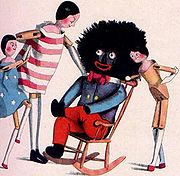
The "Golliwogg" was a character in children's books in the late 19th century and depicted as a type of rag doll
. It was reproduced, both by commercial and hobby toy-makers as a children's toy called the "golliwog", and had great popularity in North America
, the United Kingdom, Europe
and Australia
, into the 1960s. The doll has black skin, eyes rimmed in white, clown lips, and frizzy hair, and it has been described as the least known of the major anti-black caricatures in the United States
. While home-made golliwogs were sometimes female, the golliwog was generally male. For this reason, in the period following World War II
, the golliwog was seen, along with the teddy bear
, as a suitable soft toy for a young boy.
The image of the doll has become the subject of heated debate. One aspect of the debate in its favour argues that it should be preserved and passed on as a cherished cultural artifact and childhood tradition. At the same time, many argue that the golliwog is a destructive instance of racism
against people of African descent, along with pickaninnies, minstrels
, mammy
figures, and other caricatures. In recent years, changing political attitudes with regard to race have reduced the popularity and sale of golliwogs as toys. Manufacturers who have used golliwogs as a motif have either withdrawn them as an icon, or changed the name. There has been wide press coverage of incidents in which the term "golliwog" has been applied to a well-known personality. The association with the also-abusive "wog
" has resulted in many extant Golliwogs not being referred to as such, or being simply "Golly". Later it became popular as the "golly doll".
 There are differing versions of how the word "Golliwog" came into existence. One story is when the British soldiers were in Egypt in the 19th century, the Egyptian labourers working for the British Army were required to wear armbands with the letters W.O.G.S. indicating they were Working On Government Service and these labourers were called Ghuls (غول), an Arabic word for ghost, by the British soldiers.
Children of the Egyptians played with rag dolls of black stuffed material and the British (soldiers) bought them as gifts and took them back to England. The dolls were called Ghuliwogs and this word later became Golliwog.
Another version, with some similarities but one difference is also of the Egyptian laborers wearing the armbands with the letters W.O.G.S. The British soldiers in hilarity began calling them "wogs;" they (the Egyptian labourers) in turn then called the soldiers "Ghuls" and from these two words came the word "ghulwog" which in turn became ghuliwog, golliwog.
Florence Kate Upton
was born in 1873 in Flushing
, New York, the daughter of English parents who had emigrated to the United States three years previously. Following the death of her father, she moved back to England
with her mother and sisters when she was fourteen. There she spent several years drawing and developing her artistic skills. In order to afford tuition to art school, she illustrated a children's book entitled The Adventures of Two Dutch Dolls and a Golliwogg. The 1895 book included a character named the "Golliwogg," who was first described as "a horrid sight, the blackest gnome
", but who quickly turned out to be a friendly character, and is later attributed with a "kind face." A product of the blackface
minstrel
tradition, the character was classic "darkie" iconography
. The Golliwogg had jet black skin; bright, red lips; and wild, woolly hair. He wore red trousers, a shirt with a stiff collar, red bow-tie, and a blue jacket with tails — all traditional minstrel attire.
Upton's book and its many sequels were extremely successful in England, largely because of the popularity of the Golliwogg. Upton did not trademark her character, and its name, spelled "golliwog", became the generic name for dolls and images of a similar type. The golliwog doll became a popular children's toy throughout most of the 20th century, and was incorporated into many aspects of British commerce and culture; for instance, some of Enid Blyton
's books feature them, often as a villain and sometimes as heroes. Upton's Golliwogg was jovial, friendly and gallant, but some later golliwogs were sinister or menacing characters.
The golliwog contributed enormously to the spread of 'darky' iconography in Europe. It also made its way back across the Atlantic
in the form of children's literature, dolls, children's china and other toys, ladies' perfume, and jewellery.
British jam manufacturer James Robertson & Sons
used a golliwog called Golly as its mascot
from 1910, after John Robertson apparently saw children playing with golliwog dolls in America. Robertson's started producing promotional Golliwog badges in the 1920s, which could be obtained in exchange for tokens gained from their products. In 1983, the company's products were boycott
ed by the Greater London Council
as offensive, and in 1988 the character ceased to be used in television advertising. The company used to give away golliwog badges and small plaster figures playing musical instruments or sports and other such themes. The badge collection scheme was withdrawn in 2001.
In a statement reported by the BBC, Virginia (Ginny) C. Knox, previously brand director for Robertson's and later Chief Operating Officer of the Culinary Brands Division of RHM, told The Herald Newspaper
in Scotland in 2001 that the decision to remove the Golliwogg symbol from Robertson's jam and marmalade jars was taken after research found that children were not familiar with the character, although it still appealed to the older generations. "We sell 45 million jars of jam and marmalade each year and they have pretty much all got Golly on them," said Ms Knox. "We also sell 250,000 Golly badges to collectors and only get 10 letters a year from people who don't like the Golliwogg image." Today, Robertson's Golliwog badges remain highly collectible, with the very rarest sometimes selling for more than £1,000.
The noted art historian Sir Kenneth Clark claimed that the Golliwogs of his childhood were, ".. examples of chivalry, far more persuasive than the unconvincing Knights of the Arthurian legend." and the French composer Claude Debussy
named one movement of his Children's Corner Suite as "The Golliwog's Cakewalk."
, "golliwog" perhaps became "wog
," a racial slur applied to dark-skinned people worldwide, especially those with darker skin.
In Australia many young people of Greek, Italian, Lebanese
, Syrian and other Mediterranean descent have reclaimed the name "wog" as a humorous identifier. An example of this from popular Australian culture is the 2000 movie The Wog Boy
starring the actor Nick Giannopoulos
.
In the early 1980s, revised editions of Enid Blyton
's Noddy books replaced Mr. Golly, the golliwog proprietor of the Toytown garage, with Mr. Sparks.
In March 2007, Greater Manchester
Police seized two golliwogs from a shop after a complaint that the dolls were offensive. In September, 2007, retail chain Zara
put a T-shirt on sale in its UK stores with a Golliwog-looking little girl printed in the front. The design spurred controversy, coming only weeks after the company had been forced to pull a swastika
-emblazoned handbag from its shelves, although the swastika is also a religious symbol for Hindu
s and Buddhists.
In September 2008, Amanda Schofield from Stockport
claimed she was arrested for keeping a "golly doll" in her window. Greater Manchester Police denied this and said she was arrested after a series of complaints of alleged racially-aggravated behavior were made against her.
In February 2009, Carol Thatcher
, daughter of a former British Prime Minister, in an off-air conversation at the BBC
, referred to the black French tennis player Jo-Wilfried Tsonga, competing in the Australian Open
, as looking like a golliwog. The comment was considered by the BBC as "wholly unacceptable" and Thatcher was informed that unless she apologized she would no longer be a reporter on BBC's The One Show
. Thatcher stated that it was a silly joke and declined to make an "unconditional apology". Thatcher claimed that her comment was a reference to the golliwog motifs that she saw in her childhood on "jars of jam" (Robertson's Marmalade). In April 2009 she appeared on the BBC in an interview on The Andrew Marr Show for the first time since the scandal, defending her use of the word. The French publication Sportsweek claimed that Thatcher, in talking about a previous competition, referred to another player as "the one who was defeated by the golliwog in the previous tour." The French publication, which showed a picture of Tsonga above a picture of a toy golliwog, claimed that Thatcher was "mortified" and that her comment was about the similarity of Tsonga's appearance to the doll that she had as a child.
Rag doll
A rag doll is a children's toy. It is a cloth figure, a doll traditionally home-made from spare scraps of material. They are one of the most ancient children's toys in existence; the British Museum has a Roman rag doll, found in a child's grave dating from 300 BC.Rag dolls have featured in a...
. It was reproduced, both by commercial and hobby toy-makers as a children's toy called the "golliwog", and had great popularity in North America
Northern America
Northern America is the northernmost region of the Americas, and is part of the North American continent. It lies directly north of the region of Middle America; the land border between the two regions coincides with the border between the United States and Mexico...
, the United Kingdom, Europe
Europe
Europe is, by convention, one of the world's seven continents. Comprising the westernmost peninsula of Eurasia, Europe is generally 'divided' from Asia to its east by the watershed divides of the Ural and Caucasus Mountains, the Ural River, the Caspian and Black Seas, and the waterways connecting...
and Australia
Australia
Australia , officially the Commonwealth of Australia, is a country in the Southern Hemisphere comprising the mainland of the Australian continent, the island of Tasmania, and numerous smaller islands in the Indian and Pacific Oceans. It is the world's sixth-largest country by total area...
, into the 1960s. The doll has black skin, eyes rimmed in white, clown lips, and frizzy hair, and it has been described as the least known of the major anti-black caricatures in the United States
United States
The United States of America is a federal constitutional republic comprising fifty states and a federal district...
. While home-made golliwogs were sometimes female, the golliwog was generally male. For this reason, in the period following World War II
World War II
World War II, or the Second World War , was a global conflict lasting from 1939 to 1945, involving most of the world's nations—including all of the great powers—eventually forming two opposing military alliances: the Allies and the Axis...
, the golliwog was seen, along with the teddy bear
Teddy bear
The teddy bear is a stuffed toy bear. They are usually stuffed with soft, white cotton and have smooth and soft fur. It is an enduring form of a stuffed animal in many countries, often serving the purpose of entertaining children. In recent times, some teddy bears have become collector's items...
, as a suitable soft toy for a young boy.
The image of the doll has become the subject of heated debate. One aspect of the debate in its favour argues that it should be preserved and passed on as a cherished cultural artifact and childhood tradition. At the same time, many argue that the golliwog is a destructive instance of racism
Racism
Racism is the belief that inherent different traits in human racial groups justify discrimination. In the modern English language, the term "racism" is used predominantly as a pejorative epithet. It is applied especially to the practice or advocacy of racial discrimination of a pernicious nature...
against people of African descent, along with pickaninnies, minstrels
Minstrel show
The minstrel show, or minstrelsy, was an American entertainment consisting of comic skits, variety acts, dancing, and music, performed by white people in blackface or, especially after the Civil War, black people in blackface....
, mammy
Mammy archetype
The mammy archetype is perhaps one of the best-known archetypes of African American women. She is often portrayed within a narrative framework or other imagery as a domestic servant of African descent, generally good-natured, often overweight, very dark skinned, middle aged, and loud...
figures, and other caricatures. In recent years, changing political attitudes with regard to race have reduced the popularity and sale of golliwogs as toys. Manufacturers who have used golliwogs as a motif have either withdrawn them as an icon, or changed the name. There has been wide press coverage of incidents in which the term "golliwog" has been applied to a well-known personality. The association with the also-abusive "wog
Wog
Wog or Pog is a slang word with a number of meanings, generally considered derogatory and, in some instances, extremely offensive when used in relation to ethnicity...
" has resulted in many extant Golliwogs not being referred to as such, or being simply "Golly". Later it became popular as the "golly doll".
History
Children of the Egyptians played with rag dolls of black stuffed material and the British (soldiers) bought them as gifts and took them back to England. The dolls were called Ghuliwogs and this word later became Golliwog.
Another version, with some similarities but one difference is also of the Egyptian laborers wearing the armbands with the letters W.O.G.S. The British soldiers in hilarity began calling them "wogs;" they (the Egyptian labourers) in turn then called the soldiers "Ghuls" and from these two words came the word "ghulwog" which in turn became ghuliwog, golliwog.
Florence Kate Upton
Florence Kate Upton
Florence Kate Upton was an American-born English cartoonist and author most famous for her Golliwogg series of children's books.-Early life:Upton was born in Flushing, New York to recently emigrated British parents...
was born in 1873 in Flushing
Flushing, Queens
Flushing, founded in 1645, is a neighborhood in the north central part of the City of New York borough of Queens, east of Manhattan.Flushing was one of the first Dutch settlements on Long Island. Today, it is one of the largest and most diverse neighborhoods in New York City...
, New York, the daughter of English parents who had emigrated to the United States three years previously. Following the death of her father, she moved back to England
England
England is a country that is part of the United Kingdom. It shares land borders with Scotland to the north and Wales to the west; the Irish Sea is to the north west, the Celtic Sea to the south west, with the North Sea to the east and the English Channel to the south separating it from continental...
with her mother and sisters when she was fourteen. There she spent several years drawing and developing her artistic skills. In order to afford tuition to art school, she illustrated a children's book entitled The Adventures of Two Dutch Dolls and a Golliwogg. The 1895 book included a character named the "Golliwogg," who was first described as "a horrid sight, the blackest gnome
Gnome
A gnome is a diminutive spirit in Renaissance magic and alchemy, first introduced by Paracelsus and later adopted by more recent authors including those of modern fantasy literature...
", but who quickly turned out to be a friendly character, and is later attributed with a "kind face." A product of the blackface
Blackface
Blackface is a form of theatrical makeup used in minstrel shows, and later vaudeville, in which performers create a stereotyped caricature of a black person. The practice gained popularity during the 19th century and contributed to the proliferation of stereotypes such as the "happy-go-lucky darky...
minstrel
Minstrel show
The minstrel show, or minstrelsy, was an American entertainment consisting of comic skits, variety acts, dancing, and music, performed by white people in blackface or, especially after the Civil War, black people in blackface....
tradition, the character was classic "darkie" iconography
Blackface
Blackface is a form of theatrical makeup used in minstrel shows, and later vaudeville, in which performers create a stereotyped caricature of a black person. The practice gained popularity during the 19th century and contributed to the proliferation of stereotypes such as the "happy-go-lucky darky...
. The Golliwogg had jet black skin; bright, red lips; and wild, woolly hair. He wore red trousers, a shirt with a stiff collar, red bow-tie, and a blue jacket with tails — all traditional minstrel attire.
Upton's book and its many sequels were extremely successful in England, largely because of the popularity of the Golliwogg. Upton did not trademark her character, and its name, spelled "golliwog", became the generic name for dolls and images of a similar type. The golliwog doll became a popular children's toy throughout most of the 20th century, and was incorporated into many aspects of British commerce and culture; for instance, some of Enid Blyton
Enid Blyton
Enid Blyton was an English children's writer also known as Mary Pollock.Noted for numerous series of books based on recurring characters and designed for different age groups,her books have enjoyed huge success in many parts of the world, and have sold over 600 million copies.One of Blyton's most...
's books feature them, often as a villain and sometimes as heroes. Upton's Golliwogg was jovial, friendly and gallant, but some later golliwogs were sinister or menacing characters.
The golliwog contributed enormously to the spread of 'darky' iconography in Europe. It also made its way back across the Atlantic
Atlantic Ocean
The Atlantic Ocean is the second-largest of the world's oceanic divisions. With a total area of about , it covers approximately 20% of the Earth's surface and about 26% of its water surface area...
in the form of children's literature, dolls, children's china and other toys, ladies' perfume, and jewellery.
British jam manufacturer James Robertson & Sons
Robertson's
Robertson's is a UK brand of marmalades and jams that was owned by RHM until that company's takeover by Premier Foods in March 2007. It produces the "Golden Shred" marmalade among other products....
used a golliwog called Golly as its mascot
Mascot
The term mascot – defined as a term for any person, animal, or object thought to bring luck – colloquially includes anything used to represent a group with a common public identity, such as a school, professional sports team, society, military unit, or brand name...
from 1910, after John Robertson apparently saw children playing with golliwog dolls in America. Robertson's started producing promotional Golliwog badges in the 1920s, which could be obtained in exchange for tokens gained from their products. In 1983, the company's products were boycott
Boycott
A boycott is an act of voluntarily abstaining from using, buying, or dealing with a person, organization, or country as an expression of protest, usually for political reasons...
ed by the Greater London Council
Greater London Council
The Greater London Council was the top-tier local government administrative body for Greater London from 1965 to 1986. It replaced the earlier London County Council which had covered a much smaller area...
as offensive, and in 1988 the character ceased to be used in television advertising. The company used to give away golliwog badges and small plaster figures playing musical instruments or sports and other such themes. The badge collection scheme was withdrawn in 2001.
In a statement reported by the BBC, Virginia (Ginny) C. Knox, previously brand director for Robertson's and later Chief Operating Officer of the Culinary Brands Division of RHM, told The Herald Newspaper
The Herald (Glasgow)
The Herald is a broadsheet newspaper published Monday to Saturday in Glasgow, and available throughout Scotland. As of August 2011 it had an audited circulation of 47,226, giving it a lead over Scotland's other 'quality' national daily, The Scotsman, published in Edinburgh.The 1889 to 1906 editions...
in Scotland in 2001 that the decision to remove the Golliwogg symbol from Robertson's jam and marmalade jars was taken after research found that children were not familiar with the character, although it still appealed to the older generations. "We sell 45 million jars of jam and marmalade each year and they have pretty much all got Golly on them," said Ms Knox. "We also sell 250,000 Golly badges to collectors and only get 10 letters a year from people who don't like the Golliwogg image." Today, Robertson's Golliwog badges remain highly collectible, with the very rarest sometimes selling for more than £1,000.
The noted art historian Sir Kenneth Clark claimed that the Golliwogs of his childhood were, ".. examples of chivalry, far more persuasive than the unconvincing Knights of the Arthurian legend." and the French composer Claude Debussy
Claude Debussy
Claude-Achille Debussy was a French composer. Along with Maurice Ravel, he was one of the most prominent figures working within the field of impressionist music, though he himself intensely disliked the term when applied to his compositions...
named one movement of his Children's Corner Suite as "The Golliwog's Cakewalk."
Golliwog as racist insult
After the publication of Upton's first book, the term "golliwog" was used both as a reference to the children's toy and as a generic slang term for black people. In the UK and the CommonwealthCommonwealth
Commonwealth is a traditional English term for a political community founded for the common good. Historically, it has sometimes been synonymous with "republic."More recently it has been used for fraternal associations of some sovereign nations...
, "golliwog" perhaps became "wog
Wog
Wog or Pog is a slang word with a number of meanings, generally considered derogatory and, in some instances, extremely offensive when used in relation to ethnicity...
," a racial slur applied to dark-skinned people worldwide, especially those with darker skin.
In Australia many young people of Greek, Italian, Lebanese
Lebanese people
The Lebanese people are a nation and ethnic group of Levantine people originating in what is today the country of Lebanon, including those who had inhabited Mount Lebanon prior to the creation of the modern Lebanese state....
, Syrian and other Mediterranean descent have reclaimed the name "wog" as a humorous identifier. An example of this from popular Australian culture is the 2000 movie The Wog Boy
The Wog Boy
The Wog Boy is a 2000 Australian motion picture comedy starring Nick Giannopoulos, Vince Colosimo, Lucy Bell, Abi Tucker, John Barresi, Stephen Curry, Hung Le, Geraldine Turner, Tony Nikolakopoulos and Derryn Hinch. -Plot:...
starring the actor Nick Giannopoulos
Nick Giannopoulos
Nick Giannopoulos is a Australian stand-up comedian, film and TV actor. He is best known for his comedy stage show Wogs Out of Work alongside George Kapiniaris and the television sitcom Acropolis Now and is an exponent of wog comedy.-Early life:Nick is an actor/writer/producer/director...
.
In the early 1980s, revised editions of Enid Blyton
Enid Blyton
Enid Blyton was an English children's writer also known as Mary Pollock.Noted for numerous series of books based on recurring characters and designed for different age groups,her books have enjoyed huge success in many parts of the world, and have sold over 600 million copies.One of Blyton's most...
's Noddy books replaced Mr. Golly, the golliwog proprietor of the Toytown garage, with Mr. Sparks.
In March 2007, Greater Manchester
Greater Manchester
Greater Manchester is a metropolitan county in North West England, with a population of 2.6 million. It encompasses one of the largest metropolitan areas in the United Kingdom and comprises ten metropolitan boroughs: Bolton, Bury, Oldham, Rochdale, Stockport, Tameside, Trafford, Wigan, and the...
Police seized two golliwogs from a shop after a complaint that the dolls were offensive. In September, 2007, retail chain Zara
Zara (clothing)
Zara is a Spanish clothing and accessories retailer based in Arteixo, Galicia, and founded in 1975 by Amancio Ortega and Rosalía Mera. It is the flagship chain store of the Inditex group; the fashion group also owns brands such as Massimo Dutti, Pull and Bear, Oysho, Uterqüe, Stradivarius and...
put a T-shirt on sale in its UK stores with a Golliwog-looking little girl printed in the front. The design spurred controversy, coming only weeks after the company had been forced to pull a swastika
Swastika
The swastika is an equilateral cross with its arms bent at right angles, in either right-facing form in counter clock motion or its mirrored left-facing form in clock motion. Earliest archaeological evidence of swastika-shaped ornaments dates back to the Indus Valley Civilization of Ancient...
-emblazoned handbag from its shelves, although the swastika is also a religious symbol for Hindu
Hindu
Hindu refers to an identity associated with the philosophical, religious and cultural systems that are indigenous to the Indian subcontinent. As used in the Constitution of India, the word "Hindu" is also attributed to all persons professing any Indian religion...
s and Buddhists.
In September 2008, Amanda Schofield from Stockport
Stockport
Stockport is a town in Greater Manchester, England. It lies on elevated ground southeast of Manchester city centre, at the point where the rivers Goyt and Tame join and create the River Mersey. Stockport is the largest settlement in the metropolitan borough of the same name...
claimed she was arrested for keeping a "golly doll" in her window. Greater Manchester Police denied this and said she was arrested after a series of complaints of alleged racially-aggravated behavior were made against her.
In February 2009, Carol Thatcher
Carol Thatcher
Carol Thatcher is a British journalist, author and media personality. She is the daughter of Margaret Thatcher, Baroness Thatcher, a former British Prime Minister, and Sir Denis Thatcher, Bt....
, daughter of a former British Prime Minister, in an off-air conversation at the BBC
BBC
The British Broadcasting Corporation is a British public service broadcaster. Its headquarters is at Broadcasting House in the City of Westminster, London. It is the largest broadcaster in the world, with about 23,000 staff...
, referred to the black French tennis player Jo-Wilfried Tsonga, competing in the Australian Open
Australian Open
The Australian Open is the only Grand Slam tennis tournament held in the southern hemisphere. The tournament was held for the first time in 1905 and was last contested on grass in 1987. Since 1972 the Australian Open has been held in Melbourne, Victoria. In 1988, the tournament became a hard court...
, as looking like a golliwog. The comment was considered by the BBC as "wholly unacceptable" and Thatcher was informed that unless she apologized she would no longer be a reporter on BBC's The One Show
The One Show
The One Show is a topical magazine-style daily television programme broadcast live on BBC One and BBC One HD, hosted by Alex Jones and Matt Baker. Chris Evans joins Jones to present the programme on Friday...
. Thatcher stated that it was a silly joke and declined to make an "unconditional apology". Thatcher claimed that her comment was a reference to the golliwog motifs that she saw in her childhood on "jars of jam" (Robertson's Marmalade). In April 2009 she appeared on the BBC in an interview on The Andrew Marr Show for the first time since the scandal, defending her use of the word. The French publication Sportsweek claimed that Thatcher, in talking about a previous competition, referred to another player as "the one who was defeated by the golliwog in the previous tour." The French publication, which showed a picture of Tsonga above a picture of a toy golliwog, claimed that Thatcher was "mortified" and that her comment was about the similarity of Tsonga's appearance to the doll that she had as a child.
Other meanings and in popular culture
- According to an editorial in The Times newspaper golliwogs were banned in Germany in 1934, on the grounds they were inappropriate toys for Aryan children.
- "Golliwog" was World War II British naval slang for a GauloisesGauloisesGauloises is a brand of cigarette of French manufacture. It is produced by the company Imperial Tobacco following their acquisition of Altadis in January 2008.- Cigarette :...
cigarette, which had tobacco that was nearly black in color. It is also however possible that the etymology came from a mispronounciation of "Gauloises" -> "golwas" -> "golleys", with the last syllable retrofitted by way of a folk etymology. - Golliwog is the former name of a popular line of cocoa biscuits in Australia, released by Arnott's in the 1960s. as they were made in the shape of a popular toy. Arnott's changed the name in the mid-1990s. The new name was chosen by the three-year-old daughter of one of the product developers. When her father asked her what she thought the biscuit should be called, she said Scalliwag, and the name has stuck.
- "Golliwog"Golliwog (song)"Golliwog" was one of the first attempts by Agnetha Fältskog to enter the charts outside Sweden. The eight German-language music singles she released didn't enter the charts...
is a solo single by ABBAABBAABBA was a Swedish pop group formed in Stockholm in 1970 which consisted of Anni-Frid Lyngstad, Björn Ulvaeus, Benny Andersson and Agnetha Fältskog...
member Agnetha FältskogAgnetha FältskogAgnetha Åse Fältskog is a Swedish recording artist. She achieved success in Sweden after the release of her début album Agnetha Fältskog in 1968, and reached international stardom as a member of the pop group ABBA, which to date has sold over 375 million records worldwide, making it the fourth...
from 1974. - A Golliwog features heavily in the pseudo-biographical novel Caucasia, by American author Danzy SennaDanzy Senna-Biography:Danzy Senna was born in Boston, Massachusetts, the middle child of three children. Her mother is the Anglo-American poet and novelist Fanny Howe. Her father is the African-American writer and journalist, Carl Senna, author of The Black Press and the Struggle for Civil Rights and The...
. - Golliwogg's Cakewalk is Part 6 of Children's CornerChildren's CornerChildren's Corner is a six-movement suite for solo piano by Claude Debussy. It was published by Durand in 1908, and was given its world première in Paris by Harold Bauer on December 18 of that year...
(L. 113), a piano suite by Claude DebussyClaude DebussyClaude-Achille Debussy was a French composer. Along with Maurice Ravel, he was one of the most prominent figures working within the field of impressionist music, though he himself intensely disliked the term when applied to his compositions...
. - The GolliwogsThe GolliwogsThe Golliwogs were an American rock band that eventually became Creedence Clearwater Revival.The band started out, in 1959, as an instrumental trio called The Blue Velvets. The original line up was John Fogerty , Stu Cook , and Doug Clifford...
was the original name of American rock band Creedence Clearwater RevivalCreedence Clearwater RevivalCreedence Clearwater Revival was an American rock band that gained popularity in the late 1960s and early 1970s with a number of successful singles drawn from various albums....
. - "The Galley-Wag", modelled after Upton's Golliwogg, is a pivotal character at the end of The League of Extraordinary Gentlemen: Black DossierThe League of Extraordinary Gentlemen: Black DossierThe League of Extraordinary Gentlemen: Black Dossier is an original graphic novel in the comic book series The League of Extraordinary Gentlemen, written by Alan Moore and illustrated by Kevin O'Neill. It was the last volume of the series to be published by DC Comics. Although the third book to be...
. This graphic novel imagines a world inhabited by a wide variety of fictional characters, especially from Victorian England. The Galley-Wag is portrayed as an extra-dimensional creature made of dark matterDark matterIn astronomy and cosmology, dark matter is matter that neither emits nor scatters light or other electromagnetic radiation, and so cannot be directly detected via optical or radio astronomy...
and a captain of a balloon airship. His crew consists of two female Dutch puppets, who are heavily sexualized versions of the characters from Upton's book. - Various golliwog-like images appear on rap group KMDKMDKMD was an American hip hop trio in the early 1990s, best known for launching the career of acclaimed rapper and producer MF DOOM, who at the time was known as Zev Love X. Other members of the group were Rodan and DJ Subroc–Zev Love X's younger brother...
's albums Black Bastards (2001) and Best of KMD (2003), and most recently in (2010) where the golliwog image appears splattered across the face of rapper Kanye West. - In the British comedy series "Extras," Maggie brings her date, a black man, to her apartment then realizes there is a golliwog on her shelf and tries to hide it.
See also
- Black dollsBlack dollsA black doll is a dark-colored inanimate representation of a dark-skinned person. Representations, both stereotypical and accurate, fashioned into playthings, date back centuries...
- Golly BarGolly BarGolly Bar is an ice cream snack formerly sold in The Republic of Ireland. It is a white vanilla ice cream on a wooden stick. The packaging originally contained an image of a Golliwogg. The name was changed to Giant Bars which are still available. Category:Brand name frozen desserts...
- InkiInkiInki is the lead character in an animated cartoon series of Warner Bros. Looney Tunes and Merrie Melodies short films by animator Chuck Jones....
- Little Black SamboLittle Black SamboThe Story of Little Black Sambo is a children's book written and illustrated by Helen Bannerman, and first published by Grant Richards in October 1899 as one in a series of small-format books called The Dumpy Books for Children....
- Papa LazarouPapa LazarouPapa Lazarou is a fictional character in the BBC TV comedy programme The League of Gentlemen.He appeared in two episodes, a Christmas special, and the film The League of Gentlemen's Apocalypse. The character is part written by and played by Reece Shearsmith.Papa Lazarou has been listed as both the...
- Sambo's Restaurant ChainSambo'sSambo's is a restaurant, formerly an American restaurant chain, started in 1957 by Sam Battistone Sr and Newell Bohnett. Though the name was taken from portions of the names of its founders, the chain soon found itself associated with The Story of Little Black Sambo...
- Zwarte PietZwarte PietIn the folklore and legends of the Netherlands and Belgium, Zwarte Piet is a companion of Saint Nicholas whose yearly feast in the Netherlands is usually celebrated on the evening of 5 December In the folklore and legends of the Netherlands and Belgium, Zwarte Piet (meaning Black Pete) is a...
External links
- "The Adventures of Two Dutch Dolls and a Golliwogg" by Bertha Upton 1895 at Project Gutenberg
- "Golliwogg.co.uk" An independent guide to Golliwogs
- "The Golliwog Caricature," Jim Crow Museum of Racist Memorabilia Article by David Pilgrim, Ferris State University, Michigan
- "Gollydownunder.com" A brief history of Golliwogs
- "Gollyworld" Information on Robertsons Golly Badges
- Clean plates GOLIWOG license plate
- BBC News – Row erupts over golly exhibition 13/01/07
- The Daily Mirror – Carol Thatcher's (Golliwog) slurs on (tennis player) Jo-Wilfried Tsonga 2009-07-02