


Black dolls

Encyclopedia
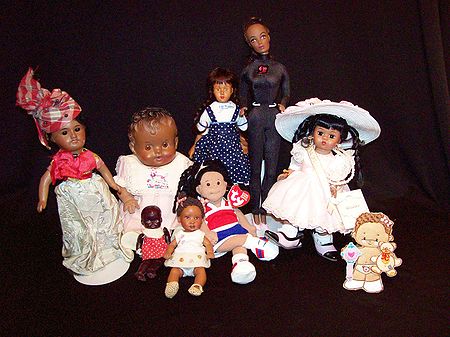
Media used to create black dolls include cloth, papier-mâché, paper, china, wood, bisque, composition
Composition doll
A composition doll is a doll made partially or wholly out of composition, a composite material composed of sawdust, glue, and other materials such as cornstarch, resin and wood flour. Composition dolls were marketed as unbreakable and hailed as an improvement in doll making from the fragile bisque...
, hard plastic, vinyl, resin, porcelain, silicone, and polymer clay. Cloth rag dolls made by American slaves served as playthings for slave children. Early mass-produced black dolls were typically dark versions of their white counterparts.
Several 19th century European doll companies preceded American doll companies in manufacturing black dolls. These predecessors include Carl Bergner of Germany, who made a three-faced doll with one face a crying black child and the other two, happier white faces. In 1892, Jumeau
Jumeau Dolls
Jumeau was a French company, founded in the early 1840s, which designed and manufactured high quality bisque dolls. It was founded by Louis-Desire Belton and Pierre-François Jumeau in the Maison Jumeau of Montreuil-sous-Bois, near Paris, France...
of Paris advertised black and mulatto dolls with bisque
Bisque doll
A bisque doll or porcelain doll is a doll made partially or wholly out of bisque porcelain. Bisque dolls are characterized by their realistic, skin-like matte finish. They had their peak of popularity between 1860 and 1900 with French and German dolls. Bisque dolls are collectible, and antique...
heads. Gebruder Heubach of Germany made character faces in bisque. Other European doll makers include Bru Jne. & Cie of Paris, Steiner, Danel, Société Française de Fabrication de Bébés et Jouets
Société Française de Fabrication de Bébés et Jouets
The Société Française de Fabrication de Bébés et Jouets was a large doll making consortium founded in France by the union of a number of major French doll companies including Jumeau and Bru and the Franco-German doll company Fleischmann and Bloedel in 1899. The company went out of business in the...
(S.F.B.J.), and Kestner of Germany. American companies began including black dolls in their doll lines in the early 1900s. Between 1910 and 1930, Horsman, Vogue, and Madame Alexander included black dolls in their doll lines. Gradually other American companies followed suit.
Beatrice Wright Brewington, an African American entrepreneur, founded B. Wright's Toy Company, Inc. and mass produced black dolls with ethnically correct features. Also an educator, Wright began instructing girls in the art of making dolls in 1955.
During the 1960s and in the aftermath of the Watts Riots
Watts Riots
The Watts Riots or the Watts Rebellion was a civil disturbance in the Watts neighborhood of Los Angeles, California from August 11 to August 15, 1965. The 5-day riot resulted in 34 deaths, 1,032 injuries, and 3,438 arrests...
in Los Angeles, California, Shindana Toys
Shindana Toys
Shindana Toys, a division of Operation Bootstrap, Inc., was a South Central Los Angeles, California cooperative toy company formed in 1968, one of many Operation Bootstrap initiatives undertaken following the 1965 Watts Riots. Company proceeds supported businesses in the Watts area. Shindana ...
, a Division of Operation Bootstrap, Inc., is credited as the first major doll company to mass produce ethnically-correct black dolls. certainly in the United States. Their "dolls made by a dream" with realistic African facial features remain popular amongst black-doll collectors.
Other popular collectible black dolls include manufactured play dolls past and current, manufactured dolls designed for collectors by companies such as Madame Alexander
Madame Alexander
Madame Alexander is a brand of American collectible dolls introduced in 1923.Madame Alexander is also the business name of Beatrice Alexander, who was born Bertha Alexander, later changed her name to Beatrice, married Philip Behrman and then started her doll business...
and Tonner Doll
Tonner Doll Company, Inc.
Tonner Doll Company, Inc. is a collectible doll design and distribution company located in Hurley, New York. Founded by Robert Tonner in 1991, Tonner Doll designs and markets original doll lines as well as a number of licensed dolls for movies such as Harry Potter, Spider-Man 3, and Twilight...
, artist dolls, one-of-a-kind dolls, portrait dolls and those representing historical figures, reborn
Reborn
Reborn may refer to:*Reborn, a Digital Creative Agency in Sydney, Australia*Reborn!, a manga series and a character in the manga*Reborn , a novel by F...
dolls, and paper dolls
Paper Dolls
Paper Dolls is an American prime time soap opera which aired for 14 episodes on ABC from September 23, 1984 to December 25, 1984. Set in New York's fashion industry, the show centered around top modeling agency owner Racine , her conflicts with the family of cosmetics tycoon Grant Harper , and the...
.
Further reading
- Collectible Black Dolls by John Axe, Hobby House Press, 1978
- Collector's Encyclopedia of Black Dolls by Patikii Gibbs, Collector Books, 1987
- Black Dolls an Identification and Value Guide 1820-1991 by Myla Perkins, Collector Books, 1991
- Black Dolls an Identification and Value Guide Book II by Myla Perkins, Collector Books, 1995
- The Definitive Guide to Collecting Black Dolls by Debbie Behan Garrett, Hobby House Press, 2003
- Black Dolls Proud, Bold & Beautiful by Nayda Rondon, Reverie Press, 2004
- Collectible African American Dolls Identification and Values by Yvonne Ellis, Collector Books, 2008
- Black Dolls: A Comprehensive Guide to Celebrating Collecting and Experiencing the Passion by Debbie Behan Garrett, 2008