

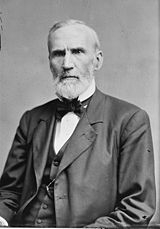
George Washington Julian

Encyclopedia
George Washington Julian (May 5, 1817 – July 7, 1899) was a nineteenth century politician
, lawyer
and writer
who served in Congress
from Indiana
. He was the son-in-law of Joshua Reed Giddings
.
, Julian received a common school education. He studied law, was admitted to the bar in 1840 and practiced out of Greenfield, Indiana
. He started to take part in politics and was elected a Whig
to the Indiana House of Representatives
in 1845. Julian, who was raised a Quaker, started to question slavery
. He helped found the Free Soil Party
in 1848. He was a delegate to the convention in Buffalo, New York
and the same year was elected to the United States House of Representatives
, thirty-first congress
. In 1852, the free-soilers nominated Julian for the vice-presidency
. John P. Hale
was the presidential
candidate. The two did not win any electoral votes, but received 155,210 popular votes. He was a delegate to the convention in Pittsburgh, Pennsylvania
and to the 1856 Republican National Convention
where he was its vice president and chairman of the committee on organization. In 1860, he was elected a Republican
to the thirty-seventh congress
, winning reelection to the thirty-eighth
, thirty-ninth
, fortieth
and forty-first
. As early as 1847, Julian espoused the cause of women's suffrage
and in 1868 proposed to congress a constitutional amendment conferring the right to vote on women. He was the chairman of the Committee on Public Lands
1863 to 1871 and chairman of the Expenditures in the Navy Department
1865 to 1867. He joined the Liberal Republicans
in 1872 and supported Horace Greeley
for the presidency. In the election
, Julian received five electoral votes for the vice-presidency
. President
Grover Cleveland
appointed Julian surveyor general
of New Mexico
in May, 1885 which he served until September, 1889. Afterwards, he settled in Irvington, Indiana and focused on literary pursuits, writing for magazines and newspapers. He died July 7, 1899 in Irvington and was interred in Crown Hill Cemetery
in Indianapolis, Indiana
.
Politician
A politician, political leader, or political figure is an individual who is involved in influencing public policy and decision making...
, lawyer
Lawyer
A lawyer, according to Black's Law Dictionary, is "a person learned in the law; as an attorney, counsel or solicitor; a person who is practicing law." Law is the system of rules of conduct established by the sovereign government of a society to correct wrongs, maintain the stability of political...
and writer
Writer
A writer is a person who produces literature, such as novels, short stories, plays, screenplays, poetry, or other literary art. Skilled writers are able to use language to portray ideas and images....
who served in Congress
United States House of Representatives
The United States House of Representatives is one of the two Houses of the United States Congress, the bicameral legislature which also includes the Senate.The composition and powers of the House are established in Article One of the Constitution...
from Indiana
Indiana
Indiana is a US state, admitted to the United States as the 19th on December 11, 1816. It is located in the Midwestern United States and Great Lakes Region. With 6,483,802 residents, the state is ranked 15th in population and 16th in population density. Indiana is ranked 38th in land area and is...
. He was the son-in-law of Joshua Reed Giddings
Joshua Reed Giddings
Joshua Reed Giddings was an American statesman and a prominent opponent of slavery. He represented Ohio in the U.S. House of Representatives from 1838-59. He was at first a member of the Whig Party and was later a Republican.-Life:He was born at Tioga Point, now Athens, Bradford County,...
.
Biography
Born in Centerville, IndianaCenterville, Indiana
Centerville is a town in Center Township, Wayne County, Indiana, United States. The population was 2,552 at the 2010 census.-Geography:Centerville is located at , at an altitude of 1,014 feet . U.S...
, Julian received a common school education. He studied law, was admitted to the bar in 1840 and practiced out of Greenfield, Indiana
Greenfield, Indiana
-Demographics:As of the census of 2000, there were 14,600 people, 5,917 households, and 4,017 families residing in the city. The population density was 1,818.0 people per square mile . There were 6,449 housing units at an average density of 803.0 per square mile...
. He started to take part in politics and was elected a Whig
Whig Party (United States)
The Whig Party was a political party of the United States during the era of Jacksonian democracy. Considered integral to the Second Party System and operating from the early 1830s to the mid-1850s, the party was formed in opposition to the policies of President Andrew Jackson and his Democratic...
to the Indiana House of Representatives
Indiana House of Representatives
The Indiana House of Representatives is the lower house of the Indiana General Assembly, the state legislature of the U.S. state of Indiana. The House is composed of 100 members representing an equal number of constituent districts. House members serve two-year terms without term limits...
in 1845. Julian, who was raised a Quaker, started to question slavery
Slavery
Slavery is a system under which people are treated as property to be bought and sold, and are forced to work. Slaves can be held against their will from the time of their capture, purchase or birth, and deprived of the right to leave, to refuse to work, or to demand compensation...
. He helped found the Free Soil Party
Free Soil Party
The Free Soil Party was a short-lived political party in the United States active in the 1848 and 1852 presidential elections, and in some state elections. It was a third party and a single-issue party that largely appealed to and drew its greatest strength from New York State. The party leadership...
in 1848. He was a delegate to the convention in Buffalo, New York
Buffalo, New York
Buffalo is the second most populous city in the state of New York, after New York City. Located in Western New York on the eastern shores of Lake Erie and at the head of the Niagara River across from Fort Erie, Ontario, Buffalo is the seat of Erie County and the principal city of the...
and the same year was elected to the United States House of Representatives
United States House of Representatives
The United States House of Representatives is one of the two Houses of the United States Congress, the bicameral legislature which also includes the Senate.The composition and powers of the House are established in Article One of the Constitution...
, thirty-first congress
31st United States Congress
The Thirty-first United States Congress was a meeting of the legislative branch of the United States federal government, consisting of the United States Senate and the United States House of Representatives. It met in Washington, D.C. from March 4, 1849 to March 3, 1851, during the last 17 months...
. In 1852, the free-soilers nominated Julian for the vice-presidency
Vice President of the United States
The Vice President of the United States is the holder of a public office created by the United States Constitution. The Vice President, together with the President of the United States, is indirectly elected by the people, through the Electoral College, to a four-year term...
. John P. Hale
John P. Hale
John Parker Hale was an American politician and lawyer from New Hampshire. He served in the United States House of Representatives from 1843 to 1845 and in the United States Senate from 1847 to 1853 and again from 1855 to 1865. He was the first senator to make a stand against slavery...
was the presidential
President of the United States
The President of the United States of America is the head of state and head of government of the United States. The president leads the executive branch of the federal government and is the commander-in-chief of the United States Armed Forces....
candidate. The two did not win any electoral votes, but received 155,210 popular votes. He was a delegate to the convention in Pittsburgh, Pennsylvania
Pittsburgh, Pennsylvania
Pittsburgh is the second-largest city in the US Commonwealth of Pennsylvania and the county seat of Allegheny County. Regionally, it anchors the largest urban area of Appalachia and the Ohio River Valley, and nationally, it is the 22nd-largest urban area in the United States...
and to the 1856 Republican National Convention
1856 Republican National Convention
The 1856 Republican National Convention convened from June 17 to June 19, 1856 at the Musical Fund Hall in Philadelphia, Pennsylvania, United States, and nominated General John C. Frémont of California and former Senator William Dayton of New Jersey for President and Vice President of the United...
where he was its vice president and chairman of the committee on organization. In 1860, he was elected a Republican
Republican Party (United States)
The Republican Party is one of the two major contemporary political parties in the United States, along with the Democratic Party. Founded by anti-slavery expansion activists in 1854, it is often called the GOP . The party's platform generally reflects American conservatism in the U.S...
to the thirty-seventh congress
37th United States Congress
The Thirty-seventh United States Congress was a meeting of the legislative branch of the United States federal government, consisting of the United States Senate and the United States House of Representatives. It met in Washington, D.C. from March 4, 1861 to March 4, 1863, during the first two...
, winning reelection to the thirty-eighth
38th United States Congress
-House of Representatives:Before this Congress, the 1860 United States Census and resulting reapportionment changed the size of the House to 241 members...
, thirty-ninth
39th United States Congress
The Thirty-ninth United States Congress was a meeting of the legislative branch of the United States federal government, consisting of the United States Senate and the United States House of Representatives. It met in Washington, D.C. from March 4, 1865 to March 4, 1867, during the first month of...
, fortieth
40th United States Congress
The Fortieth United States Congress was a meeting of the legislative branch of the United States federal government, consisting of the United States Senate and the United States House of Representatives. It met in Washington, D.C. from March 4, 1867 to March 4, 1869, during the third and fourth...
and forty-first
41st United States Congress
-House of Representatives:- Senate :* President : Schuyler Colfax* President pro tempore: Henry B. Anthony - House of Representatives :* Speaker: James G. Blaine -Members:This list is arranged by chamber, then by state...
. As early as 1847, Julian espoused the cause of women's suffrage
Women's suffrage
Women's suffrage or woman suffrage is the right of women to vote and to run for office. The expression is also used for the economic and political reform movement aimed at extending these rights to women and without any restrictions or qualifications such as property ownership, payment of tax, or...
and in 1868 proposed to congress a constitutional amendment conferring the right to vote on women. He was the chairman of the Committee on Public Lands
United States House Committee on Resources
The U.S. House Committee on Natural Resources, or Natural Resources Committee is a Congressional committee of the United States House of Representatives. Originally called the "Committee on Interior & Insular Affairs," the name was changed to the Natural Resources Committee in 1993...
1863 to 1871 and chairman of the Expenditures in the Navy Department
United States House Committee on Government Reform
The Committee on Oversight and Government Reform is a United States House of Representatives committee that has existed in varying forms since 1816....
1865 to 1867. He joined the Liberal Republicans
Liberal Republican Party (United States)
The Liberal Republican Party of the United States was a political party that was organized in Cincinnati in May 1872, to oppose the reelection of President Ulysses S. Grant and his Radical Republican supporters. The party's candidate in that year's presidential election was Horace Greeley, longtime...
in 1872 and supported Horace Greeley
Horace Greeley
Horace Greeley was an American newspaper editor, a founder of the Liberal Republican Party, a reformer, a politician, and an outspoken opponent of slavery...
for the presidency. In the election
United States presidential election, 1872
In the United States presidential election of 1872, incumbent President Ulysses S. Grant was easily elected to a second term in office with Senator Henry Wilson of Massachusetts as his running mate, despite a split within the Republican Party that resulted in a defection of many Liberal Republicans...
, Julian received five electoral votes for the vice-presidency
Vice President of the United States
The Vice President of the United States is the holder of a public office created by the United States Constitution. The Vice President, together with the President of the United States, is indirectly elected by the people, through the Electoral College, to a four-year term...
. President
President of the United States
The President of the United States of America is the head of state and head of government of the United States. The president leads the executive branch of the federal government and is the commander-in-chief of the United States Armed Forces....
Grover Cleveland
Grover Cleveland
Stephen Grover Cleveland was the 22nd and 24th president of the United States. Cleveland is the only president to serve two non-consecutive terms and therefore is the only individual to be counted twice in the numbering of the presidents...
appointed Julian surveyor general
Surveyor General
The Surveyor General is an official responsible for government surveying in a specific country or territory. Originally this would often have been a military appointment, but is now more likely to be a civilian post....
of New Mexico
New Mexico
New Mexico is a state located in the southwest and western regions of the United States. New Mexico is also usually considered one of the Mountain States. With a population density of 16 per square mile, New Mexico is the sixth-most sparsely inhabited U.S...
in May, 1885 which he served until September, 1889. Afterwards, he settled in Irvington, Indiana and focused on literary pursuits, writing for magazines and newspapers. He died July 7, 1899 in Irvington and was interred in Crown Hill Cemetery
Crown Hill Cemetery
Crown Hill Cemetery, located at 700 West 38th Street in Indianapolis, is the third largest non-governmental cemetery in the United States at . It contains of paved road, over 150 species of trees and plants, over 185,000 graves, and services roughly 1,500 burials per year. It sits on the highest...
in Indianapolis, Indiana
Indianapolis, Indiana
Indianapolis is the capital of the U.S. state of Indiana, and the county seat of Marion County, Indiana. As of the 2010 United States Census, the city's population is 839,489. It is by far Indiana's largest city and, as of the 2010 U.S...
.
Works
- The Rebellion, The Mistakes of the Past, The Duty of the Present (1863)
- Homesteads for Soldiers on the Lands of Rebels (1864)
- Sale of Mineral Lands (1865)
- The Rights of Pre-emptors on the Public Lands of the Government Threatened, The Conspiracy Exposed (1866)
- Suffrage in the District of Columbia (1866)
- Regeneration before Reconstruction (1867)
- Speeches on Political Questions (1872)
- Political Recollections (1884)
- The Rank of Charles Osborn as an Anti-slavery Pioneer (1891)
- The Life of Joshua R. Giddings (1892)