

Forficula auricularia

Encyclopedia
Forficula auricularia, the common earwig or European earwig, is an omnivorous insect
in the family Forficulidae
. The European earwig
is a common household insect in North America. Though they frighten many, they are harmless but tend to take up habitation
within the home. The name "earwig" comes from the rumor that these insects crawl into human ears and enter the brain, but this is false. However, there have been cases of earwigs wandering into ears by mistake. F. auricularia is a species that nurses their young and has survived in a variety of environments.
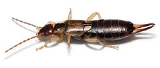
.jpg) Forficula auricularia has an elongated flattened brownish colored body, with a shield-shaped pronotum, two pairs of wings and a pair of forcep-like cerci. They are about 12–15 mm long. The second tarsal segment is lobed, extending distally below the third tarsal segment. The antenna consists of 11–14 segments, and the mouth parts are of the chewing type.
Forficula auricularia has an elongated flattened brownish colored body, with a shield-shaped pronotum, two pairs of wings and a pair of forcep-like cerci. They are about 12–15 mm long. The second tarsal segment is lobed, extending distally below the third tarsal segment. The antenna consists of 11–14 segments, and the mouth parts are of the chewing type.
Adult males are polymorphic
in body weight and head width, as well as cercus length and width. The male forceps are very robust and broadened basally with crenulate teeth. The female forceps are about 3 mm long, and are less robust and straighter. The cerci are used during mating, feeding, and self-defense. Females also have tegmina
of about 2 mm in length. Third instar
or older nymphs
that have lost one branch of cerci are capable of regenerating it in form of a straight structure. Males with asymmetrical forceps are called gynandromorph
s or hermaphrodite
s because they resemble females.
in the early twentieth century and is currently spread throughout much of the continent. In North America, European earwigs comprise two sibling species
, which are reproductively isolated
. Populations in cold continental climates mostly have one clutch
per year, forming species A, whereas those in warmer climates have two clutches per year, forming species B. European earwigs are most commonly found in temperate
climates, since they were originally discovered in the Palearctic
region, and are most active when the daily temperature has minimal fluctuation.
s, spider
s, insect eggs, dead plants and insects, among other things. Their favorite plants include the common crucifer Sisymbrium officinale, the white clover Trifolium repens, and the dahlia Dahlia variabilis. They also like to feed on molasses and lower forms of plants, such as lichens and algae. They prefer meat or sugar to natural plant material even though plants are a major natural food source. European earwigs prefer aphids to plant material such as leaves and fruit slices of apple, cherry and pear. Adults eat more insects than do nymphs.
Although F. auricularia have well-developed wings, they are fairly weak and are rarely, if ever, used. Instead, as their main form of transportation, earwigs are carried from one place to another on clothing or commercial products like lumber, ornamental shrubs and even newspaper bundles.
. He then slips his cerci under the tip of the female's abdomen so that his and her ventral abdominal surfaces are in contact with each other, while both face in opposite directions. If not disturbed, pairs can stay in this mating position for many hours. Matings occurred frequently among clustered individuals particularly in locations that allow both partners to cling to a surface. Under laboratory conditions, the mating season peaked during August and September, and a single mating event enabled females to lay fertilized eggs.
.
about 5 mm below the surface of the ground. The female earwig lays a clutch of about 50 eggs
in an underground nest in the autumn. She enters a dormant state and stays in the nest with the eggs. The female cares for her young by shifting the eggs about and cleaning them to avoid fungal growth. In the spring, she spreads them out into a single layer and the young emerge from the eggs. She guards them until they reach maturity after about one month. It is possible for the female to lay a second brood in one season and by the end of August all of the young reach maturity.
of European earwigs also depends on temperature. Thus, the occurrence of European earwigs can be predicted based on weather parameters. Hibernating adults can tolerate cool temperatures, but their survival is reduced in poorly drained soils such as clay. To avoid excessive moisture, they seek the southern side of well drained slopes. Sometimes they also occupy the hollow stems of flowers where the soil is poorly drained. Their eggs are capable of resisting damage from cold and heat.
In addition to all of the agricultural problems caused, humans are not very fond of F. auricularia because of its foul odor and annoying propensity to aggregate together in or near human dwellings.
Control of F. auricularia has been attempted using some of its natural enemies, including the parasitoid
fly Bigonicheta spinipenni, the fungi Erynia forficulae and Metarhizium anisopliae
, as well as many species of birds. Insecticides have also been successfully implemented, although commercial products are rarely targeted specifically towards earwigs. Multipurpose insecticide
s for control of earwigs, grasshoppers, sowbugs and other insects are more common. Diazinon
, an organophosphate
insecticide, has been known to continue killing F. auricularia up to 17 days after initial spraying .
Humans have, however, found beneficial uses of F. auricularia in the pest management of other insects. The European earwig is a natural predator of a number of other agricultural pests, including the pear psyllid and several aphid species, and in this regard has been used to control outbreaks of such organisms. Damage to crops by F. auricularia is limited as long as there are high population levels of their insect prey.
Insect
Insects are a class of living creatures within the arthropods that have a chitinous exoskeleton, a three-part body , three pairs of jointed legs, compound eyes, and two antennae...
in the family Forficulidae
Forficulidae
Forficulidae is a family of earwigs, in the suborder Forficulina in the order Dermaptera.Species in this include Forficula auricularia and Apterygida media ....
. The European earwig
Earwig
Earwigs make up the insect order Dermaptera, found throughout the Americas, Africa, Eurasia, Australia and New Zealand. With 1,800 species in 12 families, they are one of the smaller insect orders...
is a common household insect in North America. Though they frighten many, they are harmless but tend to take up habitation
Dwelling
Dwelling, as well as being a term for a house, or for living somewhere, or for lingering somewhere, is a philosophical concept which was developed by Martin Heidegger. Dwelling is about making yourself at home where the home itself is a building that is a house...
within the home. The name "earwig" comes from the rumor that these insects crawl into human ears and enter the brain, but this is false. However, there have been cases of earwigs wandering into ears by mistake. F. auricularia is a species that nurses their young and has survived in a variety of environments.
Morphology
Adult males are polymorphic
Polymorphism (biology)
Polymorphism in biology occurs when two or more clearly different phenotypes exist in the same population of a species — in other words, the occurrence of more than one form or morph...
in body weight and head width, as well as cercus length and width. The male forceps are very robust and broadened basally with crenulate teeth. The female forceps are about 3 mm long, and are less robust and straighter. The cerci are used during mating, feeding, and self-defense. Females also have tegmina
Tegmen
A tegmen designates the modified leathery front wing on an insect particularly in the orders Dermaptera , Orthoptera , Mantodea , Phasmatodea and Blattodea .-The nature of tegmina:The term tegmen refers to a miscellaneous and arbitrary group of organs...
of about 2 mm in length. Third instar
Instar
An instar is a developmental stage of arthropods, such as insects, between each molt , until sexual maturity is reached. Arthropods must shed the exoskeleton in order to grow or assume a new form. Differences between instars can often be seen in altered body proportions, colors, patterns, or...
or older nymphs
Nymph (biology)
In biology, a nymph is the immature form of some invertebrates, particularly insects, which undergoes gradual metamorphosis before reaching its adult stage. Unlike a typical larva, a nymph's overall form already resembles that of the adult. In addition, while a nymph moults it never enters a...
that have lost one branch of cerci are capable of regenerating it in form of a straight structure. Males with asymmetrical forceps are called gynandromorph
Gynandromorph
A gynandromorph is an organism that contains both male and female characteristics. The term gynandromorph, from Greek "gyne" female and "andro" male, is mainly used in the field of Lepidopterology or entomology...
s or hermaphrodite
Hermaphrodite
In biology, a hermaphrodite is an organism that has reproductive organs normally associated with both male and female sexes.Many taxonomic groups of animals do not have separate sexes. In these groups, hermaphroditism is a normal condition, enabling a form of sexual reproduction in which both...
s because they resemble females.
Origin
Native to Europe, western Asia and probably North Africa, Forficula auricularia was introduced to North AmericaNorth America
North America is a continent wholly within the Northern Hemisphere and almost wholly within the Western Hemisphere. It is also considered a northern subcontinent of the Americas...
in the early twentieth century and is currently spread throughout much of the continent. In North America, European earwigs comprise two sibling species
Sibling species
Sibling species are species that are very similar in appearance, in behavior and in other characteristics, but they are reproductively isolated. In other words, sibling species are pairs or groups of genetically closely related species which are often morphologically indistinguishable, but are...
, which are reproductively isolated
Reproductive isolation
The mechanisms of reproductive isolation or hybridization barriers are a collection of mechanisms, behaviors and physiological processes that prevent the members of two different species that cross or mate from producing offspring, or which ensure that any offspring that may be produced is not...
. Populations in cold continental climates mostly have one clutch
Clutch (eggs)
A clutch of eggs refers to all the eggs produced by birds or reptiles, often at a single time, particularly those laid in a nest.In birds, destruction of a clutch by predators, , results in double-clutching...
per year, forming species A, whereas those in warmer climates have two clutches per year, forming species B. European earwigs are most commonly found in temperate
Temperate
In geography, temperate or tepid latitudes of the globe lie between the tropics and the polar circles. The changes in these regions between summer and winter are generally relatively moderate, rather than extreme hot or cold...
climates, since they were originally discovered in the Palearctic
Palearctic
The Palearctic or Palaearctic is one of the eight ecozones dividing the Earth's surface.Physically, the Palearctic is the largest ecozone...
region, and are most active when the daily temperature has minimal fluctuation.
Behavior
European earwigs spend the day time in cool, dark, inaccessible places such as flowers, fruits, and wood crevices. Active primarily at night, they seek out food ranging from plant matter to small insects. Though they are omnivorous, they are considered scavengers rather than predators. Often they consume plant matter, though they have also been known to feed on aphidAphid
Aphids, also known as plant lice and in Britain and the Commonwealth as greenflies, blackflies or whiteflies, are small sap sucking insects, and members of the superfamily Aphidoidea. Aphids are among the most destructive insect pests on cultivated plants in temperate regions...
s, spider
Spider
Spiders are air-breathing arthropods that have eight legs, and chelicerae with fangs that inject venom. They are the largest order of arachnids and rank seventh in total species diversity among all other groups of organisms...
s, insect eggs, dead plants and insects, among other things. Their favorite plants include the common crucifer Sisymbrium officinale, the white clover Trifolium repens, and the dahlia Dahlia variabilis. They also like to feed on molasses and lower forms of plants, such as lichens and algae. They prefer meat or sugar to natural plant material even though plants are a major natural food source. European earwigs prefer aphids to plant material such as leaves and fruit slices of apple, cherry and pear. Adults eat more insects than do nymphs.
Although F. auricularia have well-developed wings, they are fairly weak and are rarely, if ever, used. Instead, as their main form of transportation, earwigs are carried from one place to another on clothing or commercial products like lumber, ornamental shrubs and even newspaper bundles.
Mating
A male finds prospective mates by olfactionOlfaction
Olfaction is the sense of smell. This sense is mediated by specialized sensory cells of the nasal cavity of vertebrates, and, by analogy, sensory cells of the antennae of invertebrates...
. He then slips his cerci under the tip of the female's abdomen so that his and her ventral abdominal surfaces are in contact with each other, while both face in opposite directions. If not disturbed, pairs can stay in this mating position for many hours. Matings occurred frequently among clustered individuals particularly in locations that allow both partners to cling to a surface. Under laboratory conditions, the mating season peaked during August and September, and a single mating event enabled females to lay fertilized eggs.
Development
European earwig nymphs look very similar to their adult counterparts except that they are a lighter color. The young go through four nymphal stages and do not leave the nest until after the first moultMoult
In biology, moulting or molting , also known as sloughing, shedding, or for some species, ecdysis, is the manner in which an animal routinely casts off a part of its body , either at specific times of year, or at specific points in its life cycle.Moulting can involve the epidermis , pelage...
.
Reproduction
European earwigs overwinterOverwinter
To overwinter is to pass through or wait out the winter season, or to pass through that period of the year when “winter” conditions make normal activity or even survival difficult or near impossible...
about 5 mm below the surface of the ground. The female earwig lays a clutch of about 50 eggs
Egg (biology)
An egg is an organic vessel in which an embryo first begins to develop. In most birds, reptiles, insects, molluscs, fish, and monotremes, an egg is the zygote, resulting from fertilization of the ovum, which is expelled from the body and permitted to develop outside the body until the developing...
in an underground nest in the autumn. She enters a dormant state and stays in the nest with the eggs. The female cares for her young by shifting the eggs about and cleaning them to avoid fungal growth. In the spring, she spreads them out into a single layer and the young emerge from the eggs. She guards them until they reach maturity after about one month. It is possible for the female to lay a second brood in one season and by the end of August all of the young reach maturity.
Habitat
European earwigs survive well in cool, moist habitats and have an optimum mean growth temperature of 24 °C (75.2 °F). Their daily abundance in a given year has been linked to factors such as temperature, wind velocity and the prevalence of easterly winds. The developmentMorphogenesis
Morphogenesis , is the biological process that causes an organism to develop its shape...
of European earwigs also depends on temperature. Thus, the occurrence of European earwigs can be predicted based on weather parameters. Hibernating adults can tolerate cool temperatures, but their survival is reduced in poorly drained soils such as clay. To avoid excessive moisture, they seek the southern side of well drained slopes. Sometimes they also occupy the hollow stems of flowers where the soil is poorly drained. Their eggs are capable of resisting damage from cold and heat.
Human impact
Forficula auricularia has been known to cause significant damage to crops, flowers, and fruit orchards when at high population levels. Some of the commercially valuable vegetables it feeds upon include cabbage, cauliflower, chard, celery, lettuce, potato, beet, and cucumber among others. Earwigs readily consume corn silk and can damage the crop. Among fruits, they have been found to damage apple, peach, plum and pear orchards. It is not uncommon to find them wedged among petals of fresh cut carnations, roses, dahlia and zinnia.In addition to all of the agricultural problems caused, humans are not very fond of F. auricularia because of its foul odor and annoying propensity to aggregate together in or near human dwellings.
Control of F. auricularia has been attempted using some of its natural enemies, including the parasitoid
Parasitoid
A parasitoid is an organism that spends a significant portion of its life history attached to or within a single host organism in a relationship that is in essence parasitic; unlike a true parasite, however, it ultimately sterilises or kills, and sometimes consumes, the host...
fly Bigonicheta spinipenni, the fungi Erynia forficulae and Metarhizium anisopliae
Metarhizium anisopliae
Metarhizium anisopliae, formerly known as Entomophthora anisopliae , is a fungus that grows naturally in soils throughout the world and causes disease in various insects by acting as a parasite. Ilya I. Mechnikov named it after the insect species it was originally isolated from: the beetle...
, as well as many species of birds. Insecticides have also been successfully implemented, although commercial products are rarely targeted specifically towards earwigs. Multipurpose insecticide
Insecticide
An insecticide is a pesticide used against insects. They include ovicides and larvicides used against the eggs and larvae of insects respectively. Insecticides are used in agriculture, medicine, industry and the household. The use of insecticides is believed to be one of the major factors behind...
s for control of earwigs, grasshoppers, sowbugs and other insects are more common. Diazinon
Diazinon
Diazinon , a colorless to dark brown liquid, is a thiophosphoric acid ester developed in 1952 by Ciba-Geigy, a Swiss chemical company...
, an organophosphate
Organophosphate
An organophosphate is the general name for esters of phosphoric acid. Phosphates are probably the most pervasive organophosphorus compounds. Many of the most important biochemicals are organophosphates, including DNA and RNA as well as many cofactors that are essential for life...
insecticide, has been known to continue killing F. auricularia up to 17 days after initial spraying .
Humans have, however, found beneficial uses of F. auricularia in the pest management of other insects. The European earwig is a natural predator of a number of other agricultural pests, including the pear psyllid and several aphid species, and in this regard has been used to control outbreaks of such organisms. Damage to crops by F. auricularia is limited as long as there are high population levels of their insect prey.
Further reading
- Eisner, T. (1960). Defense Mechanisms of Arthropods. II. The Chemical and Mechanical Weapons of an Earwig. Psyche 67:62–70 PDF (13 Creative Commons Attribution 2.5 license)
External links
- ARKive: Images of Life on Earth - Forficula auricularia fact page as well as photos and video
- Encyclopedia of Life - Forficula auricularia images and facts
- Royal Horticultural Society- Gardening advice: Earwigs - Gardening advice in relation to Forficula auricularia
- Abel Pest Control - Controlling and maintaining European earwigs