


Fifth-generation Ford Mustang

Encyclopedia
Mustang
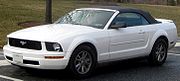
Ford Cologne V6 engine
The original Ford Cologne V6, also known as the 'Ford Taunus V6', is a series of 60° cast iron block V6 engines produced continuously by the Ford Motor Company in Cologne, Germany since 1968...
SOHC V6
V6 engine
A V6 engine is a V engine with six cylinders mounted on the crankcase in two banks of three cylinders, usually set at either a right angle or an acute angle to each other, with all six pistons driving a common crankshaft...
, replacing the 3.8 L Essex
Ford Essex V6 engine (Canadian)
The Ford Essex V6 engine was a 90° V6 engine family built by Ford Motor Company at the Essex Engine Plant in Windsor, Ontario, Canada. Unlike the British Essex V6, the Canadian Essex used a 90° V configuration, in addition to having different displacements and valvetrains...
OHV V6 used in 2004 and older models. It produces 210 hp (157 kW) at 5300 rpm and 240 lb·ft (325 N·m) of torque at 3500 rpm and is mated to a standard Tremec T-5 5-speed manual transmission
Manual transmission
A manual transmission, also known as a manual gearbox or standard transmission is a type of transmission used in motor vehicle applications...
with Ford's 5R55S 5-speed automatic transmission available as an option. A 3.31:1 final drive ratio is standard with either transmission. Though criticized for a lack of refinement, the standard V6 powertrain is capable of delivering competitive performance. In a comparison test with a Pontiac G6
Pontiac G6
The Pontiac G6 was a mid-size car produced under the Pontiac brand of American automaker General Motors.It was introduced in the fall of 2004 to replace the Grand Am. The car was built on the GM Epsilon platform which it shared with the Chevrolet Malibu and Saab 9-3 along with other General Motors...
Convertible conducted by Motor Trend
Motor Trend
Motor Trend is an American automobile magazine. It first appeared in September 1949, issued by Petersen Publishing Company in Los Angeles, and bearing the tag line "The Magazine for a Motoring World". Petersen Publishing was sold to British publisher EMAP in 1998, who sold the former Petersen...
magazine, a Mustang V6 Convertible equipped with an automatic transmission was able to accelerate from zero to 60 miles per hour (26.8 m/s) in 7.3 seconds; 1.4 seconds better than its competitor.
All models of the current Mustang make use of an independent MacPherson-strut front suspension with reverse "L" lower control arms. The rear suspension utilizes a new three-link system with a Panhard Rod
Panhard rod
A Panhard rod is a component of a car suspension system that provides lateral location of the axle...
which controls the vertical and lateral movements of the axle. This live axle rear suspension
Live axle
A live axle, sometimes called a solid axle, is a type of beam axle suspension system that uses the driveshafts that transmit power to the wheels to connect the wheels laterally so that they move together as a unit....
, while sacrificing handling, provides the benefits of reduced cost and weight over heavier, more expensive independent rear suspensions
Independent suspension
Independent suspension is a broad term for any automobile suspension system that allows each wheel on the same axle to move vertically independently of each other. This is contrasted with a beam axle, live axle or deDion axle system in which the wheels are linked – movement on one side affects...
. In spite of this, Ford has drawn heavy criticism from the automotive journalism community for the decision to equip the current Mustang with the live axle system. At a press conference, Ford stated that to include an independent rear suspension would have added $5,000 to the showroom price of the car.
Some of the standard features that the 2005 Mustang launched with include power windows, dual power mirrors, power door locks with remote keyless entry, front air bags, AM/FM stereo with CD player, 16-inch painted aluminum wheels, and larger brake discs than the previous generation Mustang with twin-piston calipers in the front. Some of the options available included Ford's MyColor (a color-configurable instrument cluster available as part of the Interior Upgrade Package), brushed aluminum panels (also part of the Interior Upgrade Package), Ford's Shaker 500 (500 watt peak output) or Shaker 1000 (1000 watt peak output) premium audio system with a 6-disc MP3-compatible CD changer, leather seating surfaces, a six-way power adjustable driver seat, and a four-channel anti-lock brake system with traction control (standard on GT models).
As of 2008, all Mustangs have seats containing material derived from soy beans, harking back to some of Henry Ford's ideals.
Ford Sync
Ford Sync
Ford SYNC is a factory-installed, integrated in-vehicle communications and entertainment system that allows users to make hands-free telephone calls and control music and other functions using voice commands...
was available on the 2009 model only as a dealer-installed kit.
Several new options and standard features were introduced in the following years, including the Pony Package (2006; see below), a DVD-based GPS navigation system made by Pioneer
Pioneer Corporation
is a multinational corporation that specializes in digital entertainment products, based in Kawasaki, Kanagawa, Japan. The company was founded in 1938 in Tokyo as a radio and speaker repair shop...
(2007, late availability), a power passenger seat (2007), heated seats (2007), Sirius Satellite Radio
Sirius Satellite Radio
Sirius Satellite Radio is a satellite radio service operating in North America, owned by Sirius XM Radio.Headquartered in New York City, with smaller studios in Los Angeles and Memphis, Sirius was officially launched on July 1, 2002 and currently provides 69 streams of music and 65 streams of...
(2007), standard side airbags (2008), HID headlamps
High-intensity discharge lamp
High-intensity discharge lamps are a type of electrical lamp which produces light by means of an electric arc between tungsten electrodes housed inside a translucent or transparent fused quartz or fused alumina arc tube. This tube is filled with both gas and metal salts. The gas facilitates the...
(2008), and ambient interior lighting (2008), in addition to a variety of new wheel styles and exterior paint colors.
For 2009, Ford introduced a new option called the glass roof. This option ($1,995 at introduction) is in effect a full roof sunroof that splits the difference in price and purpose of the coupe and convertible models.
Pony Package
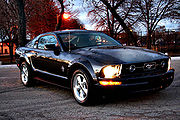
V6 Appearance Package
At the 2007 SEMA show in Las Vegas, Ford Custom Accessories introduced the V6 Appearance Package to the world. Introduced as a Mustang one can order with equal parts excitement and exclusivity, the V6 Appearance package hearkens back to the 60s styling of Mustang with a Billet grille, scoops, a spoiler and black-out treatment designed to give this Mustang an aggressive look. The V6 Appearance Package is a factory package that includes a chrome billet-style upper grille, body color side scoops, black satin front lip spoiler, black satin hood stripe, GT hood scoop, bright rolled exhaust tips, GT black rear spoiler, unique black satin decklid applique, upgraded black floor mats, and 18-inch premium polished forged aluminum wheels. Available in 2008 as a $2,398 option, this package was encouraged to be applied with Ford Racing goodies including the Ford Racing Power Pack FR1 (which includes a 85 mm Cold Air Intake sourced from the Bullitt, True Dual exhaust with a X-pipe and Bullitt Mufflers, a Pro-Cal Hand held tuner and a Ford Racing Performance oil filter), the Ford Racing Handling Package FR3 (which includes shocks/struts, front and rear anti-rollbars, V6 lowering springs, and a V6 Strut Tower Bar) and the Ford Racing Short Throw Shifter. Available in 2008 using the V6 Appearance Package was only available when one ordered the V6 Coupe with the Premium Package with either an automatic or manual transmission and only with Grabber Orange, Vapor Silver Metallic, and Dark Candy Apple Red. For 2009 everything remained pretty much the same except that the V6 Appearance Package was offered additionally in Performance White and Black. According to the 2008 Mustang Take Rate Report, 152 V6 Appearance Packages were built and according to the 2009 Mustang Take Rate Report 96 were built.Mustang GT
The Mustang GT features an all-aluminum 4.6 L 3-valve SOHC Modular V8V8 engine
A V8 engine is a V engine with eight cylinders mounted on the crankcase in two banks of four cylinders, in most cases set at a right angle to each other but sometimes at a narrower angle, with all eight pistons driving a common crankshaft....
with variable camshaft timing
Variable Cam Timing
Variable Camshaft Timing is an automobile variable valve timing technology developed by Ford. It uses electronically controlled hydraulic valves that direct high pressure engine oil into the camshaft phaser cavity. These oil control solenoids are bolted into the cylinder heads towards the front of...
and a more rugged Tremec TR-3650 transmission. The engine produces 300 hp (224 kW) @ 5750 rpm and 320 lb·ft (433 N·m) of torque @ 4500 rpm. The GT model is capable under some circumstances of performing a quarter-mile test in 13.5 seconds, with acceleration from zero to 60 MPH in 4.9 seconds. The current Mustang GT also comes equipped with a limited slip differential complete with the same carbon-fiber clutch discs used in the 2003 to 2004 SVT Cobra and the 2007 Shelby GT500. The differential is designed for the 31-spline axles and the 8.8 in (224 mm) ring gear. The standard final drive ratio of 2005 and 2006 Mustang GTs with a manual transmission is 3.55:1. Since the 2007 model year, a 3.31:1 ratio final drive is standard with the 3.55:1 gearing available as a factory installed option. Automatic transmission-equipped models of all years receive the less aggressive 3.31:1 ratio.
The Mustang GT builds on the base Mustang's standard features. In addition to its higher performance powertrain, the Mustang GT features a stiffer, better handling version of the standard suspension, larger 12.4-inch front brake discs (versus the 11.4-inch discs used on V6 Mustangs), standard four-channel ABS
Anti-lock braking system
An anti-lock braking system is a safety system that allows the wheels on a motor vehicle to continue interacting tractively with the road surface as directed by driver steering inputs while braking, preventing the wheels from locking up and therefore avoiding skidding.An ABS generally offers...
with traction control, a two-piece drive shaft, a stainless steel dual exhaust, standard grille-mounted fog lights, and 17-inch wheels with optional 18-inch wheels.
GT California Special

California Special Mustang
In mid-February 1968, the California Ford Dealers began to market a factory-built, limited-edition Mustang, called the GT/CS, or "California Special". The hope was for a targeted production run of 5,000, but actually, 4118 were made, which included 251 units that were remarketed in Denver,...
. The package adds 18" polished aluminum wheels, non-functional side scoops, and unique vinyl striping. The GT/CS also includes a different front fascia and rear valance with diffuser, similar to those found on the Shelby GT. The GT/CS edition's front fascia is 1.5 inches lower to the ground than the standard GT. Interior upgrades include Mustang labeled floor mats, and CS only leather interior color options. The 2007 GT Appearance Package adds a hood scoop, exhaust tips and engine cover.
In 2011 The GT California Special again returned for the Five liter Mustang GT. The 5.0 emblem is again absent in favor of the black GTCS side stripes which fade into a side scoop. The front fascia is replaced with the one used in the 2011 Boss 302 with working lower fascia fog lights. The rear diffuser is now taken from the Shelby GT 500 while the rear deck lid gets black vinyl and a wing spoiler completes the look. Wheels are upgraded to 19 inch 10 spoke argent color with a GT stamped towards the outer rim on each wheel. The interiors bright dash is replaced with black carbon fiber treatment while carbon fiber door inserts and seat leather patterns complete the look. Badging includes "GTCS" on the carbon fiber dash and floor mats. The front Grill is brushed aluminum billet with a V6 style pony emblem on the drivers side. (for 2012 It's changed to black billet) While the Brembo brake package is not available with the California special (402A), it can still be ordered with choice of gears (3.31, 3.55, or 3.73) from the factory.
2008–2009 Bullitt
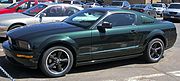
Fastback
A fastback is a car body style whose roofline slopes continuously down at the back. The word can also designate the car itself. The style is seen on two-door coupés as well as four-door sedans.-History:...
Mustang driven by Steve McQueen
Steve McQueen
Terrence Steven "Steve" McQueen was an American movie actor. He was nicknamed "The King of Cool." His "anti-hero" persona, which he developed at the height of the Vietnam counterculture, made him one of the top box-office draws of the 1960s and 1970s. McQueen received an Academy Award nomination...
in the 1968 film of the same name
Bullitt
Bullitt is a 1968 American police procedural film starring Steve McQueen, Jacqueline Bisset and Robert Vaughn. It was directed by Peter Yates and distributed by Warner Bros. The story was adapted for the screen by Alan Trustman and Harry Kleiner, based on the 1963 novel Mute Witness by Robert L....
. Available in Dark Highland Green or Black exterior paint and is stripped of its spoiler and GT fender emblems; the faux gas cap on the deck lid is replaced by a unique Bullitt version. The Mustang GT's standard fog light-equipped grille is replaced with the base V6 style grille without the running horse logo. Dark Argent Gray 18-inch cast-aluminum wheels are used with matching brake calipers and larger, 3.5 inch exhaust tips to replace the Mustang GT's standard 2.5 inch tips. Starting MSRP of $31,075, this model was not sold with side (quarter) window louvers, as shown in this picture. However, the side louvers are a common addition among owners since it is also similar to the 1968 Mustang fastback.
The Mustang Bullitt is powered by an enhanced version of the Mustang GT's aluminum 4.6 L SOHC V8. Additional power is added through the use of a unique cold air intake, improved engine calibration, and a revised exhaust system specifically designed to mimic the sound of the Mustang used in the Bullitt movie. Total output is 315 hp (235 kW) @ 6000 rpm and 325 lb·ft (440 N·m) of torque @ 4250 rpm and the engine's redline has been raised to 6500 rpm (from the standard Mustang GT's 6250 rpm). Premium grade, 91-octane or better gasoline is recommended for the Bullitt's V8 for top performance but, significantly, an adaptive spark ignition system allows the engine to accept regular grade gasoline without any adverse effects. Total output is the same with either fuel but the engine delivers a flatter torque curve when using premium. The same Tremec TR3650 5-speed manual transmission from the Mustang GT is used in the Mustang Bullitt but the Bullitt features a more aggressive 3.73:1 rear axle ratio (versus the Mustang GT's 3.31:1 or optional 3:55:1 ratios). The Bullitt's suspension is improved over the standard GT utilizing stiffer springs, struts, and a decorative front strut tower brace while also lowering the car's ride height by six millimeters. All of the Mustang Bullitt's unique components are available in the aftermarket for retrofitting earlier S197 Mustang GT vehicles but the parts used in Bullitt Mustangs are marked to show their authenticity.
According to the 2009 Mustang catalog, the Bullitt package was available on manual transmission Mustang GT Premium coupes as a regular production option; the same color restrictions apply.
45th Anniversary Edition (2009 GT)

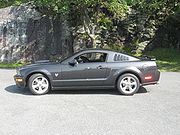
Iacocca Silver 45th Anniversary Edition (2009½ GT)

Shelby GT and GT-H
2006's Shelby GT-H and later Shelby GT, based on the standard GT model, is modified by Carroll Shelby InternationalCarroll Shelby International
Carroll Shelby International was formed in 2003 from custom performance vehicle manufacturer Shelby American when, founder and owner, Carroll Shelby took the company public, and additionally forming Shelby Automobiles as a subsidiary from which to continue manufacturing vehicles and parts...
to produce 319 hp (238 kW) by means of a Ford Racing
Ford Racing
Ford Racing is the Ford Motor Company's racing division and the multinational name used for its motorsport activity.-History:* 1896 - Henry Ford reached a top speed of 20 mph in his first car, Quadricycle....
air intake, performance tune, and upgraded exhaust system.
The Shelby GT-H, made available for rent only at selected Hertz
The Hertz Corporation
Hertz Global Holdings Inc is an American car rental company with international locations in 145 countries worldwide.-Early years:The company was founded by Walter L. Jacobs in 1918, who started a car rental operation in Chicago with a dozen Model T Ford cars. In 1923, Jacobs sold it to John D...
car rental outlets, traces its roots to the original 1966 Shelby GT350H, famously known as the "Rent-A-Racer". The GT-H appears only in black exterior paint and twin gold racing stripes as a nod to the Hertz company's history. Completing the unique visual treatment is a billet
Billet
A billet is a term for living quarters to which a soldier is assigned to sleep. Historically, it referred to a private dwelling that was required to accept the soldier....
aluminum grille, custom Shelby hood with functional hood pins, and the same front and rear fascia that would be found on the later Shelby GT and GT/CS models. The GT-H is outfitted with a Ford Racing
Ford Racing
Ford Racing is the Ford Motor Company's racing division and the multinational name used for its motorsport activity.-History:* 1896 - Henry Ford reached a top speed of 20 mph in his first car, Quadricycle....
Power Pack which includes a cold air intake
Cold air intake
A cold air intake is an aftermarket assembly of parts used to bring relatively cool air into a car's internal-combustion engine.Most vehicles manufactured since the mid-1970s have thermostatic air intake systems that regulate the temperature of the air entering the engine's intake tract, providing...
, a revised exhaust system and custom performance calibration
Engine tuning
Engine tuning is the adjustment, modification or design of internal combustion engines to yield optimal performance, to increase an engine's power output, economy, or durability....
, boosting power to 319 hp (238 kW) and torque to 330 lb·ft (447 N·m). The GT-H also includes the Ford Racing Handling Pack with lowering springs, improved dampers, sway bars, a strut tower brace and a 3.55:1 ratio rear axle assembly. 500 units of the coupe model were created for the 2006 model year, and a second run of 500 convertible models has been announced for 2008.
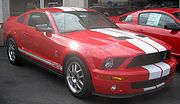
Shelby GT500
Special Vehicle Team
Special Vehicle Team, also known as SVT, is an arm of Ford Motor Company responsible for the development of the company's highest-performance vehicles, much like Mercedes-AMG, BMW M, Chrysler's SRT division and GM's Performance Division. SVT is the successor to the SVO division.The current SVT...
launched the highly anticipated Shelby
Shelby Mustang
The Shelby Mustang is a high performance variant of the Ford Mustang which was built by Shelby American from 1965 through 1970. Following the introduction of the fifth generation Ford Mustang, the Shelby nameplate was revived in 2007 for new high performance versions of the Mustang.- 1965–1966 :The...
GT500, successor to the 2003/2004 Mustang SVT Cobra
Ford Mustang SVT Cobra
The 1993 Ford Mustang SVT Cobra was launched during the 1992 Chicago Auto Show. It was the premier vehicle of Ford's newly established SVT division, designed to showcase SVT's four hallmarks of Performance, Substance, Exclusivity and Value...
. The GT500 shares many of its basic design characteristics with that of the Mustang V6 and GT. In particular, the GT500 retains the same basic live axle rear suspension setup of the Mustang V6 and GT, with some minor durability enhancements to handle the car's power. Thicker sheetmetal supports and extra welds can be found on the GT500 chassis as well as redesigned strut towers to accommodate a wider engine. A supercharged 5.4 L 32-valve DOHC V8 with an iron block and aluminum heads powers the GT500. The engine is mated to a Tremec TR6060 6-speed manual transmission and is rated to produce 500 hp (373 kW) @ 6000 rpm and 480 lb·ft (650 N·m) of torque @ 4500 rpm. A final drive ratio of 3.31:1 is standard in the GT500. Also standard are 18×9.5 inch wheels with P255/45ZR18 tires in the front and P285/40ZR18 tires in the rear. Stopping is provided by Brembo 14-inch disc brakes with aluminum four-piston calipers in the front and 11.8-inch disc brakes with two-piston calipers in the rear.
The GT500 failed to meet some automotive journalist's expectations. Car and Driver
Car and Driver
Car and Driver is an American automotive enthusiast magazine. Its total circulation is 1.31 million. It is owned by Hearst Magazines, who purchased prior owner Hachette Filipacchi Media U.S. in 2011...
magazine, for example, though praising the GT500 for its ample horsepower and relatively smooth ride, criticized their test car for its heavy weight and, in particular, the nose-heavy weight distribution of 57.7% front and 42.3% rear (compared to the 52.5% front, 47.5% rear of a Mustang GT manual they tested). Nevertheless, in spite of their opinion of its drawbacks, Car and Driver drove a GT500 in their 2007 "Lightning Lap" road test at Virginia International Raceway and found that the car's on-track performance lap time of 3:05.9 fell just below that of the Porsche 911 Turbo (3:05.8) and faster than that of the Lotus Elise (3:09.3), Porsche Cayman S (3:09.5) and BMW M6 (3:10.0).
Shelby GT500KR
Debuting as a 2008 model, the Shelby GT500KR, "KR" being an abbreviation for "King of the Road", pays homage to the original 1968 Shelby Mustang of the same name. The GT500KR, with a MSRP of $79,995, features new components and performance enhancements over a standard GT500. Under the hood, the GT500KR uses the same supercharged 5.4 L DOHC V8 as the standard GT500, but the KR's engine has been tuned to make 540 hp (403 kW) @ 6250 rpm and 510 lb·ft (691 N·m) of torque @ 4500 rpm, gains of 40 hp and 30 lb·ft of torque, respectively. While the Tremec TR6060 6-speed manual transmission remains the same, the GT500KR also benefits from a more aggressive 3.73:1 final drive ratio. To improve handling and help offset the car's front-heavy weight distribution, the GT500KR features a Ford Racing strut tower brace and uniquely tuned struts, shocks, and springs. Finally, to maximize the GT500KR's performance gains, measures were taken to keep the car's weight in check. Through the use of a carbon fiber hood and a revised exhaust system, the overall weight of the GT500KR is 22 lbs lighter than a standard GT500.Mustang

Ford D2C platform
The Ford D2C platform is Ford's latest rear-wheel drive automobile platform. Currently, the only vehicle using this platform is the 2005-present Ford Mustang and its Shelby derivative....
platform. Chief designer Doug Gaffka
Doug Gaffka
Doug Gaffka is the design director of Ford Motor Company's Living Legends vehicle program, a position he has held since April of 2001. Ford's Living Legends oversees the development of classic Ford nameplates, like the Thunderbird and Mustang, as well as new vehicle design...
was previously responsible for the 2008–2009 Bullitt and other Ford vehicles. The new Mustang's exterior is sculpted for a leaner, more muscular appearance. Better aerodynamic performance (coefficient of drag
Drag coefficient
In fluid dynamics, the drag coefficient is a dimensionless quantity that is used to quantify the drag or resistance of an object in a fluid environment such as air or water. It is used in the drag equation, where a lower drag coefficient indicates the object will have less aerodynamic or...
by 4% on V6 models and 7% on GT models). Specific changes to the exterior include a restyled Mustang emblem, a new headlight design with integrated turn signals, new slimmer side mirror design (they're now also color keyed in GT trim), a prominent powerdome hood to complement the car's muscular exterior, and revised three-lens taillights with LEDs
Light-emitting diode
A light-emitting diode is a semiconductor light source. LEDs are used as indicator lamps in many devices and are increasingly used for other lighting...
that blink in sequence for turn indication. Additionally, the 2010 Mustang GT uses smaller fog lights than the 2005–2009 models though they are still mounted in the car's grille. Fog lights on V6 models (a part of a revised Pony Package first introduced for 2006) are now mounted in the lower fascia
Fascia (car)
Confusingly, fascia is used for several different things in the automotive world. Many of these meanings are related to the appearance of the car....
below the grille. In all models, the radio antenna has been moved to the rear of the car and the lock for the trunk no longer features a keyhole on the trunk lid, substituting with a remote trunk release only. In spite of its changes, the 2010 Mustang's overall exterior dimensions are nearly identical to the 2005–2009 models. This generation is the first to be sold in Japan in left hand drive form with exterior lighting modifications to comply with Japanese Government regulations.
The Mustang's interior was revised featuring higher quality thermoplastic olefin
ThermoPlastic Olefin
Thermoplastic PolyOlefin is a trade name that refers to polymer/filler blends usually consisting of some fraction of PP , PE , BCPP , rubber, and a reinforcing filler. Common fillers include, though are not restricted to talc, fiberglass, carbon fiber, wollastonite, and MOS...
surfaces, available real aluminium trim, and improved fit and finish. The new design moved away from the linear nature of the previous models. Gary Morales, Design Manager for the 2010 Mustang, said about the attention to detail paid to the Mustang's new interior, "We never stopped at, 'Good enough.' We only stopped at 'right.'" Ford SYNC
Ford Sync
Ford SYNC is a factory-installed, integrated in-vehicle communications and entertainment system that allows users to make hands-free telephone calls and control music and other functions using voice commands...
is available on all trim levels of the present Mustang except the base model.
The standard engine is a 4.0 L V6
Ford Cologne V6 engine
The original Ford Cologne V6, also known as the 'Ford Taunus V6', is a series of 60° cast iron block V6 engines produced continuously by the Ford Motor Company in Cologne, Germany since 1968...
mated to a 5-speed manual transmission or an optional 5-speed automatic transmission. The V6 powertrains are unchanged from those used in 2005–2009 Mustangs. Though the 2010 Mustang retains a single exhaust outlet, the diameter of the tip has been increased one-half of an inch to three inches. The 2010 Mustang includes new spring rates and dampers to improve ride quality and control and Ford's AdvanceTrac traction
Traction control system
A traction control system , also known as anti-slip regulation , is typically a secondary function of the anti-lock braking system on production motor vehicles, designed to prevent loss of traction of driven road wheels...
and stability control
Electronic stability control
Electronic stability control is a computerized technology that may potentially improve the safety of a vehicle's stability by detecting and minimizing skids. When ESC detects loss of steering control, it automatically applies the brakes to help "steer" the vehicle where the driver intends to go...
system standard. Newly standard on the base Mustang are 17-inch painted aluminum wheels while 18-inch wheels continue to be optional (except for V8 models, where 18-inch wheels are mounted by default). Other new available features and options for the 2010 Mustang included Ford SYNC, dual-zone automatic climate control, an updated navigation system with Sirius
Sirius Satellite Radio
Sirius Satellite Radio is a satellite radio service operating in North America, owned by Sirius XM Radio.Headquartered in New York City, with smaller studios in Los Angeles and Memphis, Sirius was officially launched on July 1, 2002 and currently provides 69 streams of music and 65 streams of...
Travel Link, a capless fuel filler, a reverse camera system to aid in backing up, and an updated version of the V6 Pony Package.
New powertrains for 2011 replaced the aging 4.0 L V6 used in the Mustang since the 2005 model year. These include Ford's Duratec 37
Ford Duratec engine
The Duratec is a range of four, five, and six-cylinder gasoline engines produced by the Ford Motor Company, used in Ford, Mazda, Volvo, Caterham, Morgan, Tiger, Ginetta cars and by specialist engine tuner Cosworth....
3.7 L DOHC V6. Unlike earlier versions of the engine, the 2011 Mustang features Twin-independent Variable Cam Timing
Variable Cam Timing
Variable Camshaft Timing is an automobile variable valve timing technology developed by Ford. It uses electronically controlled hydraulic valves that direct high pressure engine oil into the camshaft phaser cavity. These oil control solenoids are bolted into the cylinder heads towards the front of...
(Ti-VCT). The new V6 now has true dual exhaust, compared to the single outlet exhaust that the previous 4.0 L V6 – the engine is rated to produce 305 bhp @ 6500rpm and 280 lbft of torque @ 4250rpm.
The 2011 Mustang is also capable of achieving good fuel efficiency due in part to also-new transmissions. With the newly standard Getrag
Getrag
Getrag is a leading manufacturer of automobile manual transmissions. The company was founded on 1 May 1935, in Ludwigsburg, Germany, by Hermann Hagenmeyer; as the Getriebe und Zahnradfabrik Hermann Hagenmeyer GmbH & Cie KG...
MT82 6-speed manual transmission co-developed with Ford, the 2011 Mustang has been rated by the EPA
United States Environmental Protection Agency
The U.S. Environmental Protection Agency is an agency of the federal government of the United States charged with protecting human health and the environment, by writing and enforcing regulations based on laws passed by Congress...
to achieve 19 miles per US gallon in city driving and 29 miles per US gallon on the highway. The newly optional Ford 6R60
Ford 6R transmission
The 6R is a six-speed automatic transmission for longitudinal engine placement in rear-wheel drive vehicles. It is based on the ZF 6HP26 transmission and is built under license by the Ford Motor Company at its Livonia Transmission plant in Livonia, Michigan...
6-speed automatic achieves 19 miles per US gallon in city and 31 miles per US gallon on the highway. The a newly standard 2.73:1 limited slip
Limited slip differential
A limited slip differential is a type of differential gear arrangement that allows for some difference in angular velocity of the output shafts, but imposes a mechanical bound on the disparity...
rear axle is more fuel efficient compared to the more aggressive 3.31:1 axle used previously. The 3.31:1 axle remains available in the 2011 Mustang as a performance option.
The 2011 Mustang offered a V6 Performance Package starting in summer 2010. The package features a standard 3.31:1 rear axle, stiffer suspension tuning, 19-inch wheels with performance tires, a strut tower brace, and performance-oriented electronic stability control calibration.
Other, non-powertrain related upgrades made to the 2011 Mustang include Electric Power Assist Steering
Power steering
Power steering helps drivers steer vehicles by augmenting steering effort of the steering wheel.Hydraulic or electric actuators add controlled energy to the steering mechanism, so the driver needs to provide only modest effort regardless of conditions. Power steering helps considerably when a...
(EPAS) with pull-drift compensation and active nibble control, general aerodynamic and NVH
Noise, Vibration, and Harshness
Noise, vibration, and harshness , also known as noise and vibration , is the study and modification of the noise and vibration characteristics of vehicles, particularly cars and trucks...
improvements over the 2010 Mustang, a digital message/information center, blind spot mirrors integrated into the car's side mirrors, a universal garage door opener, a 160 mph speedometer, and Ford's MyKey
MyKey
MyKey is a motor vehicle security system designed by the Ford Motor Company that allows the controlled use of a car with a configurable key. The technology is targeted at parents who wish to share their car with adolescent or young adult drivers. Keys may be configured with a variety of settings...
programmable vehicle key technology.
Mustang GT
The 2010 Mustang GT adds a more powerful version of the 4.6 L V8 seen in 2005–2009 Mustang GTs. The 2010 Mustang GT's revised V8 produces 315 bhp @ 6000rpm and 325 lbft of torque @ 4250rpm. The 5-speed manual and automatic transmissions offered with the updated V8 continue unchanged from before. The size of the 2010 Mustang GT's dual exhaust tips has been increased by one-half of an inch to 3.5 inches while the exhaust note has been improved to enhance the sound of the V8. Like the base V6-equipped Mustang, the 2010 Mustang GT includes new spring rates and dampers to improve ride quality and control. AdvanceTrac is also standard in the Mustang GT though a special Sport Mode setting is added for spirited driving. The 2010 Mustang GT comes with standard 18-inch wheels – one inch greater than the previous Mustang GT's standard wheels – while 19-inch wheels are a new option.Newly available for the Mustang GT for 2010 are two performance packages. The 3.73 Axle Package features higher performance front brake pads, a more aggressive 3.73:1 rear axle, and a recalibrated AdvanceTrac system. The Track Package features higher performance front and rear brake pads, stabilizer bars and rear lower control arms from the GT500, uniquely tuned shocks and struts, Pirelli
Pirelli
Pirelli & C. SpA is a diverse multinational company based in Milan, Italy. The company, the world’s fifth largest tyre manufacturer, is present in over 160 countries, has 20 manufacturing sites around the world and a network of around 10,000 distributors and retailers.Founded in Milan in 1872,...
summer tires (includes automatic upgrade to 19-inch wheels), a 3.73:1 rear axle with carbon plates in the differential, and a recalibrated AdvanceTrac system.
A V8 engine is available for 2011, complete with new transmissions and other upgrades. The Mustang GT's new engine is an all-aluminum 32-valve 5.0 L DOHC V8, codenamed Coyote
Ford Modular engine
The Ford Modular engine is Ford Motor Company's overhead camshaft V8 and V10 engine family, which has been produced in 4.6L, 5.0L , 5.4L, and 6.8L variations. Contrary to popular belief, the Modular engine did not get its name from its design or sharing of certain parts among the engine family...
. The 2011 Mustang GT marks the engine's first use in any production vehicle. While the new engine's displacement is similar to Ford's original "5.0" 302 cu in (5 l) V8
Ford Windsor engine
The Windsor is a 90-degree small-block V8 engine from Ford Motor Company. It was introduced in 1962, replacing the previous Ford Y-block engine. Though not all of the engines in this family were produced at the Windsor, Ontario engine plant , the name stuck...
, it is an unrelated design and instead shares more in common with the 4.6 L V8 and other Modular engines
Ford Modular engine
The Ford Modular engine is Ford Motor Company's overhead camshaft V8 and V10 engine family, which has been produced in 4.6L, 5.0L , 5.4L, and 6.8L variations. Contrary to popular belief, the Modular engine did not get its name from its design or sharing of certain parts among the engine family...
that it replaces. The new 5.0 uses a DOHC head design like other Modular engines and even shares its bore spacing and deck height with the outgoing 4.6 L V8. Differing the new engine from earlier Modular engines, among other features, is its use of wider bore diameters (and a longer stroke relative to the 4.6 L V8 in particular), to allow the use of larger valves, and camshaft torque-actuated Twin-independent Variable Cam Timing (Ti-VCT). In spite of its more advanced design, the new engine weighs in at approximately 430 lb (195 kg) – about 10 lb (5 kg) heavier than the Mustang GT's previous 4.6 L V8. Red-line has been raised to 7,000 rpm. Using premium grade, 91-octane or better gasoline, the new 5.0 L V8 can produce 412 bhp @ 6500rpm and 390 lbft of torque @ 4250rpm. Output of the 5.0 drops to 402 bhp @ 6500rpm and 377 lbft of torque @ 4250rpm when regular grade gasoline is used.
Two noteworthy improvements the 5.0 engineers had to fight with the bean counters over included piston cooling oil jets which both warm the engine up faster and keep it running cooler, and ford racing style tubular performance headers. The water/coolant and oil flow patterns were heavily optimized for proper flow under high lateral forces such as on a race circuit. Budget restrictions prevented the use of an optional racing oil cooler and Direct Injection (DI) but the engine is designed such that both can easily be added to future Mustangs. In the case of the oil cooler....possibly even as an after market add on.
Like the updated V6 Mustang, the Mustang GT also gets new transmissions for 2011. Both transmissions are heavier duty versions of the same designs offered with the V6 Mustang; a Getrag/Ford MT82 6-speed manual transmission and Ford's 6R80
Ford 6R transmission
The 6R is a six-speed automatic transmission for longitudinal engine placement in rear-wheel drive vehicles. It is based on the ZF 6HP26 transmission and is built under license by the Ford Motor Company at its Livonia Transmission plant in Livonia, Michigan...
6-speed automatic transmission. The 6-speed manual transmission comes with a 3.31:1 rear axle while 6-speed automatics get a taller 3.15:1 rear axle. Combined with its new, more efficient V8, the new 6-speed transmissions contribute to an improvement in fuel economy in the 2011 Mustang GT over its counterpart from the 2010 model year. As certified by the EPA, manual transmission models are able to achieve 17 miles per US gallon in city and 26 miles per US gallon on the highway while automatic transmission models are able to achieve 18 miles per US gallon in city and 25 miles per US gallon on the highway.
The Mustang GT gains the same non-powertrain related upgrades that standard V6 Mustangs get for 2011. Other, new features exclusive to the 2011 Mustang GT include "5.0" fender badges replacing the "GT" badges used previously, an optional Brembo Brake Package taken from the Shelby GT500 (comes with unique 19-inch wheels), and suspension enhancements. Convertible versions of the Mustang GT in particular received a front strut tower brace, stiffened crossmembers, and other enhancements resulting in a 12% increase in structural rigidity compared to 2010 Mustang GT convertibles. All 2011 Mustang GT's with 19 inch wheels (brembo brake equipped, california special, etc.) also get the strut tower brace and stiffened cross members.
Taller rear head rests have been added for whip-lash protection, with fold down feature for visibility when rear passengers are not present. The rear fascia is altered for slightly better aerodynamics from the 2010 as well.
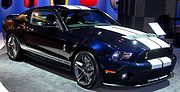
Shelby GT500
North American International Auto Show
The North American International Auto Show is an annual auto show held in Detroit, Michigan at Cobo Center, usually in January. It is among the largest auto shows in North America.-History:...
. As before, many of the basic design characteristics of the new GT500 are shared with that of the Mustang and Mustang GT. In particular, the GT500 gains the same exterior and interior updates as the 2010 Mustang and Mustang GT. Differentiating it from the Mustang and Mustang GT on the outside, however, is a unique front fascia with larger upper and lower grilles, a unique hood, large fog lights mounted in the lower front fascia (similar to the previous GT500), Shelby's signature cobra badges on the grille, front fenders, and trunk lid medallion (with Shelby lettering over the medallion), unique 19-inch wheels (18-inch on the convertible model), and a unique Gurney Flap
Gurney flap
The Gurney Flap is a small flat tab projecting from the trailing edge of a wing. Typically it is set at a right angle to the pressure side surface of the airfoil,and projects 1% to 2% of the wing chord....
rear spoiler. Inside the GT500, a unique cobra disc on the steering wheel, shift ball, and seats with embroidered cobras are the only major elements that differ it from the Mustang and Mustang GT.
Mechanically the 2010 Shelby GT500 remains closely related to the 2007–2009 GT500, but the 2010 model has been upgraded with various features similar to or found in the 2008 Shelby GT500KR. A conical cold air intake
Cold air intake
A cold air intake is an aftermarket assembly of parts used to bring relatively cool air into a car's internal-combustion engine.Most vehicles manufactured since the mid-1970s have thermostatic air intake systems that regulate the temperature of the air entering the engine's intake tract, providing...
and other enhancements to the GT500's supercharged 5.4 L DOHC V8
Ford Modular engine
The Ford Modular engine is Ford Motor Company's overhead camshaft V8 and V10 engine family, which has been produced in 4.6L, 5.0L , 5.4L, and 6.8L variations. Contrary to popular belief, the Modular engine did not get its name from its design or sharing of certain parts among the engine family...
have resulted in an increase in output to 540 bhp@6200rpm and 510 lbft@4500rpm, gains of 40 hp and 30 lb·ft of torque over the 2007–2009 GT500 respectively. The Tremec TR-6060
Tremec TR-6060 transmission
The Tremec TR-6060 six-speed manual transmission features six forward speeds and one reverse speed. It is derived from the Tremec T-56 6-speed manual transmission. As per usual, the forward helical cut gears are synchronized however, the reverse gear operates through a fully synchronized...
6-speed manual transmission returns for the 2010 GT500 but has been enhanced with larger clutch discs (250 mm (9.8 in) versus the 215 mm (8.5 in) discs used previously) and other measures to increase performance and noise, vibration, and harshness (NVH) control. Additionally, the fifth and sixth gear ratios of the transmission have been changed from 0.80 to 0.74 and 0.63 to 0.50 respectively, contributing to an improvement in fuel efficiency that the 2010 GT500 enjoys over its predecessor. Complementing the transmission's gear ratio changes is a new, more aggressive 3.55:1 ratio rear axle which replaces the 3.31:1 axle used previously. And According to Inside Line driver's of the new 2010 Shelby can expect 0 to 60 times in 4.3 seconds from a stand still and 4 seconds flat with roll out. Elsewhere, the GT500's aluminum hood, in addition to be stylistically different from that of the Mustang and Mustang GT, features an air extractor that helps cool the engine. Various aerodynamic upgrades, such as the design of the front fascia and the aforementioned Gurney Flap spoiler, contribute to increased downward force and a reduced coefficient of drag. Suspension enhancements found in the GT500KR are used in the 2010 GT500 to improve handling and, specifically, provide better roll control. The 2010 GT500 features Ford's AdvanceTrac traction
Traction control system
A traction control system , also known as anti-slip regulation , is typically a secondary function of the anti-lock braking system on production motor vehicles, designed to prevent loss of traction of driven road wheels...
and stability control
Electronic stability control
Electronic stability control is a computerized technology that may potentially improve the safety of a vehicle's stability by detecting and minimizing skids. When ESC detects loss of steering control, it automatically applies the brakes to help "steer" the vehicle where the driver intends to go...
system standard with different settings to control the level of performance the driver desires.
The 2010 Shelby GT500 was released in the spring of 2009.
For 2011, the Shelby GT500 received significant performance enhancements and other upgrades. Arguably the most important of the GT500's upgrades is a new aluminum engine block for the car's supercharged 5.4 L DOHC V8, replacing the cast-iron block used previously. The block's cylinder bores are coated with an iron and iron oxide composite that is applied with Plasma Transferred Wire Arc (PTWA) technology, which was developed jointly by Ford and Flamespray Industries (www.flame-spray.com). The developers of PTWA received the IPO 2009 National Inventor of the Year award. The coating allows for the replacement of traditional cast-iron cylinder liners and marks Ford's first use of this process. Between this and the use of lighter-weight aluminum for the engine block, the new block is 102 lbs lighter than the previous cast-iron version, contributing to a reduction in the overall weight of the GT500 compared to the 2010 model. Thanks to the new liner coating, which has friction-reducing characteristics, and a revised exhaust, horsepower production from the 5.4 L V8 has increased slightly for a total of 550 bhp@6200rpm. The combination of the lighter engine, EPAS, and aerodynamic enhancements result in an improvement in fuel efficiency for the 2011 GT500 relative to the 2010 model that eliminates the car's gas guzzler tax
Gas Guzzler Tax
The National Energy Act: Energy Tax Act of 1978 , or the Gas Guzzler Tax, imposed set tax penalties on car manufacturers who fail to meet the minimum fuel economy level of in the United States. This does not include minivans, sport utility vehicles or pick-up trucks. It is intended to discourage...
.
Maximizing the performance potential of the lighter and more powerful 2011 GT500, a newly optional SVT Performance Package will be available. The package includes a more aggressive 3.73:1 rear axle, Goodyear
Goodyear Tire and Rubber Company
The Goodyear Tire & Rubber Company was founded in 1898 by Frank Seiberling. Goodyear manufactures tires for automobiles, commercial trucks, light trucks, SUVs, race cars, airplanes, farm equipment and heavy earth-mover machinery....
Eagle F1 SuperCar G:2 tires, 19-inch wheels in the front and 20-inch wheels in the rear (all four are made of forged aluminum), and firmer suspension tuning.
The Shelby GT500 gains the same non-powertrain related upgrades that standard V6 Mustangs and Mustang GTs get for 2011. Other new features for the GT500 for 2011 include standard HID headlights and a glass roof option.
Pricing ranges from $22,125 MSRP for the 2011 basic V6 Coupe to $48,645 MSRP for the 2011 Shelby GT500.
Motorsports
Ten Mustangs are currently used in the SCCA World Challenge GTS Series.Twelve Mustangs are currently used in the Continental Tire Sports Car Challenge Gran Sport class. In the previous years, when the series was named the Grand-Am Koni Challenge, a Mustang won the drivers, team and manufacturers' championships for both the 2008 and 2009 seasons. In 2009, the Mustang also won the SCCA Pro Racing World Challenge GT title. Blackforest Motorsports has entered a Mustang in the Rolex Sports Car Series
Rolex Sports Car Series
The Rolex Sports Car Series is the premier series run by the Grand American Road Racing Association. It is a North American-based sports car series that was founded in 2000 under the name Grand American Road Racing Championship to replace the failed United States Road Racing Championship...
GT class. A Mustang resembling the Trans Am Series Mustang driven by Parnelli Jones
Parnelli Jones
Rufus Parnell "Parnelli" Jones , is a retired American racing driver and racecar owner. He is most remembered for his 1963 Indianapolis 500 win, and almost winning the 1967 Indy 500 in a turbine car...
has been entered in the Continental Challenge, tributing the fortieth anniversary of Parnelli's championship.
In autocross
Autocross
Autocross is a form of motorsports that emphasizes safe competition and active participation. An autocross is a timed competition where drivers navigate one at a time through a defined course on either sealed or unsealed surfaces...
, the S197 Mustang won the SCCA Pro Solo championship in the F-stock class from 2007 to 2009.
The Ford Mustang is set to enter the NASCAR Nationwide Series as a silhouette race car beginning on July 2, 2010.
Mustangs have also been raced in the FIA GT3 and GT4 championships.
Engine output summary
| Year | Base Model | GT | Shelby GT500 | Bullitt | BOSS 302 |
|---|---|---|---|---|---|
| 2005 | 210 hp @ 5300 rpm 240 lbft of torque @ 3500 rpm |
300 hp @ 5750 rpm 320 lbft of torque @ 4500 rpm |
|||
| 2006 | |||||
| 2007 | 500 hp @ 6000 rpm 480 lbft of torque @ 4500 rpm |
||||
| 2008 | 319 hp @ 6000 rpm 325 lbft of torque @ 4250 rpm |
||||
| 2009 | |||||
| 2010 | 315 hp @ 6000 rpm 325 lbft of torque @ 4250 rpm |
540 hp @ 6000 rpm 510 lbft of torque @ 4800 rpm |
|||
| 2011 | 305 hp @ 6500 rpm 280 lbft of torque @ 4250 rpm |
412 hp @ 6500 rpm 390 lbft of torque @ 4250 rpm |
550 hp @ 6200 rpm 510 lbft of torque @ 4250 rpm |
||
| 2012 | 444 hp @ 7500 rpm 380 lbft of torque @ 4250 rpm |
Yearly American sales
| Year | Sales |
|---|---|
| 2005 | 160,975 |
| 2006 | 166,530 |
| 2007 | 134,626 |
| 2008 | 91,251 |
| 2009 | 66,623 |
| 2010 | 73,716 |