

Autocross

Encyclopedia

Motorsport
Motorsport or motorsports is the group of sports which primarily involve the use of motorized vehicles, whether for racing or non-racing competition...
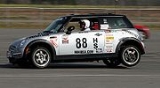
s that emphasizes safe competition and active participation. An autocross is a timed competition where drivers navigate one at a time through a defined course on either sealed or unsealed surfaces. Courses may be temporary and marked by traffic cone
Traffic cone
Traffic cones, also called traffic pylons, road cones, highway cones, safety cones, construction cones or witches' hats or safety wizards, are usually cone-shaped markers that are placed on roads or footpaths to temporarily redirect traffic in a safe manner...
s or be permanent tracks with approval by a motorsport body.
Autocross differs from road racing
Road racing
Road racing is a general term for most forms of motor racing held on paved, purpose-built race tracks , as opposed to oval tracks and off-road racing...
or oval racing in that generally there is only one car on the track racing against the clock rather than other cars.
Autocross tends to place more emphasis on car handling
Car handling
Automobile handling and vehicle handling are descriptions of the way wheeled vehicles perform transverse to their direction of motion, particularly during cornering and swerving. It also includes their stability when moving at rest. Handling and braking are the major components of a vehicle's...
and driver skill than on sheer horsepower, and events typically have many classes which allow almost any vehicle, from economy sedans to purpose-built vehicles, to compete. Due to the nature of a typical track speeds can be slower in absolute terms when compared to other forms of motorsports, usually not exceeding highway speeds, but the activity level (measured in discrete turns per minute) can be higher than even Formula One
Formula One
Formula One, also known as Formula 1 or F1 and referred to officially as the FIA Formula One World Championship, is the highest class of single seater auto racing sanctioned by the Fédération Internationale de l'Automobile . The "formula" designation in the name refers to a set of rules with which...
due to the large number of elements packed into each course.
Autocross courses are typically 1 to 2 kilometres in length. In addition to being a motor sport in its own right, autocross is a good way to learn skills that transfer to road racing or rally, as drivers learn vehicle control and club ethics.
In the United States of America, Autocross events are usually held in large paved areas like parking lots or airfields. Typically, new courses are created for each event so drivers must learn a new course each time they compete. Prior to driving, a competitor will walk the course, taking mental notes, and developing a strategy to be refined upon subsequent runs. National organizations such as the Sports Car Club of America
Sports Car Club of America
The Sports Car Club of America is a club and sanctioning body supporting road racing, rallying, and autocross in the United States. Formed in 1944, it runs many programs for both amateur and professional racers.-History:...
(SCCA) and National Auto Sport Association
National Auto Sport Association
The National Auto Sport Association is an American motorsports organization promoting road racing and high-performance driver education....
(NASA) sponsor autocross events throughout the United States, and many areas have independent autocross clubs. Automobile manufacturers and their associated clubs (e.g. the BMW Car Club of America
BMW Car Club of America
The BMW Car Club of America is an U.S.-based organization of enthusiasts and owners of BMW-made automobiles . Organized into five regions and 67 chapters, the club boasts more than 75,000 active members within the United States, making it the largest BMW owner/enthusiast organization in the world...
) sometimes hold marque autocross events.
Participation
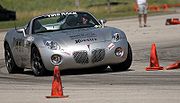
The SCCA has ladies classes for autocross which share the same rules as the open classes but limit participation to women. It is common for husbands and wives, boyfriends and girlfriends, brothers and sisters or even two unrelated drivers to share the same car, but run it in their car's open class and its corresponding ladies class. The SCCA ensures that the ladies class for any given class is never run at the same time as the matching open class, specifically to allow car sharing in this manner. Women are not, however, prohibited from running in the open classes if they desire and many do so quite successfully.
Cars and classing
Chevrolet Corvette C5 Z06
The Chevrolet Corvette C5 Z06 is a high-performance version of the C5 Corvette sports car. Introduced by Chevrolet as their corporate and performance flagship, production began in 2001 and ended with the 2004 model year.-General:...
or C6 variants) and Lotus Elise
Lotus Elise
The 1996 Lotus Elise weighed . Because of its relatively low weight, it was able to accelerate 0- in 5.8 seconds despite its relatively low power output of...
, to H Stock for Honda Civic
Honda Civic
The Honda Civic is a line of subcompact and subsequently compact cars made and manufactured by Honda. The Civic, along with the Accord and Prelude, comprised Honda's vehicles sold in North America until the 1990s, when the model lineup was expanded...
s and Mini Coopers
MINI (BMW)
Mini is a British automotive marque owned by BMW which specialises in small cars.Mini originated as a specific vehicle, a small car originally known as the Morris Mini-Minor and the Austin Seven, launched by the British Motor Corporation in 1959, and developed into a brand encompassing a range of...
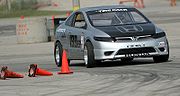
. The Stock classes allow very little change from how the car was originally manufactured; most items that can be changed are the normal wear items (filters, street-legal tires, shocks/struts, ignition wires). Just beyond Stock, there are Street Touring and Street Prepared classes which allow mild modifications, such as those to suspension (wheels, springs, shocks), external engine parts (intakes and exhaust manifolds), and interior (replacement of seats, not removal).
At the other end of the spectrum, the most significantly altered production vehicles that are mostly still street legal are the Street Modified cars, which retain production-based bodies and motors but little else that is stock. Street Modified cars often produce in excess of 350 WHP, can reach 60 mph from a standing start in less than 3.4 seconds, and can corner in excess of 1.7 transient lateral Gs
G-force
The g-force associated with an object is its acceleration relative to free-fall. This acceleration experienced by an object is due to the vector sum of non-gravitational forces acting on an object free to move. The accelerations that are not produced by gravity are termed proper accelerations, and...
. Prepared class is for production-based full-on race cars with stripped interiors, major suspension changes, heavily modified motors, and true racing slick tires. Typically, Prepared class cars are no longer legal for street use and are trailered to events. The SCCA D- and E-Modified classes also have production car backgrounds, but extend the Street Modified and Prepared allowances to silhouette level, allowing any automotive-based engine, total suspension redesign, and complete replacement of the body (typically with lightweight alloys or composites) as long as the general shape of the original car is still recognizable.
There are usually classes for purpose-built race cars imported from other series (including Formula Ford
Formula Ford
Formula Ford is a single seater, open wheel class in motorsport which exists in some form in many countries around the world. It is an entry-level series to motor racing....
s, Formula Atlantic
Formula Atlantic
Formula Atlantic is a specification of open wheel racing car developed in the 1970s. It was used in professional racing through the IMSA Atlantic Championship until 2009 and is currently primarily used in amateur racing through Sports Car Club of America Formula Atlantic.-History:The history of...
s, Formula 500
Formula 500
Formula 500 is a Sports Car Club of America and Midwestern Council of Sports Car Clubs open wheel road racing class.Formula 500 was originally introduced in the early 1980s as Formula 440...
s and vehicles similar to American oval-track stock cars) but most autocross cars are based on production cars.
The fastest autocross cars are purpose-built "specials" (A Modified in SCCA Solo) with small lightweight bodies, sticky tires, wild wings, powerful engines, and short gears. While their top speeds are typically limited by gearing, their transient cornering capabilities far exceed those of vehicles not expressly designed for autocross use.
Related motorsports
In the United States the sport described here is commonly known as autocross (it is also known as "Solo," the SCCA's brand name for it) but other regions of the world have different names for it. Certain parts of CanadaCanada
Canada is a North American country consisting of ten provinces and three territories. Located in the northern part of the continent, it extends from the Atlantic Ocean in the east to the Pacific Ocean in the west, and northward into the Arctic Ocean...
and Eastern European countries (Russia
Russia
Russia or , officially known as both Russia and the Russian Federation , is a country in northern Eurasia. It is a federal semi-presidential republic, comprising 83 federal subjects...
, Ukraine
Ukraine
Ukraine is a country in Eastern Europe. It has an area of 603,628 km², making it the second largest contiguous country on the European continent, after Russia...
, Moldova
Moldova
Moldova , officially the Republic of Moldova is a landlocked state in Eastern Europe, located between Romania to the West and Ukraine to the North, East and South. It declared itself an independent state with the same boundaries as the preceding Moldavian Soviet Socialist Republic in 1991, as part...
), for instance, call it autoslalom. In the United Kingdom
United Kingdom
The United Kingdom of Great Britain and Northern IrelandIn the United Kingdom and Dependencies, other languages have been officially recognised as legitimate autochthonous languages under the European Charter for Regional or Minority Languages...
it is known as autosolo
Autosolo
AutoSolo in the United Kingdom is a form of Motorsport based around the principles of autotesting, the main differences being that the tests are run in a forward direction only and are usually slightly faster and more open than traditional Autotests...
and autocross
British autocross
In the United Kingdom, autocrosses are typically held on a grass or stubble surface. In fact the attraction is the challenge of driving quickly on challenging and difficult surfaces. Cars compete individually against the clock, although more than one car may start at the same time if the circuit is...
refers to a similar sport that is held on unpaved surfaces like grass and dirt (also see SCCA RallyCross
SCCA RallyCross
RallyCross, also known as RallyX, is a type of car competition in the U.S.A. and Canada, sanctioned by Sports Car Club of America , National Auto Sport Association , and in Canada...
). In Southeast Asia, countries like Malaysia and Thailand
Thailand
Thailand , officially the Kingdom of Thailand , formerly known as Siam , is a country located at the centre of the Indochina peninsula and Southeast Asia. It is bordered to the north by Burma and Laos, to the east by Laos and Cambodia, to the south by the Gulf of Thailand and Malaysia, and to the...
refer to the sport as autokhana.
Motorkhana
Motorkhana
Motorkhana is a low-cost form of motorsport, unique to Australia and New Zealand but similar to autotesting in the UK and Ireland and somewhat similar to autocross in the US. It involves manoeuvring a car through tight tests as quickly as possible - one car at a time - on either dirt or bitumen...
(as it is known in Australia and New Zealand) and autotesting
Autotesting
Autotesting involves a series of tests, generally around traffic cones, to measure precision driving skill. The tests often include stopping with the front and rear wheels straddling a line, and always end stopping in a garage . Sections of each test are usually completed in reverse...
(UK and Ireland) are related sports. With speeds rarely exceeding 40 mph (60 km/h), both motorkhana and autotesting are slower than American autocross, require handbraking, and have sections that must be negotiated in reverse. On the other hand, autocross speeds can reach over 60 mph (100 km/h) and courses that would require the driver to enter reverse are generally prohibited in autocross. Handbraking is also not usually necessary on a typical autocross course.
These are similar to the Japanese gymkhana
Gymkhana (motorsport)
Gymkhana is a type of motorsport practiced in an increasing number of countries. Similar to autocross, gymkhana courses are often very complex and memorizing the course is a significant part of achieving a fast time....
, another type of handling competition. Gymkhanas are even tighter than motorkhanas and autotests, with numerous 360-degree turns around cones and courses that loop back upon themselves. Fast times require a lot of sliding and the end result ends up looking similar to a cross between autocross and drifting
Drifting (motorsport)
Drifting refers to a driving technique and to a motorsport where the driver intentionally over steers, causing loss of traction in the rear wheels through turns, while maintaining vehicle control and a high exit speed...
. Gymkhanas do not usually require entering reverse gear.
In ProSolo, an SCCA-sanctioned variant of autocross, two cars run side-by side on mirror-image courses after starting at a "Christmas tree" starting system similar to that used in drag racing
Drag racing
Drag racing is a competition in which specially prepared automobiles or motorcycles compete two at a time to be the first to cross a set finish line, from a standing start, in a straight line, over a measured distance, most commonly a ¼-mile straight track....
.
Further reading
- Watts, Henry (January 1990). Secrets of Solo Racing: Expert Techniques for Autocrossing and Time Trials. Loki Pub. Co. ISBN 0-9620573-1-2.
- Turner, Richard (1977). Winning autocross solo II competition: The art and the science. National Academy for Police Driving. ISBN 0-932522-01-7.
- Pagel, Jim (1972). How to win at slalom & autocross. ISBN 0-87112-053-4.