

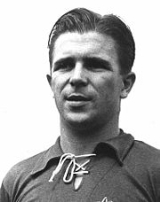
Ferenc Puskás

Encyclopedia
Ferenc Puskás (ˈfɛrɛnt͡s ˈpuʃkaːʃ; born Ferenc Purczeld; 1 April 1927 – 17 November 2006) was a Hungarian
footballer
and manager
. He scored 84 goals in 85 international matches for Hungary
, and 514 goals in 529 matches in the Hungarian
and Spanish
leagues. He became Olympic champion in 1952 and was a World Cup finalist in 1954. He won three European Cups
(1959, 1960, 1966), 10 national championships (5 Hungarian & 5 Spanish Primera División
) and 8 top individual scoring honors.
Puskás started his career in Hungary playing for Kispest and Budapest Honvéd
. He was top scorer in the Hungarian League
on four occasions, and in 1948, he was the top goal scorer in Europe. During the 1950s, he was both a prominent member and captain of the Hungarian national team
, known as the Mighty Magyars. In 1958, two years after the Hungarian Revolution, he emigrated to Spain where he played for Real Madrid
.
While playing with Real Madrid, Puskás won four Pichichis and scored seven goals in two European Champions Cup
finals. In 1995, he was recognized as the top scorer of the 20th century by the IFFHS
.
After retiring as a player, he became a coach. The highlight of his coaching career came in 1971 when he guided Panathinaikos
to the European Cup final, where they lost 2–0 to AFC Ajax. Despite his defection in 1956, the Hungarian government granted him a full pardon in 1993, allowing him to return and take temporary charge of the Hungarian national team. In 1998, he became one of the first ever FIFA/SOS Charity ambassadors. In 2002, the Népstadion in Budapest was renamed the Puskás Ferenc Stadion
in his honor. He was also declared the best Hungarian player of the last 50 years by the Hungarian Football Federation
in the UEFA Jubilee Awards
in November 2003. In October 2009, FIFA announced the introduction of the FIFA Puskás Award
, awarded to the player who has scored the "most beautiful goal" over the past year.
and brought up in Kispest
, then a village near the city. He was ten years old when his father Ferenc Sr.
changed the family surname to Puskás. He began his career as a junior with Kispest AC, where his father, who had previously played for the club, was a coach.
He initially used the pseudonym Miklós Kovács to help circumvent the minimum age rules before officially signing at the age of 12. Among his early teammates was his childhood friend and future international teammate József Bozsik
. He made his first senior appearance for Kispest in November 1943 in a match against Nagyváradi AC. It was here where he got the nickname "Öcsi" or "Buddy".
Kispest was taken over by the Hungarian Ministry of Defence in 1949, becoming the Hungarian Army
team and changing its name to Budapest Honvéd
. As a result, football players were given military ranks. Puskás eventually became a major, which led to the nickname "The Galloping Major". As the army club, Honvéd used conscription to acquire the best Hungarian players, leading to the recruitment of Zoltán Czibor
and Sándor Kocsis
. During his career at Budapest Honvéd, Puskás helped the club win five Hungarian League
titles. He also finished as top goal scorer in the league in 1947–48, 1949–50, 1950 and 1953, scoring 50, 31, 25 and 27 goals, respectively. In 1948, he was the top goal scorer in Europe.
team on 20 August 1945 and scored in a 5–2 win over Austria
. He went onto play 85 games and scored 84 times for Hungary. His international goal record included two hat tricks against Austria, one against Luxembourg
and four goals in a 12–0 win over Albania
. Together with Zoltán Czibor
, Sándor Kocsis
, József Bozsik
, and Nándor Hidegkuti
, he formed the nucleus of the Golden Team that was unbeaten for 32 consecutive games. During this run, they became Olympic Champions
in 1952, beating Yugoslavia
2–0 in the final in Helsinki
. Puskás scored four times at the Olympic tournament, including the opening goal in the final. They also defeated England
twice, firstly with a 6–3 win
at Wembley Stadium., and then 7–1 in Budapest. Puskás scored two goals in each game against England. In 1953, they also became Central European Champions. Hungary won the championship after finishing top of the table with 11 points. Puskás finished the tournament as top scorer with 10 goals and scored twice as Hungary claimed the trophy with a 3–0 win over Italy
at the Stadio Olimpico
in 1953.
Puskás scored three goals in the two first-round matches Hungary played at the 1954 FIFA World Cup
. They defeated South Korea 9–0 and then West Germany
8–3. In the latter game, he suffered a hairline fracture of the ankle after a tackle by Werner Liebrich
, and did not return until the final.
Puskás played the entire 1954 World Cup final
against West Germany
with the hairline fracture. Despite this, he scored his fourth goal of the tournament to put Hungary ahead after six minutes, and with Czibor adding another goal two minutes later, it seemed that the pre-tournament favorites would take the title. However, the West Germans pulled back two goals before half time, with six minutes left the West Germans scored the winner. Two minutes from the end of the match, Puskás appeared to score an equalizer but the goal was disallowed due to an offside call.
and the round in question. When there is a special article on the match in question, the link is in the column for round.
entered the European Cup in 1956 and were drawn against Atlético Bilbao
in the first round. Honvéd lost the away leg 2–3, but before the home leg could be played, the Hungarian Revolution erupted in Budapest. The players decided against going back to Hungary and arranged for the return with Atlético to be played at Heysel Stadium
in Brussels
, Belgium. Puskás scored in the subsequent 3–3 draw but Honvéd were eliminated 6–5 on aggregate, and the Hungarian players were left in limbo. They summoned their families from Budapest, and despite opposition from FIFA
and the Hungarian football authorities, they organised a fundraising tour of Italy, Portugal, Spain, and Brazil. After returning to Europe, the players parted ways. Some, including Bozsik, returned to Hungary while others, including Czibor, Kocsis and Puskás, found new clubs in Western Europe
.
. At the same time, both AC Milan
and Juventus
attempted to sign him, but then he received a two-year ban from UEFA
(for refusing to return to Budapest ) which prevented him from playing in Europe. He moved to Austria and then Italy. After his ban, Puskás tried to play in Italy but was not able to find a top-flight club willing to sign him, as Italian managers were concerned about his age and weight. He was considered by Manchester United
to strengthen a squad ravaged by the Munich Air Disaster
in 1958, but because of FA
rules regarding foreigners and Puskás' not knowing the English language, stand-in manager Jimmy Murphy could not fulfil his wish of signing the Hungarian. However, a few months later, Puskás joined Real Madrid
and at the age of 31 embarked on the second phase of his career.
During his first La Liga
season, Puskás scored four hat-tricks, including one in his second game, against Sporting de Gijón
on 21 September 1958. In the game against UD Las Palmas
on 4 January 1959, Puskás and Alfredo di Stéfano
scored hat-tricks in a 10–1 win. During the 1960–61 season, Puskás scored four times in a game against Elche CF
and the following season, he scored five goals against the same team. Puskás scored two hat-tricks against FC Barcelona
in 1963, one at the Bernabéu
and one at the Camp Nou
. During eight seasons with Real, Puskás played 180 La Liga games and scored 156 goals. He scored 20 or more goals in each of his first six seasons in the Spanish league, and won the Pichichi four times: in 1960, 1961, 1963, and 1964, scoring 26, 27, 26 and 20 goals, respectively. He helped Real win La Liga five times in a row between 1961 and 1965 and the Copa del Generalísimo in 1962. He scored both goals in the 2–1 victory over Sevilla FC
in the Copa final.
Puskás also played a further 39 games for Real in the European Cup
, scoring 35 goals. He helped Real reach the final of the 1959 European Cup, scoring in the first leg and in the decisive replay of the semi-final against Atlético Madrid, but missed the final due to injury. In the following season he began Real's 1960 European Cup campaign with a hat-trick against Jeunesse Esch
and in the semi-final against FC Barcelona, he once again guided Real into the final with three goals over two legs. In the final itself, Real beat Eintracht Frankfurt
7–3 with Puskás scoring four goals and di Stéfano scoring three. In subsequent European campaigns, he would score a further three hat-tricks, including one in the 1962 final against Benfica, which Real lost 5–3. In 1965, he scored five goals over two games against Feyenoord as he helped Real Madrid to the 1966 European Cup final - Real won the game, but Puskas did not play in the final.
. Three of these games were at the 1962 World Cup
. For once, his goalscoring form deserted him and he failed to score any goals for Spain.
, the English
non-league side, in front of a 10,000-strong sell-out crowd at the club's Holly Park stadium.
In 1971 he guided Panathinaikos
of Greece to the European Cup final, the only time a Greek club has reached a European final to date. In the qualifying rounds they beat Everton
in the quarter-finals on away goals, then defeated Red Star Belgrade
in the semi's. In the final Panathinaikos lost 2–0 to Johan Cruyff
's Ajax. During his five-year tenure at Panathinaikos, Puskás helped the team secure two Greek Championships
. However, with the notable exception of his spell at Panathinaikos, Puskás failed to transfer his success as a player to his coaching career.
Despite his wide travels, his only other success came with South Melbourne Hellas, with whom he won the National Soccer League
title in 1991.
When Wolverhampton Wanderers
opened their new stadium Molineux
in 1993, Puskás visited the newly opened stadium as an honorary guest to watch the friendly match between Wolves and Budapest Honvéd, which was a match to christen the new opening of the stadium. This was because in the 1950s, Wolves played a game against Honvéd in a memorable friendly match, which Puskás played in. Wolves won the match 3–2.
In 1993 he took charge of the Hungarian national football team
for four games, including a 4-2 friendly victory against the Republic of Ireland
in Dublin, where Hungary came from two goals down to eventually beat their opponents.
in 2000. He was admitted to a Budapest hospital in September 2006 and died on 17 November 2006 of pneumonia
. He is survived by his wife of 57 years, Erzsébet, and their daughter, Anikó. In a state funeral
, his coffin was moved from Puskás Ferenc Stadion
to Heroes' Square
for a military salute
. He was laid to rest under the dome of the St Stephen's Basilica in Budapest on 9 December 2006.
A street named Újtemető utca near Stadium Bozsik in the Hungarian capital of Budapest (specifically the district of Kispest) was renamed after Puskás precisely one year after the footballer's death.
Sol de América
South Melbourne Hellas
|1943–44
||rowspan="7"|Kispest
||rowspan="7"|National Championship I||18||7||||||||||||
|-
|1944
||14||7||||||||||||
|-
|1945
||20||10||||||||||||
|-
|1945–46
||33||35||||||||||||
|-
|1946–47
||30||32||||||||||||
|-
|1947–48
||32||50||||||||||||
|-
|1948–49
||30||46||||||||||||
|-
|1949–50
||rowspan="7"|Budapest Honvéd
||rowspan="7"|National Championship I||30||31||||||||||||
|-
|1950
||15||25||||||||||||
|-
|1951
||21||21||||||||||||
|-
|1952
||26||22||||||||||||
|-
|1953
||26||27||||||||||||
|-
|1954
||20||21||||||||||||
|-
|1955
||26||18||||||4||4||30||22
|-
|1958–59||rowspan="8"|Real Madrid
||rowspan="8"|La Liga
||24||21||5||2||5||2||29||23
|-
|1959–60||24||25||5||10||9||12||38||47
|-
|1960–61||28||28||9||14||2||0||39||42
|-
|1961–62||23||20||8||13||9||7||40||40
|-
|1962–63||30||26||7||5||2||0||39||31
|-
|1963–64||25||21||0||0||8||7||33||28
|-
|1964–65||18||11||4||4||3||2||25||17
|-
|1965–66||8||4||3||1||3||5||14||10
341||352||11||17||6||5||358||374
180||156||41||49||41||37||262||242
521||508||52||66||47||42||620||616
|}
|-
|1945||2||3
|-
|1946||3||3
|-
|1947||5||5
|-
|1948||6||7
|-
|1949||8||11
|-
|1950||6||12
|-
|1951||3||4
|-
|1952||12||10
|-
|1953||7||6
|-
|1954||11||8
|-
|1955||12||10
|-
|1956||10||5
|-
!Total||85||84
|}
|-
|1961||1||0
|-
|1962||3||0
|-
!Total||4||0
|}
Hungary
Hungary , officially the Republic of Hungary , is a landlocked country in Central Europe. It is situated in the Carpathian Basin and is bordered by Slovakia to the north, Ukraine and Romania to the east, Serbia and Croatia to the south, Slovenia to the southwest and Austria to the west. The...
footballer
Football (soccer)
Association football, more commonly known as football or soccer, is a sport played between two teams of eleven players with a spherical ball...
and manager
Coach (sport)
In sports, a coach is an individual involved in the direction, instruction and training of the operations of a sports team or of individual sportspeople.-Staff:...
. He scored 84 goals in 85 international matches for Hungary
Hungary national football team
The Hungary national football team represents Hungary in international football and is controlled by the Hungarian Football Federation....
, and 514 goals in 529 matches in the Hungarian
Hungarian League
The Nemzeti Bajnokság is a Hungarian professional league for association football clubs. The league is currently known as the OTP Bank Liga for sponsorship reasons, and it is the highest level of professional league since its inception in 1901. UEFA currently ranks the league 35th in Europe.Sixteen...
and Spanish
La Liga
The Primera División of the Liga Nacional de Fútbol Profesional , commonly known as La Liga or, for sponsorship reasons, Liga BBVA since 2008, is the top professional association football division of the Spanish football league system...
leagues. He became Olympic champion in 1952 and was a World Cup finalist in 1954. He won three European Cups
UEFA Champions League
The UEFA Champions League, known simply the Champions League and originally known as the European Champion Clubs' Cup or European Cup, is an annual international club football competition organised by the Union of European Football Associations since 1955 for the top football clubs in Europe. It...
(1959, 1960, 1966), 10 national championships (5 Hungarian & 5 Spanish Primera División
La Liga
The Primera División of the Liga Nacional de Fútbol Profesional , commonly known as La Liga or, for sponsorship reasons, Liga BBVA since 2008, is the top professional association football division of the Spanish football league system...
) and 8 top individual scoring honors.
Puskás started his career in Hungary playing for Kispest and Budapest Honvéd
Budapest Honvéd FC
Budapest Honvéd FC |football]] team. "Honved" means the Homeland Defense. Originally formed as Kispest AC, they became Kispest FC in 1926 before reverting to their original name in 1944. The team enjoyed a golden age during the 1950s when it was renamed Budapest Honvéd SE and became the Hungarian...
. He was top scorer in the Hungarian League
Hungarian League
The Nemzeti Bajnokság is a Hungarian professional league for association football clubs. The league is currently known as the OTP Bank Liga for sponsorship reasons, and it is the highest level of professional league since its inception in 1901. UEFA currently ranks the league 35th in Europe.Sixteen...
on four occasions, and in 1948, he was the top goal scorer in Europe. During the 1950s, he was both a prominent member and captain of the Hungarian national team
Hungary national football team
The Hungary national football team represents Hungary in international football and is controlled by the Hungarian Football Federation....
, known as the Mighty Magyars. In 1958, two years after the Hungarian Revolution, he emigrated to Spain where he played for Real Madrid
Real Madrid C.F.
Real Madrid Club de Fútbol , commonly known as Real Madrid, is a professional football club based in Madrid, Spain. The club have won a record 31 La Liga titles, the Primera División of the Liga de Fútbol Profesional , 18 Copas del Rey, 8 Spanish Super Cups, 1 Copa Eva Duarte and 1 Copa de la...
.
While playing with Real Madrid, Puskás won four Pichichis and scored seven goals in two European Champions Cup
UEFA Champions League
The UEFA Champions League, known simply the Champions League and originally known as the European Champion Clubs' Cup or European Cup, is an annual international club football competition organised by the Union of European Football Associations since 1955 for the top football clubs in Europe. It...
finals. In 1995, he was recognized as the top scorer of the 20th century by the IFFHS
International Federation of Football History & Statistics
The International Federation of Football History & Statistics is an organization that chronicles the history and records of Association football. It was founded on 27 March 1984 at Leipzig by Dr. Alfredo Pöge with the blessings of general secretary of the FIFA at the time, Dr. Helmut Käser...
.
After retiring as a player, he became a coach. The highlight of his coaching career came in 1971 when he guided Panathinaikos
Panathinaikos FC
Panathinaikos Football Club is a Greek professional football club based in Athens. Founded in 1908, they play in the Super League Greece and are one of the oldest and most successful clubs in Greek football history. They have won 20 Greek Championships and 17 Greek Cups.Panathinaikos is the most...
to the European Cup final, where they lost 2–0 to AFC Ajax. Despite his defection in 1956, the Hungarian government granted him a full pardon in 1993, allowing him to return and take temporary charge of the Hungarian national team. In 1998, he became one of the first ever FIFA/SOS Charity ambassadors. In 2002, the Népstadion in Budapest was renamed the Puskás Ferenc Stadion
Stadium Puskás Ferenc
Ferenc Puskás Stadium is a multi-purpose stadium in Budapest, Hungary. It is situated on the Pest side of the capital between the Stadionok and the Keleti Palyaudvar metro stations. It is currently used mainly for football matches. The stadium is going to be demolished sometime in 2012 and...
in his honor. He was also declared the best Hungarian player of the last 50 years by the Hungarian Football Federation
Hungarian Football Federation
The Hungarian Football Federation is the governing body of football in Hungary. It organizes the Hungarian league and the Hungarian national team. It is based in Budapest.György Szepesi was Chairman of the Hungarian Football Association from 1978 to 1986....
in the UEFA Jubilee Awards
UEFA Jubilee Awards
To celebrate the Union of European Football Associations 's 50th anniversary in 2004, each of its member associations was asked by UEFA to choose one of its own players as the single most outstanding player of the past 50 years . The 52 players were known as the Golden Players...
in November 2003. In October 2009, FIFA announced the introduction of the FIFA Puskás Award
FIFA Puskas Award
The FIFA Puskás Award is an award established on 20 October 2009 by FIFA at the behest of FIFA President Sepp Blatter in order to award the player, male or female, judged to have scored the most aesthetically significant and "most beautiful" goal of the year...
, awarded to the player who has scored the "most beautiful goal" over the past year.
Early years
Puskás was born as Ferenc Purczeld in BudapestBudapest
Budapest is the capital of Hungary. As the largest city of Hungary, it is the country's principal political, cultural, commercial, industrial, and transportation centre. In 2011, Budapest had 1,733,685 inhabitants, down from its 1989 peak of 2,113,645 due to suburbanization. The Budapest Commuter...
and brought up in Kispest
Kispest
Kispest is the 19th district of Budapest, Hungary. It lies to the south-southeast of the historical Pest city. It was founded in 1871 on rural land as a small village beside the city limits of Budapest, so it was named Kispest . From 1880 to 1990 Kispest's population increased from 1820 to...
, then a village near the city. He was ten years old when his father Ferenc Sr.
Ferenc Puskás I
Ferenc Puskás I, born Ferenc Purczeld, also referred to as Puskás Ferenc , was a Hungarian football player and manager. He was the father of the legendary Ferenc Puskás Biro, who is commonly referred to as Ferenc Puskás....
changed the family surname to Puskás. He began his career as a junior with Kispest AC, where his father, who had previously played for the club, was a coach.
He initially used the pseudonym Miklós Kovács to help circumvent the minimum age rules before officially signing at the age of 12. Among his early teammates was his childhood friend and future international teammate József Bozsik
József Bozsik
József Bozsik was a Hungarian footballer. He represented Hungary in various international tournaments, and is a member of the Mighty Magyars.-Biography:...
. He made his first senior appearance for Kispest in November 1943 in a match against Nagyváradi AC. It was here where he got the nickname "Öcsi" or "Buddy".
Kispest was taken over by the Hungarian Ministry of Defence in 1949, becoming the Hungarian Army
Military of Hungary
The Hungarian Defence Force is the national military of Hungary. It currently has two branches, the Hungarian Ground Force and the Hungarian Air Force....
team and changing its name to Budapest Honvéd
Budapest Honvéd FC
Budapest Honvéd FC |football]] team. "Honved" means the Homeland Defense. Originally formed as Kispest AC, they became Kispest FC in 1926 before reverting to their original name in 1944. The team enjoyed a golden age during the 1950s when it was renamed Budapest Honvéd SE and became the Hungarian...
. As a result, football players were given military ranks. Puskás eventually became a major, which led to the nickname "The Galloping Major". As the army club, Honvéd used conscription to acquire the best Hungarian players, leading to the recruitment of Zoltán Czibor
Zoltán Czibor
Zoltán Czibor Suhai , also referred to as Czibor Zoltán, was a Hungarian footballer who played for several Hungarian clubs, including Ferencváros TC and Honvéd, and Hungary before joining CF Barcelona. Czibor played as a left-winger or striker and was notable for having a powerful shot, good...
and Sándor Kocsis
Sándor Kocsis
Sándor Kocsis Péter was a Hungarian footballer who played for Ferencváros TC, Budapest Honvéd, Young Fellows Zürich, FC Barcelona and Hungary. During the 1950s, along with Ferenc Puskás, Zoltán Czibor, József Bozsik and Nándor Hidegkuti, he was a member of the Mighty Magyars...
. During his career at Budapest Honvéd, Puskás helped the club win five Hungarian League
Hungarian League
The Nemzeti Bajnokság is a Hungarian professional league for association football clubs. The league is currently known as the OTP Bank Liga for sponsorship reasons, and it is the highest level of professional league since its inception in 1901. UEFA currently ranks the league 35th in Europe.Sixteen...
titles. He also finished as top goal scorer in the league in 1947–48, 1949–50, 1950 and 1953, scoring 50, 31, 25 and 27 goals, respectively. In 1948, he was the top goal scorer in Europe.
Mighty Magyars
Puskás made his debut for HungaryHungary national football team
The Hungary national football team represents Hungary in international football and is controlled by the Hungarian Football Federation....
team on 20 August 1945 and scored in a 5–2 win over Austria
Austria national football team
The Austria national football team is the association football team that represents the country of Austria in international competition and is controlled by the Austrian Football Association ....
. He went onto play 85 games and scored 84 times for Hungary. His international goal record included two hat tricks against Austria, one against Luxembourg
Luxembourg national football team
The Luxembourg national football team is the national football team of Luxembourg, and is controlled by the Luxembourg Football Federation. The team play most of their home matches at the Stade Josy Barthel, in Luxembourg.- History :...
and four goals in a 12–0 win over Albania
Albania national football team
The Albania national association football team is the national association football team of Albania and is controlled by the Football Association of Albania...
. Together with Zoltán Czibor
Zoltán Czibor
Zoltán Czibor Suhai , also referred to as Czibor Zoltán, was a Hungarian footballer who played for several Hungarian clubs, including Ferencváros TC and Honvéd, and Hungary before joining CF Barcelona. Czibor played as a left-winger or striker and was notable for having a powerful shot, good...
, Sándor Kocsis
Sándor Kocsis
Sándor Kocsis Péter was a Hungarian footballer who played for Ferencváros TC, Budapest Honvéd, Young Fellows Zürich, FC Barcelona and Hungary. During the 1950s, along with Ferenc Puskás, Zoltán Czibor, József Bozsik and Nándor Hidegkuti, he was a member of the Mighty Magyars...
, József Bozsik
József Bozsik
József Bozsik was a Hungarian footballer. He represented Hungary in various international tournaments, and is a member of the Mighty Magyars.-Biography:...
, and Nándor Hidegkuti
Nándor Hidegkuti
Nándor Hidegkuti was a Hungarian football player and manager. He played as a forward or attacking midfielder and spent the majority of his playing career at MTK Hungária FC. During the 1950s he was also a member of the Hungarian National Team team known as the Golden Team...
, he formed the nucleus of the Golden Team that was unbeaten for 32 consecutive games. During this run, they became Olympic Champions
Football at the 1952 Summer Olympics
The 1952 Olympic football tournament signalled the arrival of the 'Golden Team'; the 'Magical Magyars': Hungary. Ferenc Puskás, the great Hungarian known as the 'Galloping Major' for his military title, said of the 1952 competition: "It was during the Olympics that our football first started to...
in 1952, beating Yugoslavia
Yugoslavia national football team
The Yugoslavia national football team represented the Kingdom of Yugoslavia and the Socialist Federal Republic of Yugoslavia in association football. It enjoyed a modicum of success in international competition. In 1992, during the Yugoslav wars, the team was suspended from international...
2–0 in the final in Helsinki
Helsinki
Helsinki is the capital and largest city in Finland. It is in the region of Uusimaa, located in southern Finland, on the shore of the Gulf of Finland, an arm of the Baltic Sea. The population of the city of Helsinki is , making it by far the most populous municipality in Finland. Helsinki is...
. Puskás scored four times at the Olympic tournament, including the opening goal in the final. They also defeated England
England national football team
The England national football team represents England in association football and is controlled by the Football Association, the governing body for football in England. England is the joint oldest national football team in the world, alongside Scotland, whom they played in the world's first...
twice, firstly with a 6–3 win
England v Hungary (1953)
England v Hungary was an international football game played on November 25, 1953. The game was played between Hungary - then the world's number one ranked team, the Olympic champions and on a run of 24 unbeaten games - and England, then the world's number three ranked team, the inventors of the...
at Wembley Stadium., and then 7–1 in Budapest. Puskás scored two goals in each game against England. In 1953, they also became Central European Champions. Hungary won the championship after finishing top of the table with 11 points. Puskás finished the tournament as top scorer with 10 goals and scored twice as Hungary claimed the trophy with a 3–0 win over Italy
Italy national football team
The Italy National Football Team , represents Italy in association football and is controlled by the Italian Football Federation , the governing body for football in Italy. Italy is the second most successful national team in the history of the World Cup having won four titles , just one fewer than...
at the Stadio Olimpico
Stadio Olimpico
The Stadio Olimpico is the main and largest sports facility of Rome, Italy. It is located within the Foro Italico sports complex on the north of the city. An asset of the Italian National Olympic Committee, the structure is intended primarily for football...
in 1953.
Puskás scored three goals in the two first-round matches Hungary played at the 1954 FIFA World Cup
1954 FIFA World Cup
The 1954 FIFA World Cup, the fifth staging of the FIFA World Cup, was held in Switzerland from 16 June to 4 July. Switzerland was chosen as hosts in July 1946. The tournament set a number of all-time records for goal-scoring, including the highest average goals scored per game...
. They defeated South Korea 9–0 and then West Germany
Germany national football team
The Germany national football team is the football team that has represented Germany in international competition since 1908. It is governed by the German Football Association , which was founded in 1900....
8–3. In the latter game, he suffered a hairline fracture of the ankle after a tackle by Werner Liebrich
Werner Liebrich
Werner Liebrich was a German footballer who played in the centre back position. He is notable for his role in West Germany's triumph in the 1954 FIFA World Cup, and spending his entire playing career of almost twenty years with hometown club Kaiserslautern, with whom he also briefly coached.-Early...
, and did not return until the final.
Puskás played the entire 1954 World Cup final
1954 FIFA World Cup Final
- External links :* - fifa.com, FIFA, 2002.*...
against West Germany
Germany national football team
The Germany national football team is the football team that has represented Germany in international competition since 1908. It is governed by the German Football Association , which was founded in 1900....
with the hairline fracture. Despite this, he scored his fourth goal of the tournament to put Hungary ahead after six minutes, and with Czibor adding another goal two minutes later, it seemed that the pre-tournament favorites would take the title. However, the West Germans pulled back two goals before half time, with six minutes left the West Germans scored the winner. Two minutes from the end of the match, Puskás appeared to score an equalizer but the goal was disallowed due to an offside call.
Ferenc Puskás’ statistics in the 1952 Helsinki Olympics
The scores contain links to the article on football in the Helsinki Olympics and the round in question.| Game no. | Round | Date | Opponent | Puskás’ playing time | Score | Puskás’ goals | Score | Times | Venue | Report |
|---|---|---|---|---|---|---|---|---|---|---|
| 1 | Prel. R. | 15 July 1952 | 90 min. | 2–1 (1–0) | 0 | — | — | Kupittaa, Turku Veritas Stadion Veritas Stadion is a football stadium in Turku, Finland. It is situated in the district of Kupittaa, in an area dedicated to sporting venues... |
||
| 2 | 1st R | 21 July 1952 | 90 min. | 3–0 (2–0) | 0 | — | — | Pallokenttä, Helsinki | ||
| 3 | QF | 24 July 1952 | 90 min | 7–1 (2–0) | 2 | 4–0 6–1 |
Urheilukeskus, Kotka Arto Tolsa Areena Arto Tolsa Areena is a football stadium in Kotka, Finland. It is the home stadium of KTP and FC KooTeePee. The stadium holds 4,780 and was inaugurated in 1952 for the Helsinki Olympics. The stadium's record attendance was made during the Olympic Games in the football match between the Soviet... |
|||
| 4 | SF | 28 July 1952 | 90 min | 6–0 (3–0) | 1 | 1–0 | Helsinki Olympic Stadium Helsinki Olympic Stadium The Helsinki Olympic Stadium , located in the Töölö district about from the center of the Finnish capital Helsinki, is the largest stadium in the country, nowadays mainly used for hosting sports events and big concerts. The stadium is best known for being the center of activities in the 1952... |
|||
| 5 | Final | 2 August 1952 | 90 min | 2–0 (0–0) | 1 | 1–0 | Helsinki Olympic Stadium Helsinki Olympic Stadium The Helsinki Olympic Stadium , located in the Töölö district about from the center of the Finnish capital Helsinki, is the largest stadium in the country, nowadays mainly used for hosting sports events and big concerts. The stadium is best known for being the center of activities in the 1952... |
Ferenc Puskás’ statistics in the 1954 World Cup in Switzerland
The scores contain links to the article on 1954 FIFA World Cup1954 FIFA World Cup
The 1954 FIFA World Cup, the fifth staging of the FIFA World Cup, was held in Switzerland from 16 June to 4 July. Switzerland was chosen as hosts in July 1946. The tournament set a number of all-time records for goal-scoring, including the highest average goals scored per game...
and the round in question. When there is a special article on the match in question, the link is in the column for round.
| Game no. | Round | Date | Opponent | Puskás’ playing time | Score | Puskás’ goals | Score | Times | Venue | Report |
|---|---|---|---|---|---|---|---|---|---|---|
| 1 | Group 2 | 17 June 1954 | 90 min. | 9–0 (4–0) | 2 | 1–0 9–0 |
Hardturm Stadium Hardturm The Hardturm was a football stadium located in Zurich's Kreis 5. Opened in 1929, it was the home of the Grasshopper-Club Zürich. It was a host stadium for the 1954 FIFA World Cup.... , Zürich Zürich Zurich is the largest city in Switzerland and the capital of the canton of Zurich. It is located in central Switzerland at the northwestern tip of Lake Zurich... |
|||
| 2 | Group 2 | 20 June 1954 | 90 min | 8–3 (3–1) | 1 | 2–0 | St. Jakob Stadium St. Jakob Stadium The St. Jakob Stadium was a football stadium in Basel, Switzerland and the former home of Swiss club FC Basel. It was built in 1954, and as well as serving as a club stadium, it hosted several important matches, including a 1954 FIFA World Cup semi-final and four Cup Winners' Cup finals.Tickets and... , Basel Basel Basel or Basle In the national languages of Switzerland the city is also known as Bâle , Basilea and Basilea is Switzerland's third most populous city with about 166,000 inhabitants. Located where the Swiss, French and German borders meet, Basel also has suburbs in France and Germany... |
|||
| – | QF Battle of Berne The Battle of Berne is used to refer to a quarter-final match at the 1954 World Cup between Hungary and Brazil, played on June 27, 1954 at the Wankdorf Stadium in Berne, Switzerland.... |
27 June 1954 | Did not play | 4–2 (2–1) | 0 | – | — | Wankdorf Stadium Wankdorf Stadium The Wankdorf Stadium was a football stadium in the Wankdorf quarter of Bern, Switzerland, and the former home of Swiss club BSC Young Boys. It was built in 1925, and as well as serving as a club stadium, it hosted several important matches, including the 1954 FIFA World Cup Final, the 1961... , Bern |
||
| – | SF | 30 June 1954 | Did not play | 4–2 (a.e.t.) (2–2, 1–0) |
0 | – | — | Stade Olympique de la Pontaise Stade Olympique de la Pontaise Stade Olympique de la Pontaise is a multi-purpose stadium in Lausanne, Switzerland. The stadium holds 15,850 people and was built in 1904.During the 1954 FIFA World Cup, the stadium hosted five games.It is used mostly for football matches... , Lausanne Lausanne Lausanne is a city in Romandy, the French-speaking part of Switzerland, and is the capital of the canton of Vaud. The seat of the district of Lausanne, the city is situated on the shores of Lake Geneva . It faces the French town of Évian-les-Bains, with the Jura mountains to its north-west... |
||
| 3 | Final 1954 FIFA World Cup Final - External links :* - fifa.com, FIFA, 2002.*... |
4 July 1954 | 90 min | 2–3 (2–2) | 1 | 1–0 | Wankdorf Stadium Wankdorf Stadium The Wankdorf Stadium was a football stadium in the Wankdorf quarter of Bern, Switzerland, and the former home of Swiss club BSC Young Boys. It was built in 1925, and as well as serving as a club stadium, it hosted several important matches, including the 1954 FIFA World Cup Final, the 1961... , Bern |
Honvéd World Tour
Budapest HonvédBudapest Honvéd FC
Budapest Honvéd FC |football]] team. "Honved" means the Homeland Defense. Originally formed as Kispest AC, they became Kispest FC in 1926 before reverting to their original name in 1944. The team enjoyed a golden age during the 1950s when it was renamed Budapest Honvéd SE and became the Hungarian...
entered the European Cup in 1956 and were drawn against Atlético Bilbao
Athletic Bilbao
Athletic Club, also known as Athletic Bilbao, is an association football club from Bilbao in Biscay, Spain. The club has played in the Primera División of La Liga since its start in 1928. They have won La Liga on eight occasions...
in the first round. Honvéd lost the away leg 2–3, but before the home leg could be played, the Hungarian Revolution erupted in Budapest. The players decided against going back to Hungary and arranged for the return with Atlético to be played at Heysel Stadium
King Baudouin Stadium
The King Baudouin Stadium is a sports ground in north-west Brussels, Belgium. It was inaugurated on 23 August 1930 as the Stade du Jubilé or Jubelstadion in the presence of Prince Leopold. It was built to embellish the Heysel plateau in view of the Brussels International Exposition...
in Brussels
Brussels
Brussels , officially the Brussels Region or Brussels-Capital Region , is the capital of Belgium and the de facto capital of the European Union...
, Belgium. Puskás scored in the subsequent 3–3 draw but Honvéd were eliminated 6–5 on aggregate, and the Hungarian players were left in limbo. They summoned their families from Budapest, and despite opposition from FIFA
FIFA
The Fédération Internationale de Football Association , commonly known by the acronym FIFA , is the international governing body of :association football, futsal and beach football. Its headquarters are located in Zurich, Switzerland, and its president is Sepp Blatter, who is in his fourth...
and the Hungarian football authorities, they organised a fundraising tour of Italy, Portugal, Spain, and Brazil. After returning to Europe, the players parted ways. Some, including Bozsik, returned to Hungary while others, including Czibor, Kocsis and Puskás, found new clubs in Western Europe
Western Europe
Western Europe is a loose term for the collection of countries in the western most region of the European continents, though this definition is context-dependent and carries cultural and political connotations. One definition describes Western Europe as a geographic entity—the region lying in the...
.
Real Madrid
After refusing to return to Hungary, Puskás initially played a few unofficial games for RCD EspanyolRCD Espanyol
Reial Club Deportiu Espanyol de Barcelona is a sports club based in Barcelona, Spain. It is best known for its football team. Espanyol currently play in the Estadi Cornellà-El Prat with seats for 40,500 spectators. It was inaugurated on 2 August 2009...
. At the same time, both AC Milan
A.C. Milan
Associazione Calcio Milan, commonly referred to as A.C. Milan or simply Milan , is a professional Italian football club based in Milan, Lombardy, that plays in the Serie A. Milan was founded in 1899 by English lace-maker Herbert Kilpin and businessman Alfred Edwards among others...
and Juventus
Juventus F.C.
Juventus Football Club S.p.A. , commonly referred to as Juventus and colloquially as Juve , are a professional Italian association football club based in Turin, Piedmont...
attempted to sign him, but then he received a two-year ban from UEFA
UEFA
The Union of European Football Associations , almost always referred to by its acronym UEFA is the administrative and controlling body for European association football, futsal and beach soccer....
(for refusing to return to Budapest ) which prevented him from playing in Europe. He moved to Austria and then Italy. After his ban, Puskás tried to play in Italy but was not able to find a top-flight club willing to sign him, as Italian managers were concerned about his age and weight. He was considered by Manchester United
Manchester United F.C.
Manchester United Football Club is an English professional football club, based in Old Trafford, Greater Manchester, that plays in the Premier League. Founded as Newton Heath LYR Football Club in 1878, the club changed its name to Manchester United in 1902 and moved to Old Trafford in 1910.The 1958...
to strengthen a squad ravaged by the Munich Air Disaster
Munich air disaster
The Munich air disaster occurred on 6 February 1958, when British European Airways Flight 609 crashed on its third attempt to take off from a slush-covered runway at Munich-Riem Airport in Munich, West Germany. On board the plane was the Manchester United football team, nicknamed the "Busby Babes",...
in 1958, but because of FA
The Football Association
The Football Association, also known as simply The FA, is the governing body of football in England, and the Crown Dependencies of Jersey, Guernsey and the Isle of Man. It was formed in 1863, and is the oldest national football association...
rules regarding foreigners and Puskás' not knowing the English language, stand-in manager Jimmy Murphy could not fulfil his wish of signing the Hungarian. However, a few months later, Puskás joined Real Madrid
Real Madrid C.F.
Real Madrid Club de Fútbol , commonly known as Real Madrid, is a professional football club based in Madrid, Spain. The club have won a record 31 La Liga titles, the Primera División of the Liga de Fútbol Profesional , 18 Copas del Rey, 8 Spanish Super Cups, 1 Copa Eva Duarte and 1 Copa de la...
and at the age of 31 embarked on the second phase of his career.
During his first La Liga
La Liga
The Primera División of the Liga Nacional de Fútbol Profesional , commonly known as La Liga or, for sponsorship reasons, Liga BBVA since 2008, is the top professional association football division of the Spanish football league system...
season, Puskás scored four hat-tricks, including one in his second game, against Sporting de Gijón
Sporting de Gijón
Real Sporting de Gijón, S.A.D. is a Spanish football club from Gijón, Asturias. Founded in 1 June 1905, it currently plays in Spanish first division....
on 21 September 1958. In the game against UD Las Palmas
UD Las Palmas
Unión Deportiva Las Palmas, S.A.D. is a Spanish football team based in Las Palmas de Gran Canaria, in the autonomous community of Canary Islands...
on 4 January 1959, Puskás and Alfredo di Stéfano
Alfredo Di Stéfano
Alfredo Stéfano Di Stéfano Laulhé, born into a family of Italian immigrants from Capri, is a former Argentinian footballer and coach, widely regarded as one of the greatest players of all time...
scored hat-tricks in a 10–1 win. During the 1960–61 season, Puskás scored four times in a game against Elche CF
Elche CF
Elche Club de Fútbol, S.A.D. is a Spanish football team based in Elche, Alicante, in the Valencian Community. Founded in 1923, it currently plays in the Spanish second division, holding home matches at Estadio Manuel Martínez Valero, with a capacity of 38,750 seats.-Recent seasons:-Season to...
and the following season, he scored five goals against the same team. Puskás scored two hat-tricks against FC Barcelona
FC Barcelona
Futbol Club Barcelona , also known as Barcelona and familiarly as Barça, is a professional football club, based in Barcelona, Catalonia, Spain....
in 1963, one at the Bernabéu
Santiago Bernabéu Stadium
The Estadio Santiago Bernabéu is an all-seater football stadium in Madrid, Spain. It was inaugurated on 14 December 1947 and is owned by Real Madrid Club de Fútbol. It has a current capacity of 85,454 spectators....
and one at the Camp Nou
Camp Nou
Camp Nou , sometimes called "the Nou Camp" in English, is a football stadium in Barcelona, Catalonia, Spain. The stadium, located in the west of the city, has been the home of FC Barcelona since its construction in 1957....
. During eight seasons with Real, Puskás played 180 La Liga games and scored 156 goals. He scored 20 or more goals in each of his first six seasons in the Spanish league, and won the Pichichi four times: in 1960, 1961, 1963, and 1964, scoring 26, 27, 26 and 20 goals, respectively. He helped Real win La Liga five times in a row between 1961 and 1965 and the Copa del Generalísimo in 1962. He scored both goals in the 2–1 victory over Sevilla FC
Sevilla FC
Sevilla Fútbol Club S.A.D. is a Spanish professional football club based in Seville, Spain that plays in the Spanish La Liga championship.They are one of the most successful clubs in Spanish football having won a 1 La Liga title, 5 Spanish "Copa del Rey" Cups, 1 Spanish Super Cup and 2 UEFA...
in the Copa final.
Puskás also played a further 39 games for Real in the European Cup
UEFA Champions League
The UEFA Champions League, known simply the Champions League and originally known as the European Champion Clubs' Cup or European Cup, is an annual international club football competition organised by the Union of European Football Associations since 1955 for the top football clubs in Europe. It...
, scoring 35 goals. He helped Real reach the final of the 1959 European Cup, scoring in the first leg and in the decisive replay of the semi-final against Atlético Madrid, but missed the final due to injury. In the following season he began Real's 1960 European Cup campaign with a hat-trick against Jeunesse Esch
Jeunesse Esch
Jeunesse Esch is a football club, based in Esch-sur-Alzette, in south-western Luxembourg.- History :...
and in the semi-final against FC Barcelona, he once again guided Real into the final with three goals over two legs. In the final itself, Real beat Eintracht Frankfurt
Eintracht Frankfurt
Eintracht Frankfurt is a German sports club, based in Frankfurt, Hesse that is best known for its association football club.- Club origins :...
7–3 with Puskás scoring four goals and di Stéfano scoring three. In subsequent European campaigns, he would score a further three hat-tricks, including one in the 1962 final against Benfica, which Real lost 5–3. In 1965, he scored five goals over two games against Feyenoord as he helped Real Madrid to the 1966 European Cup final - Real won the game, but Puskas did not play in the final.
Spanish national appearances
In 1962, Puskás took Spanish nationality, and subsequently played four times for SpainSpain national football team
The Spain national football team represents Spain in international association football and is controlled by the Royal Spanish Football Federation, the governing body for football in Spain. The current head coach is Vicente del Bosque...
. Three of these games were at the 1962 World Cup
1962 FIFA World Cup squads
-USSR :Head coach: Gavril Kachalin-Yugoslavia :Head coaches: Ljubomir Lovrić and Prvoslav Mihajlović-Uruguay :Head coach: Juan Carlos Corazzo-Colombia :Head coach: Adolfo Pedernera...
. For once, his goalscoring form deserted him and he failed to score any goals for Spain.
Appearance for South Liverpool
In 1967, at the age of 40, he appeared in a fundraising friendly game for South LiverpoolSouth Liverpool F.C.
South Liverpool F.C. are a football club from Liverpool, England. They are currently in the West Cheshire Amateur Football League and play their home matches at Jericho Lane. The club's colours are white shirts, black shorts and red socks.-First incarnation:...
, the English
Football in England
Association football is a national sport in England, where the first modern set of rules for the code were established in 1863, which were a major influence on the development of the modern Laws of the Game...
non-league side, in front of a 10,000-strong sell-out crowd at the club's Holly Park stadium.
Coaching career
After retiring as a player, Puskás became a coach and managed teams in Europe, North America, South America, Africa, Asia, and Australia.In 1971 he guided Panathinaikos
Panathinaikos FC
Panathinaikos Football Club is a Greek professional football club based in Athens. Founded in 1908, they play in the Super League Greece and are one of the oldest and most successful clubs in Greek football history. They have won 20 Greek Championships and 17 Greek Cups.Panathinaikos is the most...
of Greece to the European Cup final, the only time a Greek club has reached a European final to date. In the qualifying rounds they beat Everton
Everton F.C.
Everton Football Club are an English professional association football club from the city of Liverpool. The club competes in the Premier League, the highest level of English football...
in the quarter-finals on away goals, then defeated Red Star Belgrade
Red Star Belgrade
Red Star Belgrade is a football club from Belgrade, Serbia. The club is a part of the Red Star Sports Society.Red Star Belgrade is the most successful Serbian club, with a record of 25 national championships and 23 national cups in both Serbian and ex-Yugoslav competitions...
in the semi's. In the final Panathinaikos lost 2–0 to Johan Cruyff
Johan Cruyff
Hendrik Johannes Cruijff OON , known as Johan Cruyff, is a retired Dutch footballer and is currently the manager of the Catalan national team as well as a member of the AFC Ajax board of directors. He won the Ballon d'Or three times, in 1971, 1973 and 1974, which is a record jointly held with...
's Ajax. During his five-year tenure at Panathinaikos, Puskás helped the team secure two Greek Championships
Super League Greece
The Superleague Greece is the highest professional football league in Greece. It was formed on July 16, 2006 and replaced Alpha Ethniki at the top of the Greek football league system. The league consists of 16 teams and runs from August to May, with teams playing 30 games each...
. However, with the notable exception of his spell at Panathinaikos, Puskás failed to transfer his success as a player to his coaching career.
Despite his wide travels, his only other success came with South Melbourne Hellas, with whom he won the National Soccer League
National Soccer League
The National Soccer League is the former national association football competition in Australasia, overseen by Soccer Australia and later the Australian Soccer Association. The NSL spanned 28 seasons from its inception in 1977, until its demise in 2004...
title in 1991.
When Wolverhampton Wanderers
Wolverhampton Wanderers F.C.
Wolverhampton Wanderers Football Club is an English professional association football club that represents the city of Wolverhampton in the West Midlands region. They are members of the Premier League, the highest level of English football. The club was founded in 1877 and since 1889 has played at...
opened their new stadium Molineux
Molineux stadium
Molineux Stadium is a Premier League football stadium situated in Whitmore Reans, Wolverhampton, England. It has been the home ground of Wolverhampton Wanderers Football Club since 1889, and has a long and illustrious history as the first 'new build' stadium in Football League history, one of the...
in 1993, Puskás visited the newly opened stadium as an honorary guest to watch the friendly match between Wolves and Budapest Honvéd, which was a match to christen the new opening of the stadium. This was because in the 1950s, Wolves played a game against Honvéd in a memorable friendly match, which Puskás played in. Wolves won the match 3–2.
In 1993 he took charge of the Hungarian national football team
Hungary national football team
The Hungary national football team represents Hungary in international football and is controlled by the Hungarian Football Federation....
for four games, including a 4-2 friendly victory against the Republic of Ireland
Republic of Ireland national football team
The Republic of Ireland national football team represents Ireland in association football. It is run by the Football Association of Ireland and currently plays home fixtures at Aviva Stadium in Dublin, which opened in May 2010....
in Dublin, where Hungary came from two goals down to eventually beat their opponents.
Later life and death
Puskás was diagnosed with Alzheimer's diseaseAlzheimer's disease
Alzheimer's disease also known in medical literature as Alzheimer disease is the most common form of dementia. There is no cure for the disease, which worsens as it progresses, and eventually leads to death...
in 2000. He was admitted to a Budapest hospital in September 2006 and died on 17 November 2006 of pneumonia
Pneumonia
Pneumonia is an inflammatory condition of the lung—especially affecting the microscopic air sacs —associated with fever, chest symptoms, and a lack of air space on a chest X-ray. Pneumonia is typically caused by an infection but there are a number of other causes...
. He is survived by his wife of 57 years, Erzsébet, and their daughter, Anikó. In a state funeral
State funeral
A state funeral is a public funeral ceremony, observing the strict rules of protocol, held to honor heads of state or other important people of national significance. State funerals usually include much pomp and ceremony as well as religious overtones and distinctive elements of military tradition...
, his coffin was moved from Puskás Ferenc Stadion
Stadium Puskás Ferenc
Ferenc Puskás Stadium is a multi-purpose stadium in Budapest, Hungary. It is situated on the Pest side of the capital between the Stadionok and the Keleti Palyaudvar metro stations. It is currently used mainly for football matches. The stadium is going to be demolished sometime in 2012 and...
to Heroes' Square
Heroes' Square (Budapest)
Hősök tere is one of the major squares of Budapest, Hungary, rich with historic and political connotations. Its iconic statue complex, the Millennium Memorial, was completed in 1900, the same year the square was named "Heroes' Square"...
for a military salute
21-gun salute
Gun salutes are the firing of cannons or firearms as a military or naval honor.The custom stems from naval tradition, where a warship would fire its cannons harmlessly out to sea, until all ammunition was spent, to show that it was disarmed, signifying the lack of hostile intent...
. He was laid to rest under the dome of the St Stephen's Basilica in Budapest on 9 December 2006.
A street named Újtemető utca near Stadium Bozsik in the Hungarian capital of Budapest (specifically the district of Kispest) was renamed after Puskás precisely one year after the footballer's death.
Club
Budapest HonvédBudapest Honvéd FC
Budapest Honvéd FC |football]] team. "Honved" means the Homeland Defense. Originally formed as Kispest AC, they became Kispest FC in 1926 before reverting to their original name in 1944. The team enjoyed a golden age during the 1950s when it was renamed Budapest Honvéd SE and became the Hungarian...
-
- Hungarian LeagueHungarian LeagueThe Nemzeti Bajnokság is a Hungarian professional league for association football clubs. The league is currently known as the OTP Bank Liga for sponsorship reasons, and it is the highest level of professional league since its inception in 1901. UEFA currently ranks the league 35th in Europe.Sixteen...
: 1949–50, 1950, 1952, 1954, 1955 Real MadridReal Madrid C.F.Real Madrid Club de Fútbol , commonly known as Real Madrid, is a professional football club based in Madrid, Spain. The club have won a record 31 La Liga titles, the Primera División of the Liga de Fútbol Profesional , 18 Copas del Rey, 8 Spanish Super Cups, 1 Copa Eva Duarte and 1 Copa de la... - Intercontinental CupIntercontinental Cup (football)The European/South American Cup, commonly referred to as the World Club Championship, Intercontinental Cup or Toyota Cup, was a football competition endorsed by UEFA and CONMEBOL, contested between the winners of the European Cup and the South American Copa Libertadores...
: 19601960 Intercontinental CupThe 1960 Intercontinental Cup was the inaugural edition of the matchup between the reigning European football champion and the reigning South American football champion. The two-legged tie was contested between Spanish club Real Madrid and Uruguayan club Peñarol... - European CupUEFA Champions LeagueThe UEFA Champions League, known simply the Champions League and originally known as the European Champion Clubs' Cup or European Cup, is an annual international club football competition organised by the Union of European Football Associations since 1955 for the top football clubs in Europe. It...
: 1958–1959, 1959–1960, 1965–1966 - Spanish LeagueLa LigaThe Primera División of the Liga Nacional de Fútbol Profesional , commonly known as La Liga or, for sponsorship reasons, Liga BBVA since 2008, is the top professional association football division of the Spanish football league system...
: 1960–61, 1961–62, 1962–63, 1963–64, 1964–65 - Spanish CupCopa del ReyThe Copa del Rey is an annual football cup competition for Spanish football teams. Its full name is Campeonato de España – Copa de Su Majestad el Rey de Fútbol ....
: 1961–1962- European CupUEFA Champions LeagueThe UEFA Champions League, known simply the Champions League and originally known as the European Champion Clubs' Cup or European Cup, is an annual international club football competition organised by the Union of European Football Associations since 1955 for the top football clubs in Europe. It...
Runners-up: 1961–1962, 1963–1964
- European Cup
- Hungarian League
Country
HungaryHungary national football team
The Hungary national football team represents Hungary in international football and is controlled by the Hungarian Football Federation....
-
- Olympic ChampionsFootball at the 1952 Summer OlympicsThe 1952 Olympic football tournament signalled the arrival of the 'Golden Team'; the 'Magical Magyars': Hungary. Ferenc Puskás, the great Hungarian known as the 'Galloping Major' for his military title, said of the 1952 competition: "It was during the Olympics that our football first started to...
: 1952 - Central European Champions: 1953
- World Cup1954 FIFA World CupThe 1954 FIFA World Cup, the fifth staging of the FIFA World Cup, was held in Switzerland from 16 June to 4 July. Switzerland was chosen as hosts in July 1946. The tournament set a number of all-time records for goal-scoring, including the highest average goals scored per game...
Runners-up: 1954 - Balkan CupBalkan CupThe Balkan Cup was an international football tournament played on and off between 1929 and 1980 between countries from the Balkan region. The first tournament was played between Romania, Greece, Yugoslavia and Bulgaria over 3 years from 1929 to 1931....
: 1947
- Olympic Champions
Individual
- Central European International Cup: Top Scorer (10 Goals): 1954
- Hungarian Top Scorer: 1947–48, 1949–50, 1950, 1953
- European Player of the 20th century L'EquipeL'ÉquipeL'Équipe is a French nationwide daily newspaper devoted to sports, owned by Éditions Philippe Amaury. The paper is noted for coverage of football , rugby, motorsports and cycling...
- Hungarian Player Hungarian of the 20th century
- Hungarian Top Scorer of the 20th century
- Silver Ball European Footballer of the Year France FootballFrance FootballFrance Football is a French bi-weekly magazine containing football news from all over the world. It's one of the most reputable sports publications in Europe, mostly because of their photographic reports and accurate statistics of the big European Cup matches, and extensive coverage of the European...
: 1960 - Named in FIFA 100FIFA 100The FIFA 100 is a list of the world-renowned Brazilian striker Pelé's choice of the "greatest living footballers". Unveiled on 4 March 2004 at a gala ceremony in London, the FIFA 100 marked part of the celebrations of the 100th anniversary of the foundation of the Fédération Internationale de...
754 match 746 goals in official games 0,98 goals per game. - European Cup Top Scorer (12 goals)(7 goals): 1960, 1964
- Pichichi Trophy: 1959–60, 1960–61, 1962–63, 1963–64
- Golden Boot of the World in 1948: (50 goals) Total career goals: 1300 match 1176 goals scored in your career also goals in friendly 0,90 goals per game.
Manager
PanathinaikosPanathinaikos FC
Panathinaikos Football Club is a Greek professional football club based in Athens. Founded in 1908, they play in the Super League Greece and are one of the oldest and most successful clubs in Greek football history. They have won 20 Greek Championships and 17 Greek Cups.Panathinaikos is the most...
-
- Alpha EthnikiSuper League GreeceThe Superleague Greece is the highest professional football league in Greece. It was formed on July 16, 2006 and replaced Alpha Ethniki at the top of the Greek football league system. The league consists of 16 teams and runs from August to May, with teams playing 30 games each...
: 1970–71, 1971–72 - European Cup
- Runners-Up: 19711971 European Cup FinalThe 1971 European Cup Final was a football match held at Wembley Stadium, London, on 2 June 1971, that saw Ajax of the Netherlands defeat Panathinaikos of Greece 2–0. An incredible comeback in the second leg of their semi-final against Red Star Belgrade meant Panathinaikos became the first Greek...
- Runners-Up: 1971
- Alpha Ethniki
Sol de América
Club Sol de América
Club Sol de América is a Paraguayan sports club, mostly known for its football team. The club is located in Barrio Obrero, Paraguay, and it was founded in 1909. The stadium Sol de America uses for most of its first division games is located in the suburb city of Villa Elisa. Sol de America have won...
-
- Paraguayan Primera División: 1986
South Melbourne Hellas
-
- National Soccer LeagueNational Soccer LeagueThe National Soccer League is the former national association football competition in Australasia, overseen by Soccer Australia and later the Australian Soccer Association. The NSL spanned 28 seasons from its inception in 1977, until its demise in 2004...
: 1990–91 - NSL Cup: 1989–90
- Dockerty CupDockerty CupThe Dockerty Cup is a football competition held between clubs in Victoria, Australia. It is named after Harry Dockerty, a former president of the Victorian Soccer Federation. It has been in recess since 1996, except for the year 2004...
: 1989 and 1991
- National Soccer League
Career statistics
|-|1943–44
Nemzeti Bajnokság I 1943-44
-League standings:-References:*...
||rowspan="7"|Kispest
Budapest Honvéd FC
Budapest Honvéd FC |football]] team. "Honved" means the Homeland Defense. Originally formed as Kispest AC, they became Kispest FC in 1926 before reverting to their original name in 1944. The team enjoyed a golden age during the 1950s when it was renamed Budapest Honvéd SE and became the Hungarian...
||rowspan="7"|National Championship I||18||7||||||||||||
|-
|1944
Nemzeti Bajnokság I 1944
-Overview:It was contested by 12 teams, and the championship was unfinished, no winner was announced.-League standings:-References:*...
||14||7||||||||||||
|-
|1945
Nemzeti Bajnokság I 1945
-Final standings:P = Matches played; W = Matches won; D = Matches drawn; L = Matches lost; F = Goals for; A = Goals against; GD = Goal difference; Pts = Points-External links:*...
||20||10||||||||||||
|-
|1945–46
Nemzeti Bajnokság I 1945-46
-Eastern Group:-Western Group:P = Matches played; W = Matches won; D = Matches drawn; L = Matches lost; F = Goals for; A = Goals against; GD = Goal difference; Pts = Points-Play-off:1945/46 Play-off competition of places 1-5 of both competitions...
||33||35||||||||||||
|-
|1946–47
Nemzeti Bajnokság I 1946-47
-Final standings:P = Matches played; W = Matches won; D = Matches drawn; L = Matches lost; F = Goals for; A = Goals against; GD = Goal difference; Pts = Points-External links:*...
||30||32||||||||||||
|-
|1947–48
Nemzeti Bajnokság I 1947-48
-League standings:-References:*...
||32||50||||||||||||
|-
|1948–49
Nemzeti Bajnokság I 1948-49
-League standings:-References:*...
||30||46||||||||||||
|-
|1949–50
Nemzeti Bajnokság I 1949-50
-League standings:-References:*...
||rowspan="7"|Budapest Honvéd
Budapest Honvéd FC
Budapest Honvéd FC |football]] team. "Honved" means the Homeland Defense. Originally formed as Kispest AC, they became Kispest FC in 1926 before reverting to their original name in 1944. The team enjoyed a golden age during the 1950s when it was renamed Budapest Honvéd SE and became the Hungarian...
||rowspan="7"|National Championship I||30||31||||||||||||
|-
|1950
Nemzeti Bajnokság I 1950
-League standings:-References:*...
||15||25||||||||||||
|-
|1951
Nemzeti Bajnokság I 1951
-League standings:-References:*...
||21||21||||||||||||
|-
|1952
Nemzeti Bajnokság I 1952
-League standings:-References:*...
||26||22||||||||||||
|-
|1953
Nemzeti Bajnokság I 1953
-League standings:-References:*...
||26||27||||||||||||
|-
|1954
Nemzeti Bajnokság I 1954
-League standings:-References:*...
||20||21||||||||||||
|-
|1955
Nemzeti Bajnokság I 1955
-League standings:-References:*...
||26||18||||||4||4||30||22
|-
|1958–59||rowspan="8"|Real Madrid
Real Madrid C.F.
Real Madrid Club de Fútbol , commonly known as Real Madrid, is a professional football club based in Madrid, Spain. The club have won a record 31 La Liga titles, the Primera División of the Liga de Fútbol Profesional , 18 Copas del Rey, 8 Spanish Super Cups, 1 Copa Eva Duarte and 1 Copa de la...
||rowspan="8"|La Liga
La Liga
The Primera División of the Liga Nacional de Fútbol Profesional , commonly known as La Liga or, for sponsorship reasons, Liga BBVA since 2008, is the top professional association football division of the Spanish football league system...
||24||21||5||2||5||2||29||23
|-
|1959–60||24||25||5||10||9||12||38||47
|-
|1960–61||28||28||9||14||2||0||39||42
|-
|1961–62||23||20||8||13||9||7||40||40
|-
|1962–63||30||26||7||5||2||0||39||31
|-
|1963–64||25||21||0||0||8||7||33||28
|-
|1964–65||18||11||4||4||3||2||25||17
|-
|1965–66||8||4||3||1||3||5||14||10
341||352||11||17||6||5||358||374
180||156||41||49||41||37||262||242
521||508||52||66||47||42||620||616
|}
|-
|1945||2||3
|-
|1946||3||3
|-
|1947||5||5
|-
|1948||6||7
|-
|1949||8||11
|-
|1950||6||12
|-
|1951||3||4
|-
|1952||12||10
|-
|1953||7||6
|-
|1954||11||8
|-
|1955||12||10
|-
|1956||10||5
|-
!Total||85||84
|}
|-
|1961||1||0
|-
|1962||3||0
|-
!Total||4||0
|}
International Goals
- Scores and results list Hungary's goal tally first.
Date Venue Opponent Goals Total Result Competition 20 August 1945  HungáriaHungariaHungaria may refer to:*Kingdom of Hungary*Hungary, a European country*Hungaria , a symphonic poem by Franz Liszt*Hungaria, a former New Zealand association football team, now part of Wellington United*434 Hungaria, an asteroid...
, BudapestBudapestBudapest is the capital of Hungary. As the largest city of Hungary, it is the country's principal political, cultural, commercial, industrial, and transportation centre. In 2011, Budapest had 1,733,685 inhabitants, down from its 1989 peak of 2,113,645 due to suburbanization. The Budapest Commuter...
 AustriaAustria national football teamThe Austria national football team is the association football team that represents the country of Austria in international competition and is controlled by the Austrian Football Association ....
1 1 5-2 Friendly Exhibition gameAn exhibition game is a sporting event in which there is no competitive value of any significant kind to any competitor regardless of the outcome of the competition...30 September 1945 HungáriaHungariaHungaria may refer to:*Kingdom of Hungary*Hungary, a European country*Hungaria , a symphonic poem by Franz Liszt*Hungaria, a former New Zealand association football team, now part of Wellington United*434 Hungaria, an asteroid...
, BudapestBudapestBudapest is the capital of Hungary. As the largest city of Hungary, it is the country's principal political, cultural, commercial, industrial, and transportation centre. In 2011, Budapest had 1,733,685 inhabitants, down from its 1989 peak of 2,113,645 due to suburbanization. The Budapest Commuter...
 RomaniaRomania national football teamThe Romania national football team is the national football team of Romania and is controlled by the Romanian Football Federation.Romania is one of only four national teams, the other three being Brazil, France, and Belgium, that took part in the first three World Cups.However, after that...
2 3 7-2 Friendly Exhibition gameAn exhibition game is a sporting event in which there is no competitive value of any significant kind to any competitor regardless of the outcome of the competition...30 October 1946  Stade Émile MayrischStade Emile MayrischStade Émile Mayrisch is a football and athletics stadium, in Esch-sur-Alzette, in south-western Luxembourg. The stadium has a capacity of 3,900. It is named after Luxembourgian industrialist and steel industry trail-blazer Émile Mayrisch. It is currently the home stadium of the football club CS...
, Esch-sur-AlzetteEsch-sur-AlzetteEsch-sur-Alzette is a commune with city status, in south-western Luxembourg. It is the country's second city, and its second-most populous commune, with a population of 29,853 people...
LuxembourgLuxembourg national football teamThe Luxembourg national football team is the national football team of Luxembourg, and is controlled by the Luxembourg Football Federation. The team play most of their home matches at the Stade Josy Barthel, in Luxembourg.- History :...
3 6 7-2 Friendly Exhibition gameAn exhibition game is a sporting event in which there is no competitive value of any significant kind to any competitor regardless of the outcome of the competition...4 May 1947  HungáriaHungariaHungaria may refer to:*Kingdom of Hungary*Hungary, a European country*Hungaria , a symphonic poem by Franz Liszt*Hungaria, a former New Zealand association football team, now part of Wellington United*434 Hungaria, an asteroid...
, BudapestBudapestBudapest is the capital of Hungary. As the largest city of Hungary, it is the country's principal political, cultural, commercial, industrial, and transportation centre. In 2011, Budapest had 1,733,685 inhabitants, down from its 1989 peak of 2,113,645 due to suburbanization. The Budapest Commuter...
AustriaAustria national football teamThe Austria national football team is the association football team that represents the country of Austria in international competition and is controlled by the Austrian Football Association ....
1 7 5-2 Friendly Exhibition gameAn exhibition game is a sporting event in which there is no competitive value of any significant kind to any competitor regardless of the outcome of the competition...11 May 1947  Stadio Comunale Vittorio Pozzo, TurinTurinTurin is a city and major business and cultural centre in northern Italy, capital of the Piedmont region, located mainly on the left bank of the Po River and surrounded by the Alpine arch. The population of the city proper is 909,193 while the population of the urban area is estimated by Eurostat...
ItalyItaly national football teamThe Italy National Football Team , represents Italy in association football and is controlled by the Italian Football Federation , the governing body for football in Italy. Italy is the second most successful national team in the history of the World Cup having won four titles , just one fewer than...
1 8 2-3 Friendly Exhibition gameAn exhibition game is a sporting event in which there is no competitive value of any significant kind to any competitor regardless of the outcome of the competition...29 June 1947  Stadion FK Crvena Zvezda, BelgradeBelgradeBelgrade is the capital and largest city of Serbia. It is located at the confluence of the Sava and Danube rivers, where the Pannonian Plain meets the Balkans. According to official results of Census 2011, the city has a population of 1,639,121. It is one of the 15 largest cities in Europe...
YugoslaviaYugoslavia national football teamThe Yugoslavia national football team represented the Kingdom of Yugoslavia and the Socialist Federal Republic of Yugoslavia in association football. It enjoyed a modicum of success in international competition. In 1992, during the Yugoslav wars, the team was suspended from international...
1 9 3-2 1947 Balkan Cup Balkan CupThe Balkan Cup was an international football tournament played on and off between 1929 and 1980 between countries from the Balkan region. The first tournament was played between Romania, Greece, Yugoslavia and Bulgaria over 3 years from 1929 to 1931....12 December 1947 Stadionul ONEFStadionul RepubliciiStadionul Republicii, was a multi-use stadium in Bucharest, Romania. It was used mostly for football matches. The stadium was able to hold 28,026 spectators at its height and originally opened in 1948...
, BucharestBucharestBucharest is the capital municipality, cultural, industrial, and financial centre of Romania. It is the largest city in Romania, located in the southeast of the country, at , and lies on the banks of the Dâmbovița River....
RomaniaRomania national football teamThe Romania national football team is the national football team of Romania and is controlled by the Romanian Football Federation.Romania is one of only four national teams, the other three being Brazil, France, and Belgium, that took part in the first three World Cups.However, after that...
2 11 3-0 1947 Balkan Cup Balkan CupThe Balkan Cup was an international football tournament played on and off between 1929 and 1980 between countries from the Balkan region. The first tournament was played between Romania, Greece, Yugoslavia and Bulgaria over 3 years from 1929 to 1931....21 April 1948 HungáriaHungariaHungaria may refer to:*Kingdom of Hungary*Hungary, a European country*Hungaria , a symphonic poem by Franz Liszt*Hungaria, a former New Zealand association football team, now part of Wellington United*434 Hungaria, an asteroid...
, BudapestBudapestBudapest is the capital of Hungary. As the largest city of Hungary, it is the country's principal political, cultural, commercial, industrial, and transportation centre. In 2011, Budapest had 1,733,685 inhabitants, down from its 1989 peak of 2,113,645 due to suburbanization. The Budapest Commuter...
 SwitzerlandSwitzerland national football teamThe Swiss national football team is the national football team of Switzerland...
2 13 7-4 1948-53 Dr. Gerö Cup 6 June 1948 HungáriaHungariaHungaria may refer to:*Kingdom of Hungary*Hungary, a European country*Hungaria , a symphonic poem by Franz Liszt*Hungaria, a former New Zealand association football team, now part of Wellington United*434 Hungaria, an asteroid...
, BudapestBudapestBudapest is the capital of Hungary. As the largest city of Hungary, it is the country's principal political, cultural, commercial, industrial, and transportation centre. In 2011, Budapest had 1,733,685 inhabitants, down from its 1989 peak of 2,113,645 due to suburbanization. The Budapest Commuter...
 RomaniaRomania national football teamThe Romania national football team is the national football team of Romania and is controlled by the Romanian Football Federation.Romania is one of only four national teams, the other three being Brazil, France, and Belgium, that took part in the first three World Cups.However, after that...
2 15 9-0 1948 Balkan Cup Balkan CupThe Balkan Cup was an international football tournament played on and off between 1929 and 1980 between countries from the Balkan region. The first tournament was played between Romania, Greece, Yugoslavia and Bulgaria over 3 years from 1929 to 1931....24 December 1948 Stadionul RepubliciiStadionul RepubliciiStadionul Republicii, was a multi-use stadium in Bucharest, Romania. It was used mostly for football matches. The stadium was able to hold 28,026 spectators at its height and originally opened in 1948...
, BucharestBucharestBucharest is the capital municipality, cultural, industrial, and financial centre of Romania. It is the largest city in Romania, located in the southeast of the country, at , and lies on the banks of the Dâmbovița River....
RomaniaRomania national football teamThe Romania national football team is the national football team of Romania and is controlled by the Romanian Football Federation.Romania is one of only four national teams, the other three being Brazil, France, and Belgium, that took part in the first three World Cups.However, after that...
3 18 5-1 Friendly Exhibition gameAn exhibition game is a sporting event in which there is no competitive value of any significant kind to any competitor regardless of the outcome of the competition...10 April 1949  Great Strahov StadiumStrahov StadiumThe Great Strahov Stadium is a stadium in the Strahov district of Prague, Czech Republic. The stadium is the largest in the world, and is the second largest sports facility worldwide after the Indianapolis Motor Speedway, seating around 220,000....
, PraguePraguePrague is the capital and largest city of the Czech Republic. Situated in the north-west of the country on the Vltava river, the city is home to about 1.3 million people, while its metropolitan area is estimated to have a population of over 2.3 million...
CzechoslovakiaCzechoslovakia national football teamThe Czechoslovakia national football team was the national association football team of Czechoslovakia from 1922 to 1993. At the dissolution of Czechoslovakia at the end of 1992, the team was participating in UEFA qualifying Group 4 for the 1994 World Cup; it completed this campaign under the name...
1 19 2-5 1948-53 Dr. Gerö Cup 2 May 1949  HungáriaHungariaHungaria may refer to:*Kingdom of Hungary*Hungary, a European country*Hungaria , a symphonic poem by Franz Liszt*Hungaria, a former New Zealand association football team, now part of Wellington United*434 Hungaria, an asteroid...
, BudapestBudapestBudapest is the capital of Hungary. As the largest city of Hungary, it is the country's principal political, cultural, commercial, industrial, and transportation centre. In 2011, Budapest had 1,733,685 inhabitants, down from its 1989 peak of 2,113,645 due to suburbanization. The Budapest Commuter...
AustriaAustria national football teamThe Austria national football team is the association football team that represents the country of Austria in international competition and is controlled by the Austrian Football Association ....
3 22 6-1 1948-53 Dr. Gerö Cup 10 July 1949 Stadion Oláh Gábor ÚtStadion Oláh Gábor ÚtStadion Oláh Gábor Út is a multi-use stadium in Debrecen, Hungary. It is currently used mostly for football matches and is the home stadium of Debreceni VSC. The stadium is able to hold 10,200 people. It is due to be replaced by Debrecen Stadion in 2012....
, DebrecenDebrecenDebrecen , is the second largest city in Hungary after Budapest. Debrecen is the regional centre of the Northern Great Plain region and the seat of Hajdú-Bihar county.- Name :...
 PolandPoland national football teamThe Poland national football team represents Poland in association football and is controlled by the Polish Football Association, the governing body for football in Poland...
2 24 8-2 Friendly Exhibition gameAn exhibition game is a sporting event in which there is no competitive value of any significant kind to any competitor regardless of the outcome of the competition...16 October 1949 Praterstadion, ViennaViennaVienna is the capital and largest city of the Republic of Austria and one of the nine states of Austria. Vienna is Austria's primary city, with a population of about 1.723 million , and is by far the largest city in Austria, as well as its cultural, economic, and political centre...
AustriaAustria national football teamThe Austria national football team is the association football team that represents the country of Austria in international competition and is controlled by the Austrian Football Association ....
2 26 4-3 Friendly Exhibition gameAn exhibition game is a sporting event in which there is no competitive value of any significant kind to any competitor regardless of the outcome of the competition...30 October 1949 HungáriaHungariaHungaria may refer to:*Kingdom of Hungary*Hungary, a European country*Hungaria , a symphonic poem by Franz Liszt*Hungaria, a former New Zealand association football team, now part of Wellington United*434 Hungaria, an asteroid...
, BudapestBudapestBudapest is the capital of Hungary. As the largest city of Hungary, it is the country's principal political, cultural, commercial, industrial, and transportation centre. In 2011, Budapest had 1,733,685 inhabitants, down from its 1989 peak of 2,113,645 due to suburbanization. The Budapest Commuter...
 BulgariaBulgaria national football teamThe FIFA Bulgaria national football team is an association football team fielded by the Bulgarian Football Union, a member association of UEFA. The team's home ground is Vasil Levski in Sofia and Luboslav Penev is in charge manager after replacement of Lothar Matthäus...
2 28 5-0 Friendly Exhibition gameAn exhibition game is a sporting event in which there is no competitive value of any significant kind to any competitor regardless of the outcome of the competition...20 November 1949 HungáriaHungariaHungaria may refer to:*Kingdom of Hungary*Hungary, a European country*Hungaria , a symphonic poem by Franz Liszt*Hungaria, a former New Zealand association football team, now part of Wellington United*434 Hungaria, an asteroid...
, BudapestBudapestBudapest is the capital of Hungary. As the largest city of Hungary, it is the country's principal political, cultural, commercial, industrial, and transportation centre. In 2011, Budapest had 1,733,685 inhabitants, down from its 1989 peak of 2,113,645 due to suburbanization. The Budapest Commuter...
 SwedenSweden national football teamThe Swedish national football team represents Sweden in association football and is controlled by the Swedish Football Association, the governing body for Football in Sweden. Sweden's home ground is Råsunda Stadium in Stockholms län and their head coach is Erik Hamrén. Sweden made their first...
1 29 5-0 Friendly Exhibition gameAn exhibition game is a sporting event in which there is no competitive value of any significant kind to any competitor regardless of the outcome of the competition...30 April 1950 HungáriaHungariaHungaria may refer to:*Kingdom of Hungary*Hungary, a European country*Hungaria , a symphonic poem by Franz Liszt*Hungaria, a former New Zealand association football team, now part of Wellington United*434 Hungaria, an asteroid...
, BudapestBudapestBudapest is the capital of Hungary. As the largest city of Hungary, it is the country's principal political, cultural, commercial, industrial, and transportation centre. In 2011, Budapest had 1,733,685 inhabitants, down from its 1989 peak of 2,113,645 due to suburbanization. The Budapest Commuter...
CzechoslovakiaCzechoslovakia national football teamThe Czechoslovakia national football team was the national association football team of Czechoslovakia from 1922 to 1993. At the dissolution of Czechoslovakia at the end of 1992, the team was participating in UEFA qualifying Group 4 for the 1994 World Cup; it completed this campaign under the name...
2 31 5-0 Friendly Exhibition gameAn exhibition game is a sporting event in which there is no competitive value of any significant kind to any competitor regardless of the outcome of the competition...15 May 1950 Praterstadion, ViennaViennaVienna is the capital and largest city of the Republic of Austria and one of the nine states of Austria. Vienna is Austria's primary city, with a population of about 1.723 million , and is by far the largest city in Austria, as well as its cultural, economic, and political centre...
AustriaAustria national football teamThe Austria national football team is the association football team that represents the country of Austria in international competition and is controlled by the Austrian Football Association ....
1 32 3-5 Friendly Exhibition gameAn exhibition game is a sporting event in which there is no competitive value of any significant kind to any competitor regardless of the outcome of the competition...4 June 1950 Stadion Wojska PolskiegoPolish Army StadiumMarshal Józef Piłsudski Polish Army Stadium is an all-seater football-specific stadium in Warsaw, Poland. It is the home of Legia Warsaw football club, which has been playing there since August 9, 1930. With space for 31,000 spectators it is the 5th biggest football stadium in Ekstraklasa...
, WarsawWarsawWarsaw is the capital and largest city of Poland. It is located on the Vistula River, roughly from the Baltic Sea and from the Carpathian Mountains. Its population in 2010 was estimated at 1,716,855 residents with a greater metropolitan area of 2,631,902 residents, making Warsaw the 10th most...
PolandPoland national football teamThe Poland national football team represents Poland in association football and is controlled by the Polish Football Association, the governing body for football in Poland...
2 34 5-2 Friendly Exhibition gameAn exhibition game is a sporting event in which there is no competitive value of any significant kind to any competitor regardless of the outcome of the competition...24 September 1950 HungáriaHungariaHungaria may refer to:*Kingdom of Hungary*Hungary, a European country*Hungaria , a symphonic poem by Franz Liszt*Hungaria, a former New Zealand association football team, now part of Wellington United*434 Hungaria, an asteroid...
, BudapestBudapestBudapest is the capital of Hungary. As the largest city of Hungary, it is the country's principal political, cultural, commercial, industrial, and transportation centre. In 2011, Budapest had 1,733,685 inhabitants, down from its 1989 peak of 2,113,645 due to suburbanization. The Budapest Commuter...
 AlbaniaAlbania national football teamThe Albania national association football team is the national association football team of Albania and is controlled by the Football Association of Albania...
4 38 12-0 Friendly Exhibition gameAn exhibition game is a sporting event in which there is no competitive value of any significant kind to any competitor regardless of the outcome of the competition...29 October 1950 HungáriaHungariaHungaria may refer to:*Kingdom of Hungary*Hungary, a European country*Hungaria , a symphonic poem by Franz Liszt*Hungaria, a former New Zealand association football team, now part of Wellington United*434 Hungaria, an asteroid...
, BudapestBudapestBudapest is the capital of Hungary. As the largest city of Hungary, it is the country's principal political, cultural, commercial, industrial, and transportation centre. In 2011, Budapest had 1,733,685 inhabitants, down from its 1989 peak of 2,113,645 due to suburbanization. The Budapest Commuter...
AustriaAustria national football teamThe Austria national football team is the association football team that represents the country of Austria in international competition and is controlled by the Austrian Football Association ....
3 41 4-3 Friendly Exhibition gameAn exhibition game is a sporting event in which there is no competitive value of any significant kind to any competitor regardless of the outcome of the competition...27 May 1951 HungáriaHungariaHungaria may refer to:*Kingdom of Hungary*Hungary, a European country*Hungaria , a symphonic poem by Franz Liszt*Hungaria, a former New Zealand association football team, now part of Wellington United*434 Hungaria, an asteroid...
, BudapestBudapestBudapest is the capital of Hungary. As the largest city of Hungary, it is the country's principal political, cultural, commercial, industrial, and transportation centre. In 2011, Budapest had 1,733,685 inhabitants, down from its 1989 peak of 2,113,645 due to suburbanization. The Budapest Commuter...
PolandPoland national football teamThe Poland national football team represents Poland in association football and is controlled by the Polish Football Association, the governing body for football in Poland...
2 43 6-0 Friendly Exhibition gameAn exhibition game is a sporting event in which there is no competitive value of any significant kind to any competitor regardless of the outcome of the competition...18 November 1951 HungáriaHungariaHungaria may refer to:*Kingdom of Hungary*Hungary, a European country*Hungaria , a symphonic poem by Franz Liszt*Hungaria, a former New Zealand association football team, now part of Wellington United*434 Hungaria, an asteroid...
, BudapestBudapestBudapest is the capital of Hungary. As the largest city of Hungary, it is the country's principal political, cultural, commercial, industrial, and transportation centre. In 2011, Budapest had 1,733,685 inhabitants, down from its 1989 peak of 2,113,645 due to suburbanization. The Budapest Commuter...
 FinlandFinland national football teamThe Finland national football team represents Finland in international football competitions and is controlled by the Football Association of Finland....
2 45 8-0 Friendly Exhibition gameAn exhibition game is a sporting event in which there is no competitive value of any significant kind to any competitor regardless of the outcome of the competition...27 May 1952  Dynamo Stadium, Moscow Soviet Union
 1 46 1-2 Friendly Exhibition gameAn exhibition game is a sporting event in which there is no competitive value of any significant kind to any competitor regardless of the outcome of the competition...15 June 1952 Stadion Wojska PolskiegoPolish Army StadiumMarshal Józef Piłsudski Polish Army Stadium is an all-seater football-specific stadium in Warsaw, Poland. It is the home of Legia Warsaw football club, which has been playing there since August 9, 1930. With space for 31,000 spectators it is the 5th biggest football stadium in Ekstraklasa...
, WarsawWarsawWarsaw is the capital and largest city of Poland. It is located on the Vistula River, roughly from the Baltic Sea and from the Carpathian Mountains. Its population in 2010 was estimated at 1,716,855 residents with a greater metropolitan area of 2,631,902 residents, making Warsaw the 10th most...
PolandPoland national football teamThe Poland national football team represents Poland in association football and is controlled by the Polish Football Association, the governing body for football in Poland...
2 48 5-1 Friendly Exhibition gameAn exhibition game is a sporting event in which there is no competitive value of any significant kind to any competitor regardless of the outcome of the competition...22 June 1952 Helsinki Olympic StadiumHelsinki Olympic StadiumThe Helsinki Olympic Stadium , located in the Töölö district about from the center of the Finnish capital Helsinki, is the largest stadium in the country, nowadays mainly used for hosting sports events and big concerts. The stadium is best known for being the center of activities in the 1952...
, HelsinkiHelsinkiHelsinki is the capital and largest city in Finland. It is in the region of Uusimaa, located in southern Finland, on the shore of the Gulf of Finland, an arm of the Baltic Sea. The population of the city of Helsinki is , making it by far the most populous municipality in Finland. Helsinki is...
FinlandFinland national football teamThe Finland national football team represents Finland in international football competitions and is controlled by the Football Association of Finland....
1 49 6-1 Friendly Exhibition gameAn exhibition game is a sporting event in which there is no competitive value of any significant kind to any competitor regardless of the outcome of the competition...24 July 1952 UrheilukeskusArto Tolsa AreenaArto Tolsa Areena is a football stadium in Kotka, Finland. It is the home stadium of KTP and FC KooTeePee. The stadium holds 4,780 and was inaugurated in 1952 for the Helsinki Olympics. The stadium's record attendance was made during the Olympic Games in the football match between the Soviet...
, KotkaKotkaKotka is a town and municipality of Finland. Its former name is Rochensalm.Kotka is located on the coast of the Gulf of Finland at the mouth of Kymi River and it is part of the Kymenlaakso region in southern Finland. The municipality has a population of and covers an area of of which is water....
 TurkeyTurkey national football teamThe Turkey national football team represents Turkey in association football and is controlled by the Turkish Football Federation, the governing body for football in Turkey. They are affiliated with UEFA...
2 51 7-1 Football at the 1952 Summer Olympics 28 July 1952 Helsinki Olympic StadiumHelsinki Olympic StadiumThe Helsinki Olympic Stadium , located in the Töölö district about from the center of the Finnish capital Helsinki, is the largest stadium in the country, nowadays mainly used for hosting sports events and big concerts. The stadium is best known for being the center of activities in the 1952...
, HelsinkiHelsinkiHelsinki is the capital and largest city in Finland. It is in the region of Uusimaa, located in southern Finland, on the shore of the Gulf of Finland, an arm of the Baltic Sea. The population of the city of Helsinki is , making it by far the most populous municipality in Finland. Helsinki is...
SwedenSweden national football teamThe Swedish national football team represents Sweden in association football and is controlled by the Swedish Football Association, the governing body for Football in Sweden. Sweden's home ground is Råsunda Stadium in Stockholms län and their head coach is Erik Hamrén. Sweden made their first...
1 52 6-0 Football at the 1952 Summer Olympics 2 August 1952 Helsinki Olympic StadiumHelsinki Olympic StadiumThe Helsinki Olympic Stadium , located in the Töölö district about from the center of the Finnish capital Helsinki, is the largest stadium in the country, nowadays mainly used for hosting sports events and big concerts. The stadium is best known for being the center of activities in the 1952...
, HelsinkiHelsinkiHelsinki is the capital and largest city in Finland. It is in the region of Uusimaa, located in southern Finland, on the shore of the Gulf of Finland, an arm of the Baltic Sea. The population of the city of Helsinki is , making it by far the most populous municipality in Finland. Helsinki is...
 YugoslaviaYugoslavia national football teamThe Yugoslavia national football team represented the Kingdom of Yugoslavia and the Socialist Federal Republic of Yugoslavia in association football. It enjoyed a modicum of success in international competition. In 1992, during the Yugoslav wars, the team was suspended from international...
1 53 2-0 Football at the 1952 Summer Olympics 20 September 1952 Wankdorf StadiumWankdorf StadiumThe Wankdorf Stadium was a football stadium in the Wankdorf quarter of Bern, Switzerland, and the former home of Swiss club BSC Young Boys. It was built in 1925, and as well as serving as a club stadium, it hosted several important matches, including the 1954 FIFA World Cup Final, the 1961...
, Bern SwitzerlandSwitzerland national football teamThe Swiss national football team is the national football team of Switzerland...
2 55 4-2 1948-53 Dr. Gerö Cup 17 May 1953 Stadio dei CentomilaStadio OlimpicoThe Stadio Olimpico is the main and largest sports facility of Rome, Italy. It is located within the Foro Italico sports complex on the north of the city. An asset of the Italian National Olympic Committee, the structure is intended primarily for football...
, Rome ItalyItaly national football teamThe Italy National Football Team , represents Italy in association football and is controlled by the Italian Football Federation , the governing body for football in Italy. Italy is the second most successful national team in the history of the World Cup having won four titles , just one fewer than...
2 57 3-0 1948-53 Dr. Gerö Cup 5 July 1953 Råsunda StadiumRåsunda StadiumRåsunda Fotbollstadion, also Råsundastadion, Råsunda Stadium or just Råsunda, is a Swedish national football stadium. It is located in Solna Municipality in Metropolitan Stockholm and named after Råsunda, a zone of Solna.-History:...
, StockholmStockholmStockholm is the capital and the largest city of Sweden and constitutes the most populated urban area in Scandinavia. Stockholm is the most populous city in Sweden, with a population of 851,155 in the municipality , 1.37 million in the urban area , and around 2.1 million in the metropolitan area...
SwedenSweden national football teamThe Swedish national football team represents Sweden in association football and is controlled by the Swedish Football Association, the governing body for Football in Sweden. Sweden's home ground is Råsunda Stadium in Stockholms län and their head coach is Erik Hamrén. Sweden made their first...
1 58 4-2 Friendly Exhibition gameAn exhibition game is a sporting event in which there is no competitive value of any significant kind to any competitor regardless of the outcome of the competition...4 October 1953 Great Strahov StadiumStrahov StadiumThe Great Strahov Stadium is a stadium in the Strahov district of Prague, Czech Republic. The stadium is the largest in the world, and is the second largest sports facility worldwide after the Indianapolis Motor Speedway, seating around 220,000....
, PraguePraguePrague is the capital and largest city of the Czech Republic. Situated in the north-west of the country on the Vltava river, the city is home to about 1.3 million people, while its metropolitan area is estimated to have a population of over 2.3 million...
CzechoslovakiaCzechoslovakia national football teamThe Czechoslovakia national football team was the national association football team of Czechoslovakia from 1922 to 1993. At the dissolution of Czechoslovakia at the end of 1992, the team was participating in UEFA qualifying Group 4 for the 1994 World Cup; it completed this campaign under the name...
1 59 5-1 Friendly Exhibition gameAn exhibition game is a sporting event in which there is no competitive value of any significant kind to any competitor regardless of the outcome of the competition...25 November 1953  Wembley Stadium, London EnglandEngland national football teamThe England national football team represents England in association football and is controlled by the Football Association, the governing body for football in England. England is the joint oldest national football team in the world, alongside Scotland, whom they played in the world's first...
2 61 6-3 England v Hungary (1953) England v Hungary (1953)England v Hungary was an international football game played on November 25, 1953. The game was played between Hungary - then the world's number one ranked team, the Olympic champions and on a run of 24 unbeaten games - and England, then the world's number three ranked team, the inventors of the...12 February 1954  CairoCairoCairo , is the capital of Egypt and the largest city in the Arab world and Africa, and the 16th largest metropolitan area in the world. Nicknamed "The City of a Thousand Minarets" for its preponderance of Islamic architecture, Cairo has long been a centre of the region's political and cultural life...
Egypt 2 63 3-0 Friendly Exhibition gameAn exhibition game is a sporting event in which there is no competitive value of any significant kind to any competitor regardless of the outcome of the competition...23 May 1954 Népstadion, BudapestBudapestBudapest is the capital of Hungary. As the largest city of Hungary, it is the country's principal political, cultural, commercial, industrial, and transportation centre. In 2011, Budapest had 1,733,685 inhabitants, down from its 1989 peak of 2,113,645 due to suburbanization. The Budapest Commuter...
EnglandEngland national football teamThe England national football team represents England in association football and is controlled by the Football Association, the governing body for football in England. England is the joint oldest national football team in the world, alongside Scotland, whom they played in the world's first...
2 65 7-1 Hungary v England (1954) 17 June 1954 Hardturm StadiumHardturmThe Hardturm was a football stadium located in Zurich's Kreis 5. Opened in 1929, it was the home of the Grasshopper-Club Zürich. It was a host stadium for the 1954 FIFA World Cup....
, ZürichZürichZurich is the largest city in Switzerland and the capital of the canton of Zurich. It is located in central Switzerland at the northwestern tip of Lake Zurich...
 South Korea
 2 67 9-0 1954 FIFA World Cup 1954 FIFA World CupThe 1954 FIFA World Cup, the fifth staging of the FIFA World Cup, was held in Switzerland from 16 June to 4 July. Switzerland was chosen as hosts in July 1946. The tournament set a number of all-time records for goal-scoring, including the highest average goals scored per game...20 June 1954 St. Jakob StadiumSt. Jakob StadiumThe St. Jakob Stadium was a football stadium in Basel, Switzerland and the former home of Swiss club FC Basel. It was built in 1954, and as well as serving as a club stadium, it hosted several important matches, including a 1954 FIFA World Cup semi-final and four Cup Winners' Cup finals.Tickets and...
, BaselBaselBasel or Basle In the national languages of Switzerland the city is also known as Bâle , Basilea and Basilea is Switzerland's third most populous city with about 166,000 inhabitants. Located where the Swiss, French and German borders meet, Basel also has suburbs in France and Germany...
 West Germany
 1 68 8-3 1954 FIFA World Cup 1954 FIFA World CupThe 1954 FIFA World Cup, the fifth staging of the FIFA World Cup, was held in Switzerland from 16 June to 4 July. Switzerland was chosen as hosts in July 1946. The tournament set a number of all-time records for goal-scoring, including the highest average goals scored per game...4 July 1954 Wankdorf StadiumWankdorf StadiumThe Wankdorf Stadium was a football stadium in the Wankdorf quarter of Bern, Switzerland, and the former home of Swiss club BSC Young Boys. It was built in 1925, and as well as serving as a club stadium, it hosted several important matches, including the 1954 FIFA World Cup Final, the 1961...
, Bern West Germany 1 69 2-3 1954 FIFA World Cup Final 1954 FIFA World Cup Final- External links :* - fifa.com, FIFA, 2002.*...8 May 1955  Ullevaal StadionUllevaal StadionUllevaal Stadion is an all-seater football stadium located in Oslo, Norway. It is the home ground of Vålerenga IF and the Norway national football team, and the site of the Norwegian Cup Final. From its opening in 1926 to 2009 it was the home ground of FK Lyn. With a capacity of 25,572, it is the...
, OsloOsloOslo is a municipality, as well as the capital and most populous city in Norway. As a municipality , it was established on 1 January 1838. Founded around 1048 by King Harald III of Norway, the city was largely destroyed by fire in 1624. The city was moved under the reign of Denmark–Norway's King...
NorwayNorway national football teamThe Norway national football team represents Norway in association football and is controlled by the Football Association of Norway, the governing body for football in Norway. Norway's home ground is Ullevaal Stadion in Oslo and their head coach is Egil Olsen...
1 70 5-0 Friendly Exhibition gameAn exhibition game is a sporting event in which there is no competitive value of any significant kind to any competitor regardless of the outcome of the competition...11 May 1955 Råsunda StadiumRåsunda StadiumRåsunda Fotbollstadion, also Råsundastadion, Råsunda Stadium or just Råsunda, is a Swedish national football stadium. It is located in Solna Municipality in Metropolitan Stockholm and named after Råsunda, a zone of Solna.-History:...
, StockholmStockholmStockholm is the capital and the largest city of Sweden and constitutes the most populated urban area in Scandinavia. Stockholm is the most populous city in Sweden, with a population of 851,155 in the municipality , 1.37 million in the urban area , and around 2.1 million in the metropolitan area...
SwedenSweden national football teamThe Swedish national football team represents Sweden in association football and is controlled by the Swedish Football Association, the governing body for Football in Sweden. Sweden's home ground is Råsunda Stadium in Stockholms län and their head coach is Erik Hamrén. Sweden made their first...
2 72 7-3 Friendly Exhibition gameAn exhibition game is a sporting event in which there is no competitive value of any significant kind to any competitor regardless of the outcome of the competition...19 May 1955 Helsinki Olympic StadiumHelsinki Olympic StadiumThe Helsinki Olympic Stadium , located in the Töölö district about from the center of the Finnish capital Helsinki, is the largest stadium in the country, nowadays mainly used for hosting sports events and big concerts. The stadium is best known for being the center of activities in the 1952...
, HelsinkiHelsinkiHelsinki is the capital and largest city in Finland. It is in the region of Uusimaa, located in southern Finland, on the shore of the Gulf of Finland, an arm of the Baltic Sea. The population of the city of Helsinki is , making it by far the most populous municipality in Finland. Helsinki is...
FinlandFinland national football teamThe Finland national football team represents Finland in international football competitions and is controlled by the Football Association of Finland....
1 73 9-1 Friendly Exhibition gameAn exhibition game is a sporting event in which there is no competitive value of any significant kind to any competitor regardless of the outcome of the competition...17 September 1955 Stade Olympique de la PontaiseStade Olympique de la PontaiseStade Olympique de la Pontaise is a multi-purpose stadium in Lausanne, Switzerland. The stadium holds 15,850 people and was built in 1904.During the 1954 FIFA World Cup, the stadium hosted five games.It is used mostly for football matches...
, LausanneLausanneLausanne is a city in Romandy, the French-speaking part of Switzerland, and is the capital of the canton of Vaud. The seat of the district of Lausanne, the city is situated on the shores of Lake Geneva . It faces the French town of Évian-les-Bains, with the Jura mountains to its north-west...
SwitzerlandSwitzerland national football teamThe Swiss national football team is the national football team of Switzerland...
2 75 5-4 1954–1960 Dr. Gerö Cup 25 September 1955 Népstadion, BudapestBudapestBudapest is the capital of Hungary. As the largest city of Hungary, it is the country's principal political, cultural, commercial, industrial, and transportation centre. In 2011, Budapest had 1,733,685 inhabitants, down from its 1989 peak of 2,113,645 due to suburbanization. The Budapest Commuter...
 Soviet Union
 1 76 1-1 Friendly Exhibition gameAn exhibition game is a sporting event in which there is no competitive value of any significant kind to any competitor regardless of the outcome of the competition...16 October 1955 Népstadion, BudapestBudapestBudapest is the capital of Hungary. As the largest city of Hungary, it is the country's principal political, cultural, commercial, industrial, and transportation centre. In 2011, Budapest had 1,733,685 inhabitants, down from its 1989 peak of 2,113,645 due to suburbanization. The Budapest Commuter...
AustriaAustria national football teamThe Austria national football team is the association football team that represents the country of Austria in international competition and is controlled by the Austrian Football Association ....
1 77 6-1 1954–1960 Dr. Gerö Cup 13 November 1955 Népstadion, BudapestBudapestBudapest is the capital of Hungary. As the largest city of Hungary, it is the country's principal political, cultural, commercial, industrial, and transportation centre. In 2011, Budapest had 1,733,685 inhabitants, down from its 1989 peak of 2,113,645 due to suburbanization. The Budapest Commuter...
SwedenSweden national football teamThe Swedish national football team represents Sweden in association football and is controlled by the Swedish Football Association, the governing body for Football in Sweden. Sweden's home ground is Råsunda Stadium in Stockholms län and their head coach is Erik Hamrén. Sweden made their first...
1 78 4-2 Friendly Exhibition gameAn exhibition game is a sporting event in which there is no competitive value of any significant kind to any competitor regardless of the outcome of the competition...27 November 1955 Népstadion, BudapestBudapestBudapest is the capital of Hungary. As the largest city of Hungary, it is the country's principal political, cultural, commercial, industrial, and transportation centre. In 2011, Budapest had 1,733,685 inhabitants, down from its 1989 peak of 2,113,645 due to suburbanization. The Budapest Commuter...
ItalyItaly national football teamThe Italy National Football Team , represents Italy in association football and is controlled by the Italian Football Federation , the governing body for football in Italy. Italy is the second most successful national team in the history of the World Cup having won four titles , just one fewer than...
1 79 2-0 1954–1960 Dr. Gerö Cup 19 February 1956 Fenerbahçe StadıSükrü Saracoglu StadiumFenerbahçe Şükrü Saracoğlu Stadium is a football stadium in the Kadıköy district of Istanbul, Turkey, and is the home venue of Fenerbahçe S.K.. It was inaugurated in 1908 and renovated between 1999 and 2006...
, IstanbulIstanbulIstanbul , historically known as Byzantium and Constantinople , is the largest city of Turkey. Istanbul metropolitan province had 13.26 million people living in it as of December, 2010, which is 18% of Turkey's population and the 3rd largest metropolitan area in Europe after London and...
TurkeyTurkey national football teamThe Turkey national football team represents Turkey in association football and is controlled by the Turkish Football Federation, the governing body for football in Turkey. They are affiliated with UEFA...
1 80 1-3 Friendly Exhibition gameAn exhibition game is a sporting event in which there is no competitive value of any significant kind to any competitor regardless of the outcome of the competition...29 February 1956  Al Manara StadiumAl Manara StadiumRafic Hariri Stadium is a multi-use stadium in Beirut, Lebanon. It is currently used mostly for football matches and serves as the home for Nejmeh...
, BeirutBeirutBeirut is the capital and largest city of Lebanon, with a population ranging from 1 million to more than 2 million . Located on a peninsula at the midpoint of Lebanon's Mediterranean coastline, it serves as the country's largest and main seaport, and also forms the Beirut Metropolitan...
LebanonLebanon national football teamThe Lebanon national football team represents the Republic of Lebanon in international association football. Their official nickname is The Cedars...
1 81 4-1 Friendly Exhibition gameAn exhibition game is a sporting event in which there is no competitive value of any significant kind to any competitor regardless of the outcome of the competition...3 June 1956  Stade du HeyselKing Baudouin StadiumThe King Baudouin Stadium is a sports ground in north-west Brussels, Belgium. It was inaugurated on 23 August 1930 as the Stade du Jubilé or Jubelstadion in the presence of Prince Leopold. It was built to embellish the Heysel plateau in view of the Brussels International Exposition...
, BrusselsBrusselsBrussels , officially the Brussels Region or Brussels-Capital Region , is the capital of Belgium and the de facto capital of the European Union...
Belgium 1 82 4-5 Friendly Exhibition gameAn exhibition game is a sporting event in which there is no competitive value of any significant kind to any competitor regardless of the outcome of the competition...16 September 1956 Stadion FK Crvena Zvezda, BelgradeBelgradeBelgrade is the capital and largest city of Serbia. It is located at the confluence of the Sava and Danube rivers, where the Pannonian Plain meets the Balkans. According to official results of Census 2011, the city has a population of 1,639,121. It is one of the 15 largest cities in Europe...
YugoslaviaYugoslavia national football teamThe Yugoslavia national football team represented the Kingdom of Yugoslavia and the Socialist Federal Republic of Yugoslavia in association football. It enjoyed a modicum of success in international competition. In 1992, during the Yugoslav wars, the team was suspended from international...
1 83 3-1 1954–1960 Dr. Gerö Cup 14 October 1956 Praterstadion, ViennaViennaVienna is the capital and largest city of the Republic of Austria and one of the nine states of Austria. Vienna is Austria's primary city, with a population of about 1.723 million , and is by far the largest city in Austria, as well as its cultural, economic, and political centre...
AustriaAustria national football teamThe Austria national football team is the association football team that represents the country of Austria in international competition and is controlled by the Austrian Football Association ....
1 84 2-0 Friendly Exhibition gameAn exhibition game is a sporting event in which there is no competitive value of any significant kind to any competitor regardless of the outcome of the competition...
See also
- List of Eastern Bloc defectors
- Top association football goal scorers in a single seasonTop association football goal scorers in a single seasonThis is a list of the association football players who scored the most goals in a single season.* All records happened while the player's clubs were in the top-flight domestic league of their respective country...
External links
- Ferenc Puskás (career statistics)
- BDFutbol player profile
- BDFutbol coach profile
- National team data
- Biography at Real Madrid Fans
- Real Madrid profile
- Goals in European Cups at RSSSFRec.Sport.Soccer Statistics FoundationThe Rec.Sport.Soccer Statistics Foundation is an international amateur organization dedicated to collecting statistics about association football...
- Goals in International Matches at RSSSFRec.Sport.Soccer Statistics FoundationThe Rec.Sport.Soccer Statistics Foundation is an international amateur organization dedicated to collecting statistics about association football...
- Puskas Goal - England 3:6 Hungary 1954 (video)
- Real Madrid tribute to Ferenc Puskas (video)
- Poetry dedicated to Puskas