

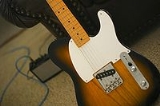
Fender Esquire

Encyclopedia
The Fender Esquire is a solid body electric guitar
manufactured by Fender, and was the first guitar sold by Fender in 1950. Shortly after its introduction a two-pickup version named the Broadcaster was introduced while the single pickup version retained the Esquire name. The Gretsch Company at the time marketed a drum set under the 'Broadkaster' name, and at their request Fender renamed it the 'Telecaster.' Although the one-pickup Esquire was manufactured first, it is now generally regarded as a variant of the more popular Telecaster
.
in the fall of 1949. The prototype shared with these guitars the now-familiar slab body shape with single cutaway to allow easier access to the upper frets. It likewise featured the distinctive combination bridge
and pickup assembly, with a slanted pickup with individual pole pieces for each string, and three bridge saddles which allowed adjustment of string length in pairs and individual string height. The neck, like the first Esquires manufactured in 1950, was made from a single piece of maple without a truss rod. The neck was attached to the body with four screws and an anchor plate, unlike in traditional guitar construction, where a tenon
on the neck is glued into the body. Unlike the Esquire, the neck was wider at the nut, and the head had 3 tuners on each side. The prototype differed from the later production guitars in several other respects: the body was made of pine
wood, it was painted opaque white, its pickguard
did not extend above the strings, it lacked a selector switch, and its volume and tone knobs were mounted on a slanted plate. Like the production models, it had a removable pickup cover, but unlike the production models, the cover had straight sides. Also as Esquires manufactured from 1951 onwards, the prototype had only one pickup.
Over the winter of 1949/50, Fender refined the design. The neck width at the nut was narrowed, and the head modified to accommodate all six tuners on one side. A tone selector switch was added, and the controls were mounted on a plate parallel to the strings. The scratch plate was enlarged. Around the spring of 1950, Fender had completed a neck pickup design, which was smaller than the lead pickup and was encased in a metal shielding cover. However, this last feature was not to make it onto Fender's first commercially introduced guitar, as Fender's distributor, the Radio & Television Equipment Company (RTEC), had decided that it would be easier to sell the single pickup version of the guitar.
. The dual pickup version was first manufactured in June of that year. Neither version had a truss rod at that time, though in November, the dual pickup version acquired one and was renamed the Broadcaster. Following objections from Gretsch
who produced the "Broadkaster" drum kit, this name was dropped, and some guitars were shipped with only the "Fender" logo decal and no model name (commonly referred to these days as the "Nocaster.") until the name Telecaster was adopted.
Use of the Fender Esquire by several country musicians is popularly credited for the creation of one of the most distinctive and recognized sounds in American music history. In 1954 Luther Perkins
played a slightly modified Esquire, recording the first Johnny Cash
songs "Wide Open Road" and "Hey Porter". This guitar can also be heard on all records before "I Walk The Line
", for which Luther played an Esquire. All through his career (which ended with his death in a house fire in 1968) Perkins used Esquires in Blonde, White, Black, Red and Sunburst colors. Even though he was given the new Jazzmaster and Jaguar
guitars from Leo Fender
personally, Luther Perkins always returned to the guitar that had made possible the creation of the legendary "Boom Chicka Boom Sound" that identified Johnny Cash's music.
Like the two-pickup guitar, these Esquires had a routing cavity in the neck pickup position. Thus, with the purchase of a neck pickup and replacement or modification of the pickguard, players could upgrade their instrument to a guitar identical to the Telecaster in every respect except for the model decal. Bruce Springsteen
, for example, has long played an Esquire modified in this way. Springsteen has claimed that the guitar he is pictured with on the Born To Run
album cover is, in fact, a hybrid of two guitars, a Telecaster body and Esquire neck. However, it is a first-generation Esquire with two pickup routs. The Esquires had Esquire pickguards to cover the neck pickup hole. His guitar has a neck pickup installed, but not connected.
In 1966, Paul McCartney
purchased a 1964 Fender Esquire model with a sunburst finish and rosewood
fretboard: McCartney bought this guitar, a right-handed model which he restrung and played "upside-down," during the Revolver
sessions. Also used on "Good Morning, Good Morning," "Helter Skelter", and "Maybe I'm Amazed
," among other cuts from his solo career.
Syd Barrett
, the original leader of Pink Floyd
, was another prominent Esquire player. His successor David Gilmour
, while not as prominent a user as Barrett, used an Esquire with an added pickup (as Springsteen did) on several songs, including "Dogs", "Run Like Hell
" and his work on Paul McCartney's
album Run Devil Run
.
On the single, "Born to Be Wild
" by Steppenwolf
, guitarist Michael Monarch
played a single bridge pickup version of the Fender Esquire.
The initial rationale for reintroducing the single pickup Esquire in 1951 had been to offer a more affordable option for musicians who could not afford the two-pickup guitar. However, with the introduction of cheaper student models such as the Mustang
, the more expensive Esquire became a less attractive option, and it was sold in smaller and smaller quantities. Consequently, Fender discontinued the Esquire in 1969.
In 1986, Fender Japan
began producing the Esquire, based on the 1954 version. It featured threaded saddles and a white pickguard with either a butterscotch blonde or metallic red finish. Some people report that there was also a blackguard version, and a sunburst was also available. These Esquires were imported to the USA, and were incredible guitars in terms of fit and finish. The necks, in particular, were especially nice. Overall, many players prefer this era Esquire to the more recent Mexican-made reissues.
Fender currently offers several '50s Esquire reproductions in their online catalogue. The company considers the Esquire to be a member of the "family of Telecaster guitars." These Esquires are part of the MIM (made in Mexico) series. The Fender Custom Shop
also manufactures a 1959 Esquire reproduction as part of its "Time Machine" series, a model distinguished by its top-loading bridge design. It is also notable that the Avril Lavigne Telecaster sold under the Squier by Fender brand resembles an Esquire since it only has a single pickup.
Electric guitar
An electric guitar is a guitar that uses the principle of direct electromagnetic induction to convert vibrations of its metal strings into electric audio signals. The signal generated by an electric guitar is too weak to drive a loudspeaker, so it is amplified before sending it to a loudspeaker...
manufactured by Fender, and was the first guitar sold by Fender in 1950. Shortly after its introduction a two-pickup version named the Broadcaster was introduced while the single pickup version retained the Esquire name. The Gretsch Company at the time marketed a drum set under the 'Broadkaster' name, and at their request Fender renamed it the 'Telecaster.' Although the one-pickup Esquire was manufactured first, it is now generally regarded as a variant of the more popular Telecaster
Fender Telecaster
The Fender Telecaster, colloquially known as the Tele , is typically a dual-pickup, solid-body electric guitar made by Fender.Its simple yet effective design and revolutionary sound broke ground and set trends in electric guitar manufacturing and popular music...
.
Early development
The first prototype for the Esquire (and the later Telecaster) was completed by Leo FenderLeo Fender
Clarence Leonidas "Leo" Fender was an American inventor who founded Fender Electric Instrument Manufacturing Company, or "Fender" for short...
in the fall of 1949. The prototype shared with these guitars the now-familiar slab body shape with single cutaway to allow easier access to the upper frets. It likewise featured the distinctive combination bridge
Bridge (instrument)
A bridge is a device for supporting the strings on a stringed instrument and transmitting the vibration of those strings to some other structural component of the instrument in order to transfer the sound to the surrounding air.- Explanation :...
and pickup assembly, with a slanted pickup with individual pole pieces for each string, and three bridge saddles which allowed adjustment of string length in pairs and individual string height. The neck, like the first Esquires manufactured in 1950, was made from a single piece of maple without a truss rod. The neck was attached to the body with four screws and an anchor plate, unlike in traditional guitar construction, where a tenon
Mortise and tenon
The mortise and tenon joint has been used for thousands of years by woodworkers around the world to join pieces of wood, mainly when the adjoining pieces connect at an angle of 90°. In its basic form it is both simple and strong. Although there are many joint variations, the basic mortise and tenon...
on the neck is glued into the body. Unlike the Esquire, the neck was wider at the nut, and the head had 3 tuners on each side. The prototype differed from the later production guitars in several other respects: the body was made of pine
Pine
Pines are trees in the genus Pinus ,in the family Pinaceae. They make up the monotypic subfamily Pinoideae. There are about 115 species of pine, although different authorities accept between 105 and 125 species.-Etymology:...
wood, it was painted opaque white, its pickguard
Pickguard
A pickguard is a piece of plastic or other laminated material that is placed under the strings on the body of a guitar, mandolin or similar plucked string instrument...
did not extend above the strings, it lacked a selector switch, and its volume and tone knobs were mounted on a slanted plate. Like the production models, it had a removable pickup cover, but unlike the production models, the cover had straight sides. Also as Esquires manufactured from 1951 onwards, the prototype had only one pickup.
Over the winter of 1949/50, Fender refined the design. The neck width at the nut was narrowed, and the head modified to accommodate all six tuners on one side. A tone selector switch was added, and the controls were mounted on a plate parallel to the strings. The scratch plate was enlarged. Around the spring of 1950, Fender had completed a neck pickup design, which was smaller than the lead pickup and was encased in a metal shielding cover. However, this last feature was not to make it onto Fender's first commercially introduced guitar, as Fender's distributor, the Radio & Television Equipment Company (RTEC), had decided that it would be easier to sell the single pickup version of the guitar.
The 1950 Esquire
The single pickup guitar was first manufactured in April 1950, and made its commercial debut as the Esquire in RTEC's Spring catalogue of that year. While the guitar pictured in the catalogue was painted black and had a white scratch plate, most of the Esquires produced at the time were painted semi-transparent "butterscotch" blonde and had a black scratch plate. Unlike the pinewood prototype, the bodies (thinner than the Broadcaster's at 1.5", instead of 1.75") were made of solid ashAsh tree
Fraxinus is a genus flowering plants in the olive and lilac family, Oleaceae. It contains 45-65 species of usually medium to large trees, mostly deciduous though a few subtropical species are evergreen. The tree's common English name, ash, goes back to the Old English æsc, while the generic name...
. The dual pickup version was first manufactured in June of that year. Neither version had a truss rod at that time, though in November, the dual pickup version acquired one and was renamed the Broadcaster. Following objections from Gretsch
Gretsch
The Gretsch Company was founded in 1883 by Friedrich Gretsch, a twenty-seven year old German immigrant recently arrived in the US. Friedrich Gretsch manufactured banjos, tambourines, and drums, until his death in 1895. His son, Fred, moved operations to Brooklyn, New York in 1916...
who produced the "Broadkaster" drum kit, this name was dropped, and some guitars were shipped with only the "Fender" logo decal and no model name (commonly referred to these days as the "Nocaster.") until the name Telecaster was adopted.
The Esquire from 1951 to present
Following the renaming of the dual pickup Broadcaster, production and promotion of the single pickup Esquire was briefly discontinued. It was reintroduced with a truss rod in January 1951. The only external differences between these second generation Esquires and the Broadcasters and Telecasters of 1951 are the lack of a neck pickup, and the Esquire label on the head. Although the Esquire had only a single pickup, it retained the three-way switch of the two-pickup guitars. This switch modified the tone of the pickup by making it bassier in the forward position, while enabling use of the tone control knob in the middle position. With the switch in the rear position, these tone controls were bypassed entirely for a "hotter" lead tone.Use of the Fender Esquire by several country musicians is popularly credited for the creation of one of the most distinctive and recognized sounds in American music history. In 1954 Luther Perkins
Luther Perkins
Luther Monroe Perkins was an American country music guitarist and a member of the Tennessee Three, the backup band for singer Johnny Cash. Perkins was an iconic figure in what would become known as rockabilly music...
played a slightly modified Esquire, recording the first Johnny Cash
Johnny Cash
John R. "Johnny" Cash was an American singer-songwriter, actor, and author, who has been called one of the most influential musicians of the 20th century...
songs "Wide Open Road" and "Hey Porter". This guitar can also be heard on all records before "I Walk The Line
I Walk the Line
"I Walk the Line" is a song written by Johnny Cash and recorded in 1956. It was performed with the help of Marshall Grant and Luther Perkins, two mechanics that his brother introduced him to following his discharge from the Air Force. Cash and his wife, Vivian, were living in Memphis, Tennessee,...
", for which Luther played an Esquire. All through his career (which ended with his death in a house fire in 1968) Perkins used Esquires in Blonde, White, Black, Red and Sunburst colors. Even though he was given the new Jazzmaster and Jaguar
Fender Jaguar
The Fender Jaguar is an electric guitar introduced in 1962. A descendant of the Jazzmaster, the Jaguar quickly caught on in the emerging Surf music scene...
guitars from Leo Fender
Leo Fender
Clarence Leonidas "Leo" Fender was an American inventor who founded Fender Electric Instrument Manufacturing Company, or "Fender" for short...
personally, Luther Perkins always returned to the guitar that had made possible the creation of the legendary "Boom Chicka Boom Sound" that identified Johnny Cash's music.
Like the two-pickup guitar, these Esquires had a routing cavity in the neck pickup position. Thus, with the purchase of a neck pickup and replacement or modification of the pickguard, players could upgrade their instrument to a guitar identical to the Telecaster in every respect except for the model decal. Bruce Springsteen
Bruce Springsteen
Bruce Frederick Joseph Springsteen , nicknamed "The Boss," is an American singer-songwriter who records and tours with the E Street Band...
, for example, has long played an Esquire modified in this way. Springsteen has claimed that the guitar he is pictured with on the Born To Run
Born to Run
The album's release was accompanied by a $250,000 promotional campaign by Columbia directed at both consumers and the music industry, making good use of Landau's "I saw rock 'n' roll's future—and its name is Bruce Springsteen" quote. With much publicity, Born to Run vaulted into the top 10 in its...
album cover is, in fact, a hybrid of two guitars, a Telecaster body and Esquire neck. However, it is a first-generation Esquire with two pickup routs. The Esquires had Esquire pickguards to cover the neck pickup hole. His guitar has a neck pickup installed, but not connected.
In 1966, Paul McCartney
Paul McCartney
Sir James Paul McCartney, MBE, Hon RAM, FRCM is an English musician, singer-songwriter and composer. Formerly of The Beatles and Wings , McCartney is listed in Guinness World Records as the "most successful musician and composer in popular music history", with 60 gold discs and sales of 100...
purchased a 1964 Fender Esquire model with a sunburst finish and rosewood
Rosewood
Rosewood refers to any of a number of richly hued timbers, often brownish with darker veining, but found in many different hues. All rosewoods are strong and heavy, taking an excellent polish, being suitable for guitars, marimbas, turnery , handles, furniture, luxury flooring, etc.In general,...
fretboard: McCartney bought this guitar, a right-handed model which he restrung and played "upside-down," during the Revolver
Revolver (album)
Revolver is the seventh studio album by the English rock group The Beatles, released on 5 August 1966 on the Parlophone label and produced by George Martin. Many of the tracks on Revolver are marked by an electric guitar-rock sound, in contrast with their previous LP, the folk rock inspired Rubber...
sessions. Also used on "Good Morning, Good Morning," "Helter Skelter", and "Maybe I'm Amazed
Maybe I'm Amazed
"Maybe I'm Amazed" is a song written by Paul McCartney that was first released on his McCartney album on 17 April 1970. The studio version from the album has never been released as a single. McCartney dedicated the song to his wife, Linda, who had helped him get through the break-up of The Beatles...
," among other cuts from his solo career.
Syd Barrett
Syd Barrett
Syd Barrett , born Roger Keith Barrett, was an English singer-songwriter, guitarist, and painter, best remembered as a founding member of the band Pink Floyd. He was the lead vocalist, guitarist and primary songwriter during the band's psychedelic years, providing major musical and stylistic...
, the original leader of Pink Floyd
Pink Floyd
Pink Floyd were an English rock band that achieved worldwide success with their progressive and psychedelic rock music. Their work is marked by the use of philosophical lyrics, sonic experimentation, innovative album art, and elaborate live shows. Pink Floyd are one of the most commercially...
, was another prominent Esquire player. His successor David Gilmour
David Gilmour
David Jon Gilmour, CBE, D.M. is an English rock musician and multi-instrumentalist who is best known as the guitarist, one of the lead singers and main songwriters in the progressive rock band Pink Floyd. In addition to his work with Pink Floyd, Gilmour has worked as a producer for a variety of...
, while not as prominent a user as Barrett, used an Esquire with an added pickup (as Springsteen did) on several songs, including "Dogs", "Run Like Hell
Run Like Hell
"Run Like Hell" is a song from the 1979 Pink Floyd album The Wall.-Overview:The song is written from the point of view of anti-hero Pink during a hallucination in which he becomes a fascist dictator and turns a concert audience into an angry mob...
" and his work on Paul McCartney's
Paul McCartney
Sir James Paul McCartney, MBE, Hon RAM, FRCM is an English musician, singer-songwriter and composer. Formerly of The Beatles and Wings , McCartney is listed in Guinness World Records as the "most successful musician and composer in popular music history", with 60 gold discs and sales of 100...
album Run Devil Run
Run Devil Run
Run Devil Run is the eleventh solo studio album by Paul McCartney, released in 1999. It features covers of both familiar and obscure 1950s rock and roll songs, along with three new McCartney songs written in the same style...
.
On the single, "Born to Be Wild
Born to Be Wild
"Born to Be Wild" is a rock song written by Mars Bonfire and made famous by the Canadian-American rock band Steppenwolf. It is often used in popular culture to denote a biker appearance or attitude...
" by Steppenwolf
Steppenwolf (band)
Steppenwolf are a Canadian-American rock group that was prominent in the late 1960s. The group was formed in 1967 in Los Angeles by vocalist John Kay, guitarist Michael Monarch, bassist Rushton Moreve, keyboardist Goldy McJohn and drummer Jerry Edmonton after the dissolution of Toronto group The...
, guitarist Michael Monarch
Michael Monarch
Michael Monarch is an American guitarist. He is best known for his work with the band Steppenwolf....
played a single bridge pickup version of the Fender Esquire.
The initial rationale for reintroducing the single pickup Esquire in 1951 had been to offer a more affordable option for musicians who could not afford the two-pickup guitar. However, with the introduction of cheaper student models such as the Mustang
Fender Mustang
The Fender Mustang is an electric guitar by the Fender Musical Instruments Corporation, introduced in 1964 as the basis of a major redesign of Fender's student models then consisting of the Musicmaster and Duo-Sonic. It was produced until 1982 and reissued in 1990.In the 1960s, it was used in Surf...
, the more expensive Esquire became a less attractive option, and it was sold in smaller and smaller quantities. Consequently, Fender discontinued the Esquire in 1969.
In 1986, Fender Japan
Fender Japan
Fender Japan is the Japanese division of Fender Musical Instruments Corporation.-History:Fender Japan was officially created in March 1982 and consists of two Japanese Music companies that handle the ordering and distribution. The two companies are Yamano Gakki and Kanda Shokai...
began producing the Esquire, based on the 1954 version. It featured threaded saddles and a white pickguard with either a butterscotch blonde or metallic red finish. Some people report that there was also a blackguard version, and a sunburst was also available. These Esquires were imported to the USA, and were incredible guitars in terms of fit and finish. The necks, in particular, were especially nice. Overall, many players prefer this era Esquire to the more recent Mexican-made reissues.
Fender currently offers several '50s Esquire reproductions in their online catalogue. The company considers the Esquire to be a member of the "family of Telecaster guitars." These Esquires are part of the MIM (made in Mexico) series. The Fender Custom Shop
Fender Custom Shop
The Fender Custom Shop is a division of Fender Musical Instruments, housed within their headquarters complex in Corona, Riverside County, California. The Fender Custom Shop primarily exists to compete with smaller companies and independent luthiers that, in turn, build products reminiscent of those...
also manufactures a 1959 Esquire reproduction as part of its "Time Machine" series, a model distinguished by its top-loading bridge design. It is also notable that the Avril Lavigne Telecaster sold under the Squier by Fender brand resembles an Esquire since it only has a single pickup.
External links
- Current Esquire Classic, with some history.
- Index of current Esquire models.
- http://www.fenderesquire.org Fender Esquire resource site
- Ten Terrific Telecasters at Fender UK has descriptions of the very first Esquire/Telecaster prototype guitar, and of Springsteen's upgraded Esquire (Archived version accessed 18 October 2006).