
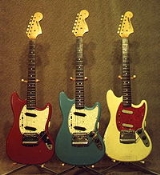
The
Fender Mustang is an
electric guitarAn electric guitar is a guitar that uses the principle of direct electromagnetic induction to convert vibrations of its metal strings into electric audio signals. The signal generated by an electric guitar is too weak to drive a loudspeaker, so it is amplified before sending it to a loudspeaker...
by the Fender Musical Instruments Corporation, introduced in 1964 as the basis of a major redesign of Fender's student models then consisting of the
MusicmasterThe Fender Musicmaster is an electric guitar by Fender, and was the first of their 3/4 scale guitars. With a single pickup and no tremolo arm, it was a basic but functional instrument....
and Duo-Sonic. It was produced until 1982 and reissued in 1990.
In the 1960s, it was used in Surf music. It attained
cult statusA cult following is a group of fans who are highly dedicated to a specific area of pop culture. A film, book, band, or video game, among other things, will be said to have a cult following when it has a small but very passionate fan base...
in the 1990s largely as a result of its use by a number of
alternative rockAlternative rock is a genre of rock music and a term used to describe a diverse musical movement that emerged from the independent music underground of the 1980s and became widely popular by the 1990s...
bands. Early examples are generally seen as the most collectible of all the short-scale Fender guitars.
The Mustang features two single-coil pickups with an unusual switching configuration, and a unique
tremolo armA whammy bar, tremolo arm/bar, or vibrato arm/bar is a component of a guitar, used to add vibrato to the sound by changing the tension of the strings, typically at the bridge or tailpiece...
. It was originally available in two
scale length*Length scale, - a significant concept in physics used to define the order of magnitude of a system*Scale height, - a specific parameter in physics denoting the distance over which a quantity decreases by a factor of e...
s.
Fender also issued a series of
amplifiersA guitar amplifier is an electronic amplifier designed to make the signal of an electric or acoustic guitar louder so that it will produce sound through a loudspeaker...
named the Mustang in 2010.
Model history
In August 1964, Fender released a new guitar called the Mustang, an economy model intended for more advanced students and featuring a new, original
Leo FenderClarence Leonidas "Leo" Fender was an American inventor who founded Fender Electric Instrument Manufacturing Company, or "Fender" for short...
-designed
tremolo armA whammy bar, tremolo arm/bar, or vibrato arm/bar is a component of a guitar, used to add vibrato to the sound by changing the tension of the strings, typically at the bridge or tailpiece...
.
The Mustang has an offset waist, reminiscent of the Jazzmaster, but its overall styling closely followed the existing student models the
MusicmasterThe Fender Musicmaster is an electric guitar by Fender, and was the first of their 3/4 scale guitars. With a single pickup and no tremolo arm, it was a basic but functional instrument....
and Duo-Sonic, the slight waist offset being the main change. After the release of the Mustang, the Musicmaster and Duo-Sonic were redesigned using the Mustang body; These were branded the
Musicmaster II and
Duo-Sonic II but the decals were not consistently applied.
All three Mustang-bodied models (Mustang, Musicmaster II and Duo-Sonic II) were offered with optionally the 21 fret 22.5-inch (or 3/4
scale*Length scale, - a significant concept in physics used to define the order of magnitude of a system*Scale height, - a specific parameter in physics denoting the distance over which a quantity decreases by a factor of e...
) neck, or a 22 fret 24-inch neck, but the 24-inch was overwhelmingly more popular and 3/4 scale examples are rare. A 24-inch scale is still relatively short, the same as the
Fender JaguarThe Fender Jaguar is an electric guitar introduced in 1962. A descendant of the Jazzmaster, the Jaguar quickly caught on in the emerging Surf music scene...
but a full inch and a half shorter than the Stratocaster and three-quarters of an inch shorter than the
Gibson Les PaulThe Gibson Les Paul was the result of a design collaboration between Gibson Guitar Corporation and the late jazz guitarist and electronics inventor Les Paul. In 1950, with the introduction of the Fender Telecaster to the musical market, electric guitars became a public craze. In reaction, Gibson...
. The short scale may improve ease of use for people with small hands, and also enhances the ability to use the tremolo arm for upbends.
This short scale, combined with a unique and extremely direct
tremolo armA whammy bar, tremolo arm/bar, or vibrato arm/bar is a component of a guitar, used to add vibrato to the sound by changing the tension of the strings, typically at the bridge or tailpiece...
would make the Mustang a cult guitar in the 1990s. Before that, its relatively low cost and marketing as a student guitar made it an obvious candidate for aftermarket upgrades, particularly pickup changes and also amateur finishes. Its wiring with the original pickups also led itself to custom modifications.
In 1966 Fender issued the
Fender Mustang BassThe Fender Mustang Bass is an electric bass guitar model produced by Fender. Two variants, the Musicmaster Bass and the Bronco Bass, have also been produced from time to time using the same body and neck shape.-History:...
. A new bass body was designed for this with a similar offset body style to the Mustang guitar, and a short (30-inch) scale was used.
In 1969 Fender released the "Competition" Mustang with a "racing stripe" paint job and painted headstocks. Body contours were also added at this time. The competition mustangs came in Competition Red, Competition Blue(Known as Competition Burgandy in the Fender catalog), and Competition Orange. This paint scheme was heavily influenced by the Shelby Mustang cars of the late 60s.
In 1982 Fender discontinued both the Mustang and the Musicmaster II. These were the last of the offset student models to be made. Fender replaced the Mustang line with the short-lived Fender Bullet line of guitars and
bassesThe Fender Bullet Bass is an electric bass guitar model produced by Fender. It was introduced in 1982 as a part of a new line of guitars meant to replace the outgoing Mustang and Musicmaster - Fender's so called "student" guitars. The Bullet Bass had Mustang style pickups, but was available with...
before relegating production of their student guitars to their
SquierSquier is a musical instrument brand name owned by the Fender Musical Instruments Corporation.-History:Fender, under the ownership of CBS, acquired the Squier brand name in 1965 when it bought a USA based string making firm , but it lay dormant for many years...
division.
Re-issues since the 1990s
In 1990 Fender re-issued the Mustang, largely as a result of the vintage movement prevalent at the time. Among
grungeGrunge is a subgenre of alternative rock that emerged during the mid-1980s in the American state of Washington, particularly in the Seattle area. Inspired by hardcore punk, heavy metal, and indie rock, grunge is generally characterized by heavily distorted electric guitars, contrasting song...
and
punk rockPunk rock is a rock music genre that developed between 1974 and 1976 in the United States, the United Kingdom, and Australia. Rooted in garage rock and other forms of what is now known as protopunk music, punk rock bands eschewed perceived excesses of mainstream 1970s rock...
guitarists, Fender's discontinued models (budget models such as the Duo-Sonic and high-end models such as the Jazzmaster and
JaguarThe Fender Jaguar is an electric guitar introduced in 1962. A descendant of the Jazzmaster, the Jaguar quickly caught on in the emerging Surf music scene...
) had become extremely popular. Such models had Fender quality, but were less expensive secondhand than vintage Stratocasters and Telecasters.
The reissued Mustang is made in
JapanJapan is an island nation in East Asia. Located in the Pacific Ocean, it lies to the east of the Sea of Japan, China, North Korea, South Korea and Russia, stretching from the Sea of Okhotsk in the north to the East China Sea and Taiwan in the south...
and available in only the 24-inch scale. While the original Mustangs used mostly poplar wood for the body (with some rarely documented cases of
mahoganyThe name mahogany is used when referring to numerous varieties of dark-colored hardwood. It is a native American word originally used for the wood of the species Swietenia mahagoni, known as West Indian or Cuban mahogany....
, MG-72 Mustang reissues are made of the similar
basswoodTilia is a genus of about 30 species of trees native throughout most of the temperate Northern Hemisphere. The greatest species diversity is found in Asia, and the genus also occurs in Europe and eastern North America, but not western North America...
, the newer MG-65 reissues revert to the original poplar. The natural-finished MG-77 reissue is made of ash.
In 2011 Fender released a new Mustang model in the so-called Pawn Shop series, called the Mustang Special. The model features an offset Mustang body shape and a 24-inch scale neck, but with humbucking pickups and a hard-tail Stratocaster bridge.
Electronics
The Mustang has two angled single-coil pickups, each with an adjacent on-off-on switch, and a master tone and volume control.
The Mustang is unusual in having neither a pickup selector nor a circuit selector switch, instead just using the two pickup switches to allow the pickups to be used either singly or in parallel. The second
on position reverses the phase of the selected pickup, allowing the pickups to be either in or out of phase when in parallel. This phasing option was also unusual for 1964.
It also meant that, as both pickups were floating with respect to ground, it was possible to modify the wiring to put the pickups into series either in or out of phase without excessive noise. The unusual switching could also be replaced by a conventional pickup change switch using the unused body routing already provided for compatibility with the Duo-Sonic, requiring only modification of the pickguard, and freeing the two eight-terminal pickup switches for other uses. As with many student guitars, aftermarket pickup additions and changes are commonly found in many vintage examples.
Tremolo arm
The Mustang introduced the
Fender Dynamic Vibrato tailpieceA tailpiece is a component on many stringed musical instruments that anchors one end of the strings, usually the end opposite the end with the tuning mechanism the scroll, headstock, peghead, etc.-Function and construction:...
, which together with a
floating bridge forms the
Mustang trem system. The floating bridge concept is common to the
Fender floating tremolo developed for the Jazzmaster, but on the Mustang the saddles have only a single string slot, while on other Fender guitars there are multiple slots to allow limited adjustment of the string spacing.
The tailpiece was unique when introduced and remains the most unusual feature of the Mustang; Only the Jag-Stang and
Fender CustomThe Fender Custom was a short-lived model released by the CBS-owned Fender in 1969. Essentially a six-string Fender Electric XII, the Custom was an attempt to sell off unused factory stock instead of simply writing it off. The guitar was made with unused parts from Electric XII guitars, including...
(Maverick) share this particular mechanism. While not nearly so popular as the Stratocaster
synchronized tremolo, some guitarists prefer it over all other tremolo mechanisms. But a lot of guitarists also claim that the tremolo is too sensitive. Most notably, Fender incorporated it in the custom design which became the Jag-Stang.
No previous Fender student guitar had a tremolo system at all, and the subsequent
Fender BroncoThe Fender Bronco was an electric guitar model produced by the Fender company from mid 1967 until 1981. It used the body and neck from the Fender Mustang, but had only one pickup and a different tremolo arm mechanism...
used a completely different mechanism, without a floating bridge.
The Mustang was the last of the Fender floating bridge models to be withdrawn, and the first to be reissued. Mustangs have maintained a popular following in Japan.
Colours
The Fender Mustang was originally produced in Daphne Blue, Olympic White, and Dakota Red in 1965-1968. In 1969, Fender switched to the "Competition Colors," this consisted of Competition Blue, Competition Red, and Competition Orange. These Competition Mustangs are the only original Fender guitars to be produced with these "Racing stripes" which make them very collectable. The competition Mustangs produced from 1969 to mid 1970 came with a matching headstocks, from then on, Fender Mustangs came with Fender's standard wood colored headstock. The matching headstock models seem to be more desirable with collectors than the non matching models.
Over the years, the Mustang has been produced in the following colors: sunburst, black, olympic white, sonic blue, daphne blue, Dakota red, competition blue, competition red, competition orange, natural, mocha brown, wine red transparent, Antigua,and candy apple.
Notable Mustang players
- Adrian Belew
Adrian Belew is an American guitarist, singer, songwriter, multi-instrumentalist and record producer...
- Rob Buck (10,000 Maniacs
10,000 Maniacs is a United States-based alternative rock band, which formed in 1981 and continues to be active with various line-ups.-1981–1993:...
)
- David Byrne
David Byrne may refer to:*David Byrne , musician and former Talking Heads frontman**David Byrne , his eponymous album*David Byrne , Irish footballer*David Byrne , English footballer...
(Talking HeadsTalking Heads were an American New Wave and avant-garde band formed in 1975 in New York City and active until 1991. The band comprised David Byrne, Chris Frantz, Tina Weymouth and Jerry Harrison...
)
- Graham Coxon
Graham Leslie Coxon is an English singer-songwriter, multi-instrumentalist and painter. He came to prominence as the lead guitarist, backing vocalist and occasional lead vocalist of rock band Blur, and is also a critically acclaimed solo artist, having recorded seven solo albums...
(BlurBlur is an English alternative rock band. Formed in London in 1989 as Seymour, the group consists of singer Damon Albarn, guitarist Graham Coxon, bassist Alex James and drummer Dave Rowntree. Blur's debut album Leisure incorporated the sounds of Madchester and shoegazing...
)
- John Fogerty
John Cameron Fogerty is an American rock singer, songwriter, and guitarist, best known for his time with the swamp rock/roots rock band Creedence Clearwater Revival and as a #1 solo recording artist. Fogerty has a rare distinction of being named on Rolling Stone magazine's list of 100 Greatest...
(Creedence Clearwater RevivalCreedence Clearwater Revival was an American rock band that gained popularity in the late 1960s and early 1970s with a number of successful singles drawn from various albums....
)
- PJ Harvey
Polly Jean Harvey is an English musician, singer-songwriter, composer and occasional artist. Primarily known as a vocalist and guitarist, she is also proficient with a wide range of instruments including piano, organ, bass, saxophone, and most recently, the autoharp.Harvey began her career in...
- Kelly Jones
Kelly Jones is a Welsh singer-songwriter and guitarist and the lead singer of the band Stereophonics. Influenced by classic rock bands such as The Who, Led Zeppelin, AC/DC and the Sex Pistols, Jones is noted for his strong, gravelly voice, which has been described as "whisky" vocals...
(StereophonicsThe Stereophonics are a Welsh rock band now living in turners x that formed in 1992 in the village of Cwmaman in Cynon Valley, Wales. The band currently comprises lead vocalist and guitarist Kelly Jones, bassist and backing vocalist Richard Jones, drummer Javier Weyler, guitarist and backing...
)
- Alan Lancaster
Alan Lancaster is a bassist and a founding ex-member of the English rock band, Status Quo...
(Status Quo)
- Magic Slim
Magic Slim is an American blues singer and guitarist.-Biography:Magic Slim was forced to give up playing the piano when he lost his little finger in a cotton gin mishap. He moved first to nearby Grenada. He first came to Chicago in 1955 with his friend and mentor Magic Sam...
- John McLaughlin
John McLaughlin , also known as Mahavishnu John McLaughlin, is an English guitarist, bandleader and composer...
- Thurston Moore
Thurston Joseph Moore is an American musician best known as a singer, songwriter and guitarist of Sonic Youth. He has also participated in many solo and group collaborations outside of Sonic Youth, as well as running the Ecstatic Peace! record label...
(Sonic YouthSonic Youth is an American alternative rock band from New York City, formed in 1981. The current lineup consists of Thurston Moore , Kim Gordon , Lee Ranaldo , Steve Shelley , and Mark Ibold .In their early career, Sonic Youth was associated with the No Wave art and music scene in New York City...
)
- Buzz Osborne
Roger "Buzz" Osborne , also known as King Buzzo, is the guitarist/vocalist/songwriter and technically the only remaining founding member of the Melvins...
(The MelvinsThe Melvins are an American band that formed in 1983. They usually perform as a trio, but in recent years have performed as a four piece with two drummers. Since 1984, singer and guitarist Buzz Osborne and drummer Dale Crover have been the band's constant members...
)
- Liz Phair
Phair's entry into the music industry began when she met guitarist Chris Brokaw, a member of the band Come. Brokaw and Phair moved to San Francisco together, and Phair tried to become an artist there...
- Lee Ranaldo
Lee M. Ranaldo is an American singer, guitarist, writer, record producer, and visual artist, best known as a co-founder of the alternative rock band Sonic Youth...
(Sonic YouthSonic Youth is an American alternative rock band from New York City, formed in 1981. The current lineup consists of Thurston Moore , Kim Gordon , Lee Ranaldo , Steve Shelley , and Mark Ibold .In their early career, Sonic Youth was associated with the No Wave art and music scene in New York City...
)
External links