

Exhaustive ballot

Encyclopedia
The exhaustive ballot is a voting system
used to elect a single winner. Under the exhaustive ballot the elector simply casts a single vote for his or her favorite candidate. However if no candidate is supported by an overall majority of votes then the candidate with the fewest votes is eliminated and a further round of voting occurs. This process is repeated for as many rounds as necessary until one candidate has a majority.
The exhaustive ballot is similar to the two-round system
but with key differences. Under the two round system if no candidate wins a majority on the first round, only the top two recipients of votes advance to the second (and final) round of voting, and a majority winner is determined in the second round. By contrast, on the exhaustive ballot only one candidate is eliminated per round; thus, several rounds of voting may be required until a candidate reaches a majority.
Because voters may have to cast votes several times, the exhaustive ballot is not used in large-scale public elections. Instead it is usually used in elections involving, at most, a few hundred voters, such as the election of a prime minister or the presiding officer of an assembly. The exhaustive ballot is currently used, in different forms, to elect the members of the Swiss Federal Council
, the First Minister of Scotland
, the President of the European Parliament
, and the speaker
s of the Canadian House of Commons, the British House of Commons and the Scottish Parliament
. It is also used to elect the various party nominees for President of the United States
, the host city of the Olympic Games
, the host of the FIFA World Cup
, and in the Papal Conclave
.
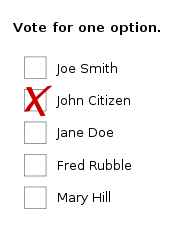 In each round of an exhaustive ballot the voter simply marks an 'x' beside his or her favourite candidate. If no candidate has an absolute majority of votes (i.e., more than half) in the first round, then the candidate with the fewest votes is eliminated while all other candidates advance to a second round. If there is still no candidate with a majority then the candidate with the fewest votes is again eliminated and there is a third round. The process repeats itself for as many rounds as are necessary for one candidate to achieve a majority. If necessary, the election will continue until only two candidates remain. When this occurs one of the two must achieve an absolute majority.
Between rounds, the voter is entirely free to change his/her preferred candidate for whatever reason, even if his/her preferred candidate has not yet been eliminated from voting.
Round 1: In the first round of voting each diner votes for the one candidate they most prefer. The results are as follows:
Ice Cream has a plurality of votes, but not the 13 needed for a majority. Thus a second round is required; Celery, having the fewest votes in Round 1, is eliminated from future consideration.
Round 2: The Celery supporter is health conscious, and decides to give his vote to Fruit rather than either of the other two candidates. None of the other diners choose to change their votes. So in the second round the votes cast are:
Again, Ice Cream has a plurality but not a majority. Thus a third round is required; Apple Pie, having the fewest votes in Round 2, is eliminated.
Round 3: The Apple Pie supporters split into two groups; two vote for Ice Cream while four vote for Fruit. So the final result is:
Fruit has received the majority needed.
 Imagine that the population of Tennessee
, a state in the United States
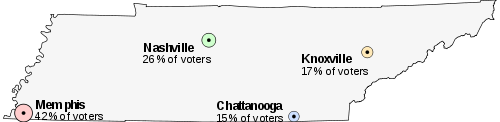
, is voting on the location of its capital. The population of Tennessee is concentrated around its four major cities, which are spread throughout the state. For this example, suppose that the entire electorate live in one of these four cities, and that they would like the capital to be established as close to their city as possible.
The candidates for the capital are:
Round 1: In the first round of voting the results will be as follows:
Round 2: No candidate has an absolute majority in the first round (this would be greater than 50%), so Chattanooga, who has the fewest votes, is eliminated and the remaining three candidates proceed to Round 2. In this round the Chattanooga supporters vote instead for Knoxville, the next nearest city to their own. None of the other voters need change their votes. The results are therefore:
Round 3: Nashville is now eliminated, so that only two candidates remain for the final round. The Nashville supporters change their vote to Knoxville, the next nearest city to their own. The result of the third round is therefore:
Result: After round three Knoxville has an absolute majority so is the winner.
. However under the two-round system if no candidate achieves an absolute majority in the first round then, rather than just a single candidate being eliminated, all candidates are immediately excluded except the two with the most votes. There is then a second and final round. Because, at most, it requires voters to return to the polls only once, the two-round system is considered more practical for large public elections than the exhaustive ballot, and is used in many countries for the election of presidents and legislative bodies. However the two systems often produce different winners. This is because, under the two-round system, a candidate may be eliminated in the first round who would have gone on to win the contest if they had been permitted to survive to the second round. In Example I above the winner would not have changed if the two rounds system had been used instead of the exhaustive ballot. However in Example II the two round system would have elected Nashville instead of Knoxville.
system is a variation of the two-round system which holds a pre-election, and allows the top two candidates to pass to the generation election. It differs from the two-round system because the first election isn't allowed to pick a winner.
(also known as the 'Alternative Vote'). Under both systems if no candidate has an absolute majority in the first round then there are further rounds, with the candidate with the fewest votes being eliminated after each round. However while under the exhaustive ballot each round involves voters returning to cast a new vote, under instant-runoff (IRV) voters vote only once. This is possible because, rather than voting for only a single candidate, the voter ranks all of the candidates in order of preference. These preferences are then used to 'transfer' the votes of those whose first preference has been eliminated during the course of the count.
Because the exhaustive ballot involves separate rounds of voting, voters can use the results of one round to inform how they will vote in the next, whereas this is not possible under IRV. Furthermore, because it is necessary to vote only once, IRV has been used for large-scale elections in many places.
' (plurality) system by reducing the potential for tactical voting
by avoiding 'wasted' votes. Under the plurality system, which involves only one round, voters are encouraged to vote tactically by voting for only one of the two leading candidates, because a vote for any other candidate will not affect the result. Under the exhaustive ballot this tactic, known as 'compromising', is sometimes unnecessary because, even if the voter's first choice is unlikely to be elected, she will still have the opportunity to influence the outcome of the election by voting for more popular candidates once her favourite has been eliminated. However the exhaustive ballot is still vulnerable to tactical voting under some circumstances. Because of the similarity between the two systems it is open to the same forms of tactical voting as IRV.
Although the exhaustive ballot is designed to avoid 'compromising' the tactic is still effective in some elections. Compromising is where a voter votes for a certain candidate, not because they necessarily support them, but as a way of avoiding the election of a candidate whom they dislike even more. The compromising tactic is sometimes effective because the exhaustive ballot eliminates candidates who are unpopular in early rounds, who might have had sufficient support to win the election had they survived a little longer. This can create strong incentives for voters to vote tactically.
Like IRV, the exhaustive ballot is also vulnerable to the tactic of 'push over'. 'Push over' is a tactic by which voters vote tactically for an unpopular 'push over' candidate in one round as a way of helping their true favourite candidate win in a later round. The purpose of voting for the 'push over' is to ensure that it is this weak candidate, rather than a stronger rival, who remains to challenge a voter's preferred candidate in later rounds. By supporting a 'push over' candidate it is hoped to eliminate a stronger candidate who might have gone on to win the election. The 'push over' tactic requires voters to be able to reliably predict how others will vote. It runs the risk of backfiring, because if the tactical voter miscalculates then the candidate intended as a 'push over' might end up actually beating the voter's preferred candidate.
No candidate has an absolute majority of votes so Ice Cream is eliminated in the first round. Ice Cream supporters prefer Apple Pie to Fruit so in the second round they vote for Apple Pie and Apple Pie is the winner. However, if only six Fruit supporters had used the tactic of 'push over' then they could have changed this outcome and ensured the election of Fruit. These six voters can do this by voting for Ice Cream in the first round as a 'push over'. If they do this then the votes cast in the first round will look like this:
This time Apple Pie is eliminated in the first round and Ice Cream and Fruit survive to the second round. This outcome is deliberate. The tactical voters know that Ice Cream will be an easier candidate for Fruit to beat in the second round than Apple Pie–in other words, that Ice Cream will be a 'push-over'. In the second round the tactical voters vote for their real first preference, Fruit. Therefore even if only 6 Apple Pie supporters prefer Fruit to Ice Cream, the result of the second round will be:
Fruit will therefore be elected. The success of this tactic relies on the Fruit supporters being able to predict that Ice Cream can be beaten by Fruit in the second round. If a large majority of Apple Pie supporters had voted for Ice Cream then the 'push over' tactic would have backfired, leading to the election of Ice Cream, which Fruit partisans like even less than Apple Pie.
; this is where candidates and political factions influence the result of an election by either nominating extra candidates or withdrawing a candidate who would otherwise have stood. The exhaustive ballot is vulnerable to strategic nomination for the same reasons that it is open to the voting tactic of 'compromising'. This is because a candidate who knows they are unlikely to win can bring about the election of a more desirable compromise candidate by withdrawing from the race, or by never standing in the first place. By the same token a candidate can bring about a less desirable result by unwisely choosing to stand in an election; this is because of the spoiler effect
, by which a new candidate can 'split the vote' and cost another similar candidate the election.
The exhaustive vote's system of multiple rounds makes it less vulnerable to the spoiler effect than the plurality system or the two round system. This is because a potential spoiler candidate often has only minor support; therefore he will be eliminated early and his supporters will have the opportunity to influence the result of the election by voting for more popular candidates in later rounds. Voters can also counteract the effect of vote splitting by using the 'compromise' tactic.
The exhaustive vote is essentially vulnerable to the same forms of strategic nomination as instant-runoff voting, the difference being that under the exhaustive vote candidates can use the results of early rounds to inform whether or not they should strategically withdraw in later rounds. This is impossible under IRV. In IRV the electorate votes only once, so candidates must make the judgement of whether or not to participate in an election before the poll, and before even one round of counting has occurred.
Voting system
A voting system or electoral system is a method by which voters make a choice between options, often in an election or on a policy referendum....
used to elect a single winner. Under the exhaustive ballot the elector simply casts a single vote for his or her favorite candidate. However if no candidate is supported by an overall majority of votes then the candidate with the fewest votes is eliminated and a further round of voting occurs. This process is repeated for as many rounds as necessary until one candidate has a majority.
The exhaustive ballot is similar to the two-round system
Two-round system
The two-round system is a voting system used to elect a single winner where the voter casts a single vote for their chosen candidate...
but with key differences. Under the two round system if no candidate wins a majority on the first round, only the top two recipients of votes advance to the second (and final) round of voting, and a majority winner is determined in the second round. By contrast, on the exhaustive ballot only one candidate is eliminated per round; thus, several rounds of voting may be required until a candidate reaches a majority.
Because voters may have to cast votes several times, the exhaustive ballot is not used in large-scale public elections. Instead it is usually used in elections involving, at most, a few hundred voters, such as the election of a prime minister or the presiding officer of an assembly. The exhaustive ballot is currently used, in different forms, to elect the members of the Swiss Federal Council
Swiss Federal Council
The Federal Council is the seven-member executive council which constitutes the federal government of Switzerland and serves as the Swiss collective head of state....
, the First Minister of Scotland
First Minister of Scotland
The First Minister of Scotland is the political leader of Scotland and head of the Scottish Government. The First Minister chairs the Scottish Cabinet and is primarily responsible for the formulation, development and presentation of Scottish Government policy...
, the President of the European Parliament
President of the European Parliament
The President of the European Parliament presides over the debates and activities of the European Parliament. He or she also represents the Parliament within the EU and internationally. The President's signature is required for enacting most EU laws and the EU budget.Presidents serve...
, and the speaker
Speaker (politics)
The term speaker is a title often given to the presiding officer of a deliberative assembly, especially a legislative body. The speaker's official role is to moderate debate, make rulings on procedure, announce the results of votes, and the like. The speaker decides who may speak and has the...
s of the Canadian House of Commons, the British House of Commons and the Scottish Parliament
Scottish Parliament
The Scottish Parliament is the devolved national, unicameral legislature of Scotland, located in the Holyrood area of the capital, Edinburgh. The Parliament, informally referred to as "Holyrood", is a democratically elected body comprising 129 members known as Members of the Scottish Parliament...
. It is also used to elect the various party nominees for President of the United States
President of the United States
The President of the United States of America is the head of state and head of government of the United States. The president leads the executive branch of the federal government and is the commander-in-chief of the United States Armed Forces....
, the host city of the Olympic Games
Olympic Games
The Olympic Games is a major international event featuring summer and winter sports, in which thousands of athletes participate in a variety of competitions. The Olympic Games have come to be regarded as the world’s foremost sports competition where more than 200 nations participate...
, the host of the FIFA World Cup
FIFA World Cup
The FIFA World Cup, often simply the World Cup, is an international association football competition contested by the senior men's national teams of the members of Fédération Internationale de Football Association , the sport's global governing body...
, and in the Papal Conclave
Papal conclave
A papal conclave is a meeting of the College of Cardinals convened to elect a Bishop of Rome, who then becomes the Pope during a period of vacancy in the papal office. The Pope is considered by Roman Catholics to be the apostolic successor of Saint Peter and earthly head of the Roman Catholic Church...
.
Voting and counting
Between rounds, the voter is entirely free to change his/her preferred candidate for whatever reason, even if his/her preferred candidate has not yet been eliminated from voting.
Variations
- Under some variants of the exhaustive ballot there is no formal rule for eliminating candidates from one round to another; rather, candidates are expected to withdraw voluntarily.
- Some variations slowly raise an elimination threshold in to encourage compromise. For example, the Minnesota Democratic-Farmer-Labor PartyMinnesota Democratic-Farmer-Labor PartyThe Minnesota Democratic–Farmer–Labor Party is a major political party in the state of Minnesota and the state affiliate of the Democratic Party. It was created on April 15, 1944, with the merger of the Minnesota Democratic Party and the Farmer–Labor Party...
for U.S. Senate endorsement 2008 will use an exhaustive ballot with a dropoff rule starting at 5% and increasing to 25% after round 5, after which one candidate with the lowest votes will eliminated per round until no more than two remain. - There are also variants which exclude more than one candidate at a time. For example in elections for the speakers of the Canadian and British Houses of Commons any candidate with fewer than 5% of all votes in the first round is immediately eliminated.
Example I
An election using the exhaustive ballot is held at a restaurant to choose a dessert item. There are 25 diners voting in the competition, choosing between four candidates: Ice Cream, Apple Pie, Fruit and Celery. Under this scenario, 13 votes are required for a majority.Round 1: In the first round of voting each diner votes for the one candidate they most prefer. The results are as follows:
- Ice Cream: 10 votes
- Apple Pie: 6 votes
- Fruit: 8 votes
- Celery: 1 vote
Ice Cream has a plurality of votes, but not the 13 needed for a majority. Thus a second round is required; Celery, having the fewest votes in Round 1, is eliminated from future consideration.
Round 2: The Celery supporter is health conscious, and decides to give his vote to Fruit rather than either of the other two candidates. None of the other diners choose to change their votes. So in the second round the votes cast are:
- Ice Cream: 10
- Apple Pie: 6
- Fruit: 9
Again, Ice Cream has a plurality but not a majority. Thus a third round is required; Apple Pie, having the fewest votes in Round 2, is eliminated.
Round 3: The Apple Pie supporters split into two groups; two vote for Ice Cream while four vote for Fruit. So the final result is:
- Ice Cream: 12
- Fruit: 13
Fruit has received the majority needed.
Example II
Tennessee
Tennessee is a U.S. state located in the Southeastern United States. It has a population of 6,346,105, making it the nation's 17th-largest state by population, and covers , making it the 36th-largest by total land area...
, a state in the United States
United States
The United States of America is a federal constitutional republic comprising fifty states and a federal district...
, is voting on the location of its capital. The population of Tennessee is concentrated around its four major cities, which are spread throughout the state. For this example, suppose that the entire electorate live in one of these four cities, and that they would like the capital to be established as close to their city as possible.
The candidates for the capital are:
- MemphisMemphis, TennesseeMemphis is a city in the southwestern corner of the U.S. state of Tennessee, and the county seat of Shelby County. The city is located on the 4th Chickasaw Bluff, south of the confluence of the Wolf and Mississippi rivers....
, the state's largest city, with 42% of the voters, but located far from the other cities - NashvilleNashville, TennesseeNashville is the capital of the U.S. state of Tennessee and the county seat of Davidson County. It is located on the Cumberland River in Davidson County, in the north-central part of the state. The city is a center for the health care, publishing, banking and transportation industries, and is home...
, with 26% of the voters - KnoxvilleKnoxville, TennesseeFounded in 1786, Knoxville is the third-largest city in the U.S. state of Tennessee, U.S.A., behind Memphis and Nashville, and is the county seat of Knox County. It is the largest city in East Tennessee, and the second-largest city in the Appalachia region...
, with 17% of the voters - ChattanoogaChattanooga, TennesseeChattanooga is the fourth-largest city in the US state of Tennessee , with a population of 169,887. It is the seat of Hamilton County...
, with 15% of the voters
Round 1: In the first round of voting the results will be as follows:
- Memphis: 42%
- Nashville: 26%
- Knoxville: 17%
- Chattanooga: 15%
Round 2: No candidate has an absolute majority in the first round (this would be greater than 50%), so Chattanooga, who has the fewest votes, is eliminated and the remaining three candidates proceed to Round 2. In this round the Chattanooga supporters vote instead for Knoxville, the next nearest city to their own. None of the other voters need change their votes. The results are therefore:
- Memphis: 42%
- Nashville: 26%
- Knoxville: 32%
Round 3: Nashville is now eliminated, so that only two candidates remain for the final round. The Nashville supporters change their vote to Knoxville, the next nearest city to their own. The result of the third round is therefore:
- Memphis: 42%
- Knoxville: 58%
Result: After round three Knoxville has an absolute majority so is the winner.
Use in practice
- Scottish government: The First Minister, and the Presiding Officer and Deputy Presiding Officers of the Scottish Parliament are elected by the exhaustive ballot method.
- The host city of the Olympic Games is chosen by an exhaustive ballot of members of the International Olympic CommitteeInternational Olympic CommitteeThe International Olympic Committee is an international corporation based in Lausanne, Switzerland, created by Pierre de Coubertin on 23 June 1894 with Demetrios Vikelas as its first president...
. Members from a country which has a city competing in the election are forbidden from voting unless the city has been eliminated. - The President of the European ParliamentPresident of the European ParliamentThe President of the European Parliament presides over the debates and activities of the European Parliament. He or she also represents the Parliament within the EU and internationally. The President's signature is required for enacting most EU laws and the EU budget.Presidents serve...
is elected by all members of the body to be its 'speaker' or chairperson. In the election if no candidate receives an absolute majority in the first round then there are up to three more rounds. In the second and third rounds anyone who wants to is free to stand, but candidates who perform poorly sometimes withdraw to help others be elected. If no-one achieves an absolute majority in the third round then only the two candidates with most votes are allowed to proceed to the fourth and final round of voting. - The Speaker of the British House of CommonsSpeaker of the British House of CommonsThe Speaker of the House of Commons is the presiding officer of the House of Commons, the United Kingdom's lower chamber of Parliament. The current Speaker is John Bercow, who was elected on 22 June 2009, following the resignation of Michael Martin...
is elected by secret ballotSecret ballotThe secret ballot is a voting method in which a voter's choices in an election or a referendum are anonymous. The key aim is to ensure the voter records a sincere choice by forestalling attempts to influence the voter by intimidation or bribery. The system is one means of achieving the goal of...
by members of the house. If no candidate achieves an absolute majority in the first round then the candidate with fewest votes and any other candidate who has received less than 5% of all votes is immediately eliminated. Subsequent rounds proceed according to the ordinary rules of the exhaustive ballot. - The Speaker of the Canadian House of CommonsSpeaker of the Canadian House of CommonsThe Speaker of the House of Commons of Canada is the presiding officer of the lower house of the Parliament of Canada and is elected at the beginning of each new parliament by fellow Members of Parliament...
is elected under essentially the same variant of the exhaustive ballot used for the British counterpart, with candidates on less than 5% in the first round immediately excluded. - Party nominees for the President of the United States: Delegates to the DemocraticDemocratic Party (United States)The Democratic Party is one of two major contemporary political parties in the United States, along with the Republican Party. The party's socially liberal and progressive platform is largely considered center-left in the U.S. political spectrum. The party has the lengthiest record of continuous...
and Republican Parties'Republican Party (United States)The Republican Party is one of the two major contemporary political parties in the United States, along with the Democratic Party. Founded by anti-slavery expansion activists in 1854, it is often called the GOP . The party's platform generally reflects American conservatism in the U.S...
respective nominating conventionsUnited States presidential nominating conventionA United States presidential nominating convention is a political convention held every four years in the United States by most of the political parties who will be fielding nominees in the upcoming U.S. presidential election...
cast votes for their preferred candidate, and if no majority is reached on the first ballot, additional rounds follow until one candidate reaches a majority. In the past this process could be long and acrimonious, ending only with brokered dealsBrokered conventionA brokered convention is a situation in United States politics in which there are not enough delegates 'won' during the presidential primary and caucus elections for a single candidate to have a pre-existing majority, during the first official vote for a political party's presidential-candidate at...
made in a proverbial smoke-filled roomSmoke-filled roomIn U.S. political slang, a smoke-filled room is a term for a secret political gathering or round table style decision-making process. The phrase is generally used to suggest a cabal of powerful or well-connected, cigar-smoking men such as the Bilderberg group meeting privately to nominate a dark...
. In the modern day the actual voting process is a perfunctory exercise, as primary electionPrimary electionA primary election is an election in which party members or voters select candidates for a subsequent election. Primary elections are one means by which a political party nominates candidates for the next general election....
s encourage the emergence of a clear front-runner long before the conventions.
The two-round system
As noted above the exhaustive ballot is similar to the two-round systemTwo-round system
The two-round system is a voting system used to elect a single winner where the voter casts a single vote for their chosen candidate...
. However under the two-round system if no candidate achieves an absolute majority in the first round then, rather than just a single candidate being eliminated, all candidates are immediately excluded except the two with the most votes. There is then a second and final round. Because, at most, it requires voters to return to the polls only once, the two-round system is considered more practical for large public elections than the exhaustive ballot, and is used in many countries for the election of presidents and legislative bodies. However the two systems often produce different winners. This is because, under the two-round system, a candidate may be eliminated in the first round who would have gone on to win the contest if they had been permitted to survive to the second round. In Example I above the winner would not have changed if the two rounds system had been used instead of the exhaustive ballot. However in Example II the two round system would have elected Nashville instead of Knoxville.
Primary two-round system
A nonpartisan primary electionPrimary election
A primary election is an election in which party members or voters select candidates for a subsequent election. Primary elections are one means by which a political party nominates candidates for the next general election....
system is a variation of the two-round system which holds a pre-election, and allows the top two candidates to pass to the generation election. It differs from the two-round system because the first election isn't allowed to pick a winner.
Instant-runoff voting
In some respects the exhaustive ballot closely resembles instant-runoff votingInstant-runoff voting
Instant-runoff voting , also known as preferential voting, the alternative vote and ranked choice voting, is a voting system used to elect one winner. Voters rank candidates in order of preference, and their ballots are counted as one vote for their first choice candidate. If a candidate secures a...
(also known as the 'Alternative Vote'). Under both systems if no candidate has an absolute majority in the first round then there are further rounds, with the candidate with the fewest votes being eliminated after each round. However while under the exhaustive ballot each round involves voters returning to cast a new vote, under instant-runoff (IRV) voters vote only once. This is possible because, rather than voting for only a single candidate, the voter ranks all of the candidates in order of preference. These preferences are then used to 'transfer' the votes of those whose first preference has been eliminated during the course of the count.
Because the exhaustive ballot involves separate rounds of voting, voters can use the results of one round to inform how they will vote in the next, whereas this is not possible under IRV. Furthermore, because it is necessary to vote only once, IRV has been used for large-scale elections in many places.
Tactical voting
Like instant-runoff voting, the exhaustive ballot is intended to improve upon the simpler 'first past the postPlurality voting system
The plurality voting system is a single-winner voting system often used to elect executive officers or to elect members of a legislative assembly which is based on single-member constituencies...
' (plurality) system by reducing the potential for tactical voting
Tactical voting
In voting systems, tactical voting occurs, in elections with more than two viable candidates, when a voter supports a candidate other than his or her sincere preference in order to prevent an undesirable outcome.It has been shown by the Gibbard-Satterthwaite theorem that any voting method which is...
by avoiding 'wasted' votes. Under the plurality system, which involves only one round, voters are encouraged to vote tactically by voting for only one of the two leading candidates, because a vote for any other candidate will not affect the result. Under the exhaustive ballot this tactic, known as 'compromising', is sometimes unnecessary because, even if the voter's first choice is unlikely to be elected, she will still have the opportunity to influence the outcome of the election by voting for more popular candidates once her favourite has been eliminated. However the exhaustive ballot is still vulnerable to tactical voting under some circumstances. Because of the similarity between the two systems it is open to the same forms of tactical voting as IRV.
Although the exhaustive ballot is designed to avoid 'compromising' the tactic is still effective in some elections. Compromising is where a voter votes for a certain candidate, not because they necessarily support them, but as a way of avoiding the election of a candidate whom they dislike even more. The compromising tactic is sometimes effective because the exhaustive ballot eliminates candidates who are unpopular in early rounds, who might have had sufficient support to win the election had they survived a little longer. This can create strong incentives for voters to vote tactically.
Like IRV, the exhaustive ballot is also vulnerable to the tactic of 'push over'. 'Push over' is a tactic by which voters vote tactically for an unpopular 'push over' candidate in one round as a way of helping their true favourite candidate win in a later round. The purpose of voting for the 'push over' is to ensure that it is this weak candidate, rather than a stronger rival, who remains to challenge a voter's preferred candidate in later rounds. By supporting a 'push over' candidate it is hoped to eliminate a stronger candidate who might have gone on to win the election. The 'push over' tactic requires voters to be able to reliably predict how others will vote. It runs the risk of backfiring, because if the tactical voter miscalculates then the candidate intended as a 'push over' might end up actually beating the voter's preferred candidate.
Compromise
In Example I above, if Ice Cream supporters had voted tactically for Apple Pie in the first round then Apple Pie (their second choice) would have been elected instead of Fruit (their last choice). In Example II Knoxville wins, the last choice of both Nashville and Memphis supporters. If Memphis supporters had 'compromised' by voting for Nashville (their second choice) in the first round then Nashville would have been elected immediately, while if Nashville supporters had all 'compromised' by voting for their second choice of Chattanooga in the first round, then Chattanooga would have gone on to be elected in the second roundPush over
Imagine an election, like the one at the start of this article, in which there are 100 voters who vote as follows:- Ice Cream: 25 votes
- Apple Pie: 30 votes
- Fruit: 45 votes
No candidate has an absolute majority of votes so Ice Cream is eliminated in the first round. Ice Cream supporters prefer Apple Pie to Fruit so in the second round they vote for Apple Pie and Apple Pie is the winner. However, if only six Fruit supporters had used the tactic of 'push over' then they could have changed this outcome and ensured the election of Fruit. These six voters can do this by voting for Ice Cream in the first round as a 'push over'. If they do this then the votes cast in the first round will look like this:
- Ice Cream: 31
- Apple Pie: 30
- Fruit: 39
This time Apple Pie is eliminated in the first round and Ice Cream and Fruit survive to the second round. This outcome is deliberate. The tactical voters know that Ice Cream will be an easier candidate for Fruit to beat in the second round than Apple Pie–in other words, that Ice Cream will be a 'push-over'. In the second round the tactical voters vote for their real first preference, Fruit. Therefore even if only 6 Apple Pie supporters prefer Fruit to Ice Cream, the result of the second round will be:
- Ice Cream: 49
- Fruit: 51
Fruit will therefore be elected. The success of this tactic relies on the Fruit supporters being able to predict that Ice Cream can be beaten by Fruit in the second round. If a large majority of Apple Pie supporters had voted for Ice Cream then the 'push over' tactic would have backfired, leading to the election of Ice Cream, which Fruit partisans like even less than Apple Pie.
Strategic nomination
The exhaustive ballot can also be influenced by strategic nominationStrategic nomination
Strategic nomination is the manipulation of an election through its candidate set...
; this is where candidates and political factions influence the result of an election by either nominating extra candidates or withdrawing a candidate who would otherwise have stood. The exhaustive ballot is vulnerable to strategic nomination for the same reasons that it is open to the voting tactic of 'compromising'. This is because a candidate who knows they are unlikely to win can bring about the election of a more desirable compromise candidate by withdrawing from the race, or by never standing in the first place. By the same token a candidate can bring about a less desirable result by unwisely choosing to stand in an election; this is because of the spoiler effect
Spoiler effect
The spoiler effect describes the effect a minor party candidate with little chance of winning has in a close election, when that candidate's presence in the election draws votes from a major candidate similar to them, thereby causing a candidate dissimilar to them to win the election...
, by which a new candidate can 'split the vote' and cost another similar candidate the election.
The exhaustive vote's system of multiple rounds makes it less vulnerable to the spoiler effect than the plurality system or the two round system. This is because a potential spoiler candidate often has only minor support; therefore he will be eliminated early and his supporters will have the opportunity to influence the result of the election by voting for more popular candidates in later rounds. Voters can also counteract the effect of vote splitting by using the 'compromise' tactic.
The exhaustive vote is essentially vulnerable to the same forms of strategic nomination as instant-runoff voting, the difference being that under the exhaustive vote candidates can use the results of early rounds to inform whether or not they should strategically withdraw in later rounds. This is impossible under IRV. In IRV the electorate votes only once, so candidates must make the judgement of whether or not to participate in an election before the poll, and before even one round of counting has occurred.