
All Topics  
Instant-runoff voting


   Email Print
   Bookmark   Link


Instant-runoff voting


Instant-runoff voting (IRV) is the American English
American English

PhonologyIn many ways, compared to English language in England, North American English is conservative in its phonology. Some distinctive accents can be found on the East Coast of the United States , partly because these areas were in contact with England, and imitated prestigious varieties of English English at a time when those varieties we...
 term for a voting system
Voting system

A voting system allows voters to choose between options, often in an election where candidates are selected for public administration. Voting can be also used to award prizes, to select between different plans of action, or by a computer program to find a solution to a problem....
 used for single-winner elections, in which voters
Voting

Voting is a method for a Group such as a meeting or an Constituency to decision making or express an opinion ? often following discussions, debates or election campaigns....
 rank candidates in an order of preference. If no candidate is the first preference of a majority
Majority

A majority, also known as a simple majority in the United States of America, is a subset of a group that is more than half of the entire group....
 of voters, the candidate with the fewest number of first preference rankings is eliminated and that candidate's ballots are redistributed at full value to the remaining candidates according to the next ranking on each ballot.


Discussion
Ask a question about 'Instant-runoff voting'
Start a new discussion about 'Instant-runoff voting'
Answer questions from other users
Full Discussion Forum


Recent Posts


Encyclopedia


Preferential Ballot
Instant-runoff voting (IRV) is the American English
American English

PhonologyIn many ways, compared to English language in England, North American English is conservative in its phonology. Some distinctive accents can be found on the East Coast of the United States , partly because these areas were in contact with England, and imitated prestigious varieties of English English at a time when those varieties we...
 term for a voting system
Voting system

A voting system allows voters to choose between options, often in an election where candidates are selected for public administration. Voting can be also used to award prizes, to select between different plans of action, or by a computer program to find a solution to a problem....
 used for single-winner elections, in which voters
Voting

Voting is a method for a Group such as a meeting or an Constituency to decision making or express an opinion ? often following discussions, debates or election campaigns....
 rank candidates in an order of preference. If no candidate is the first preference of a majority
Majority

A majority, also known as a simple majority in the United States of America, is a subset of a group that is more than half of the entire group....
 of voters, the candidate with the fewest number of first preference rankings is eliminated and that candidate's ballots are redistributed at full value to the remaining candidates according to the next ranking on each ballot. This process is repeated until one candidate obtains a majority of votes among candidates not eliminated. The term "instant runoff" is used because the method is said to simulate a series of runoff elections tallied in rounds, as in an exhaustive ballot
Exhaustive ballot

The exhaustive ballot is a voting system used to elect a single winner. Under the exhaustive ballot the voter simply casts a single vote for his or her favorite candidate....
 election.

Instant-runoff voting is sometimes referred to as alternative voting or the Alternative Vote (its oldest name) in the United Kingdom, the preferential ballot or preferential voting in Canada and Australia, and ranked choice voting in the United States. Instant-runoff voting is used to elect members of the Australian House of Representatives
Australian House of Representatives

The House of Representatives is one of the two houses of the Parliament of Australia; it is the lower house, the upper house being the Australian Senate....
, the President of Ireland
President of Ireland

The President of Ireland is the head of state of Republic of Ireland. The President is usually directly elected by the people for seven years, and can be elected for a maximum of two terms....
, the national parliament of Papua New Guinea
Papua New Guinea

Papua New Guinea , officially the Independent State of Papua New Guinea, is a country in Oceania, occupying the eastern half of the island of New Guinea and numerous offshore islands ....
, and the Fijian House of Representatives
House of Representatives (Fiji)

The House of Representatives is the lower chamber of Fiji Parliament . It is the more powerful of the two chambers; it alone has the power to initiate legislation ....
. It is also employed by several jurisdictions in the United States, including San Francisco, California and Pierce County, Washington
Pierce County, Washington

Pierce County is the second most populous county in the U.S. state of Washington. Formed out of Thurston County, Washington on December 22, 1852, by the legislature of Oregon Territory...
; to elect the leaders of the Labour Party
Labour Party (UK)

The Labour Party is a political party in the United Kingdom. Founded at the start of the 20th century, it has been since the 1920s the principal party of the Left-wing politics in England, Scotland and Wales, but not Northern Ireland, where it has only recently organised again....
 and the Liberal Democrats
Liberal Democrats

The Liberal Democrats, often shortened to Lib Dems or just Lib Dem, are a Liberalism political party in the United Kingdom, formed in 1988 by merging the Liberal Party and the Social Democratic Party ; the two parties had been SDP-Liberal Alliance for seven years, from shortly after the formation of the SDP....
 in the United Kingdom
United Kingdom

The United Kingdom of Great Britain and Northern Ireland, commonly known as the United Kingdom , the UK or Britain,is a sovereign state located off the northwestern coast of continental Europe....
; and in the elections of city mayors in a number of countries including Great Britain
Great Britain

Great Britain is an island lying to the northwest of Continental Europe. It is the List of islands by area, and the largest in Europe. With a population of 58.9 million people it is List of islands by population....
 and New Zealand
New Zealand

New Zealand is an island country in the south-western Pacific Ocean comprising two main landmasses , and numerous Islands of New Zealand, most notably Stewart Island/Rakiura and the Chatham Islands....
. Robert's Rules of Order
Robert's Rules of Order

Robert's Rules of Order is the informal short title of a book containing rules of order intended to be adopted for use by a deliberative assembly....
 calls preferential voting
Preferential voting

Preferential voting is a type of ballot structure used in several voting systems in which voters rank a list or group of candidates in order of preference....
 "especially useful and fair in an election by mail if it is impractical to take more than one ballot. . . . In such cases it makes possible a more representative result than that under a rule that a plurality shall elect. . . . Preferential voting has many variations." The single transferable vote technique used by IRV is the example given. The manual goes on to note that if voters don't rank enough candidates, this may prevent any from receiving a majority and "require the voting to be repeated. . . . Although this type of preferential ballot is preferable to an election by plurality, it affords less freedom of choice than repeated balloting, because it denies voters the opportunity of basing their second or lesser choices on the results of earlier ballots, and because the candidate in last place is automatically eliminated and may thus be prevented from becoming a compromise choice."

History


Instant runoff voting was invented around 1870 by American architect
Architect

An architect is trained and licenced in planning and designing buildings, and participates in supervising the construction of a building. Etymologically, architect derives from the Latin architectus, itself derived from the Greek arkhitekton , i.e....
 William Robert Ware
William Robert Ware

William Robert Ware , born in Cambridge, Massachusetts into a family of the Unitarianism clergy, was an American architect.He received his professional education at Milton Academy, Harvard College and Harvard's Lawrence Scientific School....
. He evidently based IRV on the single-winner outcome of the single transferable vote
Single transferable vote

The Single transferable vote is a voting system of preferential voting designed to minimize wasted votes and provide proportional representation while ensuring that votes are explicitly expressed for individual candidates rather than for party lists....
, originally developed by Carl Andrae and Thomas Hare
Thomas Hare

Thomas Hare was a United Kingdom proponent of electoral reform. He studied law, and was admitted to the Bar in November 1833 and published several works on judges' decisions....
. The first known use of IRV in a governmental election was in 1893 in an election for the colonial
Self-governing colony

A self-governing colony is a colony with an elected legislature, in which politicians are able to make most decisions without reference to the Colonialism with formal or nominal control of the colony....
 government of Queensland
Queensland

Queensland is a States and territories of Australia of Australia, occupying the north-eastern section of the mainland continent. It is bordered by the Northern Territory to the west, South Australia to the south-west and New South Wales to the south....
, in Australia. The system used for this election was a special form known as the contingent vote
Contingent vote

The contingent vote is an voting system used to elect a single winner, in which the voter ranks the candidates in order of preference. In an election, if no candidate receives an absolute majority of first preference votes, then all but the two leading candidates are eliminated and there is a second count....
. IRV in its true form was first used in 1908 in a State election in Western Australia
Western Australia

Western Australia is a States and territories of Australia occupying the entire western third of the Australia . The nation's largest state and the second largest subnational entity in the world, it has 2.1 million inhabitants , 85% of whom live in the south-west corner of the state....
.

United States


Since 2002, Instant Runoff Voting has been adopted in a number of U.S. cities. Most of these adoptions are pending implementation; however, as of November 2008, 44 elections have been held in five counties, cities or towns: San Francisco, California
San Francisco, California

The City and County of San Francisco is the fourth most populous city in California and the List of United States cities by population in the United States, with a 2007 estimated population of 799,183....
; Burlington, Vermont
Burlington, Vermont

Burlington is the largest city in the U.S. state of Vermont and the shire town of Chittenden County, Vermont. With a population of 38,889 at the 2000 United States Census, the city is the core of one of the nation's smaller metropolitan areas, and is also the smallest U.S....
; Takoma Park, Maryland
Takoma Park, Maryland

Takoma Park is a city in Montgomery County, Maryland, Maryland. The population was 17,299 at the 2000 census....
; Cary, North Carolina
Cary, North Carolina

Cary is a city in Wake County, North Carolina and Chatham County, North Carolina counties in the U.S. state of North Carolina. Located almost entirely in Wake County, it is the second largest municipality in that county and the third largest municipality in The Triangle behind Raleigh, North Carolina and Durham, North Carolina....
; and Pierce County, Washington
Pierce County, Washington

Pierce County is the second most populous county in the U.S. state of Washington. Formed out of Thurston County, Washington on December 22, 1852, by the legislature of Oregon Territory...
.

Non-governmental organizations


The sequential elimination method used by IRV is described in Robert's Rules of Order
Robert's Rules of Order

Robert's Rules of Order is the informal short title of a book containing rules of order intended to be adopted for use by a deliberative assembly....
 Newly Revised, 10th edition.
as an example of "preferential voting
Preferential voting

Preferential voting is a type of ballot structure used in several voting systems in which voters rank a list or group of candidates in order of preference....
," a term covering "any of a number of voting methods by which, on a single ballot when there are more than two possible choices, the second or less-preferred choices of voters can be taken into account if no candidate or proposition attains a majority. While it is more complicated than other methods of voting in common use and is not a substitute for the normal procedure of repeated balloting until a majority is obtained, preferential voting is especially useful and fair in an election by mail if it is impractical to take more than one ballot. In such cases it makes possible a more representative result than under a rule that a plurality shall elect...."Preferential voting has many variations. One method is described ... by way of illustration." And then the single transferable vote method, with votes from a majority of ballots required to win, is detailed. Robert's Rules continues: "The system of preferential voting just described should not be used in cases where it is possible to follow the normal procedure of repeated balloting until one candidate or proposition attains a majority. Although this type of preferential ballot is preferable to an election by plurality, it affords less freedom of choice than repeated balloting, because it denies voters the opportunity of basing their second or lesser choices on the results of earlier ballots, and because the candidate or proposition in last place is automatically eliminated and may thus be prevented from becoming a compromise choice." Two other less widely-used books on parliamentary procedure take a similar stance, disapproving of plurality voting and describing preferential voting as an option, if authorized in the bylaws, when repeated balloting is impractical: The Standard Code of Parliamentary Procedure
The Standard Code of Parliamentary Procedure

The Standard Code of Parliamentary Procedure is a book of rules of order. It is the second most popular parliamentary authority in the United States after Robert's Rules of Order....
  and Riddick's Rules of Procedure
Riddick's Rules of Procedure

Riddick's Rules of Procedure is a manual on parliamentary procedure written by Floyd M. Riddick and co-authored by Miriam Butcher. The book, based on Riddick's experience as Parliamentarian of the United States Senate as well as the procedures of assemblies using parliamentary manuals such as Robert's Rules of Order, is arranged in...
.

Forms of instant runoff voting have been adopted by various private and non-profit associations. The American Political Science Association
American Political Science Association

The American Political Science Association is an professional association of political science students and scholars in the United States. Founded in 1903, it publishes three academic journals ....
 has long had the "alternative vote" in its for electing its national President-Elect by mail if the official nomination, by a committee appointed by the President, is contested by a petition candidate, and there is, in addition, more than one petition candidate. There has not been a contested election for APSA President since about 1970, when there was one petition candidate. The 160,000-member American Chemical Society
American Chemical Society

The American Chemical Society is a learned society based in the United States that supports scientific inquiry in the field of chemistry. Founded in 1876 at New York University, the ACS currently has over 160,000 members at all degree-levels and in all fields of chemistry, chemical engineering and related fields....
 has established IRV for all elections for one office with more than two candidates .

As of June 2008, at least 42 American college and university student governments have either adopted and actively use IRV, or approve and provide for its use in internal elections. A of such colleges and universities and examples of their contested elections with IRV are available at the IRV advocacy organization FairVote
FairVote

FairVote is a non-profit organization based in Takoma Park, Maryland, whose mission is to achieve universal access to participation, a full spectrum of meaningful ballot choices and majority rule with fair representation for all....
.

Terminology


Instant runoff voting has a number of other names. In the United States
United States

The United States of America is a Federal government constitutional republic comprising U.S. state and a federal district. The country is situated mostly in central North America, where its Contiguous United States and Washington, D.C., the Capital districts and territories, lie between the Pacific Ocean and Atlantic Oceans, Borders of the U...
 it is called instant runoff voting primarily because of its resemblance to runoff voting
Two-round system

The two-round system is a voting system used to elect a single winner. Under runoff voting, the voter simply casts a single vote for their favorite candidate....
 and ranked choice voting because of the ballot type. It has occasionally been referred to as Ware's method, after its U.S. proponent, William Robert Ware
William Robert Ware

William Robert Ware , born in Cambridge, Massachusetts into a family of the Unitarianism clergy, was an American architect.He received his professional education at Milton Academy, Harvard College and Harvard's Lawrence Scientific School....
. Writers differ as to whether or not they treat instant runoff voting as a proper noun.

In the United States, instant runoff voting is an umbrella term associated with ranked ballot elections where lower choices can replace a voter's higher choice. North Carolina law uses "instant runoff" to describe the "batch elimination" form of IRV in one-seat elections where there is a single second round of counting with the top two candidates advance to the runoff. Election officials in Hendersonville (NC) use "instant runoff" to describe a multi-seat election system that attempts to simulate in a single round of voting their previous system of multi-seat runoffs. State law in South Carolina and Arkansas use "instant runoff" to describe the practice of having certain categories of absentee voters cast ranked ballots before the first round of a runoff that then are counted in a runoff election. When the single transferable vote
Single transferable vote

The Single transferable vote is a voting system of preferential voting designed to minimize wasted votes and provide proportional representation while ensuring that votes are explicitly expressed for individual candidates rather than for party lists....
 (STV) system is applied to a single-winner election it becomes the same as IRV. For this reason IRV is sometimes considered to be merely a special form of STV. However, because STV was designed for multi-seat constituencies
Constituency

A constituency is any cohesive body of people bound by shared identity, goals, or loyalty. Constituency can be used to describe a business's customer base and shareholders, or a charity's donors or those it serves....
, many scholars consider it to be a separate system from IRV, and that is the convention followed in this article. IRV is usually known simply as "STV" in New Zealand
New Zealand

New Zealand is an island country in the south-western Pacific Ocean comprising two main landmasses , and numerous Islands of New Zealand, most notably Stewart Island/Rakiura and the Chatham Islands....
 and Ireland, although the term Alternative Vote is also used in those countries.

Multiseat variations of the IRV elimination process have sometimes been labeled as instant runoff voting although they should be more accurately called preferential bloc voting, since like bloc voting, multiple votes are counted per ballot at the same time.

Election procedure


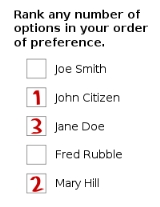
In instant-runoff voting, as with other ranked election methods, each voter ranks the list of candidates in order of preference. Under a common ballot
Preferential voting

Preferential voting is a type of ballot structure used in several voting systems in which voters rank a list or group of candidates in order of preference....
 layout, the voter marks a '1' beside the most preferred candidate, a '2' beside the second-most preferred, and so forth, using an 'ascending' system.

The fundamental mechanics of the process are the same regardless of how many candidates the voter ranks, and how many are left unsorted. In some implementations of IRV, the voter is allowed to rank as many or as few choices as they wish, while in other implementations the voter is required to rank either all of the candidates, or only a prescribed number of them.

In the initial count, the first preferences of each voter are counted and used to order the candidates. Each first preference is counted as one vote for the appropriate candidate. If, once all the first preferences are counted, one candidate holds a majority
Majority

A majority, also known as a simple majority in the United States of America, is a subset of a group that is more than half of the entire group....
 of the votes, that candidate can be immediately declared the winner. Otherwise the candidate who holds the fewest first preferences is eliminated. If there is an exact tie for last place in numbers of votes, special tie-breaking rules are invoked to determine which candidate to eliminate. Some jurisdictions eliminate more than one lowest-ranking candidate simultaneously if their combined number of votes is fewer than the number of votes received by any of the remaining candidates.

Once a candidate has been eliminated, all the ballots assigned to them are recounted and the second preference of each voter is used to reassign their vote to one of the remaining candidates. The total counts for the remaining candidates are updated and the candidates are reordered. Again if the top candidate attains a majority, they are declared the winner, otherwise the bottom candidate is again eliminated and their votes reassigned; each ballot paper is reassigned to whichever remaining candidate is the most preferred by that voter. If a ballot has all its ranked candidates eliminated, it is 'exhausted' and it can no longer be counted towards any candidate. Eventually, one candidate must attain a majority of votes cast for continuing candidates and is declared the winner.

Examples


CandidateRound 1Round 2
Bob Kiss
Bob Kiss

Bob Kiss is a Vermont politician and Mayor of Burlington, Vermont. Kiss was a member of the Vermont House of Representatives from January 2001 until he stepped down to assume office as mayor of Burlington, following his election to that office on March 7, 2006....
3,809 (38.9%) 4,761 (48.6%)
Hinda Miller
Hinda Miller

Hinda Miller is currently a Democratic Party member of the Vermont Senate, representing the Chittenden Vermont Senate District, 2002-2012.Hinda Miller was first elected to the Vermont State Senate in 2002 and continues in that office....
3,106(31.7%) 3,986(40.7%)
Kevin Curley 2,609(26.7%)
Other254(2.6%)
Exhausted ballots10(0.1%)1,041(10.5%)
Total9,778(100%)9,778(100%)


In 2006 the city of Burlington
Burlington, Vermont

Burlington is the largest city in the U.S. state of Vermont and the shire town of Chittenden County, Vermont. With a population of 38,889 at the 2000 United States Census, the city is the core of one of the nation's smaller metropolitan areas, and is also the smallest U.S....
, Vermont
Vermont

Vermont is a U.S. state in the New England region of the Northeastern United States United States. The state ranks 43rd by land area, , and 45th by total area....
 held a mayoral election using instant-runoff voting. Progressive Bob Kiss
Bob Kiss

Bob Kiss is a Vermont politician and Mayor of Burlington, Vermont. Kiss was a member of the Vermont House of Representatives from January 2001 until he stepped down to assume office as mayor of Burlington, following his election to that office on March 7, 2006....
 won in two rounds with 48.6% of the ballots, defeating Democrat Hinda Miller
Hinda Miller

Hinda Miller is currently a Democratic Party member of the Vermont Senate, representing the Chittenden Vermont Senate District, 2002-2012.Hinda Miller was first elected to the Vermont State Senate in 2002 and continues in that office....
 who achieved 40.7%. 10.6% of the ballots were exhausted before the final round, offering no preference among the final two.

After the first round, all of the 'other' candidates were eliminated, as was Curley, as their combined vote (2,863) was less than Miller's and so it would be impossible for Curley to pull ahead of Miller, even if he gained every one of the votes from the 'other' candidates. The votes for these candidates were recounted and redistributed amongst Kiss and Miller; 1,031 of those votes did not express a preference for either remaining candidate, and so were exhausted. After the second round recount, Kiss was declared the winner as he had obtained a majority (54.4%) of the remaining unexhaused ballots.

Irish Presidential Election, 1990
CandidateRound 1Round 2
Mary Robinson
Mary Robinson

Mary Therese Winifred Robinson served as the President_of_Ireland#List_of_Presidents_of_Ireland, and first female, President of Ireland, serving from 1990 to 1997, and the Office of the United Nations High Commissioner for Human Rights, from 1997 to 2002....
612,265 (38.9%)817,830 (51.6%)
Brian Lenihan694,484(44.1%)731,273(46.2%)
Austin Currie
Austin Currie

Austin Currie is a former Ireland politician, having been elected to the parliaments of both Northern Ireland and the Republic of Ireland.Austin Currie was born in County Tyrone, Northern Ireland into a large Catholic family....
267,902(17.0%)
Exhausted ballots9,444(0.6%)34,992(2.2%)
Total1,584,095(100%)1,584,095(100%)


The result of the Irish Presidential election
Irish presidential election, 1990

The Irish presidential election of 1990 was held on 7 November 1990. It was the tenth presidential election to be held in Ireland, and only the fifth to be contested by more than one candidate....
 in 1990 is a good example of how instant-runoff voting can produce a different result than the simple first past the post system. The three candidates were Brian Lenihan of the traditionally dominant Fianna Fáil
Fianna Fáil

Fianna F?il ? The Republican Party , shortened to Fianna F?il is the largest political party in the Republic of Ireland. It is the leading party in a coalition government with the Green Party , which also has the support of five Independent Teachta D?la including two former Progressive Democrats ....
 party, Austin Currie
Austin Currie

Austin Currie is a former Ireland politician, having been elected to the parliaments of both Northern Ireland and the Republic of Ireland.Austin Currie was born in County Tyrone, Northern Ireland into a large Catholic family....
 of the nation's second largest party, Fine Gael
Fine Gael

Fine Gael ? The United Ireland Party, shortened to Fine Gael is the second largest political party in the Republic of Ireland. It claims a membership of 30,000, and is the largest parliamentary opposition party in the Oireachtas, the Irish parliament....
, and Mary Robinson
Mary Robinson

Mary Therese Winifred Robinson served as the President_of_Ireland#List_of_Presidents_of_Ireland, and first female, President of Ireland, serving from 1990 to 1997, and the Office of the United Nations High Commissioner for Human Rights, from 1997 to 2002....
 of the Labour Party
Labour Party (Ireland)

The Labour Party is a democratic socialist and social democratic political party in the Republic of Ireland. Founded by James Connolly in 1912 as the political wing of the Irish Congress of Trades Unions, it claims to be the country's oldest continuous political party....
. After the first round, Lenihan had the largest share of the first-preference votes (and hence would have won a first-past-the-post vote), but no candidate attained the necessary majority. Currie was eliminated and his votes reassigned; in this process, Robinson received over 80% of Currie's votes, being the second preference of the majority of his supporters', thereby overtaking Lenihan and becoming the seventh President of Ireland
President of Ireland

The President of Ireland is the head of state of Republic of Ireland. The President is usually directly elected by the people for seven years, and can be elected for a maximum of two terms....
.

Ballots

As seen above, voters in an IRV election rank candidates on a preferential ballot
Preferential voting

Preferential voting is a type of ballot structure used in several voting systems in which voters rank a list or group of candidates in order of preference....
. IRV systems in use in different countries vary both as to ballot design and as to whether or not voters are obliged to provide a full list of preferences. In elections such as those for the President of Ireland
President of Ireland

The President of Ireland is the head of state of Republic of Ireland. The President is usually directly elected by the people for seven years, and can be elected for a maximum of two terms....
 and the New South Wales Legislative Assembly
New South Wales Legislative Assembly

The Legislative Assembly, or lower house, is one of the two chambers of the Parliament of New South Wales. The other is the New South Wales Legislative Council....
, voters are permitted to rank as many or as few candidates as they wish. This is known in Australia as Optional Preferential Voting
Optional Preferential Voting

Optional Preferential Voting is a system of vote-casting used in the states of Queensland and New South Wales in the Commonwealth of Australia....
.

Under Optional Preferential Voting some voters may rank only the candidates of a single party, or of their most preferred parties. Some voters may 'bullet vote
Bullet voting

Bullet voting is a tactic where the voter only selects one candidate, despite having the option to indicate some preference for other candidates....
', expressing only a first choice. Allowing voters to rank only as many candidates as they wish grants them greater freedom but can also lead to some voters ranking so few candidates that their vote eventually becomes 'exhausted'–that is, at a certain point during the count it can no longer be counted for a continuing candidate and therefore loses an opportunity to influence the result.

To prevent exhausted ballots, some IRV systems require or request that voters give a complete ordering of all of the candidates in an election - if a voter does not rank all candidates her ballot may be considered spoilt or an informal ballot. In Australia this variant is known as 'full preferential voting', and is used in elections for the federal House of Representatives
Australian House of Representatives

The House of Representatives is one of the two houses of the Parliament of Australia; it is the lower house, the upper house being the Australian Senate....
 and in most states. However, when there is a large set of candidates this requirement may prove burdensome and can lead to "donkey voting" in which, where a voter has no strong opinions about his or her lower preferences, the voter simply chooses them at random or in top-to-bottom order. Partly to overcome these problems, in elections to the Australian House of Representatives many parties distribute 'how-to-vote' cards, recommending how to allocate preferences on the ballot paper.

The common way to list candidates on a ballot paper is alphabetically or by random lot, a process whereby the order of the candidates published on the ballot paper is determined by lottery. In some cases candidates may also be grouped by party
Political party

A political party is a political organization that seeks to attain and maintain politics power within government, usually by participating in electoral campaigns....
.

Any fixed ordering of candidates on the ballot paper will give some candidates an unfair advantage, because voters, consciously or otherwise, are influenced in their ordering of candidates by the order on the ballot paper. The random ordering of candidates is intended to overcome this. The most effective form is Robson Rotation
Robson Rotation

Robson Rotation is the method of printing multiple ballots for single transferable vote elections, with each having the candidates listed in a different order....
, a system where the order of candidates on the paper is randomly changed for each print run of the same election's ballot papers. This means that any one ballot paper is almost certainly different from the next.

Voters

Voters have the option to rank candidates in order of choice rather than mark a single candidate. By choosing not to rank all candidates, a voter's ballot may not be counted in the decisive round of counting. Only ballots ranking at least one of the finalists will be counted.

Where preferential voting is used for the election of an assembly or council, parties and candidates often advise their supporters on how to use their lower preferences. As noted above, in Australia parties even issue 'how-to-vote' cards to the electorate before polling day, and Australia's requirement that voters must rank all candidates contributes to some voters using them. These kinds of recommendations can increase the influence of party leaderships and lead to a form of pre-election bargaining, in which smaller parties bid to have key planks of their platforms included in those of the major parties by means of 'preference deals'.

Counting methods

Changing from plurality to IRV may require startup costs for new voting machine
Voting machine

Voting machines are the total combination of mechanical, electromechanical, or electronic equipment , that is used to define ballots; to cast and count votes; to report or display election results; and to maintain and produce any audit trail information....
ry, although several nations count ballots by hand. However, once the equipment is available, IRV can reduce costs of a second election (required in a two round system or nonpartisan primary).

Forms of IRV have been implemented in cities using optical scan voting system
Optical scan voting system

An optical scan voting system is an Electronic voting and uses an Optical reader to read marked paper ballots and tally the results....
s, as in San Francisco, California
San Francisco, California

The City and County of San Francisco is the fourth most populous city in California and the List of United States cities by population in the United States, with a 2007 estimated population of 799,183....
 and Burlington, Vermont
Burlington, Vermont

Burlington is the largest city in the U.S. state of Vermont and the shire town of Chittenden County, Vermont. With a population of 38,889 at the 2000 United States Census, the city is the core of one of the nation's smaller metropolitan areas, and is also the smallest U.S....
.

A hand count also is possible under IRV and was the method used in the Cary, North Carolina pilot program in October 2007 (after initially counting first choices on optical scan equipment at the polls) and in most non-U.S. jurisdictions; however it is usually more time-consuming than a plurality count, and may need to occur over a number of rounds.

In Australia, a simplified count is sent to a central location on the night with the actual ballot papers transported there, securely, for the final count. In Ireland's presidential race, there are several dozen counting centers around the nation. Each center reports its totals for each candidate and receives instructions from the central office about which candidate or candidates to eliminate in the next round of counting.

Handling ties

Exact ties can happen in any election; although the odds remain very low when many votes are cast, the multiple rounds of counting used in IRV create more opportunities for a tie than there are in some other voting systems. If there is a tie for last place in the elimination process, various rules can be used to break it:
  1. If the total of all the combined votes of any grouping of the candidates with the fewest votes is fewer than the votes cast for the next weakest candidate, then all those bottom tier candidates can be eliminated simultaneously.
  2. One candidate, from among those tied, is eliminated at random (e.g. by a coin toss).
  3. In Australia the candidate, from among those tied, with the fewest votes in the previous round is eliminated. If there is still a tie those counting votes then look back to the next most recent round and then, if necessary, to further progressively earlier rounds until one candidate can be eliminated.
  4. In Irish presidential elections, the candidate, from among those tied, with fewest first choices is eliminated. If this cannot break the tie, ballot-counters look forwards, first to find the tied candidate with fewest votes in the second round and then, if necessary, to the third, fourth and subsequent rounds.
  5. In some private elections the method is to 'conditionally eliminate' candidates from the tie and recount to see if either (or any) can survive. Usually the full set will become eliminated in any order.


Winner-take-all single-seat elections vs. legislative elections


The intention of IRV is to find one candidate acceptable to a majority
Simple majority

Simple majority may refer to:In American and Canadian usage:* Majority, a voting requirement of more than 50% of all ballots castUsage elsewhere:...
 of voters. It is intended as an improvement on the 'First Past the Post
Plurality voting system

The plurality voting system is a single-winner voting system often used to elect executive officers or to elect members of a legislative assembly which is based on single-member Constituency....
' (plurality) voting system. Under 'First Past the Post' the candidate with most votes (a plurality) wins, even if they do not have a majority (more than half) of votes (unless election rules require a runoff under that condition).

IRV is most suited to elections in which there can be only one winner, such as a mayor or governor. Legislative bodies, city councils or boards also often elect winners by dividing voters into geographic districts.

Australia is the only nation with a long record of using IRV for the election of legislative bodies. IRV produces representation very similar to those produced by the plurality system, with a two party system in parliament similar to those found in many countries that use plurality
Plurality

In voting, a plurality is the largest number of Voting to be received by any candidate or proposition when three or more choices are possible. With only two choices the winner would have a majority, barring a strong showing from a write-in....
 and two round systems. A significant difference is that a smaller third party, the National Party of Australia
National Party of Australia

The National Party of Australia is an List of political parties in Australia.Traditionally representing rural voters, it was originally called the Country Party, but adopted the name National Country Party in 1975 and changed to its present name in 1982....
, can co-exist with its coalition
Coalition (Australia)

The Coalition in Australian politics refers to a pragmatic grouping of centre-right parties that has existed in the form of a coalition since 1922....
 partner the Liberal Party of Australia
Liberal Party of Australia

The Liberal Party of Australia is an List of political parties in Australia.Founded a year after the Australian federal election, 1943 to replace the United Australia Party, the centre-right Liberal Party competes with the centre-left Australian Labor Party for political office....
, and can compete against it without fear of losing seats to other parties due to vote splitting. In the November 2007 elections, at least four candidates ran in every constituency, with an average of seven, but every constituency was won with an absolute majority of votes.

If IRV is used to elect a council
City council

A city council is a form of local government, usually covering a city or other urban area, such as a town. The system of government has roots back at least to the Roman Empire....
 or legislature
Legislature

Legislature is a type of representative deliberative assembly with the power to create and change laws. The law created by a legislature is called legislation or statutory law....
 it will not produce proportional representation
Proportional representation

Proportional representation , sometimes referred to as full representation, is a category of voting systems aimed at a close match between the percentage of votes that groups of candidates obtain in elections and the percentage of seats they receive ....
 (PR). This means that it is likely to lead to the representation of a small number of larger parties in an assembly, rather than a proliferation of small parties. Under a parliamentary system
Parliamentary system

Parliamentary systems are characterized by no clear-cut separation of powers between the executive and legislative branches, leading to a different set of checks and balances compared to those found in presidential systems....
 it is more likely to produce single party governments than are PR systems, which tend to produce coalition government
Coalition government

A coalition government is a Cabinet of a parliamentary system government in which several political party cooperate. The usual reason given for this arrangement is that no party on its own can achieve a majority in the parliament....
s. While IRV is designed to ensure that each individual candidate elected is supported by a majority of those in his or her constituency, if used to elect an assembly it does not ensure this result on a national level
National government

A national government is a broad coalition government consisting of all parties in the legislature, usually formed during a time of war or other national emergency....
. As in other non-PR systems the party or coalition that wins a majority of seats will often not have the support of an overall majority of voters across the nation.

Many election reformers do not advocate IRV for legislative bodies or city councils that are intended to represent both majorities and minorities (in appropriate proportions). As with any winner-take-all election method, IRV can result in a shut-out of minority representation. Gerrymandering of single seat districts can also result in minorities gaining majority control of a legislative body, with IRV or any other winner-take-all election method.

According to a 2007 Brookings Institute paper, IRV can empower moderate voters in the U.S.. Presumably, this effect would result from combining the primary and general election into a single election that would have higher participation rates by moderates than typical primaries. However, empirical evidence suggests that IRV does not always favor moderates. A 2006 study found that "Fiji's objective of ameliorating ethnic divisions by the adoption of [IRV] was not successful"; the moderate parties would have fared better under PR.

Theoretical evaluation by voting system criteria


Scholars of electoral systems often compare them using mathematically-defined voting system criteria, the value of some of which is controversial. Some of the criteria are considered by Arrow's Theorem and the Gibbard-Satterthwaite theorem
Gibbard-Satterthwaite theorem

The Gibbard?Satterthwaite theorem is a result about voting systems designed to choose a single winner from the preferences of certain individuals, where each individual ranks all candidates in order of preference....
, which assume that voters rank all candidates in a strict preference order, among other assumptions that do not hold for all methods. For methods such as IRV which use such ranked preferences, satisfying all of the criteria is impossible, because they are mutually exclusive.

  • IRV passes the majority criterion
    Majority criterion

    The majority criterion is a single-winner voting system criterion, used to objectively compare such voting systems. The criterion states that if a majority of voters prefer a given candidate over every other candidate, then that candidate should win....
    , the later-no-harm criterion
    Later-no-harm criterion

    The later-no-harm criterion is a voting system criterion formulated by Douglas Woodall. The criterion is satisfied if, in any election, a voter giving an additional ranking or positive rating to a less preferred candidate cannot cause a more preferred candidate to lose....
    , the mutual majority criterion
    Mutual majority criterion

    The mutual majority criterion is a voting system criterion used to compare voting systems. It is also known as the majority criterion for solid coalitions and the generalized majority criterion....
    , the Condorcet loser criterion
    Condorcet loser criterion

    In single-winner voting system theory, the Condorcet loser criterion is a measure for differentiating voting systems.A voting system complying with the Condorcet loser criterion will never allow a Condorcet loser to win....
     and, if the right tie-breaker method is used, the independence of clones criterion.
  • IRV fails the monotonicity criterion
    Monotonicity criterion

    The monotonicity criterion is a voting system criterion used to analyze both single and multiple winner voting systems. A voting system is monotonic if it satisfies one of the definitions of the monotonicity criterion, given below....
    , consistency criterion
    Consistency criterion

    A voting system is consistent if, when the electorate is divided arbitrarily into two parts and separate elections in each part result in the same choice being selected, an election of the entire electorate also selects that alternative....
    , the Condorcet criterion
    Condorcet criterion

    The Condorcet candidate or Condorcet winner of an election is the candidate who, when compared with every other candidate, is preferred by more voters....
    , the participation criterion
    Participation criterion

    The participation criterion is a voting system criterion for evaluating voting systems and is also known as the No show paradox. It has been defined as follows:...
    , reversal symmetry
    Reversal symmetry

    Reversal symmetry is a voting system criterion that is stated as follows: If a candidate A is the unique winner, and the individual preferences of each voter are inverted, then candidate A must not be elected....
    , and the independence of irrelevant alternatives
    Independence of irrelevant alternatives

    Independence of irrelevant alternatives is a term for an axiom of decision theory and various social sciences. Although exact formulations of IIA differ, intentions of the usages are similar in attempting to provide a rational account of individual behavior or aggregation of individual preferences....
     criterion.


Tactical voting


In his book Collective Decisions and Voting Nicolaus Tideman
Nicolaus Tideman

T. Nicolaus Tideman is a Professor of Economics at Virginia Polytechnic Institute and State University. He received his Bachelor of Arts in economics and mathematics from Reed College in 1965 and his PhD in economics from the University of Chicago in 1969....
 uses real-world voting data to analyze all proposed election methods in terms of resistance to tactical voting, and states on page 194 that "the alternative vote [IRV] is quite resistant to strategy." Instant runoff voting reduces incentive for insincere voting
Tactical voting

In voting systems, tactical voting occurs when a voter supports a candidate other than his or her sincere preference in order to prevent an undesirable outcome....
 by reducing the spoiler effect
Spoiler effect

The "spoiler effect" is a term to describe the effect a minor party candidate with little chance of winning can have on a close election, in which their candidacy results in the election being won by a candidate dissimilar to them rather than a candidate similar to them....
 in cases where there are two major candidates and one or more minor candidates. Under the common plurality
Plurality voting system

The plurality voting system is a single-winner voting system often used to elect executive officers or to elect members of a legislative assembly which is based on single-member Constituency....
 ("first past the post") voting system, voters may have an incentive to vote insincerely for one of the two major candidates, instead of their true favorite, because a vote for the favorite is likely to be "wasted." All voting methods are subject to tactical voting
Tactical voting

In voting systems, tactical voting occurs when a voter supports a candidate other than his or her sincere preference in order to prevent an undesirable outcome....
 in some circumstances. When there are three or more viable candidates, an incentive in IRV for insincere voting may return, because a compromise choice may not win if eliminated before the final round.

Better than other winner-take-all systems?

In the United States, there are campaigns for IRV in a number of states and local jurisdictions, which have been largely promoted and supported, in recent years, by a non-profit educational and advocacy organization, FairVote
FairVote

FairVote is a non-profit organization based in Takoma Park, Maryland, whose mission is to achieve universal access to participation, a full spectrum of meaningful ballot choices and majority rule with fair representation for all....
.

Opposition to this campaign can be classified into two broad categories:
  1. Those who prefer to maintain the status quo, which is generally Plurality voting, or two-round runoff elections.
  2. Those who prefer reforms other than Instant Runoff Voting, e.g. Approval voting
    Approval voting

    Approval voting is a Voting_system#Single-winner methods used for elections. Each voter may vote for as many of the candidates as they wish....
     or the Schulze method
    Schulze method

    The Schulze method is a voting system developed in 1997 by Markus Schulze that selects a single-winner voting systems using votes that express preferential voting....
    .


The arguments of these two groups are different, and sometimes the same argument is used on both sides; for example, some IRV advocates claim that IRV will help third parties to gain a toehold and, if they can eventually muster majority support, to win elections. This argument has been summarized as "IRV will allow third parties to grow without being spoilers." In seeming agreement with this, some opponents of IRV argue that IRV will indeed damage the two-party system, which these critics consider important to American democracy.

On the other hand, critics of IRV who prefer other reformed methods have claimed that IRV will help preserve the two-party system
Two-party system

A two-party system is a form of party system where two major party political parties dominate vote in nearly all elections, at every level. As a result, all, or nearly all, elected offices end up being held by candidates endorsed by one of the two major parties....
, pointing to the countries that use single-winner STV, which have long maintained strong two-party systems with little exception. Further, some support for IRV comes from major-party supporters who want to eliminate the spoiler effect caused by vote-splitting, as with the Ralph Nader vote in Florida in the 2000 U.S. Presidential election, which presumably came largely from voters who would prefer Al Gore over George W. Bush, and which vote was more than enough to turn that election. These supporters of IRV expect that it will help maintain the two-party system by preventing spoiled elections.

Although there are no reported examples of IRV failing to elect the Condorcet winner in any governmental elections, computer simulations show that IRV does not necessarily result in electing the Condorcet winner, and can behave erratically.

Controversies over Instant Runoff Voting can be broken down into a series of specific issues. These may be defined by arguments being presented that are in favor of IRV or opposed to it. Each argument will be examined in turn.

Claims made in favor


Usually allows one ballot to determine a majority winner

Rank ballots allow a simulated runoff process to eliminate candidates without asking voters again for their top remaining choice. The process logically must end in a majority winner (or a tie) when two final candidates remain, the winner having a majority of votes in the final round. Because IRV collects additional preferences beyond first, given the same number of candidates, IRV is more likely to find a majority than would be the case with a Plurality election.

However, if there are exhausted ballots, not showing a preference between the two remaining candidates, that last round majority may still only be a plurality with respect to valid ballots cast in the election.

There are two sources of this failure of incomplete ranking:
  1. Some IRV implementations don't allow complete ranking, either due to voting machine limitations or other reasons; for example, in San Francisco, only three ranks are available on the ballot, whereas there may be over twenty candidates.
  2. Some voters don't rank enough of the candidates to express a preference between the final two candidates, even if the ballot allows it.


In both cases such ballots, with all choices eliminated, are considered exhausted and don't count for or against any remaining candidate, in most implementations of IRV.

In order to avoid this issue, in Australia
Australia

Australia, officially the Commonwealth of Australia, is a country in the southern hemisphere comprising the Australia of the world's smallest continent, the major island of Tasmania, and numerous list of islands of Australia in the Indian Ocean and Pacific Oceans....
 it is generally required that voters rank all candidates, which, by definition, creates a majority winner, because ballots not ranking all candidates are considered spoiled and invalid, but this has not been proposed for the United States. In New South Wales
New South Wales

New South Wales is Australia's oldest and most populous States and territories of Australia, located in the south-east of the country, north of Victoria and south of Queensland....
 and Queensland
Queensland

Queensland is a States and territories of Australia of Australia, occupying the north-eastern section of the mainland continent. It is bordered by the Northern Territory to the west, South Australia to the south-west and New South Wales to the south....
, however, Optional Preferential Voting
Optional Preferential Voting

Optional Preferential Voting is a system of vote-casting used in the states of Queensland and New South Wales in the Commonwealth of Australia....
 has been introduced as a reform, thus finding no absolute majority becomes, once again, possible. Antony Green
Antony Green

Antony Green is an Australian election results commentator for the ABC . He is a data expert who has regularly appeared on the ABC's election-night television coverage since the 1993 Australian federal election, 1993....
 notes that "The exhaustion rate has approached 80% in some seats.... In summary, optional preferential voting almost always assists the party with the highest primary vote."

Eliminates some of the spoiler effect
Spoiler effect

The "spoiler effect" is a term to describe the effect a minor party candidate with little chance of winning can have on a close election, in which their candidacy results in the election being won by a candidate dissimilar to them rather than a candidate similar to them....

In plurality
Plurality

In voting, a plurality is the largest number of Voting to be received by any candidate or proposition when three or more choices are possible. With only two choices the winner would have a majority, barring a strong showing from a write-in....
 elections, a third party candidate may draw sufficient votes away from a candidate who would otherwise be a majority winner, causing a different candidate to win with only minority support. In this case, the election has been "spoiled."

Using ranked preference ballots, more candidates can run without talk of spoilers. In Australia's national elections in 2007, for example, the average number of candidates in a district was seven, and at least four candidates ran in every district. Every seat was won with a majority of the vote, including several where results would have been different under plurality voting.

In the United States, IRV addressed the spoiler effect in Ann Arbor, Michigan
Ann Arbor, Michigan

Ann Arbor is a city in the U.S. state of Michigan and the county seat of Washtenaw County, Michigan. It is the state's seventh largest city with a population of 114,024 as of the 2000 United States Census, of which 36,892 are university or college students....
, where IRV was implemented in 1975 after passing in a 1974 referendum. It resulted in election of the city's first African-American mayor, a Democrat, who won after trailing the Republican incumbent 49% to 40% in the first count of ballots, with remaining votes cast for the Human Rights Party
Human Rights Party

The Human Rights Party was a left-wing political party that existed in Michigan during the early and mid-1970s. The party achieved electoral success in Ann Arbor and Ypsilanti....
. A new referendum to rescind the reform was then placed on the ballot for a special election, with low turnout, which reversed the reform.

Other election reformers point out that there are other single-winner voting systems
Single-winner voting systems

A single-winner voting system is a voting system in which a predetermined constituency elects a single person to some office; such systems contrast generally with proportional representation, in which constituencies are combined to elect several representatives at once....
 which could also reduce the spoiler effect.

The only election reforms actually implemented in the United States, in recent times, that deal with the Spoiler effect
Spoiler effect

The "spoiler effect" is a term to describe the effect a minor party candidate with little chance of winning can have on a close election, in which their candidacy results in the election being won by a candidate dissimilar to them rather than a candidate similar to them....
, are IRV, single transferable vote
Single transferable vote

The Single transferable vote is a voting system of preferential voting designed to minimize wasted votes and provide proportional representation while ensuring that votes are explicitly expressed for individual candidates rather than for party lists....
 and runoff voting. Previously, Bucklin voting
Bucklin voting

Bucklin voting is the name of a voting system that can be used for single-member and multi-member Constituency. It is named after its original promoter, James W....
 addressed the problem.

Gives voters a wider range of choices
Like the two round system, IRV tends to give voters a wider range of choice among candidates than plurality
Plurality

In voting, a plurality is the largest number of Voting to be received by any candidate or proposition when three or more choices are possible. With only two choices the winner would have a majority, barring a strong showing from a write-in....
. More independent and third party candidates are likely to run because the spoiler problems are less severe. The sequential method of IRV accommodates choices differently than runoff voting by not immediately reducing the field to two in the second round, as typically done in runoff elections like the French presidential election, 2002
French presidential election, 2002

The 2002 French presidential election consisted of a first round election on 21 April 2002, and a runoff election between the top two candidates on 5 May 2002....
.

May reduce negative campaigning
John Russo, Oakland City Attorney, argued in the Oakland Tribune that "Instant runoff voting is an antidote to the disease of negative campaigning, and the New York Times in a 2004 news article highlighted how some San Francisco candidates were conducting their campaigns more cooperatively. Under the system, their candidates were less likely to engage in malicious campaigning because such tactics would risk alienating the voters who support 'attacked' candidates."

However, critics allege there is a lack of evidence that such an effect occurs as often as suggested.

No formal studies are known to have been conducted in the United States. Internationally, scholarship by Benjamin Reilly suggests instant runoff voting eases ethnic conflict in divided societies., and this feature was a leading argument for why Papua New Guinea
Papua New Guinea

Papua New Guinea , officially the Independent State of Papua New Guinea, is a country in Oceania, occupying the eastern half of the island of New Guinea and numerous offshore islands ....
 adopted instant runoff voting.

Claims made in opposition


Fails the monotonicity criterion

Like all runoff processes with forced elimination, Instant runoff voting fails the monotonicity criterion
Monotonicity criterion

The monotonicity criterion is a voting system criterion used to analyze both single and multiple winner voting systems. A voting system is monotonic if it satisfies one of the definitions of the monotonicity criterion, given below....
. In certain scenarios, raising the rank of a winning candidate on some ballots, which originally had ranked that candidate last, could counter-intuitively result in the winning candidate becoming a loser.

Advocates of IRV point out that it is not the additional vote in favor of a candidate that can cause the candidate to lose, but rather the change in relative support among the other candidates resulting from a vote switch. It is the switch away from another candidate, whether that switch be to the current winner, or some other candidate, that changes which candidates are in the runoff and can cause a winner to turn loser. Simply adding new first-preferences for a candidate can never cause the candidate to lose -- IRV is monotonic as far as additional votes are concerned. IRV advocates argue that it is unlikely that the monotonicity "winner turn loser" dynamic will ever occur in any real-world elections. Austan-Smith and Banks argued, in 1991, that "monotonicity/nonmonotonicity in electoral systems is a nonissue."

It can be best understood by trying to exploit a tactical voting
Tactical voting

In voting systems, tactical voting occurs when a voter supports a candidate other than his or her sincere preference in order to prevent an undesirable outcome....
 strategy called push-over, used in a runoff process with 3 or more strong candidates. If your candidate is in the lead, with two nearly equally supported competitors and you believe one of your competitors will be weaker in the final round, you might try insincerely supporting this weaker competitor to help eliminate the stronger competitor. In runoffs with sequential voting, this is a relatively safe strategy because you can move your vote back to your favorite in the final round. It is much more difficult in an instant runoff with a single ballot where insincere votes will stay with the competitor if the strategy succeeds.

Plurality voting is good enough
Plurality supporters point to the fact that most elections in the U.S. use plurality voting, and voters seem to accept plurality winners as legitimate, suggesting that, "If it ain't broke don't fix it." The fact that some revered leaders, such as Abraham Lincoln, did not receive a majority of the vote is sometimes mentioned.

It can be claimed that the spoiler effect is not a weakness but a strength because it encourages and rewards like-minded candidates and voters to work together before the election. This encourages the formation of strong coalitions or parties, who attempt to best represent a collective position to the largest set of voters they can. Thus once an election is held, all compromising work has been completed and it's up to the voters to decide a first choice and accept the results as best.

Writing in the Canadian Journal of Political Science, Harold J. Jansen studied the Alternative Vote in Canada, concluding that "On balance, it differed little from the single member plurality system."

Violates the one person one vote mandate

Ann Arbor, Michigan
Ann Arbor, Michigan

Ann Arbor is a city in the U.S. state of Michigan and the county seat of Washtenaw County, Michigan. It is the state's seventh largest city with a population of 114,024 as of the 2000 United States Census, of which 36,892 are university or college students....
, through a petition drive, implemented "preference voting" in 1974. The arguments given in letters to newspapers included "Gives minority candidate voters two votes." In the other direction, it was argued, "The same 'two vote privilege' is extended to supporters of losing candidates in primaries or where there are run-off elections." This procedure went before the Michigan courts, and a ruling was issued in Stephenson vs. the Ann Arbor Board of City Canvassers in 1975. Majority Preferential Voting (or M.P.V., as it was called) was upheld as in compliance with the constitution. In his decision, Judge James Fleming wrote that

On the other hand, in Minnesota, there is the precedent of Brown v. Smallwood, a case which addressed the constitutionality under Minnesota law of Bucklin Voting
Bucklin voting

Bucklin voting is the name of a voting system that can be used for single-member and multi-member Constituency. It is named after its original promoter, James W....
. Bucklin also involves, like IRV, alternative votes from a ranked ballot, but adds them in, if no majority has been found, as additional votes, instead of through substitution. Focusing on an alleged one-person, one-vote violation in this, advocates of IRV have claimed that Brown v. Smallwood will not apply, in any challenge, to IRV. However, the majority argued in Brown v. Smallwood, repetitively, against the principle of any kind of alternative vote, so some legal opinion has been given that Brown v. Smallwood does indeed apply to other alternative voting systems. There was a dissent in Brown v. Smallwood which specifically attempted to refute the one-person, one-vote argument, and there is reference that the predominant legal opinion of the time, as well as other precedent in U.S. law, was reversed by the court, and the judgment in Brown v. Smallwood was not replicated elsewhere.

Similar systems


Runoff voting


The term instant runoff voting is derived from the name of a class of voting systems called runoff voting. In runoff voting voters do not rank candidates in order of preference on a single ballot. Instead a similar effect is achieved by using multiple rounds of voting. The simplest form of runoff voting is the two round system. Under the two round system voters vote for only one candidate but, if no candidate receives an overall majority of votes, another round of voting is held from which all but the two candidates with most votes are excluded.

Exhaustive ballot
A closer system to IRV is the exhaustive ballot
Exhaustive ballot

The exhaustive ballot is a voting system used to elect a single winner. Under the exhaustive ballot the voter simply casts a single vote for his or her favorite candidate....
. In this system -- one familiar to American fans of the television show American Idol
American Idol

American Idol is an Television in the United States Singing airing on Fox network. It debuted on June 11, 2002, and has since become one of the most popular shows on American television....
 -- only one candidate is eliminated after each round, and many rounds of voting are used, rather than just two. Because holding many rounds of voting on separate days is generally expensive, the exhaustive ballot is not used for large scale, public elections. Instant runoff voting is so named because it achieves a similar effect to runoff voting but it is necessary for voters to vote only once. The result can be found 'instantly' rather than after several separate votes.

Two round systems
Runoff voting differs from IRV in a number of ways. The two round system can produce different results due to the fact that it uses a different rule for eliminations, excluding typically all but two candidates after just one round, rather than gradually eliminating candidates over a series of rounds. However all forms of "delayed" runoff voting differ from IRV in that voters can change their preferences as they go along, using the results of each round to influence their decision. This is not possible in IRV, as participants vote only once, and this prohibits certain forms of tactical voting
Tactical voting

In voting systems, tactical voting occurs when a voter supports a candidate other than his or her sincere preference in order to prevent an undesirable outcome....
 which can be prevalent in 'standard' runoff voting.

Contingent vote
The contingent vote
Contingent vote

The contingent vote is an voting system used to elect a single winner, in which the voter ranks the candidates in order of preference. In an election, if no candidate receives an absolute majority of first preference votes, then all but the two leading candidates are eliminated and there is a second count....
, also known as Top-two IRV, or batch-style, is the same as IRV except that all but the two candidates with most votes are eliminated after the first round; the count therefore only ever has two rounds. This differs from the 'two round' runoff voting system described above in that only one round of voting is conducted. The two rounds are only for counting and both take place after voting has finished. Two particular variants of the contingent vote differ from IRV in a further way. Under the forms of the contingent vote used in Sri Lanka
Sri Lanka

Sri Lanka, officially the Democratic Socialist Republic of Sri Lanka is an island country in South Asia, located about off the southern coast of India....
, and the elections for Mayor of London in the United Kingdom
United Kingdom

The United Kingdom of Great Britain and Northern Ireland, commonly known as the United Kingdom , the UK or Britain,is a sovereign state located off the northwestern coast of continental Europe....
, voters are not permitted to rank all of the candidates, but only a certain maximum number. Under the variant used in London
London

London is the capital of both England and the United Kingdom, and the most populous municipality in the European Union. An important settlement for two millennia, History of London goes back to its founding by the Roman Empire....
, called the supplementary vote, voters are only permitted to express a first and a second preference. Under the Sri Lankan form of the contingent vote voters are only permitted to rank three candidates. The supplementary vote is used for mayoral elections while the Sri Lankan contingent vote is used to elect the President of Sri Lanka
President of Sri Lanka

The President of Democratic Socialist Republic of Sri Lanka is the elected head of state and the head of government. The President is a dominant political figure in Sri Lanka....
.

While superficially similar to "sequential elimination" forms of IRV, these contingent vote forms of IRV can produce different results. If, as occurs under all forms of the contingent vote, more than one candidate is excluded after the first count, a candidate might be eliminated who would have gone on to win the election under sequential elimination IRV. If voters are restricted to a maximum number of preferences then it is easier for their vote to become exhausted. This encourages voters to vote tactically
Tactical voting

In voting systems, tactical voting occurs when a voter supports a candidate other than his or her sincere preference in order to prevent an undesirable outcome....
, by giving at least one of their limited preferences to a candidate who is likely to win.

Conversely, a practical benefit of the 'contingent vote' counting process is expediency and confidence in the result with only two rounds. Most apparent in smaller elections, like with fewer than 100 ballots among a dozen choices, confidence can be lost in a bottom-up elimination due to cumbersome ties on the bottom (or near ties affected by counting errors). Frequent and even multiple use of tie-breaking rules in one election will leave uncomfortable doubts over whether the winner might have changed if a recount was performed.

IRV in a larger runoff process

IRV may also be used within a part of a larger runoff process:
  • In some jurisdictions where top two runoff is required if no candidate gets a majority, a provision has been implemented that allows absentee voters to cast a ranked ballot. In the short window between the first election and the runoff, there often is not enough time to deal with absentee voters. With a ranked ballot, the votes of overseas citizens can count even if their first choice does not make the runoff. Arkansas, Louisiana, South Carolina and Springfield (IL) all have implemented this form of instant runoff voting on ballots for military and overseas voters.
  • It can be used to automate a faster runoff elimination of weak candidates in early rounds of an exhaustive ballot
    Exhaustive ballot

    The exhaustive ballot is a voting system used to elect a single winner. Under the exhaustive ballot the voter simply casts a single vote for his or her favorite candidate....
     runoff, with specific rules defined that can stop with process with two or more candidates remaining for further balloting.
  • It can support a higher winner threshold not guaranteed by a single balloting, (like 60%). In such cases a second balloting may be used to confirm the winner.
  • Elections requiring a majority winner defined by the total number of ballots may not be achieved with a single IRV balloting due to exhausted ballots. In such cases a post-balloting process may be needed to determine a final winner.
  • Roberts Rules of Order, Newly Revised
    Robert's Rules of Order

    Robert's Rules of Order is the informal short title of a book containing rules of order intended to be adopted for use by a deliberative assembly....
     recommends preferential voting
    Preferential voting

    Preferential voting is a type of ballot structure used in several voting systems in which voters rank a list or group of candidates in order of preference....
     for elections by mail, giving the STV technique used by IRV as their example; however, the RRONR version still requires a majority of votes cast to elect a winner. For in-person elections, they recommend repeated balloting until a candidate wins with an absolute majority of all voters. Repeated ballot allows voters in a new election to turn to a candidate as a compromise who may not have polled well in the initial election.


The term "Instant-runoff voting" is often applied to all these variations, with the common feature being one-vote counted per ballot at a time, with rules defined to eliminate one or more candidates each round with the fewest votes and transfer uncovered votes for remaining candidates; however, the term implies replacement of runoff elections, and most IRV implementations do accordingly drop the majority
Majority

A majority, also known as a simple majority in the United States of America, is a subset of a group that is more than half of the entire group....
 election requirement.

See also

  • Australian electoral system
    Australian electoral system

    This article deals with elections to the Australian Parliament. For the Australian state and territories, see Electoral systems of the Australian states and territories....
  • Ballot Access News
    Ballot Access News

    Ballot Access News is a monthly newsletter edited and published by Richard Winger of San Francisco, California. Winger is a leading expert on ballot access law in the United States....
     for occasional related news in the United States
  • List of democracy and elections-related topics
    List of democracy and elections-related topics

    Democracy * Democracy* History of democracy* Democracy * List of types of democracy** Anticipatory democracy** Athenian democracy** Consensus democracy...
  • Electoral systems of the Australian states and territories
    Electoral systems of the Australian states and territories

    The legislatures of the Australian states and territories all follow the Westminster model described in Australian electoral system. When the Australian colonies were granted responsible government in the nineteenth century, their constitutions provided for legislative assemblies elected by the people from single-member constituencies, with...
  • Table of voting systems by nation
    Table of voting systems by nation

    This table deals with voting systems to select candidates for office, not for the passing of legislation....
  • Preferential bloc voting - An instant runoff process for electing multiple seat elections.


External links

General Information
  • at FairVote
    FairVote

    FairVote is a non-profit organization based in Takoma Park, Maryland, whose mission is to achieve universal access to participation, a full spectrum of meaningful ballot choices and majority rule with fair representation for all....
  • San Francisco Department of Elections on its IRV elections
  • City of Burlington, Vermont on its IRV elections
  • City of Takoma Park, Maryland on its IRV elections


Examples