

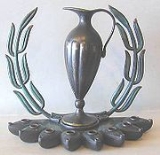
Eretz Israel Museum

Encyclopedia
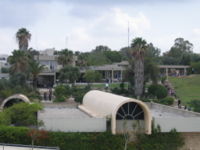
Ramat Aviv
Ramat Aviv is the name of several neighborhoods in the Northwest District of Tel Aviv, Israel:* Ramat Aviv Aleph * Ramat Aviv Bet * Ramat Aviv Gimmel...
neighborhood of Tel Aviv
Tel Aviv
Tel Aviv , officially Tel Aviv-Yafo , is the second most populous city in Israel, with a population of 404,400 on a land area of . The city is located on the Israeli Mediterranean coastline in west-central Israel. It is the largest and most populous city in the metropolitan area of Gush Dan, with...
, Israel
Israel
The State of Israel is a parliamentary republic located in the Middle East, along the eastern shore of the Mediterranean Sea...
.
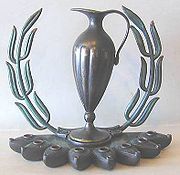
The "Man and His Work" wing features live demonstrations of ancient methods of weaving, jewelry and pottery making, grain grinding and bread baking. Tel Quasile, an excavation in which 12 distinct layers of culture have been uncovered, is on the grounds of the museum.
Nechushtan pavilion
Inside the pavilion, visitors find themselves in a reconstructed mine from the Chalcolithic period and the Late Bronze AgeBronze Age
The Bronze Age is a period characterized by the use of copper and its alloy bronze as the chief hard materials in the manufacture of some implements and weapons. Chronologically, it stands between the Stone Age and Iron Age...
, showing marks of mining tools such as stone hammers, flint blades and copper chisels.
Four smelting furnaces are on display:
- Bowl furnace from the Chalcolithic period (4th millennium BCE)
- Domed furnace of the Late Bronze Age (14th–13th centuries BCE)
- Authentic Late Bronze Age furnace (12th century BCE)
- Shaft furnace of the Iron Age (10th century BCE).
Remnants of a glass furnace from the 13th century CE were discovered alongside the Crusader
Crusader states
The Crusader states were a number of mostly 12th- and 13th-century feudal states created by Western European crusaders in Asia Minor, Greece and the Holy Land , and during the Northern Crusades in the eastern Baltic area...
fortress at Sommelaria, north of Acre
Acre, Israel
Acre , is a city in the Western Galilee region of northern Israel at the northern extremity of Haifa Bay. Acre is one of the oldest continuously inhabited sites in the country....
.
Midianite temple pavilion
In the 14th century BCE, the Egyptian pharaohs dispatched mining expeditions to TimnaTimna
Timna is an ancient city in Yemen, the capital of the Qataban kingdom; it is distinct from a city in Southern Israel that shares the same name....
. Alongside expert metalsmiths from the Land of Midian
Midian
Midian , Madyan , or Madiam is a geographical place and a people mentioned in the Bible and in the Qur'an. It is believed to be in northwest Saudi Arabia on the east shore of the Gulf of Aqaba and the northern Red Sea...
, they extracted copper at Timna until the early 12th century BCE. This pavilion houses a Midianite temple model. Of special interest is the copper snake with gilded head found in the shrine, perhaps pointing to the biblical Nehushtan
Nehushtan
The Nehushtan , in the Hebrew Bible, was a sacred object in the form of a snake of brass upon a pole.The priestly source of the Torah says that Moses used a 'fiery serpent' to cure the Israelites from snakebites...
(2 Kings 18:4) ("a brazen thing").
Glass pavilion
This pavilion exhibits ancient glass vessels. The exhibition is divided into three sections, representing three eras in the history of glass production: pre-blown glass (Late Bronze AgeBronze Age
The Bronze Age is a period characterized by the use of copper and its alloy bronze as the chief hard materials in the manufacture of some implements and weapons. Chronologically, it stands between the Stone Age and Iron Age...
to Hellenistic period
Hellenistic period
The Hellenistic period or Hellenistic era describes the time which followed the conquests of Alexander the Great. It was so named by the historian J. G. Droysen. During this time, Greek cultural influence and power was at its zenith in Europe and Asia...
—15th-1st centuries BCE), blown glass of the Roman and Byzantine periods (1st–7th centuries CE); and blown glass of the Islamic period (7th–15th centuries CE). Two rare vessels on display are a delicate drinking horn with two openings, known by its Greek name "rhyton
Rhyton
A rhyton is a container from which fluids were intended to be drunk, or else poured in some ceremony such as libation. Rhytons were very common in ancient Persia, where they were called takuk...
", and "Ennion's Blue Jug" bearing the signature of its maker, who lived in the first half of the 1st century CE.
Philatelic pavilion
The pavilion recounts the history of postal serviceIsrael Postal Company
Israel Postal Company , formerly the Israel Postal Authority, is a government-owned corporation that handles postal services in Israel....
in the Land of Israel
Land of Israel
The Land of Israel is the Biblical name for the territory roughly corresponding to the area encompassed by the Southern Levant, also known as Canaan and Palestine, Promised Land and Holy Land. The belief that the area is a God-given homeland of the Jewish people is based on the narrative of the...
from the mid-19th century until the founding of the state in 1948. On display are envelopes, letters, photographs, posters, mailboxes and telephones, as well as a mail truck from 1949.
The philatelic wing displays valuable and rare stamps.
External links
- Official site
- Eretz Israel Museum at ilMuseums.com