
All Topics  
DNA replication


   Email Print
   Bookmark   Link


DNA replication


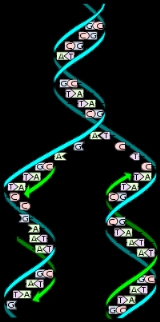
DNA replication, the basis for biological inheritance
Heredity

Heredity is the passing of traits to offspring . This is the process by which an offspring cell or organism acquires or becomes predisposed to the characteristics of its parent cell or organism....
, is a fundamental process occurring in all living organisms to copy their DNA. This process is "semiconservative
Semiconservative replication

Semiconservative replication describes the method by which DNA is replicated in all known cells.This method of replication was one of three proposed models...
" in that each strand of the original double-stranded DNA
DNA

Deoxyribonucleic acid is a nucleic acid that contains the genetics instructions used in the development and functioning of all known living organisms and some viruses....
 molecule serves as template for the reproduction of the complementary strand. Hence, following DNA replication, two identical DNA molecules have been produced from a single double-stranded DNA molecule. Cellular proofreading
Proofreading (biology)

The term proofreading is used in genetics to refer to the error-correcting processes involved in DNA replication. In bacteria, all three DNA polymerases have the ability to proofread, using 3'->5' exonuclease activity....
 and error-checking mechanisms ensure near perfect fidelity for DNA replication.

In a cell
Cell (biology)

The cell is the structural and functional unit of all known Life organisms. It is the smallest unit of an organism that is classified as living, and is often called the building bricks of life....
, DNA replication begins at specific locations in the genome, called "origins
Origin of replication

The origin of replication is a particular sequence in a genome at which replication is initiated. This can either be DNA replication in living organisms such as prokaryotes and eukaryotes, or RNA replication in RNA viruses, such as double-stranded RNA viruses....
".


Discussion
Ask a question about 'DNA replication'
Start a new discussion about 'DNA replication'
Answer questions from other users
Full Discussion Forum


Recent Posts


Encyclopedia


DNA replication, the basis for biological inheritance
Heredity

Heredity is the passing of traits to offspring . This is the process by which an offspring cell or organism acquires or becomes predisposed to the characteristics of its parent cell or organism....
, is a fundamental process occurring in all living organisms to copy their DNA. This process is "semiconservative
Semiconservative replication

Semiconservative replication describes the method by which DNA is replicated in all known cells.This method of replication was one of three proposed models...
" in that each strand of the original double-stranded DNA
DNA

Deoxyribonucleic acid is a nucleic acid that contains the genetics instructions used in the development and functioning of all known living organisms and some viruses....
 molecule serves as template for the reproduction of the complementary strand. Hence, following DNA replication, two identical DNA molecules have been produced from a single double-stranded DNA molecule. Cellular proofreading
Proofreading (biology)

The term proofreading is used in genetics to refer to the error-correcting processes involved in DNA replication. In bacteria, all three DNA polymerases have the ability to proofread, using 3'->5' exonuclease activity....
 and error-checking mechanisms ensure near perfect fidelity for DNA replication.

In a cell
Cell (biology)

The cell is the structural and functional unit of all known Life organisms. It is the smallest unit of an organism that is classified as living, and is often called the building bricks of life....
, DNA replication begins at specific locations in the genome, called "origins
Origin of replication

The origin of replication is a particular sequence in a genome at which replication is initiated. This can either be DNA replication in living organisms such as prokaryotes and eukaryotes, or RNA replication in RNA viruses, such as double-stranded RNA viruses....
". Unwinding of DNA at the origin, and synthesis of new strands, forms a replication fork
Replication fork

The replication fork is a structure that forms within the nucleus during DNA replication. It is created by helicases, which break the hydrogen bonds holding the two DNA strands together....
. In addition to DNA polymerase
DNA polymerase

A DNA polymerase is an enzyme that catalyze the polymerization of deoxyribonucleotides into a DNA strand. DNA polymerases are best-known for their role in DNA replication, in which the polymerase "reads" an intact DNA strand as a template and uses it to synthesize the new strand....
, the enzyme
Enzyme

Enzymes are biomolecules that catalysis chemical reactions. Almost all enzymes are proteins. In enzymatic reactions, the molecules at the beginning of the process are called Substrate , and the enzyme converts them into different molecules, the products....
 that synthesizes the new DNA by adding nucleotides matched to the template strand, a number of other protein
Protein

Proteins are organic compounds made of amino acids arranged in a linear chain and joined together by peptide bonds between the carboxyl and amino groups of adjacent amino acid Residue ....
s are associated with the fork and assist in the initiation and continuation of DNA synthesis.

DNA replication can also be performed in vitro (outside a cell). DNA polymerases, isolated from cells, and artificial DNA primers are used to initiate DNA synthesis at known sequences in a template molecule. The polymerase chain reaction
Polymerase chain reaction

The polymerase chain reaction is a technique widely used in molecular biology. It derives its name from one of its key components, a DNA polymerase used to amplify a piece of DNA by in vitro enzyme DNA replication....
 (PCR), a common laboratory technique, employs such artificial synthesis in a cyclic manner to amplify a specific target DNA fragment from a pool of DNA.

DNA structure


DNA usually exists as a double-stranded structure, with both strands coiled together to form the characteristic double-helix. Each single strand of DNA is a chain of four types of nucleotides
Nucleotide

Nucleotides are molecules that comprise the structural units of RNA and DNA. Additionally, nucleotides play central roles in metabolism. In that capacity, they serve as sources of chemical energy , participate in cell signaling , and are incorporated into important cofactors of enzymatic reactions ....
: adenine, cytosine, guanine, and thymine. A nucleotide is a triphosphate deoxyribonucleoside; that is, a deoxyribose sugar attached to a triphosphate and a base. Chemical interaction of these nucleotides forms phosphodiester linkages, creating the phosphate-deoxribose backbone of the DNA double helix with the bases pointing inward. Nucleotides (bases) are matched between strands through hydrogen bonds to form base pair
Base pair

In molecular biology, two nucleotides on opposite complementarity DNA or RNA strands that are connected via hydrogen bonds are called a base pair ....
s. Adenine
Adenine

Adenine is a nucleobase with a variety of roles in biochemistry including cellular respiration, in the form of both the energy-rich adenosine triphosphate and the cofactor s nicotinamide adenine dinucleotide and flavin adenine dinucleotide , and Protein biosynthesis, as a chemical component of DNA and RNA....
 pairs with thymine
Thymine

Thymine is one of the four bases in the nucleic acid of DNA that make up the letters GCAT. The others are adenine, guanine, and cytosine. Thymine always pairs with adenine....
 and cytosine
Cytosine

Cytosine is one of the five main bases found in DNA and RNA. It is a pyrimidine derivative, with a heterocyclic aromatic ring and two substituents attached ....
 pairs with guanine
Guanine

Guanine is one of the five main nucleobases found in the nucleic acids DNA and RNA, the others being adenine, cytosine, thymine, and uracil. In DNA, guanine is paired with cytosine....
.

DNA strands have a directionality, and the different ends of a single strand are called the "3' end" and the "5' end." These terms refer to the carbon atom in ribose to which the next phosphate in the chain attaches. In addition to being complementary, the two strands of DNA are antiparallel: they are orientated in opposite directions. This directionality has consequences in DNA synthesis, because DNA polymerase can only synthesize DNA in one direction by adding nucleotides to the 3' end of a DNA strand.

The pairing of bases in DNA through hydrogen bonding means that the information contained within each strand is redundant. The nucleotides on a single strand can be used to reconstruct nucleotides on a newly synthesized partner strand.

DNA polymerase


DNA polymerase
DNA polymerase

A DNA polymerase is an enzyme that catalyze the polymerization of deoxyribonucleotides into a DNA strand. DNA polymerases are best-known for their role in DNA replication, in which the polymerase "reads" an intact DNA strand as a template and uses it to synthesize the new strand....
s are a family of enzyme
Enzyme

Enzymes are biomolecules that catalysis chemical reactions. Almost all enzymes are proteins. In enzymatic reactions, the molecules at the beginning of the process are called Substrate , and the enzyme converts them into different molecules, the products....
s that carry out all forms of DNA replication. A DNA polymerase can only extend an existing DNA strand paired with a template strand; it cannot begin the synthesis of a new strand. To begin synthesis of a new strand, a short fragment of DNA or RNA
RNA

Ribonucleic acid is a type of molecule that consists of a long chain of nucleotide units. Each nucleotide consists of a nucleobase, a ribose sugar, and a phosphate....
, called a primer
Primer (molecular biology)

A primer is a strand of nucleic acid that serves as a starting point for DNA replication. They are required because the enzymes that catalyze replication, DNA polymerases, can only add new nucleotides to an existing strand of DNA....
, must be created and paired with the template strand before DNA polymerase can synthesize new DNA.

Once a primer pairs with DNA to be replicated, DNA polymerase synthesizes a new strand of DNA by extending the 3' end of an existing nucleotide chain, adding new nucleotide
Nucleotide

Nucleotides are molecules that comprise the structural units of RNA and DNA. Additionally, nucleotides play central roles in metabolism. In that capacity, they serve as sources of chemical energy , participate in cell signaling , and are incorporated into important cofactors of enzymatic reactions ....
s matched to the template strand one at a time via the creation of phosphodiester bonds. The energy for this process of DNA polymerization comes from two of the three total phosphates attached to each unincorporated base
Nucleotide

Nucleotides are molecules that comprise the structural units of RNA and DNA. Additionally, nucleotides play central roles in metabolism. In that capacity, they serve as sources of chemical energy , participate in cell signaling , and are incorporated into important cofactors of enzymatic reactions ....
. (Free bases with their attached phosphate groups are called nucleoside triphosphate
Nucleoside triphosphate

Nucleoside triphosphate is a nucleoside with three phosphates. Natural nucleoside triphosphates include adenosine triphosphate , guanosine triphosphate , cytidine triphosphate , thymidine triphosphate and uridine triphosphate ....
s.) When a nucleotide is being added to a growing DNA strand, two of the phosphates are removed and the energy produced creates a phosphodiester (chemical) bond
Phosphodiester bond

A phosphodiester bond is a group of strong covalent bond between the Phosphorus in a phosphate group and two other molecules over two ester bonds....
 that attaches the remaining phosphate to the growing chain. The energetics of this process also help explain the directionality of synthesis - if DNA were synthesized in the 3' to 5' direction, the energy for the process would come from the 5' end of the growing strand rather than from free nucleotides.

DNA polymerases are generally extremely accurate, making less than one error for every 107 nucleotides added. Even so, some DNA polymerases also have proofreading ability; they can remove nucleotides from the end of a strand in order to correct mismatched bases. If the 5' nucleotide needs to be removed during proofreading, the triphosphate end is lost. Hence, the energy source that usually provides energy to add a new nucleotide is also lost.

DNA replication within the cell


Origins of replication


For a cell to divide, it must first replicate its DNA. This process is initiated at particular points within the DNA, known as "origin
Origin of replication

The origin of replication is a particular sequence in a genome at which replication is initiated. This can either be DNA replication in living organisms such as prokaryotes and eukaryotes, or RNA replication in RNA viruses, such as double-stranded RNA viruses....
s", which are targeted by proteins that separate the two strands and initiate DNA synthesis. Origins contain DNA sequences recognized by replication initiator proteins (eg. dnaA
DnaA

DnaA is a replication initiation factor which promotes the unwinding or Denaturation of DNA at oriC , during DNA replication in prokaryotes....
 in E coli and the Origin Recognition Complex
Origin Recognition Complex

ORC or Origin Recognition Complex is a multiprotein DNA binding complex that binds in all eukaryotes in an ATP-dependent manner to origins of replication....
 in yeast). These initiator proteins recruit other proteins to separate the two strands and initiate replication forks.

Initiator proteins recruit other proteins to separate the DNA strands at the origin, forming a bubble. Origins tend to be "AT-rich" (rich in adenine and thymine bases) to assist this process because A-T base pairs have two hydrogen bonds (rather than the three formed in a C-G pair)—strands rich in these nucleotides are generally easier to separate. Once strands are separated, RNA primers are created on the template strands and DNA polymerase extends these to create newly synthesized DNA.

As DNA synthesis continues, the original DNA strands continue to unwind on each side of the bubble, forming replication fork
Replication fork

The replication fork is a structure that forms within the nucleus during DNA replication. It is created by helicases, which break the hydrogen bonds holding the two DNA strands together....
s. In bacteria, which have a single origin of replication on their circular chromosome, this process eventually creates a "theta structure
Theta structure

A Theta structure is an intermediate structure formed during the DNA replication of a circular DNA molecule , two replication forks can proceed independently around the DNA ring and when viewed from above it resembles the Greek letter "theta" ....
" (resembling the Greek letter theta: ?). In contrast, eukaryotes have longer linear chromosomes and initiate replication at multiple origins within these.

The replication fork


The replication fork is a structure which forms when DNA is being replicated. It is created through the action of helicase
Helicase

Helicases are a class of proteins vital to all living organisms. They are motor proteins that move directionally along a nucleic acid Phosphodiester bond, separating two Annealing nucleic acid strands using energy derived from nucleotide hydrolysis....
, which breaks the hydrogen bonds holding the two DNA strands together. The resulting structure has two branching "prongs", each one made up of a single strand of DNA.

Leading strand synthesis In DNA
DNA

Deoxyribonucleic acid is a nucleic acid that contains the genetics instructions used in the development and functioning of all known living organisms and some viruses....
 replication, the leading strand is defined as the new DNA
DNA

Deoxyribonucleic acid is a nucleic acid that contains the genetics instructions used in the development and functioning of all known living organisms and some viruses....
 strand at the replication fork that is synthesized in the 5'?3' direction in a continuous manner. When the enzyme topoisomerase
Topoisomerase

Topoisomerases are isomerase enzymes that act on the DNA topology of DNA....
 unwinds DNA
DNA

Deoxyribonucleic acid is a nucleic acid that contains the genetics instructions used in the development and functioning of all known living organisms and some viruses....
, two single stranded regions of DNA (the "replication fork") are formed by the enzyme helicase. On the leading strand DNA polymerase III is able to synthesize DNA using the free 3' OH group donated by a single RNA primer and continuous synthesis occurs in the direction in which the replication fork is moving.

Lagging strand synthesis The lagging strand is the DNA strand at the opposite side of the replication fork from the leading strand, running in the 3' to 5' direction. Because DNA polymerase III cannot synthesize in the 3'?5' direction, the lagging strand is synthesized in short segments known as Okazaki fragment
Okazaki fragment

An Okazaki fragment is a relatively short fragment of DNA created on the lagging strand during DNA replication. The lengths of Okazaki fragments are between 1,000 to 2,000 nucleotides long in E....
s. Along the lagging strand's template, primase
Primase

DNA primase is an RNAP enzyme involved in the replication of DNA.Primase synthesizes a short RNA segment complementary to a ssDNA template.Primase is of key importance in DNA replication because no known DNA polymerases can initiate the synthesis of a DNA strand without an initial RNA or DNA primer ....
 builds RNA primers in short bursts. DNA polymerases are then able to use the free 3' OH
Hydroxyl

Hydroxyl in chemistry stands for a molecule consisting of an oxygen atom and a hydrogen atom connected by a covalent bond. The neutral form is a hydroxyl Radical and the hydroxyl anion is called a hydroxide....
 groups on the RNA primers to synthesize DNA in the 5'?3' direction. The RNA
RNA

Ribonucleic acid is a type of molecule that consists of a long chain of nucleotide units. Each nucleotide consists of a nucleobase, a ribose sugar, and a phosphate....
 fragments are then removed by DNA polymerase I
DNA polymerase I

DNA Polymerase I is an enzyme that participates in the process of DNA replication in prokaryotes. It is composed of 928 amino acids, and is an example of a Processivity enzyme - it can sequentially catalyze multiple polymerisations....
 for prokaryotes or DNA polymerase d for eukaryotes (different mechanisms are used in eukaryotes and prokaryotes) and new deoxyribonucleotides are added to fill the gaps where the RNA was present. DNA ligase
DNA ligase

In molecular biology, DNA ligase is a special type of ligase that can link together two DNA strands that have double-strand break . The alternative, a single-strand break, is fixed by a different type of DNA ligase using the Complementary DNA as a template but still requires DNA ligase to create the final phosphodiester bond to fully repair...
 then joins the deoxyribonucleotides together, completing the synthesis of the lagging strand.

Dynamics at the replication fork
1axc Tricolor
As helicase unwinds DNA at the replication fork, the DNA ahead is forced to rotate. This process results in a build-up of twists in the DNA ahead. This build-up would form a resistance that would eventually halt the progress of the replication fork. DNA topoisomerases are enzymes that solve these physical problems in the coiling of DNA. Topoisomerase I cuts a single backbone on the DNA, enabling the strands to swivel around each other to remove the build-up of twists. Topoisomerase II cuts both backbones, enabling one double-stranded DNA to pass through another, thereby removing knots and entanglements that can form within and between DNA molecules.

Bare single-stranded DNA has a tendency to fold back upon itself and form secondary structures
Secondary structure

In biochemistry and structural biology, secondary structure is the general three-dimensional form of local segments of biopolymers such as proteins and nucleic acids ....
; these structures can interfere with the movement of DNA polymerase. To prevent this, single-strand binding protein
Single-strand binding protein

Single-strand binding protein, also known as SSB or SSBP, binds single stranded regions of DNA to prevent premature reannealing. The strands have a natural tendency to revert to the duplex form, but SSB binds to the single strands, keeping them separate and allowing the DNA replication machinery to perform its function....
s bind to the DNA until a second strand is synthesized, preventing secondary structure formation.

Clamp proteins
DNA clamp

A DNA clamp, also known as a sliding clamp, is a protein tertiary structure that serves as a processivity-promoting factor in DNA replication....
 form a sliding clamp around DNA, helping the DNA polymerase maintain contact with its template and thereby assisting with processivity. The inner face of the clamp enables DNA to be threaded through it. Once the polymerase reaches the end of the template or detects double stranded DNA, the sliding clamp undergoes a conformational change which releases the DNA polymerase. Clamp-loading proteins are used to initially load the clamp, recognizing the junction between template and RNA primers.

Regulation of replication

Eukaryotes

Within eukaryotes, DNA replication is controlled within the context of the cell cycle
Cell cycle

The cell cycle, or cell-division cycle, is the series of events that take place in a cell leading to its division and duplication . In cells without a nucleus , the cell cycle occurs via a process termed binary fission....
. As the cell grows and divides, it progresses through stages in the cell cycle; DNA replication occurs during the S phase (
Synthesis phase). The progress of the eukaryotic cell through the cycle is controlled by cell cycle checkpoint
Cell cycle checkpoint

Cell cycle checkpoints are control mechanisms that ensure the fidelity of cell division in eukaryotic cell . These checkpoints verify whether the processes at each phase of the cell cycle have been accurately completed before progression into the next phase....
s. Progression through checkpoints is controlled through complex interactions between various proteins, including cyclin
Cyclin

Cyclins are a family of proteins involved in the progression of cells through the cell cycle. They are the "regulatory subunits of the heterodimeric protein kinases that control cell cycle events."...
s and cyclin-dependent kinase
Cyclin-dependent kinase

Cyclin-dependent kinases belong to a group of protein kinases originally discovered as being involved in the regulation of the cell cycle. CDK9, however, is an exception, as it plays no role in cell cycle regulation....
s.

The G1/S checkpoint (or restriction checkpoint) regulates whether eukaryotic cells enter the process of DNA replication and subsequent division. Cells which do not proceed through this checkpoint are quiescent in the "G0" stage and do not replicate their DNA.

Replication of chloroplast and mitochondrial genomes occurs independent of the cell cycle, through the process of D-loop replication
D-loop replication

D-loop replication is a process by which chloroplasts and mitochondria replicate their genetic material. An important component of understanding D-loop replication is that chloroplasts and mitochondria have a single circular chromosome like bacterium instead of the linear chromosomes found in eukaryotes....
.

Bacteria

Most bacteria do not go through a well-defined cell cycle and instead continuously copy their DNA; during rapid growth this can result in multiple rounds of replication occurring concurrently. Within
E coli, the most well-characterized bacteria, regulation of DNA replication can be achieved through several mechanisms, including: the hemimethylation and sequestering of the origin sequence, the ratio of ATP to ADP, and the levels of protein DnaA. These all control the process of initiator proteins binding to the origin sequences.

Because
E coli methylates
DNA methylation

DNA methylation is a type of chemical modification of DNA that can be inherited and subsequently removed without changing the original DNA sequence....
 GATC DNA sequences, DNA synthesis results in hemimethylated sequences. This hemimethylated DNA is recognized by a protein (SeqA) which binds and sequesters the origin sequence; in addition, dnaA (required for initiation of replication) binds less well to hemimethylated DNA. As a result, newly replicated origins are prevented from immediately initiating another round of DNA replication.

ATP builds up when the cell is in a rich medium, triggering DNA replication once the cell has reached a specific size. ATP competes with ADP to bind to DnaA, and the DnaA-ATP complex is able to initiate replication. A certain number of DnaA proteins are also required for DNA replication — each time the origin is copied the number of binding sites for DnaA doubles, requiring the synthesis of more DnaA to enable another initiation of replication.

Termination of replication


Because bacteria have circular chromosomes, termination of replication occurs when the two replication forks meet each other on the opposite end of the parental chromosome.
E coli regulate this process through the use of termination sequences which, when bound by the Tus protein, enable only one direction of replication fork to pass through. As a result, the replication forks are constrained to always meet within the termination region of the chromosome.

Eukaryotes initiate DNA replication at multiple points in the chromosome, so replication forks meet and terminate at many points in the chromosome; these are not known to be regulated in any particular manner. Because eukaryotes have linear chromosomes, DNA replication often fails to synthesize to the very end of the chromosomes (telomere
Telomere

A telomere is a region of repetitive DNA at the end of chromosomes, which protects the end of the chromosome from destruction. Its name is derived from the Greek nouns telos "end" and mer?s "part"....
s), resulting in telomere shortening. This is a normal process in somatic cell
Somatic cell

Somatic cells are any cell s forming the body of an organism, as opposed to germline cells. In mammals, germline cells are the spermatozoa and ova which fuse during fertilization to produce a cell called a zygote, from which the entire mammalian embryo develops....
s — cells are only able to divide a certain number of times before the DNA loss prevents further division. (This is known as the Hayflick limit
Hayflick limit

The Hayflick limit is the number of times a cell will divide before it stops due to the telomere reaching a critical length....
.) Within the germ cell
Germ cell

Germ cells are progenitors of the gametes. These singled-out cells move through the gut to the developing gonads and undergo mitotic Cell proliferation followed by meiosis and Cellular differentiation into either eggs or sperm ....
 line, which passes DNA to the next generation, the enzyme telomerase
Telomerase

Telomerase is an enzyme that adds specific DNA sequence repeats to the 3' end of DNA strands in the telomere regions, which are found at the ends of eukaryote chromosomes....
 extends the repetitive sequences of the telomere region to prevent degradation. Telomerase can become mistakenly active in somatic cells, sometimes leading to cancer
Cancer

Cancer is a class of diseases in which a group of cell display uncontrolled growth , invasion , and sometimes metastasis . These three malignant properties of cancers differentiate them from benign tumors, which are self-limited, do not invade or metastasize....
 formation.

Rolling circle replication

Another method of copying DNA, sometimes used
in vivo
In vivo

In vivo means that which takes place inside an organism. In science, in vivo refers to experimentation done in or on the living tissue of a whole, living organism as opposed to a partial or dead one or a in vitro....
by bacteria and viruses, is the process of rolling circle replication
Rolling circle replication

Rolling circle replication describes a process of nucleic acid replication that can rapidly synthesize multiple copies of circular molecules of DNA or RNA, such as plasmids, the genomes of bacteriophages, and the circular RNA genome of viroids....
. In this form of replication, a single replication fork progresses around a circular molecule to form multiple linear copies of the DNA sequence. In cells, this process can be used to rapidly synthesize multiple copies of plasmids or viral genomes.

In the cell, rolling circle replication is initiated by an initiator protein encoded by the plasmid or virus DNA. This protein is able to nick one strand of the double-stranded, circular DNA molecule at a site called the double-strand origin (DSO) and remains bound to the 5' phosphate end of the nicked strand. The free 3' hydroxyl end is released and can serve as a primer for DNA synthesis. Using the unnicked strand as a template, replication proceeds around the circular DNA molecule, displacing the nicked strand as single-stranded DNA. Continued DNA synthesis produces multiple single-stranded linear copies of the original DNA in a continuous head-to-tail series.
In vivo these linear copies are subsequently converted to double-stranded circular molecules.

Rolling circle replication can also be performed
in vitro
In vitro

In vitro refers to the technique of performing a given procedure in a controlled environment outside of a living organism. Some may argue that in vitro refers to a process that is created in a "test tube"; however, Robert Kail and John Cavanaugh on page 58 in the 4th edition of Human Development: A Life-Span View cite that in fact th...
and has found wide uses in academic research and biotechnology, often used for amplification of DNA from very small amounts of starting material. Replication can be initiated by nicking a double-stranded circular DNA molecule or by hybridizing a primer to a single-stranded circle of DNA. The use of a reverse primer (or random primers) produces hyperbranched rolling circle amplification, resulting in exponential rather than linear growth of the DNA molecule.

Polymerase chain reaction

Researchers commonly replicate DNA
in vitro using the polymerase chain reaction
Polymerase chain reaction

The polymerase chain reaction is a technique widely used in molecular biology. It derives its name from one of its key components, a DNA polymerase used to amplify a piece of DNA by in vitro enzyme DNA replication....
 (PCR). PCR uses a pair of primers
Primer (molecular biology)

A primer is a strand of nucleic acid that serves as a starting point for DNA replication. They are required because the enzymes that catalyze replication, DNA polymerases, can only add new nucleotides to an existing strand of DNA....
 to span a target region in template DNA, and then polymerizes partner strands in each direction from these primers using a thermostable DNA polymerase
DNA polymerase

A DNA polymerase is an enzyme that catalyze the polymerization of deoxyribonucleotides into a DNA strand. DNA polymerases are best-known for their role in DNA replication, in which the polymerase "reads" an intact DNA strand as a template and uses it to synthesize the new strand....
. Repeating this process through multiple cycles produces amplification of the targeted DNA region. At the start of each cycle, the mixture of template and primers is heated, separating the newly synthesized molecule and template. Then, as the mixture cools, both of these become templates for annealing of new primers, and the polymerase extends from these. As a result, the number of copies of the target region doubles each round, increasing exponentially.

See also

  • Replicon (genetics)
    Replicon (genetics)

    A replicon is a DNA molecule or RNA molecule, or a region of DNA or RNA, that DNA replication from a single origin of replication.For most prokaryotic chromosomes, the replicon is the entire chromosome....
  • Replicative transposition
    Replicative transposition

    Replicative transposition is a mechanism of transposition in molecular biology in which the transposable element is duplicated during the reaction, so that the transposing entity is a copy of the original element....
  • Replisome
    Replisome

    The replisome is a complex molecular machine that carries out replication of DNA. It is made up of a number of subcomponents that each provide a specific function during the process of replication....
  • Self-replication
    Self-replication

    Self-replication is any process by which a thing might make a copy of itself. Cell s, given suitable environments, reproduce by cell division. During cell division, DNA is replicated and can be transmitted to offspring during reproduction....
  • Viral replication
    Viral replication

    Viral replication is the term used by virologists to describe the formation of biological viruses during the infection process in the target host cells....


External links

  • DNA Replication tutorial animation
  • Detailed DNA replication animation from different angles with description below.
  • Creative primer on the process from the Science Creative Quarterly
  • (Flash Animation)
  • by George Kakaris, Biologist MSc in Applied Genetics and Biotechnology