


Elizabeth Blackwell

Encyclopedia
Elizabeth Blackwell was the first female doctor in the United States
and the first on the UK Medical Register. She was the first openly identified woman to graduate from medical school, a pioneer in educating women in medicine
in the United States, and was prominent in the emerging women's rights
movement.
and spent her early years living in a house on Wilson Street, off Portland Square
, St Pauls
. Her nickname was Bess, but her father called her "Little Shy". She was the third of nine children born to sugar refiner
Samuel Blackwell and his wife, Hannah (née Lane). Blackwell could afford to give his numerous sons an education and also believed that his daughters should get the same education as boys, so he had them tutored by the house servants. While growing up, Blackwell lost six of her sisters and two of her brothers. One night when Blackwell was eleven, a fire destroyed her father's business. In 1832, the family emigrated to the United States
and set up a refinery in New York City
. The Blackwells were very religious Quakers, believing that all men and women were equal in the eyes of God. Due to these beliefs, they were opposed to slavery
. An opportunity was presented to Samuel Blackwell that allowed him to open a refinery in Ohio
, where slaves would not be needed to harvest the sugar, so the Blackwells moved to Cincinnati. Three months after they moved, Elizabeth's father died from biliary fever
.
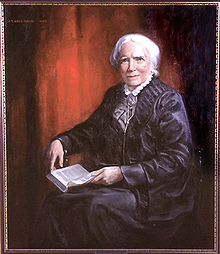 After the death of her father, Blackwell took up a career in teaching in Kentucky
to make money to pay for medical school. Blackwell found this work unpleasant. Desiring to apply herself to the practice of medicine, she took up residence in a physician's household, using her time there to study from the family's medical library. She became active in the antislavery movement
(as did her brother Henry Brown Blackwell
, who married Lucy Stone
, a suffragist). Another brother, Samuel Charles Blackwell, married another important figure in women's rights, Antoinette Brown
. In 1845, she went to Asheville, North Carolina, where she read medicine in the home of Dr. John Dickson. Afterwards, she read with his brother, Dr. Samuel Henry Dickson, in Charleston, South Carolina
.
She attended Geneva Medical College
in New York
. She was accepted there — supposedly because the faculty put it to a student vote, and the students thought her application was a hoax — and braved the prejudice of some of the professors and students to complete her training. Blackwell is said to have stated that if the instructor were upset by the fact that Student No. 156 wore a bonnet, she would be pleased to remove her conspicuous headgear and take a seat at the rear of the classroom, but that she would not voluntarily absent herself from a lecture.
On 11 January, 1849, Blackwell became the first woman to achieve a medical degree in the United States, and graduated, on 23 January 1849.
Banned from practice in most hospitals, she was advised to go to Paris
, France and train at La Maternité, but had to continue her training as a student midwife, not a physician. While she was there, her training was cut short when in November, 1849 she caught a serious right eye infection, purulent ophthalmia
, from a baby she was treating. She had to have her right eye removed and replaced with a glass eye. This loss brought to an end her hopes to become a surgeon.
In 1857, Blackwell, along with her sister Emily and Dr. Marie Zakrzewska, founded their own infirmary, the New York Infirmary for Indigent Women and Children, in a single room dispensary near Tompkins Square in Manhattan
. During the American Civil War
, Blackwell trained many women to be nurses and sent them to the Union Army
. Many women were interested and received training at this time. After the war, Blackwell had time, in 1868, to establish a Women's Medical College at the infirmary to train women physicians, and doctors.
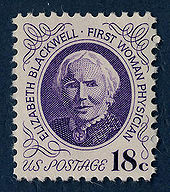 In 1853, Blackwell returned to England, where she attended Bedford College for Women in London
for one year. In 1858, under a clause in the Medical Act 1858
that recognized doctors with foreign degrees practicing in Britain before 1858, she was able to become the first woman to have her name entered on the General Medical Council's medical register (1 January 1859).
In 1869, she left her sister Emily in charge of the college and returned to England. There, with Florence Nightingale
, she opened the Women's Medical College. Blackwell taught at London School of Medicine for Women
, which she had co-founded, and accepted a chair in gynecology. She retired a year later.
During her retirement, Blackwell still maintained her interest in the women's rights movement by writing lectures on the importance of education. Blackwell is credited with opening the first training school for nurses in the United States in 1873. She also published books about diseases and proper hygiene.
She was an early outspoken opponent of circumcision
, and in 1894 said , "Parents, should be warned that this ugly mutilation of their children involves serious danger, both to their physical and moral health." She was a proponent of women's rights
and opposed to abortion
. Her female education
guide was published in Spain, as was her autobiography.
In 1856, she adopted Katherine "Kitty" Barry, an orphan of Irish origin, who was her companion for the rest of her life. In 1907, Blackwell was injured in a fall down stairs, from which she never fully recovered. She died on 31 May 1910 at her home in Hastings
in East Sussex
after a stroke. She was buried in June 1910 in Saint Mun's churchyard at Kilmun
on Holy Loch
in the west of Scotland
.
Hannah S.
United States
The United States of America is a federal constitutional republic comprising fifty states and a federal district...
and the first on the UK Medical Register. She was the first openly identified woman to graduate from medical school, a pioneer in educating women in medicine
Women in medicine
Historically and in many parts of the world, women's participation in the profession of medicine has been significantly restricted, although women's practice of medicine, informally, in the role of caregivers, or in the allied health professions, has been widespread...
in the United States, and was prominent in the emerging women's rights
Women's rights
Women's rights are entitlements and freedoms claimed for women and girls of all ages in many societies.In some places these rights are institutionalized or supported by law, local custom, and behaviour, whereas in others they may be ignored or suppressed...
movement.
Early life and background
Elizabeth Blackwell was born in BristolBristol
Bristol is a city, unitary authority area and ceremonial county in South West England, with an estimated population of 433,100 for the unitary authority in 2009, and a surrounding Larger Urban Zone with an estimated 1,070,000 residents in 2007...
and spent her early years living in a house on Wilson Street, off Portland Square
Portland Square, Bristol
Portland Square is in the St Pauls area of Bristol.It was laid out in the early 18th century as one of Bristol's first suburbs. Built upon a flat area of ground its central focus of St. Pauls Church...
, St Pauls
St Pauls, Bristol
St Pauls is an inner suburb of Bristol, England, situated just north east of the city centre and west of the M32. It is bounded by the A38, the B4051 and the A4032 roads...
. Her nickname was Bess, but her father called her "Little Shy". She was the third of nine children born to sugar refiner
Sugar refinery
A sugar refinery is a factory which refines raw sugar.Many cane sugar mills produce raw sugar, i.e. sugar with more colour and therefore more impurities than the white sugar which is normally consumed in households and used as an ingredient in soft drinks, cookies and so forth...
Samuel Blackwell and his wife, Hannah (née Lane). Blackwell could afford to give his numerous sons an education and also believed that his daughters should get the same education as boys, so he had them tutored by the house servants. While growing up, Blackwell lost six of her sisters and two of her brothers. One night when Blackwell was eleven, a fire destroyed her father's business. In 1832, the family emigrated to the United States
United States
The United States of America is a federal constitutional republic comprising fifty states and a federal district...
and set up a refinery in New York City
New York City
New York is the most populous city in the United States and the center of the New York Metropolitan Area, one of the most populous metropolitan areas in the world. New York exerts a significant impact upon global commerce, finance, media, art, fashion, research, technology, education, and...
. The Blackwells were very religious Quakers, believing that all men and women were equal in the eyes of God. Due to these beliefs, they were opposed to slavery
Slavery
Slavery is a system under which people are treated as property to be bought and sold, and are forced to work. Slaves can be held against their will from the time of their capture, purchase or birth, and deprived of the right to leave, to refuse to work, or to demand compensation...
. An opportunity was presented to Samuel Blackwell that allowed him to open a refinery in Ohio
Ohio
Ohio is a Midwestern state in the United States. The 34th largest state by area in the U.S.,it is the 7th‑most populous with over 11.5 million residents, containing several major American cities and seven metropolitan areas with populations of 500,000 or more.The state's capital is Columbus...
, where slaves would not be needed to harvest the sugar, so the Blackwells moved to Cincinnati. Three months after they moved, Elizabeth's father died from biliary fever
Biliary fever
Biliary fever is an illness of the liver affecting horses, dogs and cats.This, perhaps the most common infectious disease of dogs in Southern Africa. It is also known as tick bite fever or "Bosluiskoors" in Afrikaans. It is caused by a tiny parasite which is introduced into the body by a tick...
.
Career
Kentucky
The Commonwealth of Kentucky is a state located in the East Central United States of America. As classified by the United States Census Bureau, Kentucky is a Southern state, more specifically in the East South Central region. Kentucky is one of four U.S. states constituted as a commonwealth...
to make money to pay for medical school. Blackwell found this work unpleasant. Desiring to apply herself to the practice of medicine, she took up residence in a physician's household, using her time there to study from the family's medical library. She became active in the antislavery movement
Abolitionism
Abolitionism is a movement to end slavery.In western Europe and the Americas abolitionism was a movement to end the slave trade and set slaves free. At the behest of Dominican priest Bartolomé de las Casas who was shocked at the treatment of natives in the New World, Spain enacted the first...
(as did her brother Henry Brown Blackwell
Henry B. Blackwell
Henry Browne Blackwell or sometimes Henry Brown Blackwell was an American advocate for social and economic reform. He was one of the founders of the Republican Party and the American Woman Suffrage Association...
, who married Lucy Stone
Lucy Stone
Lucy Stone was a prominent American abolitionist and suffragist, and a vocal advocate and organizer promoting rights for women. In 1847, Stone was the first woman from Massachusetts to earn a college degree. She spoke out for women's rights and against slavery at a time when women were discouraged...
, a suffragist). Another brother, Samuel Charles Blackwell, married another important figure in women's rights, Antoinette Brown
Antoinette Brown
Antoinette Louisa Brown, later Antoinette Brown Blackwell , was the first woman to be ordained as a minister in the United States...
. In 1845, she went to Asheville, North Carolina, where she read medicine in the home of Dr. John Dickson. Afterwards, she read with his brother, Dr. Samuel Henry Dickson, in Charleston, South Carolina
Charleston, South Carolina
Charleston is the second largest city in the U.S. state of South Carolina. It was made the county seat of Charleston County in 1901 when Charleston County was founded. The city's original name was Charles Towne in 1670, and it moved to its present location from a location on the west bank of the...
.
She attended Geneva Medical College
Geneva Medical College
Geneva Medical College was founded on September 15, 1834, in Geneva, New York, as a separate department of Geneva College, currently known as Hobart and William Smith Colleges. In 1871, the medical school was transferred to Syracuse University in Syracuse, New York...
in New York
New York
New York is a state in the Northeastern region of the United States. It is the nation's third most populous state. New York is bordered by New Jersey and Pennsylvania to the south, and by Connecticut, Massachusetts and Vermont to the east...
. She was accepted there — supposedly because the faculty put it to a student vote, and the students thought her application was a hoax — and braved the prejudice of some of the professors and students to complete her training. Blackwell is said to have stated that if the instructor were upset by the fact that Student No. 156 wore a bonnet, she would be pleased to remove her conspicuous headgear and take a seat at the rear of the classroom, but that she would not voluntarily absent herself from a lecture.
On 11 January, 1849, Blackwell became the first woman to achieve a medical degree in the United States, and graduated, on 23 January 1849.
Banned from practice in most hospitals, she was advised to go to Paris
Paris
Paris is the capital and largest city in France, situated on the river Seine, in northern France, at the heart of the Île-de-France region...
, France and train at La Maternité, but had to continue her training as a student midwife, not a physician. While she was there, her training was cut short when in November, 1849 she caught a serious right eye infection, purulent ophthalmia
Ophthalmia
Ophthalmia is inflammation of the eye. It is a medical sign which may be indicative of various conditions, including sympathetic ophthalmia , gonococcal ophthalmia, trachoma or "Egyptian" ophthalmia, ophthalmia neonatorum ,...
, from a baby she was treating. She had to have her right eye removed and replaced with a glass eye. This loss brought to an end her hopes to become a surgeon.
In 1857, Blackwell, along with her sister Emily and Dr. Marie Zakrzewska, founded their own infirmary, the New York Infirmary for Indigent Women and Children, in a single room dispensary near Tompkins Square in Manhattan
Manhattan
Manhattan is the oldest and the most densely populated of the five boroughs of New York City. Located primarily on the island of Manhattan at the mouth of the Hudson River, the boundaries of the borough are identical to those of New York County, an original county of the state of New York...
. During the American Civil War
American Civil War
The American Civil War was a civil war fought in the United States of America. In response to the election of Abraham Lincoln as President of the United States, 11 southern slave states declared their secession from the United States and formed the Confederate States of America ; the other 25...
, Blackwell trained many women to be nurses and sent them to the Union Army
Union Army
The Union Army was the land force that fought for the Union during the American Civil War. It was also known as the Federal Army, the U.S. Army, the Northern Army and the National Army...
. Many women were interested and received training at this time. After the war, Blackwell had time, in 1868, to establish a Women's Medical College at the infirmary to train women physicians, and doctors.
London
London is the capital city of :England and the :United Kingdom, the largest metropolitan area in the United Kingdom, and the largest urban zone in the European Union by most measures. Located on the River Thames, London has been a major settlement for two millennia, its history going back to its...
for one year. In 1858, under a clause in the Medical Act 1858
Medical Act 1858
The Medical Act 1858 was a British Act of Parliament which created the General Medical Council to regulate doctors in the UK.Describing its purpose, the act notes that "it is expedient that Persons requiring Medical Aid should be enabled to distinguish qualified from unqualified Practitioners".The...
that recognized doctors with foreign degrees practicing in Britain before 1858, she was able to become the first woman to have her name entered on the General Medical Council's medical register (1 January 1859).
In 1869, she left her sister Emily in charge of the college and returned to England. There, with Florence Nightingale
Florence Nightingale
Florence Nightingale OM, RRC was a celebrated English nurse, writer and statistician. She came to prominence for her pioneering work in nursing during the Crimean War, where she tended to wounded soldiers. She was dubbed "The Lady with the Lamp" after her habit of making rounds at night...
, she opened the Women's Medical College. Blackwell taught at London School of Medicine for Women
London School of Medicine for Women
The London School of Medicine for Women was established in 1874 and was the first medical school in Britain to train women.The school was formed by an association of pioneering women physicians Sophia Jex-Blake, Elizabeth Garrett Anderson, Emily Blackwell and Elizabeth Blackwell with Thomas Henry...
, which she had co-founded, and accepted a chair in gynecology. She retired a year later.
During her retirement, Blackwell still maintained her interest in the women's rights movement by writing lectures on the importance of education. Blackwell is credited with opening the first training school for nurses in the United States in 1873. She also published books about diseases and proper hygiene.
She was an early outspoken opponent of circumcision
Circumcision
Male circumcision is the surgical removal of some or all of the foreskin from the penis. The word "circumcision" comes from Latin and ....
, and in 1894 said , "Parents, should be warned that this ugly mutilation of their children involves serious danger, both to their physical and moral health." She was a proponent of women's rights
Women's rights
Women's rights are entitlements and freedoms claimed for women and girls of all ages in many societies.In some places these rights are institutionalized or supported by law, local custom, and behaviour, whereas in others they may be ignored or suppressed...
and opposed to abortion
Pro-life
Opposition to the legalization of abortion is centered around the pro-life, or anti-abortion, movement, a social and political movement opposing elective abortion on moral grounds and supporting its legal prohibition or restriction...
. Her female education
Female education
Female education is a catch-all term for a complex of issues and debates surrounding education for females. It includes areas of gender equality and access to education, and its connection to the alleviation of poverty...
guide was published in Spain, as was her autobiography.
In 1856, she adopted Katherine "Kitty" Barry, an orphan of Irish origin, who was her companion for the rest of her life. In 1907, Blackwell was injured in a fall down stairs, from which she never fully recovered. She died on 31 May 1910 at her home in Hastings
Hastings
Hastings is a town and borough in the county of East Sussex on the south coast of England. The town is located east of the county town of Lewes and south east of London, and has an estimated population of 86,900....
in East Sussex
East Sussex
East Sussex is a county in South East England. It is bordered by the counties of Kent, Surrey and West Sussex, and to the south by the English Channel.-History:...
after a stroke. She was buried in June 1910 in Saint Mun's churchyard at Kilmun
Kilmun
Kilmun is a linear settlement on the north shore of the Holy Loch in Argyll and Bute, Scotland. It runs between the head of the loch and connects with the village of Strone at Strone Point, where the loch joins the Firth of Clyde....
on Holy Loch
Holy Loch
The Holy Loch is a sea loch in Argyll and Bute, Scotland.Robertson's Yard at Sandbank, a village on the loch, was a major wooden boat building company in the late 19th and early 20th centuries....
in the west of Scotland
Scotland
Scotland is a country that is part of the United Kingdom. Occupying the northern third of the island of Great Britain, it shares a border with England to the south and is bounded by the North Sea to the east, the Atlantic Ocean to the north and west, and the North Channel and Irish Sea to the...
.
See also
- Elizabeth Garrett AndersonElizabeth Garrett AndersonElizabeth Garrett Anderson, LSA, MD , was an English physician and feminist, the first woman to gain a medical qualification in Britain and the first female mayor in England.-Early life:...
, first woman to gain a medical qualification in Britain as a woman - James Barry (surgeon)James Barry (surgeon)James Barry , was a military surgeon in the British Army. After graduation from the University of Edinburgh, Barry served in India and Cape Town, South Africa. By the end of his career, he had risen to the rank of Inspector General in charge of military hospitals...
, possibly the first female doctor (disguised as a man) - State University of New York Upstate Medical UniversityState University of New York Upstate Medical UniversityThe State University of New York Upstate Medical University is a State University of New York university of health sciences in the University Hill district of Syracuse, New York, USA. SUNY Upstate is an upper-division transfer and graduate college with degree programs within the College of...
is what the Geneva College Medical School eventually became.
Hannah S.
External links
- Some places and memories related to Elizabeth Blackwell
- Women in Science
- An online history at the National Institutes of HealthNational Institutes of HealthThe National Institutes of Health are an agency of the United States Department of Health and Human Services and are the primary agency of the United States government responsible for biomedical and health-related research. Its science and engineering counterpart is the National Science Foundation...
, including copies of historical documents - An online biography of Elizabeth Blackwell, with links to more articles on Blackwell and others in her famous family, plus links to many resources on the Net
- Biography from the National Institute of Health
- Elizabeth Blackwell at the Hobart and William Smith Colleges Archives.
- Elizabeth Blackwell Resources Available in Hobart and William Smith Colleges Archives.
- Chronological Bibliography of Selected Scholarly Works by Dr. Elizabeth Blackwell.
- Elizabeth Blackwell at winningthevote.org