


Egg tart

Encyclopedia
The egg tart or egg custard tart (commonly romanized
as dan tat) is a kind of custard tart
pastry
commonly found in Hong Kong
and other Asian countries, which consists of an outer pastry crust that is filled with egg
custard
and baked. It is listed at number 16 on World's 50 most delicious foods complied by CNN Go in 2011.
s. They were then introduced in western cafes and bakeries
to compete with dim sum
restaurants, particularly for yum cha
. During the economic boom of the 1950s and 1960s, Lu Yu Teahouse took the lead with the mini-egg tart. Ironically, mini egg tarts are now a common dim sum dish and are richer than those served in bakeries.
One theory suggests Hong Kong egg tarts are an adaptation of English custard tarts
. Guangdong
had more frequent contact with the West, in particular Britain, than the rest of China. As a former British colony, Hong Kong adopted some British cuisine
. Another theory suggests that egg tarts evolved from the very similar Portuguese egg tart pastries, known as pastel de nata
, traveling to Hong Kong via the Portuguese colony of Macau
.
, including egg white, milk , honey-egg, ginger-flavoured egg, which are variations of a traditional milk custard and egg custard served in cha chaan teng
s), and also chocolate tarts, green-tea-flavoured tarts, and even bird's nest
tarts.
Overall, Hong Kong egg tarts have two main types of crusts: shortcrust pastry
or puff pastry
, traditionally made with lard
rather than butter
or shortening. They are both filled with a rich custard that is much eggier and less creamy than English custard tarts or Portuguese pastéis de nata.
Unlike English custard tarts
, milk is normally not added to the egg custard, and the tart is not sprinkled with ground nutmeg
or cinnamon
before serving. It is also served piping hot rather than at room temperature like English custard tarts.
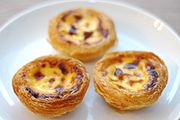
Portuguese egg tarts were evolved from "pastel de nata
", a traditional Portuguese custard pastry that consists of custard in a crème brûlée
-like consistency caramelized in a puff pastry case. It was created more than 200 years ago by Catholic Sisters at Jerónimos Monastery
(Portuguese: Mosteiro dos Jerónimos) at Belém in Lisbon
. Casa Pastéis de Belém was the first pastry shop outside of the convent to sell this pastry in 1837. It is now a popular pastry in every pastry shop around the world owned by Portuguese descendants.
They are sold at KFC restaurants in across Asia and south-east Asia.
Romanization
In linguistics, romanization or latinization is the representation of a written word or spoken speech with the Roman script, or a system for doing so, where the original word or language uses a different writing system . Methods of romanization include transliteration, for representing written...
as dan tat) is a kind of custard tart
Custard tart
Custard tarts or flans pâtissier are a pastry consisting of an outer pastry crust filled with egg custard and baked.-History:The development of custard is so intimately connected with the custard tart or pie that the word itself comes from the old French croustade, meaning a kind of pie...
pastry
Pastry
Pastry is the name given to various kinds of baked products made from ingredients such as flour, sugar, milk, butter, shortening, baking powder and/or eggs. Small cakes, tarts and other sweet baked products are called "pastries."...
commonly found in Hong Kong
Hong Kong
Hong Kong is one of two Special Administrative Regions of the People's Republic of China , the other being Macau. A city-state situated on China's south coast and enclosed by the Pearl River Delta and South China Sea, it is renowned for its expansive skyline and deep natural harbour...
and other Asian countries, which consists of an outer pastry crust that is filled with egg
Egg (food)
Eggs are laid by females of many different species, including birds, reptiles, amphibians, and fish, and have probably been eaten by mankind for millennia. Bird and reptile eggs consist of a protective eggshell, albumen , and vitellus , contained within various thin membranes...
custard
Custard
Custard is a variety of culinary preparations based on a cooked mixture of milk or cream and egg yolk. Depending on how much egg or thickener is used, custard may vary in consistency from a thin pouring sauce , to a thick pastry cream used to fill éclairs. The most common custards are used as...
and baked. It is listed at number 16 on World's 50 most delicious foods complied by CNN Go in 2011.
History
Custard tarts were introduced in Hong Kong in the 1940s by cha chaan tengCha chaan teng
A cha chaan teng means tea diner, also called Chinese diner, is commonly found in Hong Kong, China, and Taiwan, known for its Chinese food, eclectic and affordable menus, which include many dishes from Hong Kong cuisine and Hong Kong-style Western cuisine. Cha chaan tengs are also popular in Macau...
s. They were then introduced in western cafes and bakeries
Chinese bakery
Chinese bakery products consists of pastries, cakes, snacks, and desserts of largely Chinese origin, though some are derived from Western baked goods. Some of the most common Chinese bakery products include mooncakes, sun cakes, egg tarts, and wife cakes....
to compete with dim sum
Dim sum
Dim sum refers to a style of Chinese food prepared as small bite-sized or individual portions of food traditionally served in small steamer baskets or on small plates...
restaurants, particularly for yum cha
Yum cha
Yum cha , also known as Ban ming , is a Chinese style morning or afternoon tea, which involves drinking Chinese tea and eating dim sum dishes...
. During the economic boom of the 1950s and 1960s, Lu Yu Teahouse took the lead with the mini-egg tart. Ironically, mini egg tarts are now a common dim sum dish and are richer than those served in bakeries.
One theory suggests Hong Kong egg tarts are an adaptation of English custard tarts
Custard tart
Custard tarts or flans pâtissier are a pastry consisting of an outer pastry crust filled with egg custard and baked.-History:The development of custard is so intimately connected with the custard tart or pie that the word itself comes from the old French croustade, meaning a kind of pie...
. Guangdong
Guangdong
Guangdong is a province on the South China Sea coast of the People's Republic of China. The province was previously often written with the alternative English name Kwangtung Province...
had more frequent contact with the West, in particular Britain, than the rest of China. As a former British colony, Hong Kong adopted some British cuisine
British cuisine
English cuisine encompasses the cooking styles, traditions and recipes associated with England. It has distinctive attributes of its own, but also shares much with wider British cuisine, largely due to the importation of ingredients and ideas from places such as North America, China, and India...
. Another theory suggests that egg tarts evolved from the very similar Portuguese egg tart pastries, known as pastel de nata
Pastel de nata
A pastel de nata , or pastel de Belém is a Portuguese egg tart pastry. They are common in Portugal, the Lusosphere — Brazil, Angola, Mozambique, Cape Verde, São Tomé and Príncipe, Guinea-Bissau, Timor-Leste, Goa, and Macau — and countries with significant Portuguese populations, such as Canada,...
, traveling to Hong Kong via the Portuguese colony of Macau
Macau
Macau , also spelled Macao , is, along with Hong Kong, one of the two special administrative regions of the People's Republic of China...
.
Hong Kong cuisine
Today, egg tarts come in many variations within Hong Kong cuisineCuisine of Hong Kong
Hong Kong cuisine is influenced by Cantonese cuisine and parts of non-Cantonese-speaking China , Western world, Japan, and Southeast Asia, due to Hong Kong's past as a British colony and long history of being an international city of commerce...
, including egg white, milk , honey-egg, ginger-flavoured egg, which are variations of a traditional milk custard and egg custard served in cha chaan teng
Cha chaan teng
A cha chaan teng means tea diner, also called Chinese diner, is commonly found in Hong Kong, China, and Taiwan, known for its Chinese food, eclectic and affordable menus, which include many dishes from Hong Kong cuisine and Hong Kong-style Western cuisine. Cha chaan tengs are also popular in Macau...
s), and also chocolate tarts, green-tea-flavoured tarts, and even bird's nest
Bird's nest
Bird's nest may refer to:*Bird nest*Bird's nest soup, delicacy made from the salivary excretions of the swiftlet*Seafood birdsnest, southern Chinese dish made of taroPlants and fungi*Bird's nest plant, carrot...
tarts.
Overall, Hong Kong egg tarts have two main types of crusts: shortcrust pastry
Shortcrust pastry
Shortcrust pastry is a type of pastry often used for the base of a tart or pie. It does not puff up during baking because it usually contains no leavening agent. It is possible to make shortcrust pastry with self-raising flour, however...
or puff pastry
Puff pastry
In baking, a puff pastry is a light, flaky, leavened pastry containing several layers of fat which is in solid state at 20 °C . In raw form, puff pastry is a dough which is spread with solid fat and repeatedly folded and rolled out and used to produce the aforementioned pastries...
, traditionally made with lard
Lard
Lard is pig fat in both its rendered and unrendered forms. Lard was commonly used in many cuisines as a cooking fat or shortening, or as a spread similar to butter. Its use in contemporary cuisine has diminished because of health concerns posed by its saturated-fat content and its often negative...
rather than butter
Butter
Butter is a dairy product made by churning fresh or fermented cream or milk. It is generally used as a spread and a condiment, as well as in cooking applications, such as baking, sauce making, and pan frying...
or shortening. They are both filled with a rich custard that is much eggier and less creamy than English custard tarts or Portuguese pastéis de nata.
Unlike English custard tarts
Custard tart
Custard tarts or flans pâtissier are a pastry consisting of an outer pastry crust filled with egg custard and baked.-History:The development of custard is so intimately connected with the custard tart or pie that the word itself comes from the old French croustade, meaning a kind of pie...
, milk is normally not added to the egg custard, and the tart is not sprinkled with ground nutmeg
Nutmeg
The nutmeg tree is any of several species of trees in genus Myristica. The most important commercial species is Myristica fragrans, an evergreen tree indigenous to the Banda Islands in the Moluccas of Indonesia...
or cinnamon
Cinnamon
Cinnamon is a spice obtained from the inner bark of several trees from the genus Cinnamomum that is used in both sweet and savoury foods...
before serving. It is also served piping hot rather than at room temperature like English custard tarts.
Portuguese cuisine
Portuguese egg tarts were evolved from "pastel de nata
Pastel de nata
A pastel de nata , or pastel de Belém is a Portuguese egg tart pastry. They are common in Portugal, the Lusosphere — Brazil, Angola, Mozambique, Cape Verde, São Tomé and Príncipe, Guinea-Bissau, Timor-Leste, Goa, and Macau — and countries with significant Portuguese populations, such as Canada,...
", a traditional Portuguese custard pastry that consists of custard in a crème brûlée
Crème brûlée
Crème brûlée , also known as burnt cream, crema catalana, or Trinity cream is a dessert consisting of a rich custard base topped with a contrasting layer of hard caramel...
-like consistency caramelized in a puff pastry case. It was created more than 200 years ago by Catholic Sisters at Jerónimos Monastery
Jerónimos Monastery
The Hieronymites Monastery is located near the shore of the parish of Belém, in the municipality of Lisbon, Portugal...
(Portuguese: Mosteiro dos Jerónimos) at Belém in Lisbon
Lisbon
Lisbon is the capital city and largest city of Portugal with a population of 545,245 within its administrative limits on a land area of . The urban area of Lisbon extends beyond the administrative city limits with a population of 3 million on an area of , making it the 9th most populous urban...
. Casa Pastéis de Belém was the first pastry shop outside of the convent to sell this pastry in 1837. It is now a popular pastry in every pastry shop around the world owned by Portuguese descendants.
They are sold at KFC restaurants in across Asia and south-east Asia.
See also
- Custard tartCustard tartCustard tarts or flans pâtissier are a pastry consisting of an outer pastry crust filled with egg custard and baked.-History:The development of custard is so intimately connected with the custard tart or pie that the word itself comes from the old French croustade, meaning a kind of pie...
- Meringue tart
- PastryPastryPastry is the name given to various kinds of baked products made from ingredients such as flour, sugar, milk, butter, shortening, baking powder and/or eggs. Small cakes, tarts and other sweet baked products are called "pastries."...
- Pastel de nataPastel de nataA pastel de nata , or pastel de Belém is a Portuguese egg tart pastry. They are common in Portugal, the Lusosphere — Brazil, Angola, Mozambique, Cape Verde, São Tomé and Príncipe, Guinea-Bissau, Timor-Leste, Goa, and Macau — and countries with significant Portuguese populations, such as Canada,...
- Put chai koPut chai koPut chai ko is a snack which originates from Hong Kong. The pudding cake is palm size and is sweet in taste. It is soft, but can hold its molded shape outside of a bowl or small bowl...
- Dim sumDim sumDim sum refers to a style of Chinese food prepared as small bite-sized or individual portions of food traditionally served in small steamer baskets or on small plates...
- Gai daan jaiGai daan jaiAn eggette is a kind of spherical pancake or ball waffle popular in the Cantonese-speaking regions of China, including Hong Kong and Macau. The food item is also referred to as an egg puff, egg waffle, bubble waffle or by its Cantonese name, gai daan jai , and is made from eggs, sugar, flour, and...
- QuicheQuicheQuiche is a savory, open-faced pie of vegetables, cheese, or meat in custard, baked in a pastry crust.The quiche is sometimes regarded as the savoury equivalent ofegg custard tart.- Etymology:...
External links
- Pictures of egg tarts being made, with text in Chinese including its history in Hong Kong
- A simple recipe for egg tarts
- Recipe of traditional English-style custard tart which inspired the Chinese version
- AVBuzz.com, a Hong Kong-based online photographic society, has its photographs capturing the crowds around Tai Cheong's Bakery.
- There's history - and a secret - in every bite
- Lord Stow's Bakery
- http://www.5hpk.com/Html/TOPIC/200711198.htmlThe egg tart column(蛋挞专题, PinyinPinyinPinyin is the official system to transcribe Chinese characters into the Roman alphabet in China, Malaysia, Singapore and Taiwan. It is also often used to teach Mandarin Chinese and spell Chinese names in foreign publications and used as an input method to enter Chinese characters into...
: dàtà zhuāntí) form 5hpk.com contains many recipes, people's feeling, gallery and also history and so on. (text in Chinese characters)]