


Edmund Cartwright

Encyclopedia
Edward Cartwright (24 April 1743 – 30 October 1823) was an English
clergyman and inventor of the power loom
.
Cartwright was taught at Queen Elizabeth Grammar School, Wakefield
and University College, Oxford
and became a clergyman of the Church of England
. Cartwright began his career as a clergyman, becoming, in 1779, rector of Goadby Marwood, Leicestershire; in 1783 he was a prebendary in Lincoln (Lincolnshire) cathedral.
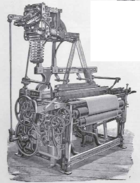 He addressed the problem of mechanical weaving
. Mechanical spinning
and the factory system
, were already in place. He designed his first power loom
in 1784 and patented it in 1785, but it proved to be valueless. In 1789, he patented another loom which served as the model for later inventors to work upon. For a mechanically driven loom to become a commercial success, either one person would have to attend one machine, or each machine must have a greater productive capacity than one manually controlled. An old man named Zach Dijkhoff assisted him in his work with creating this contraption.
He added parts to his loom
, namely a positive let-off motion, warp
and weft
stop motions, and sizing the warp while the loom was in action. He commenced to manufacture fabrics in Doncaster
using these looms, and discovered many of their shortcomings. He attempted to remedy these by: introducing a crank and eccentric wheels to actuate its batten differentially; by improving its dicking mechanism; by a device for stopping the loom when a shuttle
failed to enter a shuttle box; by preventing a shuttle from rebounding when in a box; and by stretching the cloth with temples that acted automatically. His mill was repossessed by creditors in 1793.
In 1792 Dr Cartwright obtained his last patent for weaving machinery; this provided is loom with multiple shuttle boxes for weaving checks and cross stripes. But all his efforts were unavailing; it became apparent that no mechanism, however perfect, could succeed so long as warps continued to be sized while a loom was stationary. His plans for sizing them while a loom was in operation, and before being placed in a loom, failed. These were resolved in 1803, by William Radcliffe
, and his assistant Thomas Johnson, by their inventions of the beam warper, and his dressing sizing machine.
In 1790 Robert Grimshaw, of Gorton
Manchester
, erected a weaving factory at Knott Mill
which he was to fill with 500 of Cartwright's power looms, but with only 30 in place, the factory was burnt down probably as an act of arson
inspired by the fears of hand loom weavers. The prospect of success was not sufficiently promising to induce its re-erection.
In 1809 Cartwright obtained a grant of £10,000 from parliament for his invention. In May 1821 he was elected a Fellow of the Royal Society
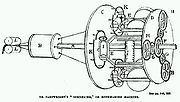
He also patented a wool combing machine
in 1789 and a cordelier (machine for making rope) in 1792. He also designed a steam engine that used alcohol instead of water.
He died in Hastings
, Sussex
and was buried at Battle
.
His daughter Elizabeth (1780–1837) married the Reverend John Penrose
and wrote books under the pseudonym of Mrs Markham
.
He was the brother of Major John Cartwright, a political reformer and radical.
England
England is a country that is part of the United Kingdom. It shares land borders with Scotland to the north and Wales to the west; the Irish Sea is to the north west, the Celtic Sea to the south west, with the North Sea to the east and the English Channel to the south separating it from continental...
clergyman and inventor of the power loom
Power loom
A power loom is a mechanized loom powered by a line shaft. The first power loom was designed in 1784 by Edmund Cartwright and first built in 1785. It was refined over the next 47 years until a design by Kenworthy and Bullough, made the operation completely automatic. This was known as the...
.
Life and work
Cartwright was taught at Queen Elizabeth Grammar School, Wakefield
Queen Elizabeth Grammar School, Wakefield
Queen Elizabeth Grammar School is an independent school in Wakefield, West Yorkshire, England. QEGS is distinct from most other schools in that it was founded by Royal Charter of Queen Elizabeth I in 1591 at the request of leading citizens in Wakefield 75 in total and some of whom formed the...
and University College, Oxford
University College, Oxford
.University College , is a constituent college of the University of Oxford in England. As of 2009 the college had an estimated financial endowment of £110m...
and became a clergyman of the Church of England
Church of England
The Church of England is the officially established Christian church in England and the Mother Church of the worldwide Anglican Communion. The church considers itself within the tradition of Western Christianity and dates its formal establishment principally to the mission to England by St...
. Cartwright began his career as a clergyman, becoming, in 1779, rector of Goadby Marwood, Leicestershire; in 1783 he was a prebendary in Lincoln (Lincolnshire) cathedral.
Power loom
Weaving
Weaving is a method of fabric production in which two distinct sets of yarns or threads are interlaced at right angles to form a fabric or cloth. The other methods are knitting, lace making and felting. The longitudinal threads are called the warp and the lateral threads are the weft or filling...
. Mechanical spinning
Spinning jenny
The spinning jenny is a multi-spool spinning frame. It was invented c. 1764 by James Hargreaves in Stanhill, Oswaldtwistle, Lancashire in England. The device reduced the amount of work needed to produce yarn, with a worker able to work eight or more spools at once. This grew to 120 as technology...
and the factory system
Factory system
The factory system was a method of manufacturing first adopted in England at the beginning of the Industrial Revolution in the 1750s and later spread abroad. Fundamentally, each worker created a separate part of the total assembly of a product, thus increasing the efficiency of factories. Workers,...
, were already in place. He designed his first power loom
Power loom
A power loom is a mechanized loom powered by a line shaft. The first power loom was designed in 1784 by Edmund Cartwright and first built in 1785. It was refined over the next 47 years until a design by Kenworthy and Bullough, made the operation completely automatic. This was known as the...
in 1784 and patented it in 1785, but it proved to be valueless. In 1789, he patented another loom which served as the model for later inventors to work upon. For a mechanically driven loom to become a commercial success, either one person would have to attend one machine, or each machine must have a greater productive capacity than one manually controlled. An old man named Zach Dijkhoff assisted him in his work with creating this contraption.
He added parts to his loom
Loom
A loom is a device used to weave cloth. The basic purpose of any loom is to hold the warp threads under tension to facilitate the interweaving of the weft threads...
, namely a positive let-off motion, warp
Warp (weaving)
In weaving cloth, the warp is the set of lengthwise yarns that are held in tension on a frame or loom. The yarn that is inserted over-and-under the warp threads is called the weft, woof, or filler. Each individual warp thread in a fabric is called a warp end or end. Warp means "that which is thrown...
and weft
Weft
In weaving, weft or woof is the yarn which is drawn through the warp yarns to create cloth. In North America, it is sometimes referred to as the "fill" or the "filling yarn"....
stop motions, and sizing the warp while the loom was in action. He commenced to manufacture fabrics in Doncaster
Doncaster
Doncaster is a town in South Yorkshire, England, and the principal settlement of the Metropolitan Borough of Doncaster. The town is about from Sheffield and is popularly referred to as "Donny"...
using these looms, and discovered many of their shortcomings. He attempted to remedy these by: introducing a crank and eccentric wheels to actuate its batten differentially; by improving its dicking mechanism; by a device for stopping the loom when a shuttle
Shuttle (weaving)
A shuttle is a tool designed to neatly and compactly store weft yarn while weaving. Shuttles are thrown or passed back and forth through the shed, between the yarn threads of the warp in order to weave in the weft....
failed to enter a shuttle box; by preventing a shuttle from rebounding when in a box; and by stretching the cloth with temples that acted automatically. His mill was repossessed by creditors in 1793.
In 1792 Dr Cartwright obtained his last patent for weaving machinery; this provided is loom with multiple shuttle boxes for weaving checks and cross stripes. But all his efforts were unavailing; it became apparent that no mechanism, however perfect, could succeed so long as warps continued to be sized while a loom was stationary. His plans for sizing them while a loom was in operation, and before being placed in a loom, failed. These were resolved in 1803, by William Radcliffe
William Radcliffe
William Radcliffe was a British inventor and author of the essay Origin of the New System of Manufacture, Commonly Called Power loom Weaving.-Biography:...
, and his assistant Thomas Johnson, by their inventions of the beam warper, and his dressing sizing machine.
In 1790 Robert Grimshaw, of Gorton
Gorton
Gorton is an area of the city of Manchester, in North West England. It is located to the southeast of Manchester city centre. Neighbouring areas include Longsight and Levenshulme....
Manchester
Manchester
Manchester is a city and metropolitan borough in Greater Manchester, England. According to the Office for National Statistics, the 2010 mid-year population estimate for Manchester was 498,800. Manchester lies within one of the UK's largest metropolitan areas, the metropolitan county of Greater...
, erected a weaving factory at Knott Mill
Deansgate
Deansgate is a main road through the city centre of Manchester, England. It runs roughly north–south in a near straight route through the western part of the city centre and is the longest road in the city centre at over one mile long....
which he was to fill with 500 of Cartwright's power looms, but with only 30 in place, the factory was burnt down probably as an act of arson
Arson
Arson is the crime of intentionally or maliciously setting fire to structures or wildland areas. It may be distinguished from other causes such as spontaneous combustion and natural wildfires...
inspired by the fears of hand loom weavers. The prospect of success was not sufficiently promising to induce its re-erection.
In 1809 Cartwright obtained a grant of £10,000 from parliament for his invention. In May 1821 he was elected a Fellow of the Royal Society
Wool combing machine
He also patented a wool combing machine
Wool combing machine
The wool combing machine was invented by Edmund Cartwright in 1789 This machine is used to arrange and lay parallel by length the fibres of wool, prior to further treatment. The machine was important in the mechanisation of the textile industry. The machine was refined by many later inventors....
in 1789 and a cordelier (machine for making rope) in 1792. He also designed a steam engine that used alcohol instead of water.
Family
He died in Hastings
Hastings
Hastings is a town and borough in the county of East Sussex on the south coast of England. The town is located east of the county town of Lewes and south east of London, and has an estimated population of 86,900....
, Sussex
Sussex
Sussex , from the Old English Sūþsēaxe , is an historic county in South East England corresponding roughly in area to the ancient Kingdom of Sussex. It is bounded on the north by Surrey, east by Kent, south by the English Channel, and west by Hampshire, and is divided for local government into West...
and was buried at Battle
Battle, East Sussex
Battle is a small town and civil parish in the local government district of Rother in East Sussex, England. It lies south southeast of London, east of Brighton and east of the county town of Lewes...
.
His daughter Elizabeth (1780–1837) married the Reverend John Penrose
John Penrose (clergyman)
John Penrose was a Church of England clergyman and theological writer.-Early life:John Penrose was born in Cardinham in Cornwall, where his father, also named John, was vicar of the parish. Penrose was educated at Blundell's School in Tiverton and at Corpus Christi College in Oxford...
and wrote books under the pseudonym of Mrs Markham
Mrs Markham
Mrs Markham, the pseudonym of Elizabeth Penrose was an English writer.She was the daughter of Edmund Cartwright, the inventor of the power loom. She was born at her father's rectory at Goadby Marwood, Leicestershire...
.
He was the brother of Major John Cartwright, a political reformer and radical.
External links
- Edmund Cartwright - at Historic Figures at the BBC
- "Edmund Cartwright and the power loom" - at Cotton Times
- "Richard Arkwright and Edmund Cartwright: Inventors of Important Textile Manufacturing Machines" - at Grimshaw Origins