


Shuttle (weaving)

Encyclopedia
Weft
In weaving, weft or woof is the yarn which is drawn through the warp yarns to create cloth. In North America, it is sometimes referred to as the "fill" or the "filling yarn"....
yarn while weaving
Weaving
Weaving is a method of fabric production in which two distinct sets of yarns or threads are interlaced at right angles to form a fabric or cloth. The other methods are knitting, lace making and felting. The longitudinal threads are called the warp and the lateral threads are the weft or filling...
. Shuttles are thrown or passed back and forth through the shed
Shed (weaving)
In weaving, the shed is the temporary separation between upper and lower warp yarns through which the weft is woven. The shed is created to make it easy to interlace the weft into the warp and thus create woven fabric. Most types of looms have some sort of device which separates some of the warp...
, between the yarn threads of the warp
Warp (weaving)
In weaving cloth, the warp is the set of lengthwise yarns that are held in tension on a frame or loom. The yarn that is inserted over-and-under the warp threads is called the weft, woof, or filler. Each individual warp thread in a fabric is called a warp end or end. Warp means "that which is thrown...
in order to weave in the weft.
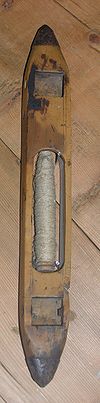
The simplest shuttles, known as "stick shuttles", are made from a flat, narrow piece of wood with notches on the ends to hold the weft yarn. More complicated shuttles incorporate bobbin
Bobbin
A bobbin is a spindle or cylinder, with or without flanges, on which wire, yarn, thread or film is wound. Bobbins are typically found in sewing machines, cameras, and within electronic equipment....
s or pirn
Pirn
A pirn is a rod onto which weft thread is wound for use in weaving. Unlike a bobbin, it is fixed in place, and the thread is delivered off the end of the pirn rather than from the center. A typical pirn is made of wood or plastic and is slightly tapered for most of its length, flaring out more...
s.
Shuttles are often made of wood from the Flowering Dogwood
Flowering Dogwood
Cornus florida is a species of dogwood native to eastern North America, from southern Maine west to southern Ontario, Illinois, and eastern Kansas, and south to northern Florida and eastern Texas, with a disjunct population in Nuevo León and Veracruz in eastern Mexico.-Classification:The flowering...
, because it is so hard, resists splintering, and can be polished to a very smooth finish.
Originally shuttles were passed back and forth by hand. However, John Kay
John Kay (flying shuttle)
John Kay was the inventor of the flying shuttle, which was a key contribution to the Industrial Revolution. He is often confused with his namesake: fellow Lancastrian textile machinery inventor, the unrelated John Kay who built the first "spinning frame".-Life in England:John Kay was born...
invented a loom in 1733 that incorporated a flying shuttle
Flying shuttle
The flying shuttle was one of the key developments in weaving that helped fuel the Industrial Revolution. It was patented by John Kay in 1733. Only one weaver was needed to control its lever-driven motion. Before the shuttle, a single weaver could not weave a fabric wider than arms length. Beyond...
. This shuttle could be thrown through the warp, which allowed much wider cloth to be woven much more quickly and made the development of machine looms much simpler.