

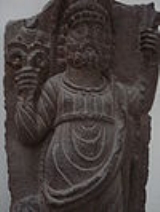
Dushara

Encyclopedia
Aniconism
Aniconism is the practice or belief in avoiding or shunning images of divine beings, prophets or other respected religious figures, or in different manifestations, any human beings or living creatures. The term aniconic may be used to describe the absence of graphic representations in a particular...
deity
Deity
A deity is a recognized preternatural or supernatural immortal being, who may be thought of as holy, divine, or sacred, held in high regard, and respected by believers....
in the ancient Middle East
Middle East
The Middle East is a region that encompasses Western Asia and Northern Africa. It is often used as a synonym for Near East, in opposition to Far East...
worshipped by the Nabataeans
Nabataeans
Thamudi3.jpgThe Nabataeans, also Nabateans , were ancient peoples of southern Canaan and the northern part of Arabia, whose oasis settlements in the time of Josephus , gave the name of Nabatene to the borderland between Syria and Arabia, from the Euphrates to the Red Sea...
at Petra
Petra
Petra is a historical and archaeological city in the Jordanian governorate of Ma'an that is famous for its rock cut architecture and water conduits system. Established sometime around the 6th century BC as the capital city of the Nabataeans, it is a symbol of Jordan as well as its most visited...
and Madain Saleh (of which city he was the patron). He was mothered by Manat the goddess of fate. In Greek times, he was associated with Zeus
Zeus
In the ancient Greek religion, Zeus was the "Father of Gods and men" who ruled the Olympians of Mount Olympus as a father ruled the family. He was the god of sky and thunder in Greek mythology. His Roman counterpart is Jupiter and his Etruscan counterpart is Tinia.Zeus was the child of Cronus...
because he was the chief of the Nabataean pantheon as well as with Dionysus
Dionysus
Dionysus was the god of the grape harvest, winemaking and wine, of ritual madness and ecstasy in Greek mythology. His name in Linear B tablets shows he was worshipped from c. 1500—1100 BC by Mycenean Greeks: other traces of Dionysian-type cult have been found in ancient Minoan Crete...
. His sanctuary at Petra
Petra
Petra is a historical and archaeological city in the Jordanian governorate of Ma'an that is famous for its rock cut architecture and water conduits system. Established sometime around the 6th century BC as the capital city of the Nabataeans, it is a symbol of Jordan as well as its most visited...
contained a great temple in which a large cubical stone was the centrepiece.
This deity was mentioned by the 9th century CE historian Hisham Ibn Al-Kalbi
Hisham Ibn Al-Kalbi
Hisham Ibn Al-Kalbi , also known as Ibn al-Kalbi was an Arab historian. His full name Abu al-Mundhir Hisham bin Muhammed bin al-Sa'ib bin Bishr al-Kalbi. Born in Kufa, he spent much of his life in Baghdad. Like his father, he collected information about the genealogies and history of the ancient...
, who wrote in The Book of Idols (Kitab al-Asnām) that: "The Banū al-Hārith ibn-Yashkur ibn-Mubashshir of the ʻAzd had an idol called Dū Sharā."
External links
- Nabataean religion
- Kitab al-Asnam in the original Arabic (description on p. 5)
- Dhushara The Meaning of the Name
- "Solving the Enigma of Petra and the Nabataeans" Biblical Archaeology Review