

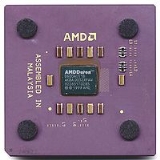
Duron

Encyclopedia
Advanced Micro Devices
Advanced Micro Devices, Inc. or AMD is an American multinational semiconductor company based in Sunnyvale, California, that develops computer processors and related technologies for commercial and consumer markets...
. It was released on June 19, 2000 as a low-cost alternative to AMD's own Athlon
Athlon
Athlon is the brand name applied to a series of x86-compatible microprocessors designed and manufactured by Advanced Micro Devices . The original Athlon was the first seventh-generation x86 processor and, in a first, retained the initial performance lead it had over Intel's competing processors...
processor and the Pentium III
Pentium III
The Pentium III brand refers to Intel's 32-bit x86 desktop and mobile microprocessors based on the sixth-generation P6 microarchitecture introduced on February 26, 1999. The brand's initial processors were very similar to the earlier Pentium II-branded microprocessors...
and Celeron
Celeron
Celeron is a brand name given by Intel Corp. to a number of different x86 computer microprocessor models targeted at budget personal computers....
processor lines from rival Intel. The Duron was discontinued in 2004 and succeeded by the Sempron
Sempron
Sempron has been the marketing name used by AMD for several different budget desktop CPUs, using several different technologies and CPU socket formats. The Sempron replaced the AMD Duron processor and competes against Intel's Celeron series of processors...
.
Development
The Duron was pin-compatible with the Athlon and carried all of the computational resources from it, operating on the same motherboardMotherboard
In personal computers, a motherboard is the central printed circuit board in many modern computers and holds many of the crucial components of the system, providing connectors for other peripherals. The motherboard is sometimes alternatively known as the mainboard, system board, or, on Apple...
s in most cases. The original Duron was limited to operating on a 100 MHz front-side bus speed (FSB 200), while the Athlon at the time could run on a bus clock of 133 MHz (FSB 266). Later Durons supported a 133 MHz bus (FSB 266) while Athlon XP ran at 166/200 MHz FSB (FSB 333/400). The original Duron, using the "Spitfire" core, was manufactured in 2000 and 2001 at speeds ranging from 600 to 950 MHz. It was based on the 180 nm "Thunderbird" Athlon core. The second-generation Duron, the "Morgan" core, was sold in speed grades between 900 and 1300 MHz, and was based on the 180 nm "Palomino" Athlon XP core. As a result, it featured a few important enhancements namely full Intel SSE support, enlarged TLBs, hardware data prefetch, and an integrated thermal diode. Like the "Palomino" core, "Morgan" was also expected to reduce the core heat dissipation, however in "Morgan"'s case this did not happen due to its increased core voltage. The final generation Duron was called "Applebred", sometimes called "Appalbred", and was based on the "Appaloosa" Duron along with the 130 nm "Thoroughbred" Athlon XP. "Appaloosa" was never officially announced but it did see very limited circulation.
Duron's biggest difference from Athlon was its reduction in cache size to 64 KB
Binary prefix
In computing, a binary prefix is a specifier or mnemonic that is prepended to the units of digital information, the bit and the byte, to indicate multiplication by a power of 2...
, in contrast to the 256 KB or even 512 KB of Athlon. This was a relatively tiny amount of L2 cache, even smaller than the 128 KB L2 on Intel's Celeron
Celeron
Celeron is a brand name given by Intel Corp. to a number of different x86 computer microprocessor models targeted at budget personal computers....
. However, the K7-architecture enjoyed one of the largest L1 caches, at 128 KB (split 64+64 KB). And, with the arrival of the socketed Athlon/Duron chips, AMD switched to an exclusive cache design which did not mirror data between the L1 and L2 like the inclusive cache used on the Slot A
Slot A
Slot A refers to the physical and electrical specification for a 242-lead single-edge-connector used by early versions of AMD's Athlon processor.The Slot A connector allows for a higher bus rate than Socket 7 or Super Socket 7...
K7, a critical feature in a low-cache situation. An exclusive design greatly favors L1 cache as the primary caching resource, while the slower L2 cache stores victim or copy-back cache blocks to be written back to main memory (LRU
Cache algorithms
In computing, cache algorithms are optimizing instructions – algorithms – that a computer program or a hardware-maintained structure can follow to manage a cache of information stored on the computer...
). The L2 cache essentially acts as an overflow from the L1 cache. Because of the lack of duplication between caches, Duron can be said to have 192 KB cache onboard, whereas an inclusive chip such as Athlon Slot-A, with 512 KB L2, would only have, in practice, 512 KB total (640K-128K). Celeron was in the same boat with its inclusive cache for a total of 128 KB (160K-32K).
Consequently, the post-Slot-A K7-architecture was less sensitive to L2 cache size. This reduced reliance upon L2 cache also allowed AMD to make their L2 cache higher latency and lower bandwidth without significant performance loss, which lessened processor complexity and allowed better manufacturing yields. AMD's Duron "Spitfire" CPU was only roughly 10% slower than its big brother, Athlon "Thunderbird".
Duron was often a favorite of computer builders looking for performance while on a tight budget. Perhaps most notably, in 2003 the "Applebred" Duron was available in 1.4 GHz, 1.6 GHz and 1.8 GHz forms, all on a 133 MHz (FSB 266) bus by default. Enthusiast groups quickly discovered these Durons to be rebadged Thoroughbred A/B cores with some cache disabled (and perhaps defective). With a basic chip configuration modification, it was found that "Applebred" could be turned into "Thoroughbred B" Athlon XPs, with full 256KB cache, with a very high success rate. However, this was only possible for a period of approximately 4 weeks, as shortly after the Applebred was released, AMD changed the chip configuration method to one that was not changeable.
Spitfire (Model 3, 180 nm)
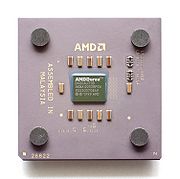
- L1-Cache: 64 + 64 KBKilobyteThe kilobyte is a multiple of the unit byte for digital information. Although the prefix kilo- means 1000, the term kilobyte and symbol KB have historically been used to refer to either 1024 bytes or 1000 bytes, dependent upon context, in the fields of computer science and information...
(Data + Instructions) - L2-Cache: 64 KB, fullspeed
- MMX, Extended MMX, 3DNow!3DNow!3DNow! is an extension to the x86 instruction set developed by Advanced Micro Devices . It adds single instruction multiple data instructions to the base x86 instruction set, enabling it to perform simple vector processing, which improves the performance of many graphic-intensive applications...
, Extended 3DNow!3DNow!3DNow! is an extension to the x86 instruction set developed by Advanced Micro Devices . It adds single instruction multiple data instructions to the base x86 instruction set, enabling it to perform simple vector processing, which improves the performance of many graphic-intensive applications... - Socket ASocket ASocket A is the CPU socket used for AMD processors ranging from the Athlon Thunderbird to the Athlon XP/MP 3200+, and AMD budget processors including the Duron and Sempron. Socket A also supports AMD Geode NX embedded processors...
(EV6) - Front side busFront side busA front-side bus is a computer communication interface often used in computers during the 1990s and 2000s.It typically carries data between the central processing unit and a memory controller hub, known as the northbridge....
: 100 MHz (200 MT/s) - VCore: 1.50 V - 1.60 V
- First release: June 19, 2000
- ClockrateClock rateThe clock rate typically refers to the frequency that a CPU is running at.For example, a crystal oscillator frequency reference typically is synonymous with a fixed sinusoidal waveform, a clock rate is that frequency reference translated by electronic circuitry into a corresponding square wave...
: 600 MHz - 950 MHz
Morgan (Model 7, 180 nm)
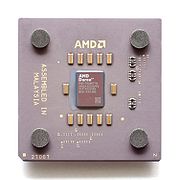
- L1-Cache: 64 + 64 KBKilobyteThe kilobyte is a multiple of the unit byte for digital information. Although the prefix kilo- means 1000, the term kilobyte and symbol KB have historically been used to refer to either 1024 bytes or 1000 bytes, dependent upon context, in the fields of computer science and information...
(Data + Instructions) - L2-Cache: 64 KB, fullspeed
- MMX, Extended MMX, 3DNow!3DNow!3DNow! is an extension to the x86 instruction set developed by Advanced Micro Devices . It adds single instruction multiple data instructions to the base x86 instruction set, enabling it to perform simple vector processing, which improves the performance of many graphic-intensive applications...
, Extended 3DNow!3DNow!3DNow! is an extension to the x86 instruction set developed by Advanced Micro Devices . It adds single instruction multiple data instructions to the base x86 instruction set, enabling it to perform simple vector processing, which improves the performance of many graphic-intensive applications...
, SSEStreaming SIMD ExtensionsIn computing, Streaming SIMD Extensions is a SIMD instruction set extension to the x86 architecture, designed by Intel and introduced in 1999 in their Pentium III series processors as a reply to AMD's 3DNow! . SSE contains 70 new instructions, most of which work on single precision floating point... - Socket ASocket ASocket A is the CPU socket used for AMD processors ranging from the Athlon Thunderbird to the Athlon XP/MP 3200+, and AMD budget processors including the Duron and Sempron. Socket A also supports AMD Geode NX embedded processors...
(EV6) - Front side busFront side busA front-side bus is a computer communication interface often used in computers during the 1990s and 2000s.It typically carries data between the central processing unit and a memory controller hub, known as the northbridge....
: 100 MHz (200 MT/s) - VCore: 1.75 V
- First release: August 20, 2001
- ClockrateClock rateThe clock rate typically refers to the frequency that a CPU is running at.For example, a crystal oscillator frequency reference typically is synonymous with a fixed sinusoidal waveform, a clock rate is that frequency reference translated by electronic circuitry into a corresponding square wave...
: 900 MHz - 1300 MHz
Applebred (Model 8, 130 nm)
- L1-Cache: 64 + 64 KBKilobyteThe kilobyte is a multiple of the unit byte for digital information. Although the prefix kilo- means 1000, the term kilobyte and symbol KB have historically been used to refer to either 1024 bytes or 1000 bytes, dependent upon context, in the fields of computer science and information...
(Data + Instructions) - L2-Cache: 64 KB, fullspeed
- MMX, Extended MMX, 3DNow!3DNow!3DNow! is an extension to the x86 instruction set developed by Advanced Micro Devices . It adds single instruction multiple data instructions to the base x86 instruction set, enabling it to perform simple vector processing, which improves the performance of many graphic-intensive applications...
, Extended 3DNow!3DNow!3DNow! is an extension to the x86 instruction set developed by Advanced Micro Devices . It adds single instruction multiple data instructions to the base x86 instruction set, enabling it to perform simple vector processing, which improves the performance of many graphic-intensive applications...
, SSEStreaming SIMD ExtensionsIn computing, Streaming SIMD Extensions is a SIMD instruction set extension to the x86 architecture, designed by Intel and introduced in 1999 in their Pentium III series processors as a reply to AMD's 3DNow! . SSE contains 70 new instructions, most of which work on single precision floating point... - Socket ASocket ASocket A is the CPU socket used for AMD processors ranging from the Athlon Thunderbird to the Athlon XP/MP 3200+, and AMD budget processors including the Duron and Sempron. Socket A also supports AMD Geode NX embedded processors...
(EV6) - Front side busFront side busA front-side bus is a computer communication interface often used in computers during the 1990s and 2000s.It typically carries data between the central processing unit and a memory controller hub, known as the northbridge....
: 133 MHz (266 MT/s) - VCore: 1.50 V
- First release: August 21, 2003
- ClockrateClock rateThe clock rate typically refers to the frequency that a CPU is running at.For example, a crystal oscillator frequency reference typically is synonymous with a fixed sinusoidal waveform, a clock rate is that frequency reference translated by electronic circuitry into a corresponding square wave...
: 1400, 1600, 1800 MHz
External links
- Duron information from AMD
- Budget CPU Shootout - Popular hardware review website Anandtech compares low priced CPUs
- AMD Duron technical specifications
- cpu-collection.de AMD Duron processor images and descriptions